
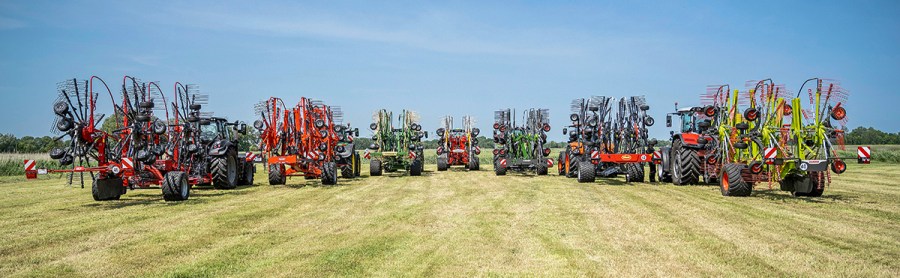
To help you navigate the four-rotor rake market, our comparison should provide some guidance. We tucked into second-cut silage last summer.
KEEPING IT BRIEF
- Even though the grass swaths looked noticeably different, this had very little effect on the self-propelled’s actual chopping performance.
- The real difference between the seven rakes is in terms of handling and set-up.
Now that the four-rotor rake market is maturing, there are more buying options on the table.
For the more intensive user that can justify the additional expense, there are the all-singing, all-dancing machines with section control and automatic working width adjustment etc. But at the other end of the scale, there is a growing market for simple models.
So, for this practical test comparison we are looking at these ‘jump on and go’ entry-level machines, those models with uncomplicated hydraulic operation (preferably without ISObus) that can row up 12m of grass into a neat swath.
The line-up
The following ‘seven’ matched that criteria:
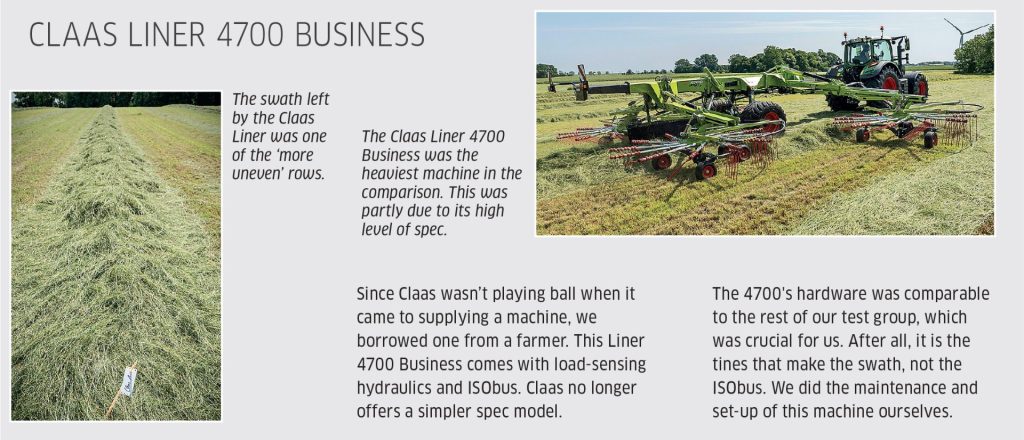
- Claas Liner 4700 Business
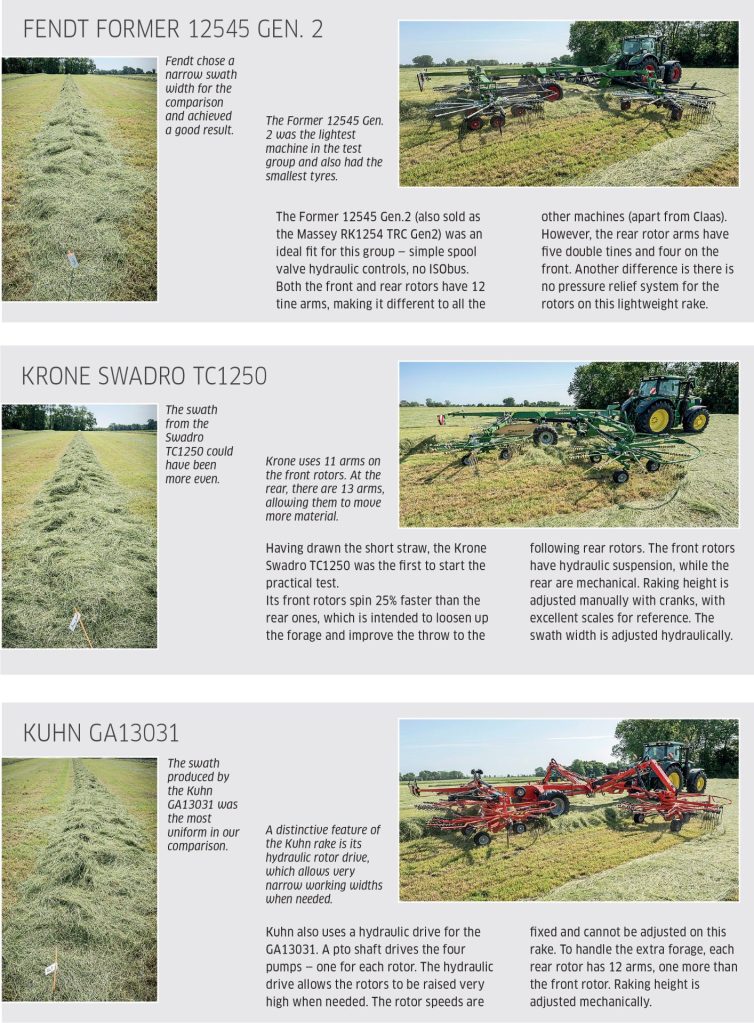
- Fendt Former 12545 Gen. 2
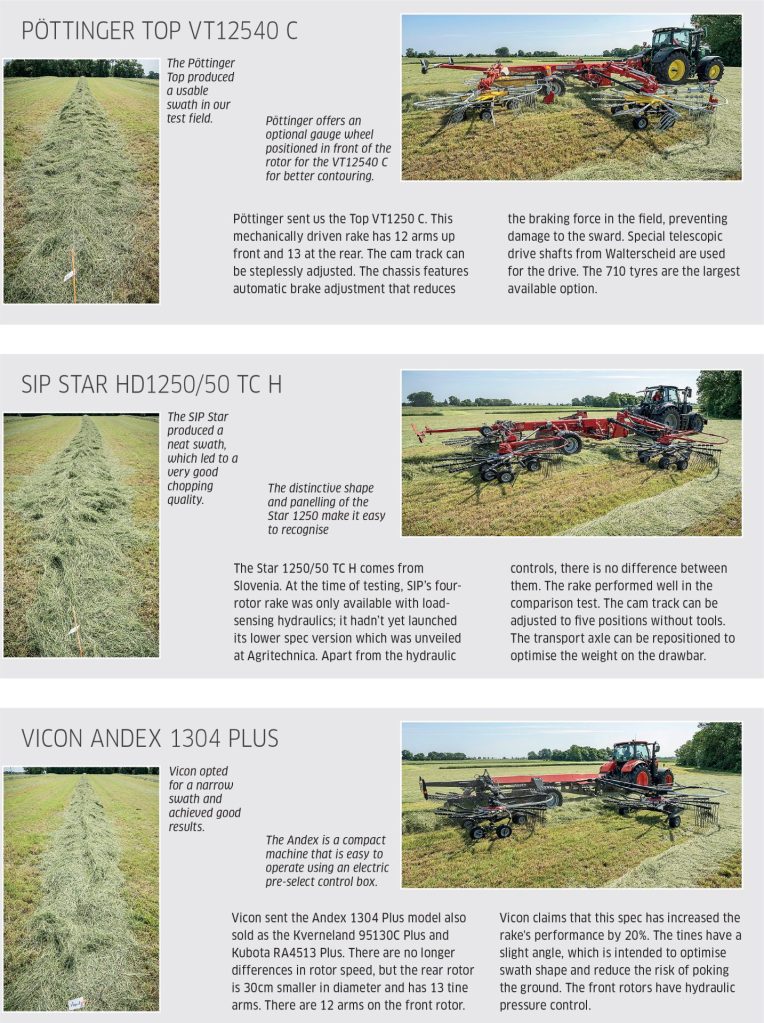
- Krone Swadro TC1250
- Kuhn GA13031
- Pöttinger TOP VT12540 C
- SIP Star HD 1250/50 TC H
- Vicon Andex 1304 Plus
All the manufacturers supported the test — except Claas, which has a tendency to not supply machines for group tests in Germany. Undeterred, we sourced a practically new Liner 4700 Business, which had clocked less than 100 hectares, from a farmer. A big thank you to the Liner’s owner, as this allowed us to do a proper, complete test with all of the main players.
While the machines were pretty much on a par, the manufacturers do have slightly different philosophies, particularly when it comes to operation. The Fendt Former, for instance, keeps things reasonably simple, making the argument that most modern tractors can handle all the various hydraulic functions and controls on a rake.
Claas, meanwhile, has a more comprehensive level of base specification, offering all new Liner Business models (formerly known as the Trend) with ISObus control and load-sensing. SIP was only able to supply its rake with load-sensing, but at Agritechnica the company introduced a more basic rake to its product range.
We will discuss the key features of the test machines in detail in the second part of our comparison in the May issue. This first part focuses on the quality of work.
Testing in permanent grassland
We had two grass fields available for the comparative test: a multi-year permanent pasture and a new reseed. Heavy rain just before the test took place meant we were not able to set foot on the grass reseed, so, together with the assembled manufacturers, we decided to only carry out the test in the permanent pasture.
The field was big enough for each machine to repeat the test run a second time. On a neighbouring field, the manufacturers had the chance to set up their machines. In the morning, the day before the raking test, we mowed the grass using a triple mower and tedded it twice that evening. This ensured uniform and realistic conditions.
Realistic conditions
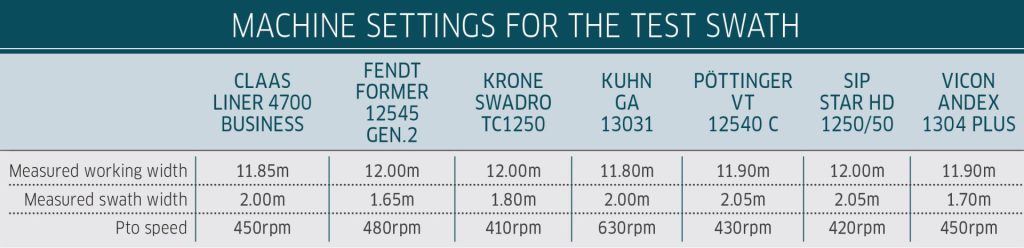
We wanted a neatly formed swath that would give the forager an even feed so it could produce consistently chopped silage. Our other parameters were a forward speed of 10km/hr and a working width of 12m. The manufacturers were free to determine swath width and pto speed (see table above — ‘Machine settings for the test swath’).
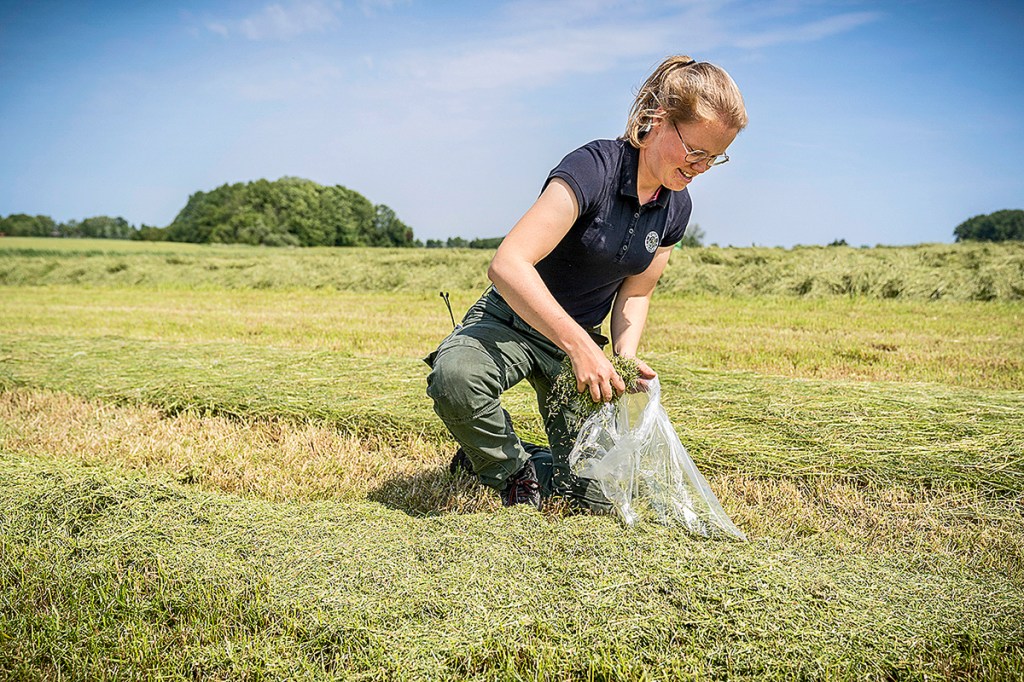
We didn’t analyse the ash content and raking losses, as the number of samples would have been unmanageable with seven rakes, each with a 12m working width.
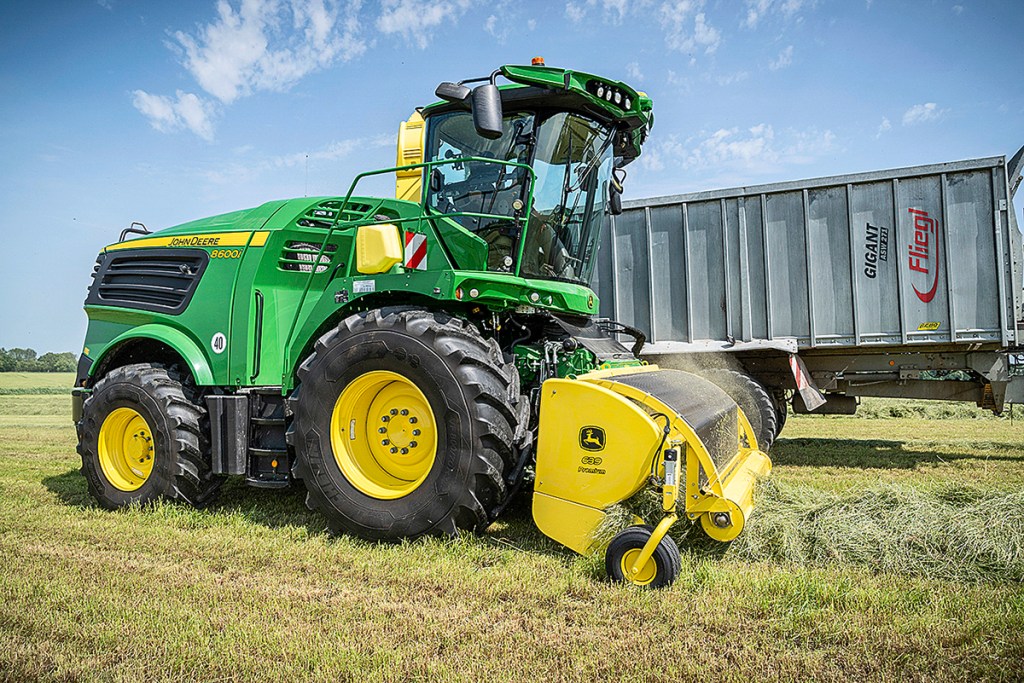
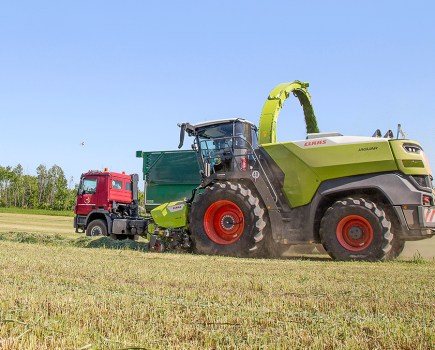
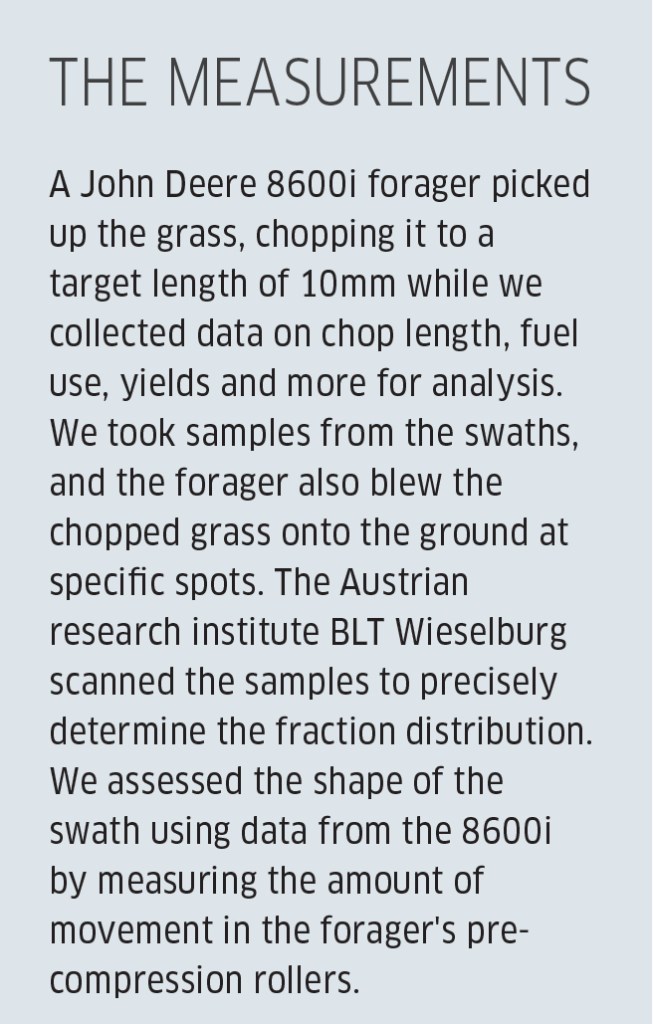
We drew lots for the running order. Since all the rakes were already hitched to their own tractor, we were able to do all seven test swaths in about 30 minutes. And the same applied to the second test run. John Deere supported us with an 8600i self-propelled and two test engineers for when we were harvesting and the data analysis (see box ‘The measurements’).
Very similar swaths
The results regarding swath shape are closer than we expected. They are shown in two graphs: The graph ‘Deviations in swath shape’ displays the coefficient of variation (CoV) for each rake, i.e., the percentage deviation of the forager’s pre-compression rollers from the mean value when chopping the respective swaths. The higher the bars, the greater the deviation from the feed rollers’ mean position.
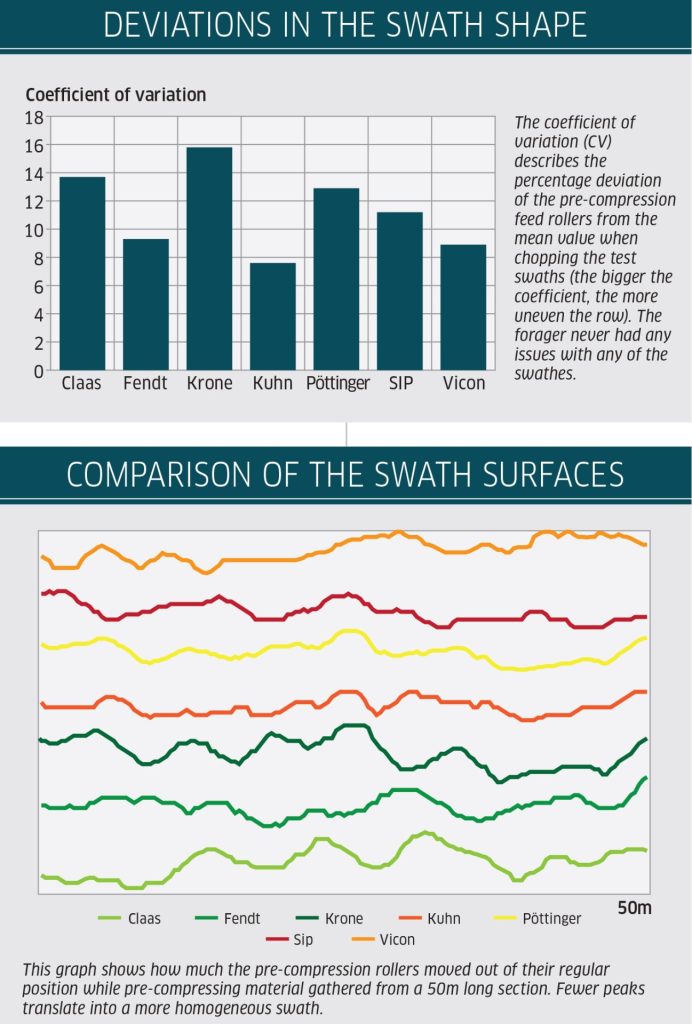
This is shown even more clearly and visibly in the graph ‘Comparison of swath surfaces’. This represents the movement of the pre-compression rollers on a 50m long section per swath. The rule here is straightforward: the straighter the line, the more even the swath. The swaths from Kuhn, Vicon and Fendt are relatively uniform (CoV = 7.6-9.3%). SIP and Pöttinger (CoV = 11.2% and 12.9%) occupy the middle ground, whereas the rows from Claas and Krone were more uneven (CoV = 13.7% and 15.8%).
Looking at the machine settings, there’s no obvious pattern; for example, a wider swath setting didn’t automatically produce better results. When it comes to pto speeds, higher revs tend to produce a slightly better swath: Krone operated at 410rpm and Pöttinger at 430rpm, and both looked as though they had room for improvement in swath shape.
Chop lengths evenly distributed
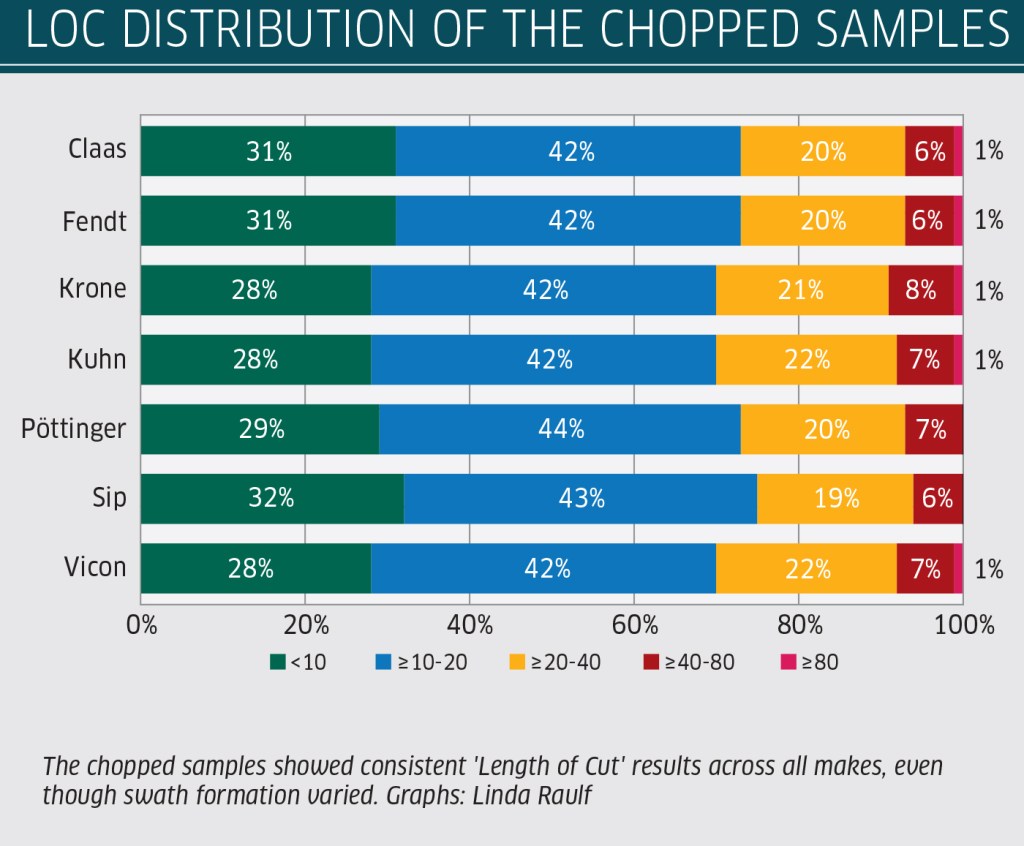
Regarding chopping quality, the rakes are almost identical (graph ‘LOC distribution of the chopped samples’). The proportion of chopped material up to 10mm ranges from 28% (Vicon) to 32% (SIP). Looking at lengths up to and including 20mm, SIP takes the lead again with 75%, whereas Claas, Fendt and Pöttinger are at 73%, followed by Krone, Kuhn and Vicon with 70%.
These measurements show that there were actual differences between the seven rakes, but in the grand scheme of things it is not significant enough to have any noticeable impact on the chopping quality.
What’s also important
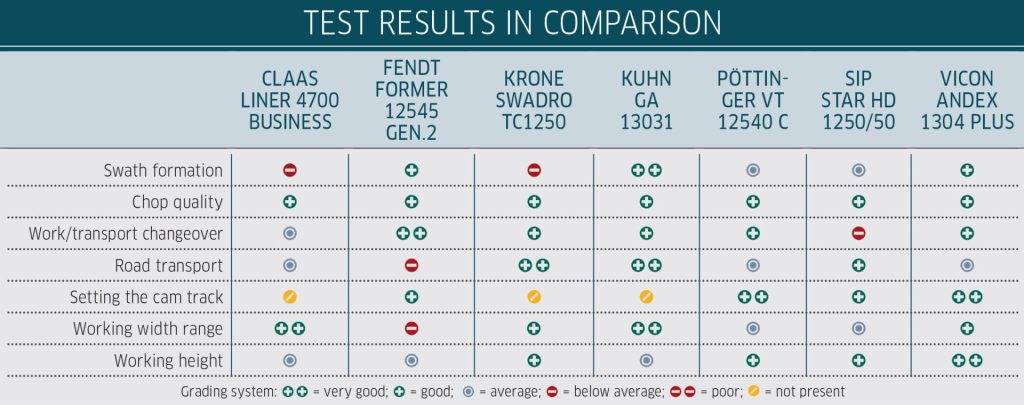
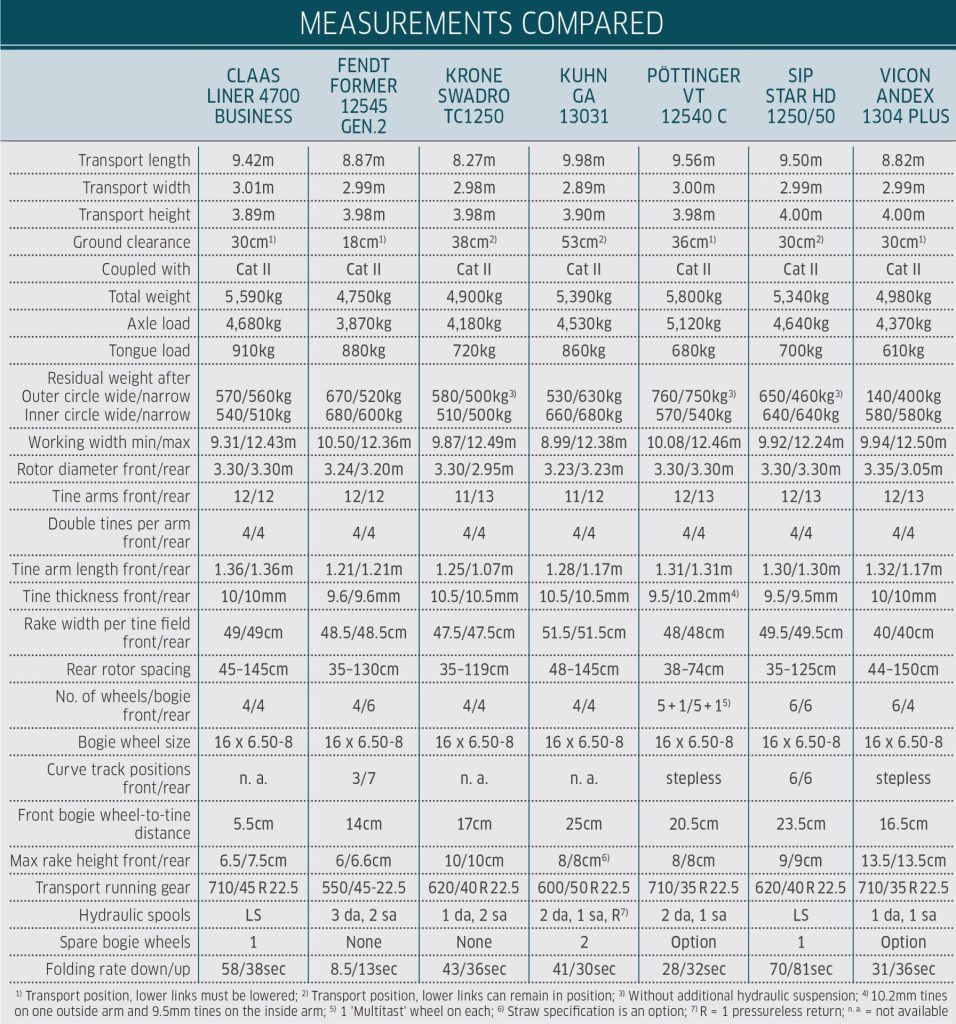
In addition to swath quality, it is important how quickly the machine can be changed over from work to its transport position. Thanks to direct control from the tractor spool, the Fendt Former model unfolds in 8.5 seconds and is ready for the road in 13 seconds. However, reducing the oil flow would be kinder on the machine. Pöttinger offers a more realistic time with 28 or 32 seconds, without putting too much strain on the mechanics. The SIP took 70 seconds to unfold and 81 seconds to fold up, which is far too long.
We also measured the ground clearance of the seven rakes: Fendt has very little ground clearance, just 18cm. Operators also have to lower the lift arms to get below a transport height of 4.0m. Both Kuhn (53cm) and Krone (38cm), on the other hand, offer significantly more clearance — and neither requires you to lower the lift arms.
The ground pressure on the rotor is another key difference. This was about 550kg on all outer rotors — although Krone, Pöttinger, and SIP offer additional hydraulic suspension even on their entry-level models. The Vicon Andex stands out here due to its design, weighing only 140kg in its widest position. Weight on the inner rotors is slightly more on all seven makes.
Finally, let’s take a look at the maximum working widths: Krone (12.49m) and Vicon (12.50m) offer the widest raking widths, whereas SIP rows up a maximum width of 12.24m. Thanks to its design and hydraulic drive, the Kuhn can tuck into a really narrow working width of just 8.99m if necessary.
Summing up the first part of our test
There are differences in the work results, but these had no significant impact on the chop quality. Differences are more likely to be found in operation and handling. More on this in the second part of our test in the May issue.
Christian Brüse
For more up-to-date farming news click here and subscribe now to profi and save.