
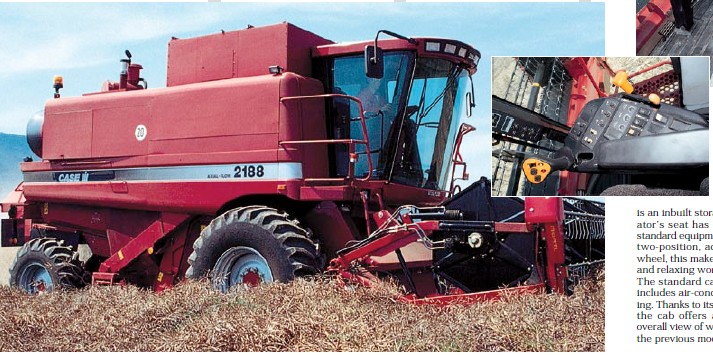
Driving impression: During last year’s oilseed rape harvest we took a seat in the new Case Axial-Flow 2188 combine to find out what is like to operate. We can say that in the new cab the designers have produced a comfortable and practical working environment that gives a clear view of operation
Right at the end of the 1994 harvest Case introduced the new 2100 combine series. The Axial-Flow 2166 and 2188 combines come with the well-proven threshing system from the preceding 1600 series. Along with detailed improvements and a higher powered engine, the combines also come with a modern, completely new cab equipped with updated controls.
The main difference between the 2166 and the larger, more powerful, 2188 is the smaller rotor diameter, reduced separation and sieve areas and not so powerful engine. The technical data from the 2188 we tested is included in our technical specification panel. With exactly the same threshing components, the output of the 2188 compared with the 1680 (tested in the German profi issue 2/92) should be a little higher because of the 2188’s extra engine power.
As before the main positive features of the axial flow design, compared with conventional combines, are a gentler threshing action and the low losses in proportion to throughput. But in our experience, in many cases, the grain is not so well cleaned in an axial flow. This wasalso apparent during our test in oilseed rape. Despite the cross-flow fans which, incidentally, provide a very well-distributed airstream and have been fitted since 1993, the rape seed contained a little more short straw compared with the sample from a conventional combine that was working in the same field.
For more up-to-date farming news click here and subscribe now to profi and save