
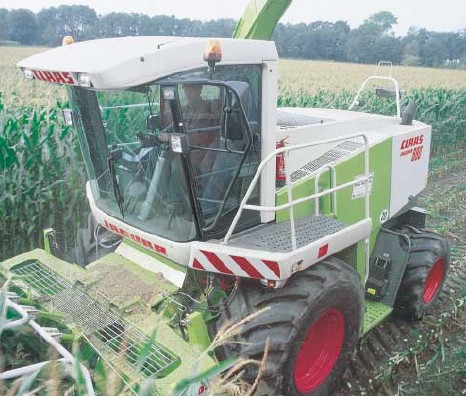
Driving impression: Shortly after re-equipping the Jaguar 840 to 880 foragers with an ‘Overdrive’ transmission, Claas has now introduced the new 830 to 900 range. Flagship is the Jaguar 900, which draws power from a V8 DaimlerChrysler engine.We operated the 445kW/605hp 900, camouflaged in old 880 livery, in a crop of maize at the tail end of last year
Out with the old, in with the new. And pretty sharply, too. Not long after adding the Overdrive transmission to the old 840 to 880 foragers, Claas has now launched the 830 to 900 range.
So what’s new on the 830 to 900 machines? Not the engines, contrary to widespread speculation. The new Jaguar models will continue to source their power from transversely mounted DaimlerChrysler motors, as outlined below:
Model/ Cubic Engine capacity Output
Jaguar 830 OM 457 LA 12 litre 236kW/321hp
Jaguar 850 OM 457 LA 12 litre 286kW/389hp
Jaguar 870 OM 457 LA 12 litre 322kW/438hp
Jaguar 890 OM 502 LA 12 litre 370kW/503hp
Jaguar 900 OM 502 LA 12 litre 445kW/605hp
When assessing the above figures, it is important to note that Daimler-Chrysler now specifies engine power in compliance with the ECE R24 standard, which measures maximum engine power at 1,800rpm. Until now Claas has always quoted rated output at rated speed, making it easier to draw comparisons with outputs at rated speeds of other manufacturers’ machines. For maximum output, the Claas forager is operated at about 1,800rpm in the maximum speed range; rated speed is around 2,000rpm, according to the manufacturer.
On-paper power aside, we were impressed with how our test 900’s 16-litre V8 unit, which meets Euro-2 emission standards, remained unfazed by anything we tucked into. OK, so most truck-type forager engines are used to dealing with peak loads. What impressed us most about the DaimlerChrysler, though, was that the engine-driven chopping assembly kept pumping material through even when engine speed was dragged down to as low as 1,500rpm. And it held those revs steady.