
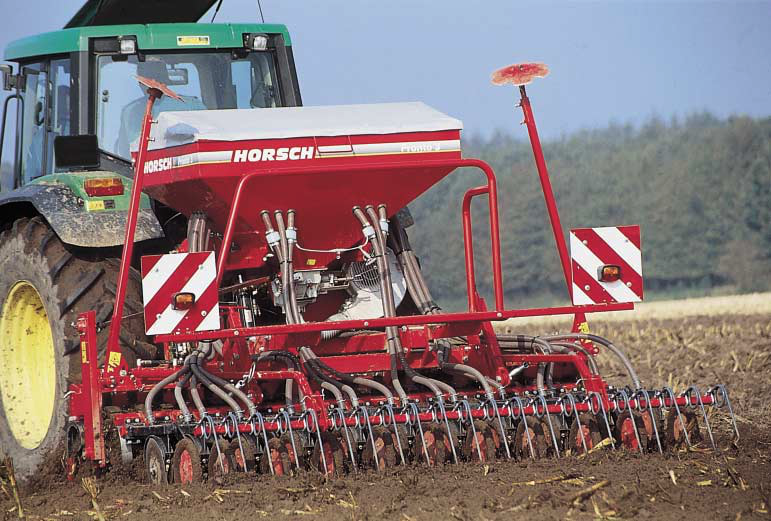
The Horsch Pronto 3 cultivation combination incorporates rotary cultivator components and a pressure system that transfers weight from the tractor on to the press. Last autumn we operated a first-generation Pronto model, drilling barley, grass seed, rape and wheat. And here’s how we got on.
With the exception of the rear following tines, all 3m Horsch Pronto 3 cultivator components turn – or, to be more precise, rotate. First up is the depth- and tiltadjustable rotary harrow, which prepares the seedbed, closely followed by the so-called Rollflex press and double-disc coulters, complete with press wheels. Yet by far the most intriguing area of this configuration is not the hardware itself; it’s the way in which weight is transferred onto and off the press.
The Horsch theory is that shifting weight on to the press gives at least two significant benefits: First it increases seedbed consolidation, and second it takes weight off the drill tractor, which is invariably fitted with less-than-ideal, soil-compacting rear tyres.
So how is this weight transfer achieved? In short, the conventional top link goes, replaced by a telescoping linkage arrangement that, in effect, moves the tractor weight on to the press via a hydraulic ram and pivoting joint. On top of that, skilled operators are able to maintain this load, irrespective of seed level within the hopper, because the oil pressure – hence the load on the press – is indicated on an appropriately positioned pressure gauge.