
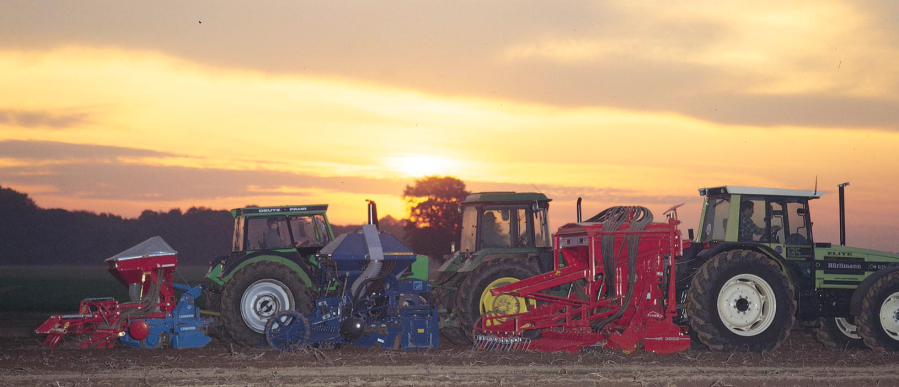
Pneumatic drilling, solo and in combination, is becoming increasingly popular and the number of machines to choose from is also rising. We tested three drills in the field and at an engineering institute to find out the difference between them, their quality of work and ease of use.
Pneumatic drilling is not new, and the number of machines and range of models available gets ever wider. Accord was probably one of the first machines having been on the market for more than 30 years. Rabe entered the market a few years ago and Rauch launched its machine at the end of 1994. The drills are not only well-known in their own right but some of their components are also used by other manufacturers. For our test we compared three 3m wide pneumatic drills from these companies.
- Accord Pneumatic DA-S
- Rabe Turbodrill T 300 A
- Rauch Venta AL 301
The Rauch is also sold as the Venta by Kuhn and the Accord system is found on other machines (Lely drills, for example, used to use the Accord system).
To provide a comprehensive test, based on practical experience of the machines’ operation and use, we tested the machines in the field, drilling winter wheat and winter barley. We evaluated the machines’ calibration, operation and use. The machines’ coulters and tines were not tested.
All the 3m mounted machines used in the practical test were worked in combination with power harrows. The Accord Pneumatic was mounted on a Zirkon 7 from Lemken, the Rabe Turbodrill worked with a Rabe PKE and our preproduction Venta drill from Rauch was attached to a Kuhn HR 3002 D power harrow.
The Accord and Rabe drills were mounted to the power harrow using an A-frame system. In the test the Rauch drill rested on a very sturdy attachment frame which transfers its weight directly on to an optional packer roller. This mounting system allows it to float independently while still attached to the power harrow by a parallelogram linkage. This type of support arrangement was necessary on the prototype Venta we tested which weighed 1,450kg. Adding a further 800kg of seed into the 1,000 litre capacity hopper made it essential, particularly because the hopper capacity can be increased to 1,500 litres.
For more up-to-date farming news click here and subscribe now to profi and save