
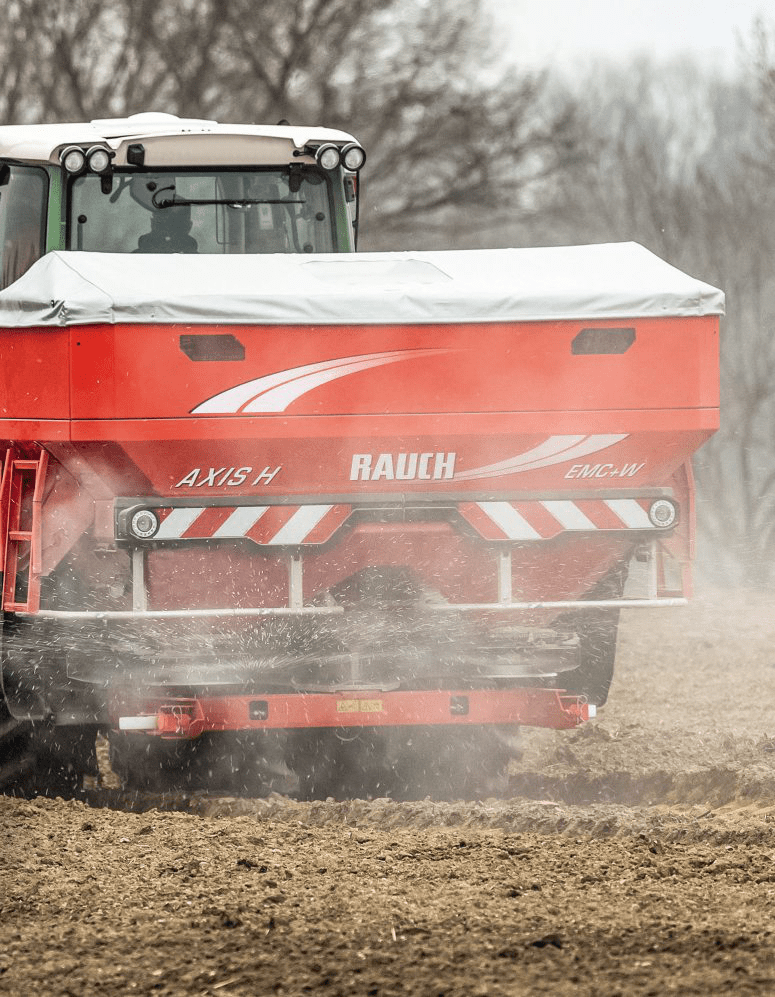
There’s something unusual about the second generation of Axis spreaders — and it’s not just lights alongside the discs to let an operator fathom what’s going on at night. Things are happening that the eye can’t see …
What do fertiliser spreaders and electric bikes (e-bikes) have in common? For most makes of spreader, not much. Rauch, though, had a problem to solve. Since 1999 it’s been able to control spread rate without monitoring hopper contents, by comparing line oil pressure before and after the disc motors. This is Electronic Mass Control (EMC), which has proved itself across a range of models. But regular calibration is needed. So company engineers began to cast about for a way round this.
The answer was to track the degree of twist in the individual spreading discs’ driveshafts. These shafts are powered at one end and carry the spreading disc at the other. Motor torque applied to the shaft is resisted by the disc (and much less so by the shaft bearings), so the shaft twists a little in work. The extent of this deflection reflects the weight of material passing over the disc, and so links directly to application rate. To measure those tiny elastic changes, the Rauch engineers use a technology that turns up, amongst other places, in the shaft connecting the pedal cranks of e-bikes. As the bike rider starts to pedal harder to speed up or to tackle a hill, shaft deflection generates a signal; this then prompts an ECU to feed proportional power from an electric motor to help. The tech underpinning this is covered in ‘Magnetoelastic sensing’ — and the neat thing for a spreader is the sensor self-calibrates quickly and automatically, just once at the start of work. The new set-up expands EMC’s strengths, says Kuhn: it operates independently on each disc, responds much faster to changes in flow and senses a blockage more quickly before opening the relevant slide to clear it. Application rate changes are still made independently for each disc by altering metering outlet position.