
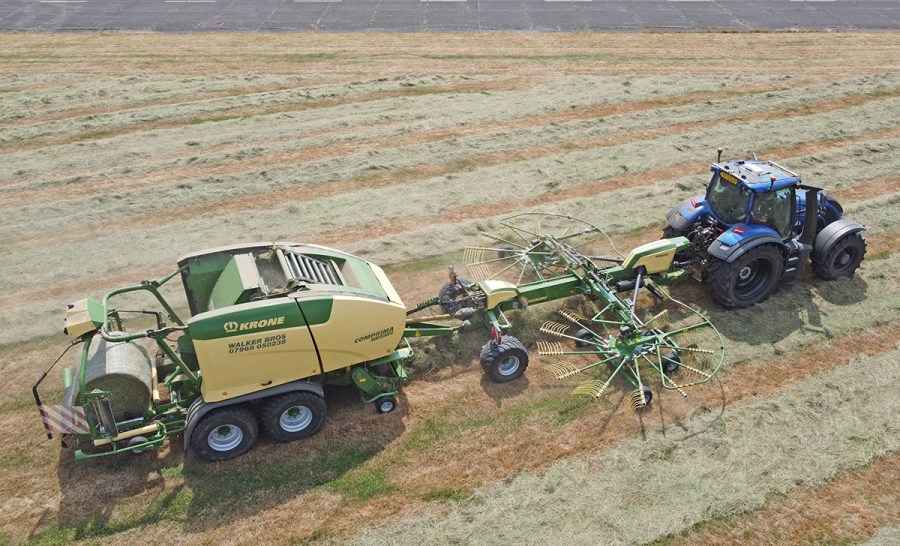
Krone’s Swadro BaleTrain combination links its twin-rotor rake with its round baler, promising greater automation and an increase in operational efficiency for those prepared to swallow the brave pill. The first of its kind has found favour with a north Yorkshire contractor, who was also involved in its development and testing during the 2025 season.
KEEPING IT BRIEF
- No swath curtain
- Hydraulic ram integrated in steering linkage
- Cost comparable to four-rotor rake
Linking multiple implements in combination has evolved over the years from simple tillage trains to balers and wrappers, streamlining multi-machine tasks into a single tractor and operator job. With the introduction of ISObus, and the prospect of ever more intelligent machines, it appears that manufacturers are looking for additional ways to make field work more efficient, by pairing up more complex machinery.
German maker Krone took the humble twin rotor rake, covered it with sensors and wires, and paired it with one of its combi round balers to create the snappily named Krone Swadro Bale Train TC880 Pro.
Last stop, Yorkshire
At first glance, it’s a lengthy combination, particularly when a twin-axle Comprima CV150 XC Plus baler-wrapper brings up the rear of the rig. And you could be forgiven for asking why, when the cost of the Bale Train rake is comparable to a four-rotor rake?
“When it first turned up at our farm, I thought this is hardly for us,” explains Andy Walker of Huby-based Walker Bros. “But the more we used it, and the longer the season went on, the more practical it became.”
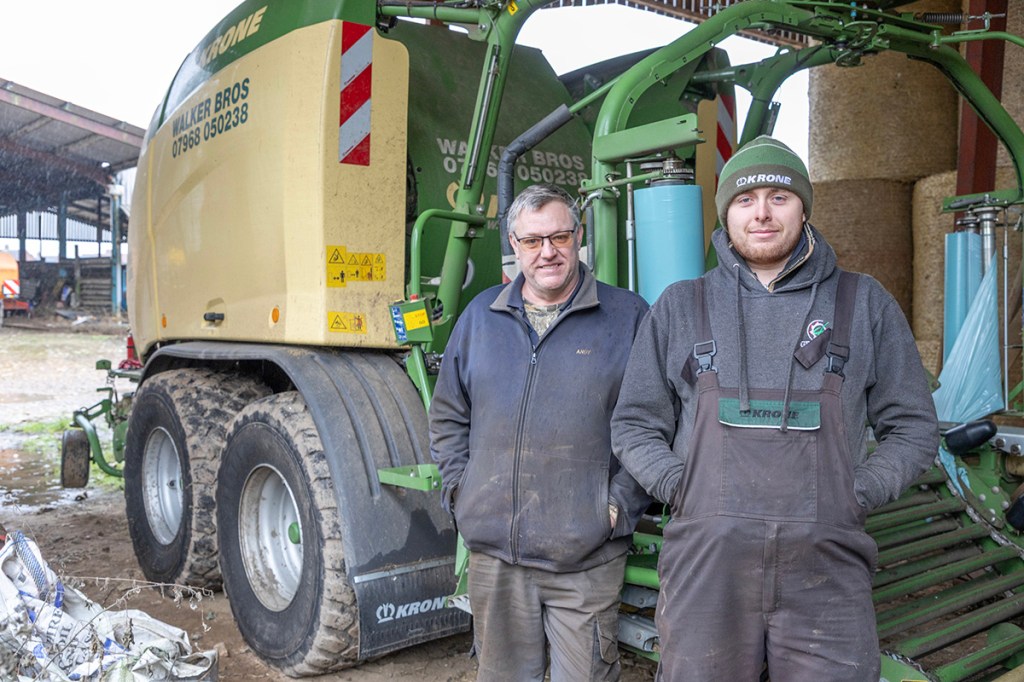
The father-and-son team of Andy and Rob Walker, based at Newton Farm, manage a 810 hectare forage workload that sees up to 15,000 bales made in a typical year. It’s exclusively a round bale affair, with the Walker fleet making the most of its two Comprima balers – one is a single axle baler, the other a twin axle baler wrapper combi with around 40,000 bales under its belt.
Bale sizes are typically 1.2m for hay and haylage, increasing marginally to 1.35m diameter for straw. The size is dictated by shed space and trailer lengths to make the most of logistics and storage space.
Own workload
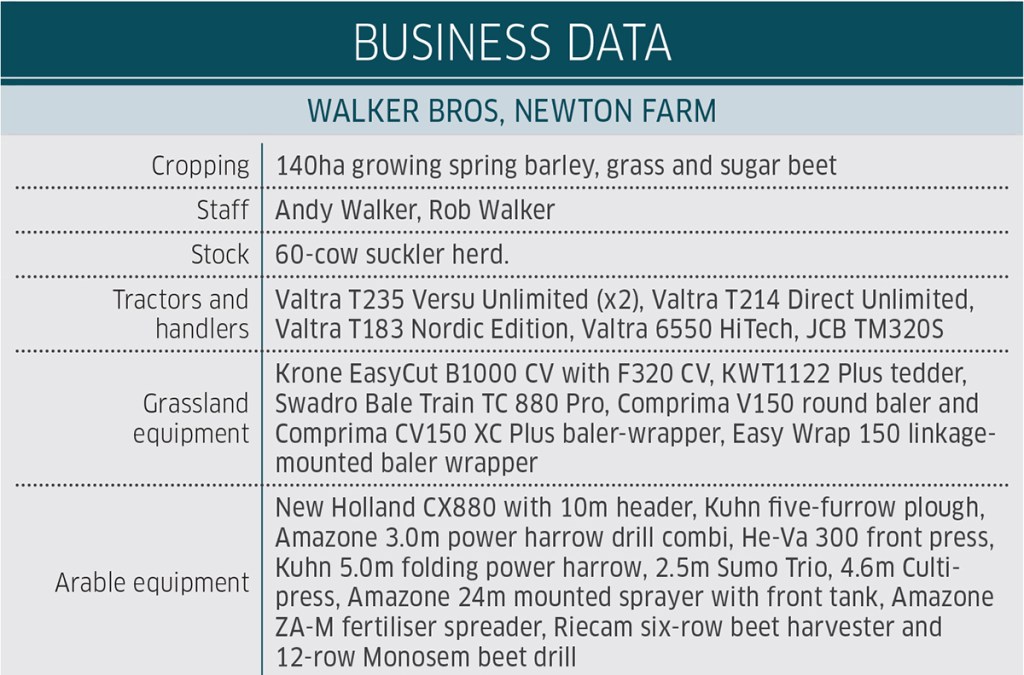
Walker Bros runs a general contracting business alongside the family’s 140ha at Newton Farm, where cropping includes grass, sugar beet and cereal crops. A herd of 60 suckler cows provides a useful source of manure that goes back on the land.
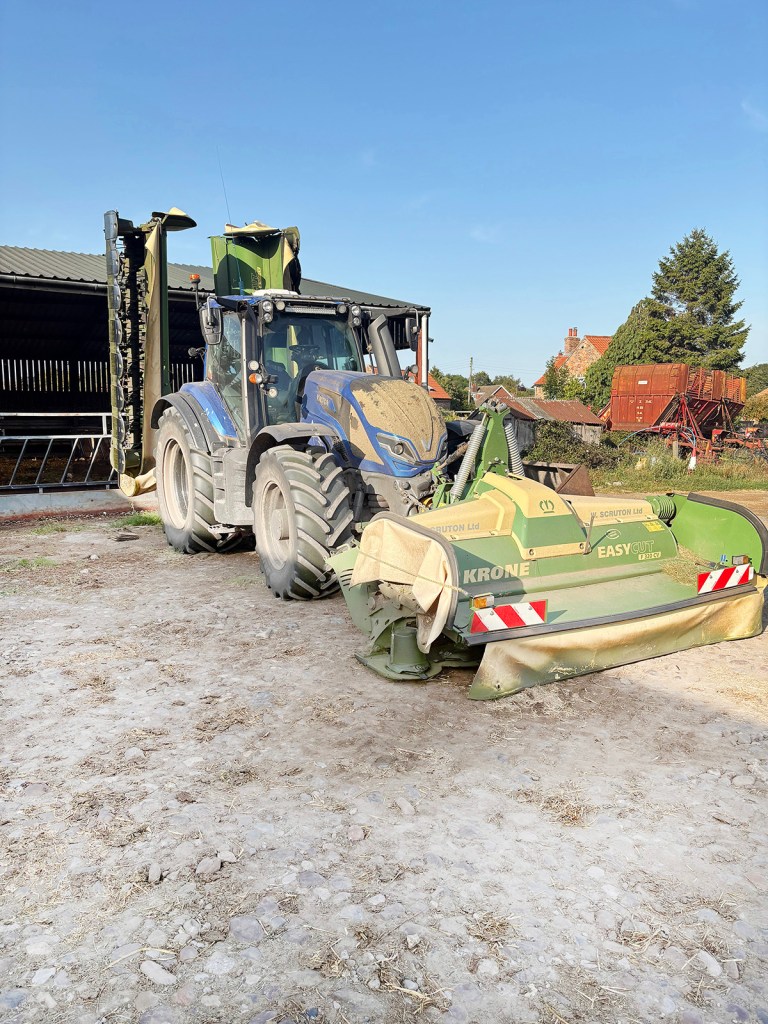
Andy and Rob Walker provide a full round bale forage service from mowing to wrapping. The machinery fleet includes a host of green and cream kit, including an Easy Cut B1000 triple moco, KWT 1122 Plus, Swadro TC880, a linkage mounted wrapper that can also be carried on the firm’s JCB TM320S pivot steer, and its two Comprima balers.
In addition, there’s a fleet of five Valtra tractors, with a pair of T235 Versu’s heading up the business, backed up by a T214 Direct, a T183 and a 23-year old 6550 HiTech that wears its 18,000 hours with ease. An impressive display for a two-man team, but the logic is simple, says Andy.
“It’s handy having spare tractors so we don’t have to keep swapping kit over when we’re flat-out busy,” he explains. “The T183 spends most of its time on the sprayer, and in winter the T214 does all the hedge cutting.”
Hours are modest on most, though the 6550 leads the way with reliability and durability.
“The 6550 has only ever needed a turbo,” says Andy. “We do like the Valtras, though the T214 is our only CVT-equipped tractor.”
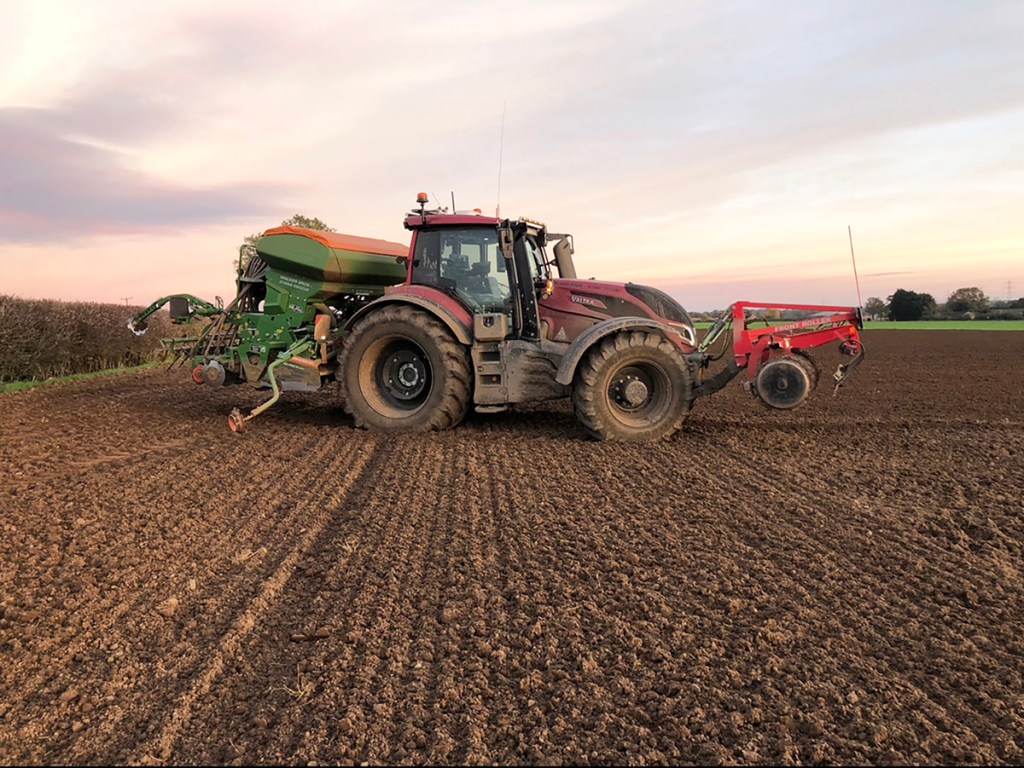
A New Holland CX880 with 9.0m header has recently replaced a TX36, while an Amazon 24m mounted sprayer with front tank, and a ZA-M spreader, manage crop care requirements. When it comes to cultivations and drilling, Walker Bros operates a 3.0m power harrow drill combi, five-furrow plough and a selection of cultivation kit including a 2.5m Sumo Trio and 4.6m Simba Cultipress to complete the line-up. Whichever way you cut it, this team has a firm grip on operational flexibility.
Bale Train logic
Andy says that the arrival of the Bale Train, while initially sceptical about the idea, has created flexibility in many ways. There will always be a need to meet customer requirements for separate raking and baling, but this now brings the flexibility to streamline the task when labour resources are stretched.
That’s because Andy commits to a local grower with a long-term 400ha potato planting and harvesting workload, which sees him involved in bed forming and working alongside the spud harvesting crew.
“Once potato lifting starts, I am away from the farm for many weeks, and it’s down to Rob to manage our own contracting work,” says Andy. “And in this instance, the Bale Train means Rob no longer has to travel back home for the baler after he’s raked up for customers. That’s when it became obvious that this was a no-brainer for us. You can waste a lot of time travelling back to base to swap kit.”
“There are those customers who want their forage crops raked ahead of baling, and the Bale Train can be easily split into its component parts when you arrive on farm,” he says. “And this provides additional flexibility in how we approach some of these baling jobs.”
The Swadro Bale Train TC880 Pro arrived mid-season at Newton Farm, and given the extremely dry summer of 2025, Andy says there wasn’t a huge amount of work for it to do, compared to a more typical season. Handy then, given the nature of constant tweaking and tuning that goes hand-in-hand with using prototype kit.
The layout
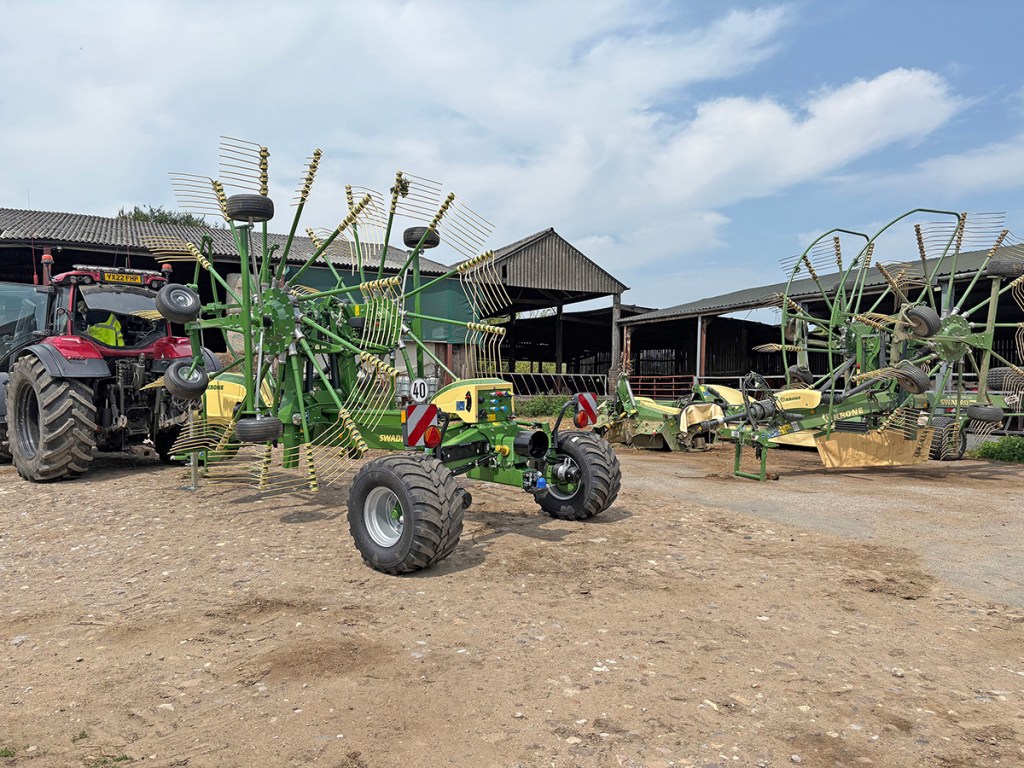
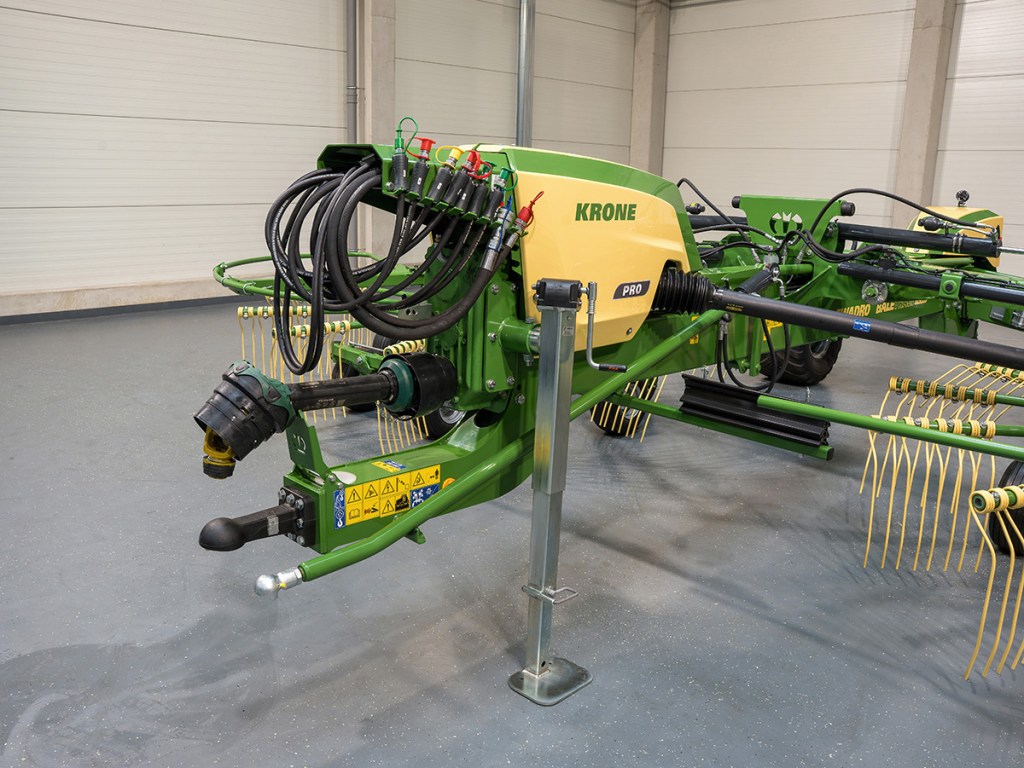
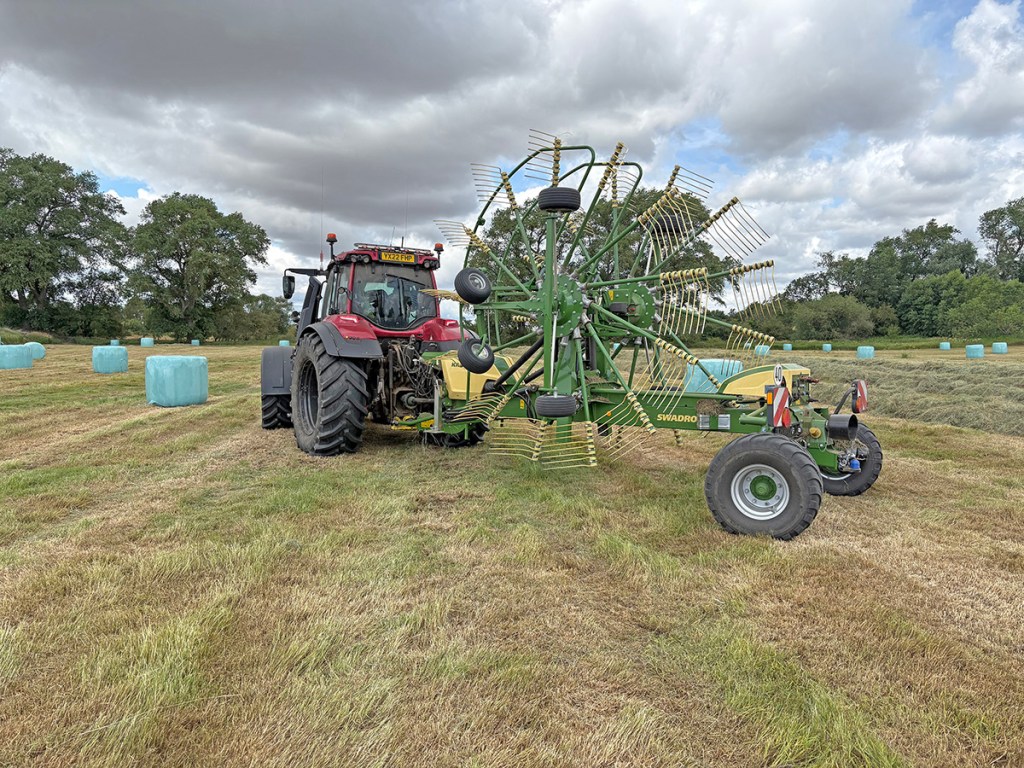
Krone’s Bale Train is based on a heavily modified Swadro 880 twin rotor rake, which offers a hydraulically adjustable working width from 7.6-8.8m and can produce a swath width from 1.3-2.5m. It connects to the tractor using a K80 ball and spoon coupling, replacing the lower link-arm connection used on a conventional rake. The logic here is a better-engineered coupling far more capable of withstanding the forces of handling a lengthy and potentially weighty combination being used over a wide variety of terrain.
At the back of the rake is a heavy-duty axle, which is force-steered from the tractor drawbar using a K50 ball and mechanical push-pull bar steering linkage. The rake sits on much larger and wider 520/50 R17 tyres, and is equipped with air brakes too. At the rear is another K80 coupling, enabling the baler to be towed close behind the rake.
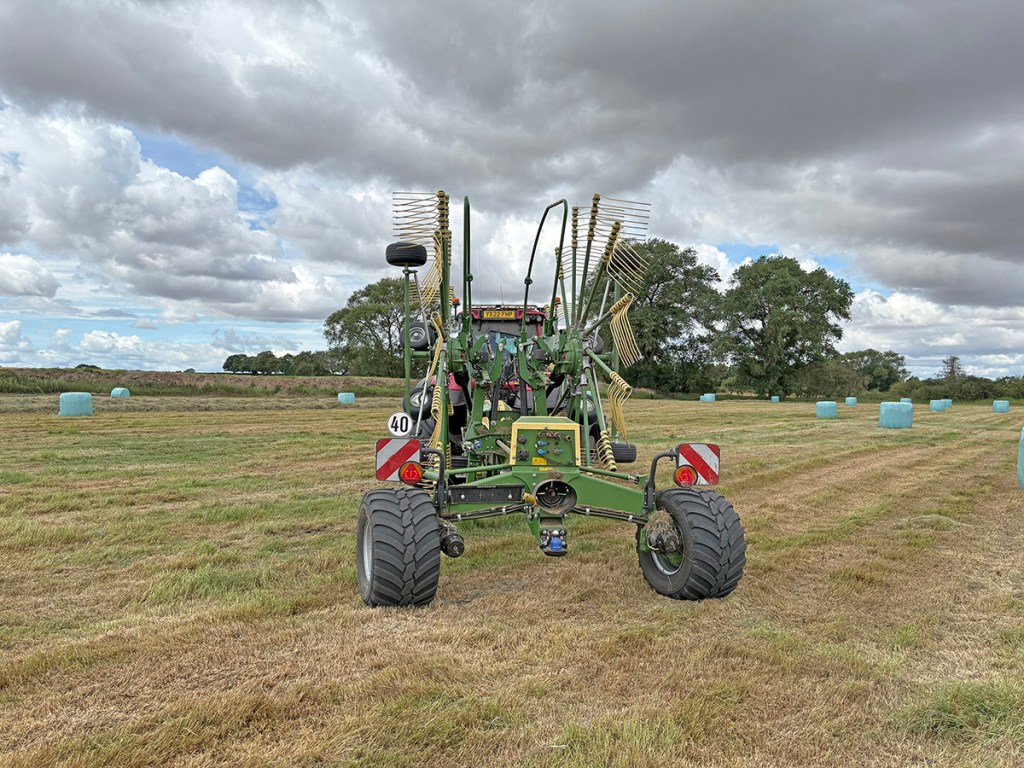
A straight-through pto driveline is concealed within the entire length of the rake’s central spine chassis, enabling the baler to get it’s pto input directly from the back of the rake, along with hydraulic and electrical connections too. This outfit uses a 540rpm driveline, and Power Beyond for its hydraulic functions.
At the front of the rake is vertical gearbox, which has two roles – it means the baler always operates at the correct pto speed, and it raises the driveline so that a separate drive can be delivered to the rake’s rotors.
This gearbox has two-speed options and a neutral function, allowing the operator to tweak rotor speeds to suit crop density and forward speed. The entire combination also features ISObus connectivity, and is managed through a CCI 1200 in-cab terminal, offering automated functions through Krone’s AutoBale feature, along with manual over-ride.
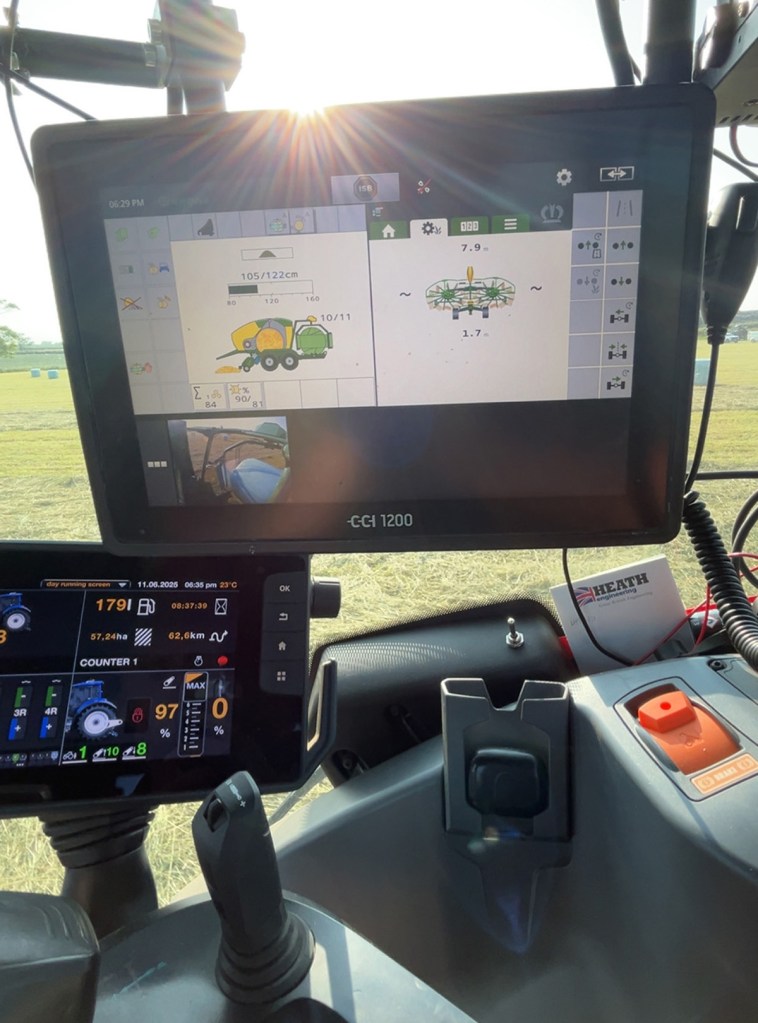
“When the rake first arrived, we headed off with it as a solo machine, which gave the opportunity to set it up and rake a headland, letting the baler get going,” he says. “Then we could link the machines together and operate the Bale Train as it was intended.”
Rob says the biggest challenge is coupling the rake up to the baler.
“I can see through to the baler pickup when working, but I can’t see the hitch – coupling up is a totally blind operation,” he says. “There’s no wriggle room on anything, and you have to be spot-on with your reversing, or you’re in and out of the cab like a fiddler’s elbow.”
Extra eyes
The outfit already has three cameras, one of which was fitted by Rob. These provide views of net going onto the bale, a view of the wrapping table, and a rear view for bale drop – or road safety.
“We do need an extra camera on the rake’s axle, looking at the hitch,” he says. “I’m sure it would help.”
Rob says connecting the rake and baler is easy when there’s two of you, but when working solo, it’s a 12-20 min job. Conversely, uncoupling is straightforward.
“If the baler caught fire, you’d want to leave it behind pretty quickly,” he says.
In-field observations and feedback has led Rob to the conclusion that the rake’s drawbar is too short.
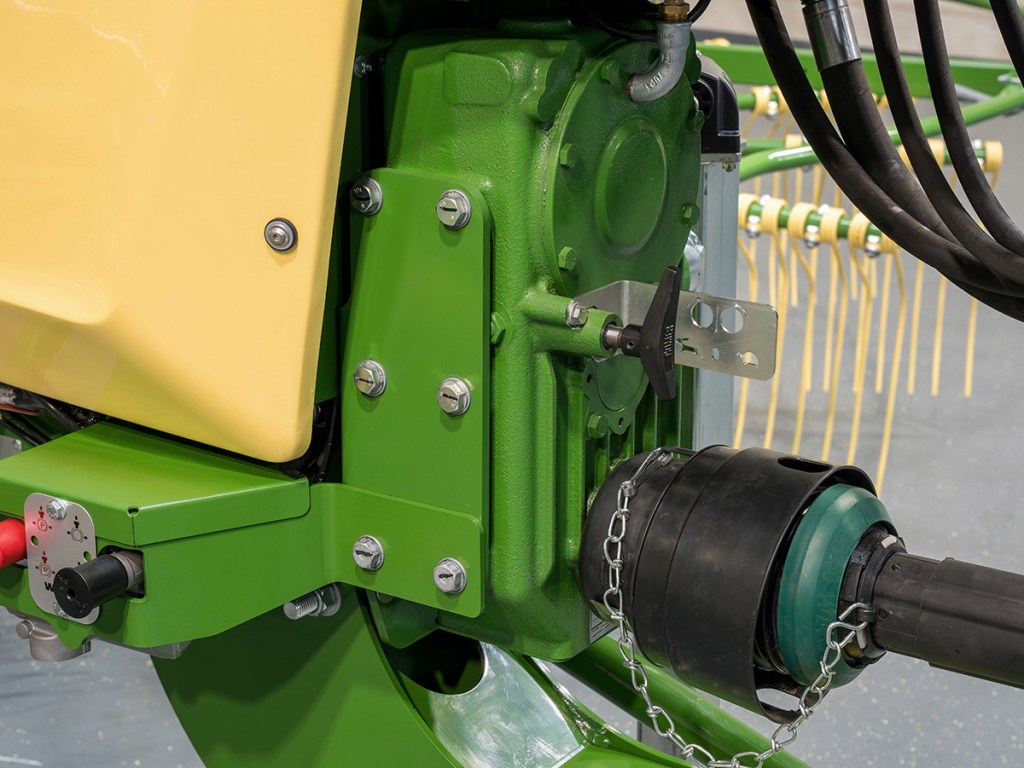
“On tight turns, the lower link arms could find themselves connecting with the main gearbox,” he says. “We do have a lot of small fields, and while the outfit is quite manoeuvrable, when you need to make a tight turn, you have to be careful. And taking link arms off the tractor is not really an option.”
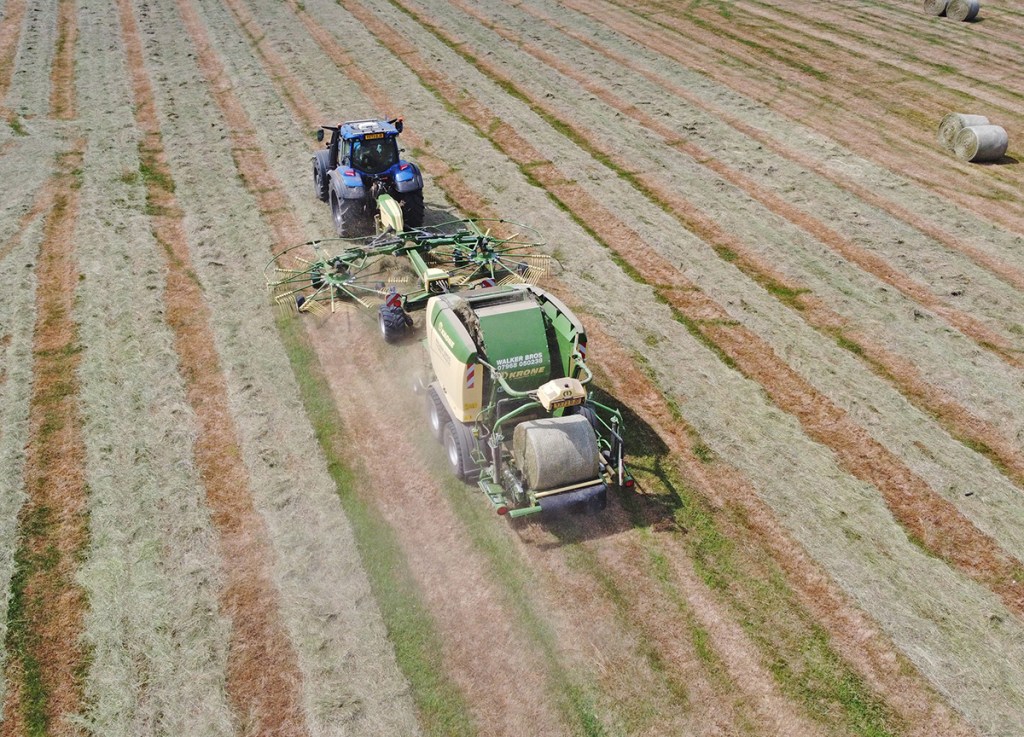
The rake’s force-steered axle sees the Swadro turn slightly wider than the tractor rather than cutting into a corner. This allows the rear axle of the Comprima to follow the rear axle of the tractor – impressive for a combination that measures 18.75 metres from front to rear, and includes two pivot points.
“Getting in and out of gateways is not a problem,” says Rob. “If the tractor goes in, the rest will follow without major concerns. And I have the option of manually steering the rake’s axle, which is also useful to stop the outfit from crabbing when working across a slope.”
Operationally, Rob says the auto functions are impressive.
“Through ISObus, the rake and baler communicate well, and this delivers a lot of automated functionality, making it simple for me,” he says. “When the buzzer goes off to stop baling, and the net process starts, the baler pickup is raised, and rake’s rotors automatically lift off the ground to a headland turn position. Once the bale chamber door closes, the rotors and pickup are automatically lowered back into work, and I’m off.”
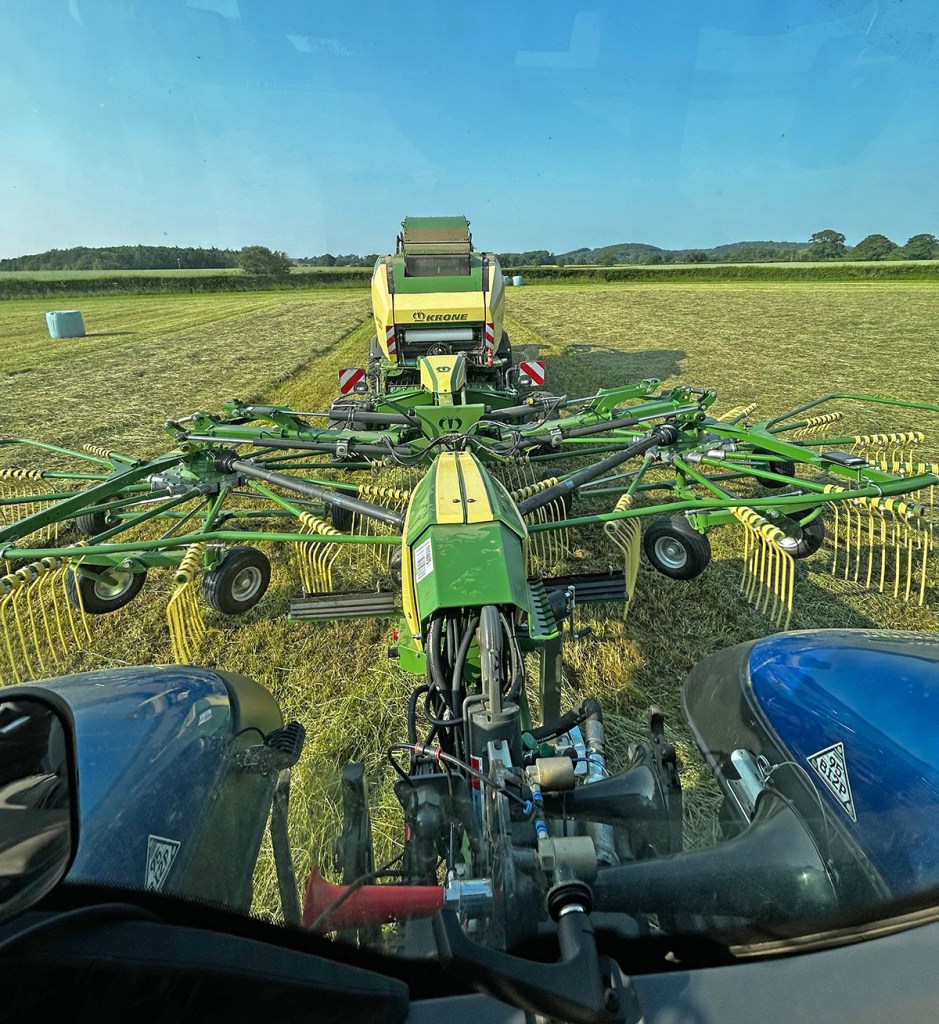
Rob says that there is full manual over-ride of all functions, if needed.
“When it works this well, why would I want to interfere,” he says. “In lighter crops, the baler will also steer the rake left and right so I don’t have to weave to fill the pickup.”
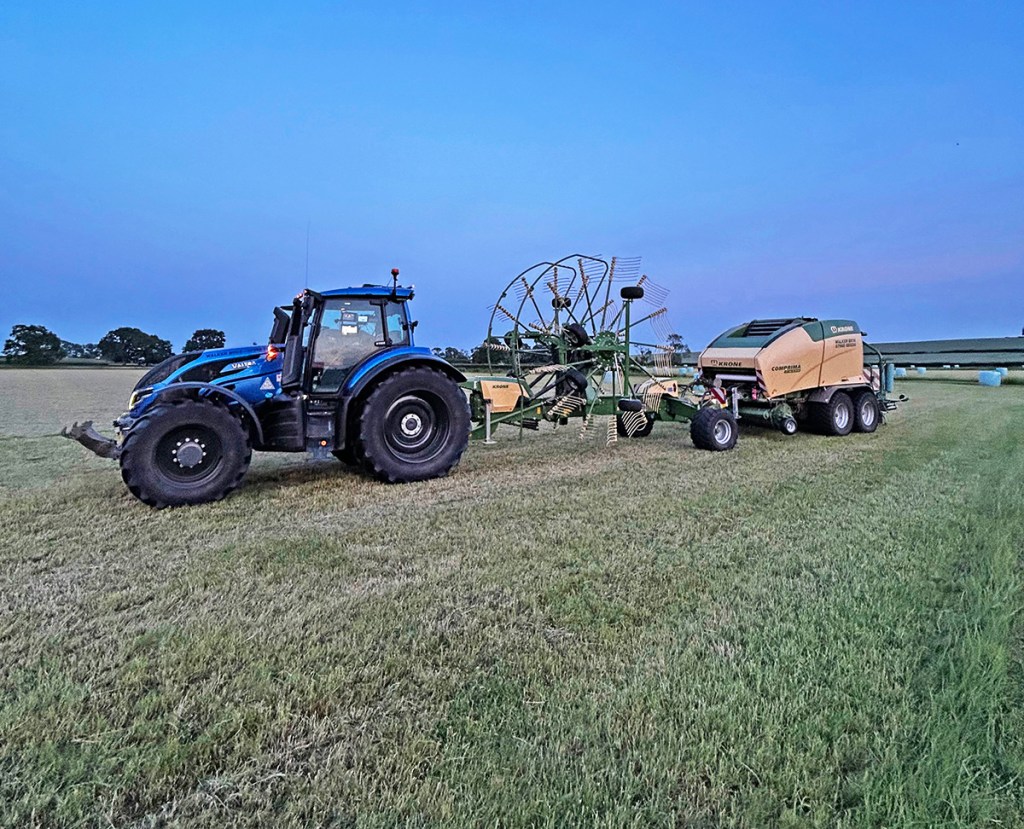
His preference is to operate using GPS for auto-steering, matching his A-B lines to the width of the rake. This way, gentle turns can be made on the headland, baling alternate rows, and once the headland is off, Rob can start and finish at the field entrance.
Andy Walker says he raked around 200ha with it as a solo rake, and Rob has baled around 100ha using the Bale Train as a full rake and baler combination.
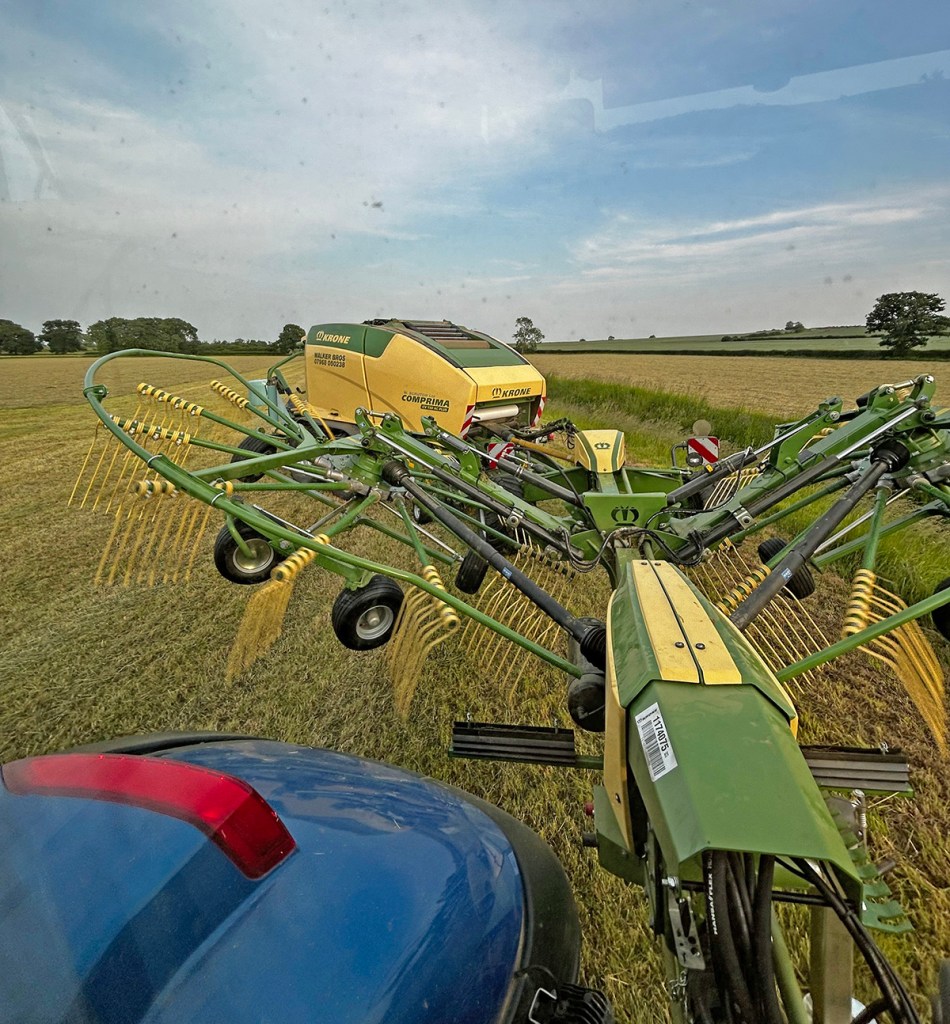
“Overall, it’s been a positive experience, and we’ve since decided to buy the prototype Swadro Bale Train, and trade-in our three-year old rake,” says Andy.
Prior to its return to Newton Farm for the 2026 season, the Swadro Bale Train is getting some additional modifications through Krone UK, based on feedback from all prototype users.
“A roller crop press has been fitted ahead of the rake’s axle, to make sure the crop doesn’t foul on the baler drawbar, and I’m hopeful that a longer drawbar will also find its way onto the final version,” adds Rob.
Summary
With labour resources stretched at peak times, and a commitment to deliver for its customers, Walker Bros’ ability to improve efficiency by linking complex kit together is a welcome move. And with advances in ISObus bringing ever more intelligent kit to market, this is likely to be the first pairing of many, that has the potential to open up opportunities for the one aspect you just can’t buy – time.
Geoff Ashcroft
For more up-to-date farming news click here and subscribe now to profi and save.