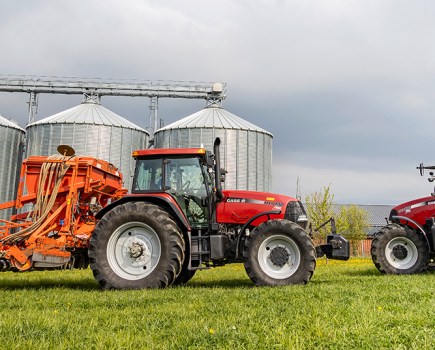

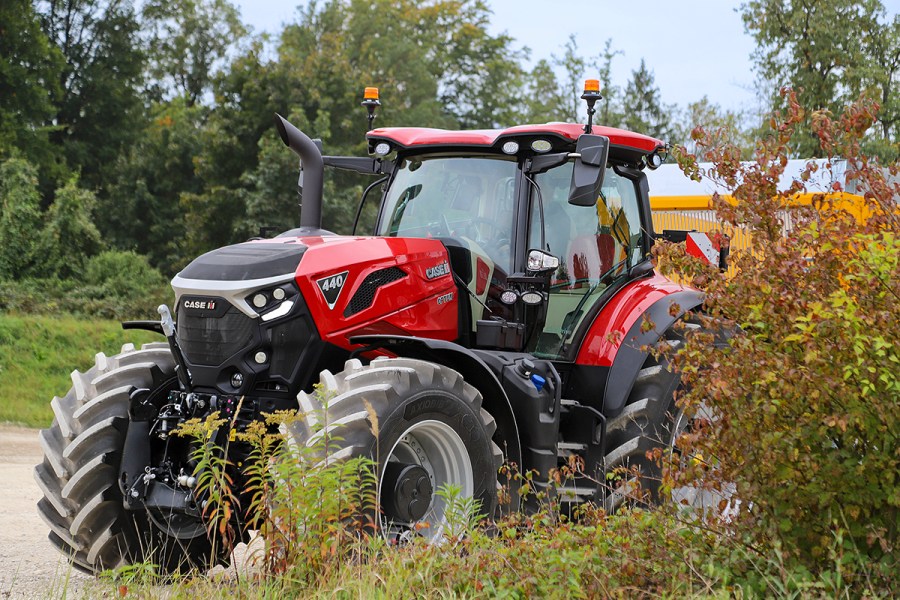
With up to 435hp, the new higher horsepower Optum models fall into the same power bracket as the legendary Magnum. We take a closer look at the new 440 from St Valentin and find out why Case IH has doubled up.
KEEPING IT BRIEF
- While the Magnum is an out-and-out fieldwork tractor, the bigger Optum is said to be a more versatile workhorse for the field and road.
- The independent front axle and cab suspension are completely new.
- New Holland showed its equivalent, the T7 XD, at Agritechnica. Steyr also has its own version, the Cervus.
It is not that many years ago that 400hp was the domain of the in-field workhorse. The likes of the Magnum filled this role and filled it very well. Even today in the UK, the Magnum, especially the half-track version, remains an important product for Case IH. But when stepping out onto tarmac the Magnum’s field bias comes under the spotlight.
Being able to move from A to B in a road- friendly manner while hauling a mighty tri-axle slurry tanker, powering a high-density square baler or even working with front- mounted kit like a seed hopper or a triple mower combination — that’s when a little more pace, agility and comfort are needed. So, as a European-built alternative, CNH has developed a new range of tractors, which Case IH is bolting on to its existing Optum family.
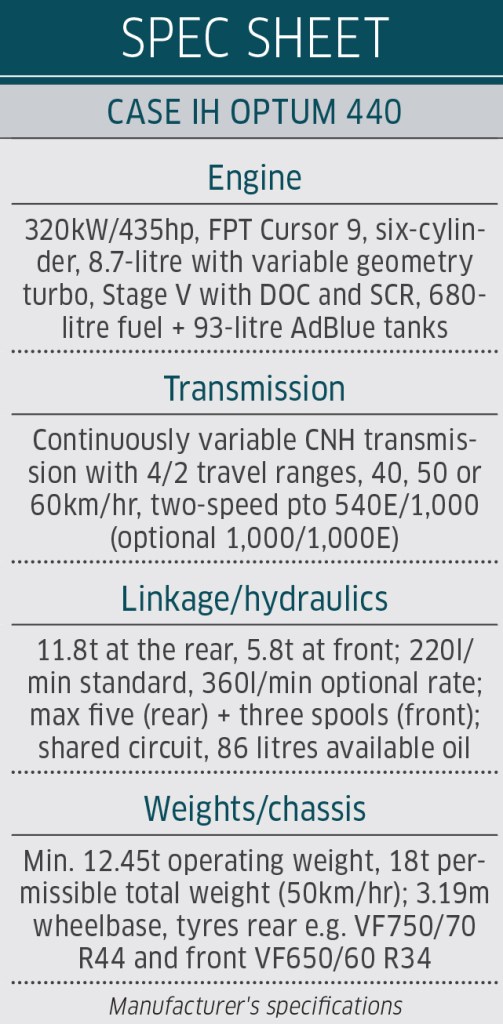
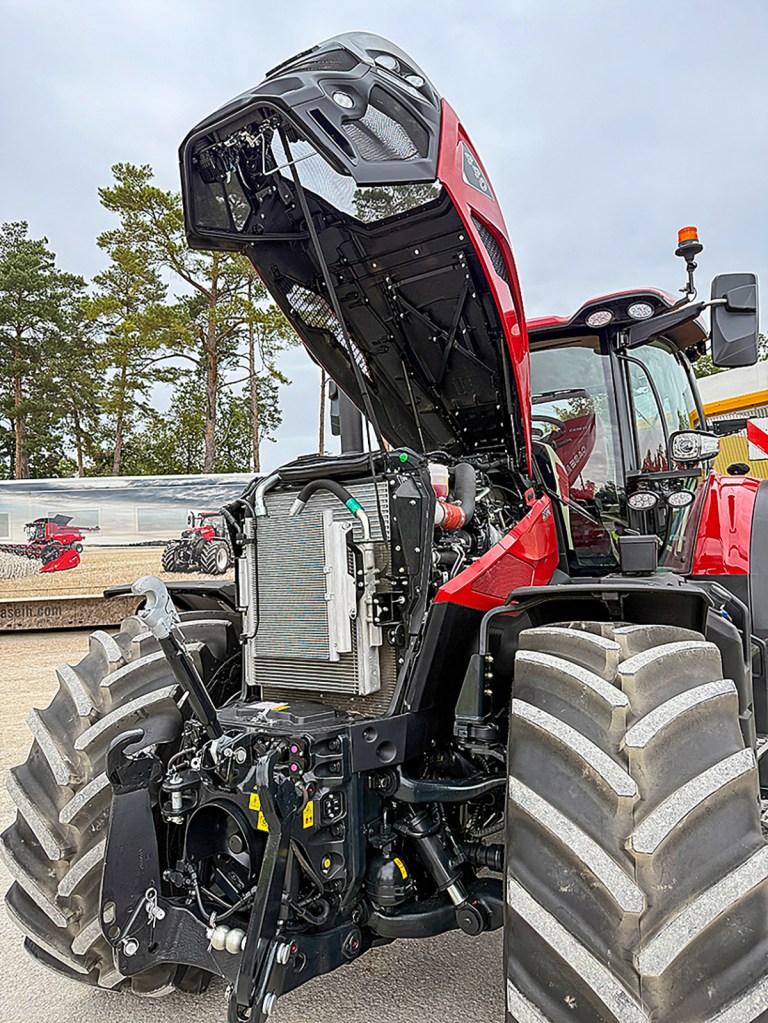
Although the FPT 8.7-litre Cursor 9 engine is virtually the same as that in the Magnum, everything else about the new Optum is rather different. The block design and the placement of the engine behind the front axle make the Optum much more compact than its US sibling.
3.19m wheelbase
But anyone who thinks that the wheelbase is also significantly shorter is mistaken: at 3.19m, the new Optum product is actually 4cm longer than the Magnum. Despite this, Case IH specifies a tight turning circle of 12.20m. However, we‘ll come back to that a little later…
First, let‘s take a closer look at the new continuously variable transmission, built inhouse by CNH in its Belgian drivetrain plant. Like the ‘little’ Optum, it offers four forward and two reverse speed ranges. In addition to 40 and 50km/hr, 60km/hr is now a possible speed option. And to ensure maximum efficiency, the combined hydraulic and transmision oil supply has a separate oil reservoir. This minimises churning and drag from the mechanical components in the gearbox while still providing 86 litres of usable oil. There is a choice of two pto speeds — 540E/1,000 or 1,000/1,000E.
Up to 360l/min on tap
The standard hydraulic pump set-up is 220l/min, but an optional double pump provides 220 plus 140l/min of oil, supplying up to three front spool valves and five rear units through separate high and low pressure circuits — with HighFlow (option) and partly with ¾-inch valves also up to 170l/min via a coupler.
Not only is the rear axle with a Cat. IV linkage (which, according to the spec sheet lifts 11,760daN) new, but CNH is also breaking new ground with the front axle featuring independent suspension. This fresh set-up not only ensures the promised manoeuvrability, but also improves comfort, especially when combined with the cab‘s hydropneumatic two-point suspension.
Case IH claims faster suspension response and 20% less vertical acceleration. We had a chance to try this out with a quick drive at the launch: even on uneven concrete and gravel roads, the Optum offers a surprisingly smooth ride.
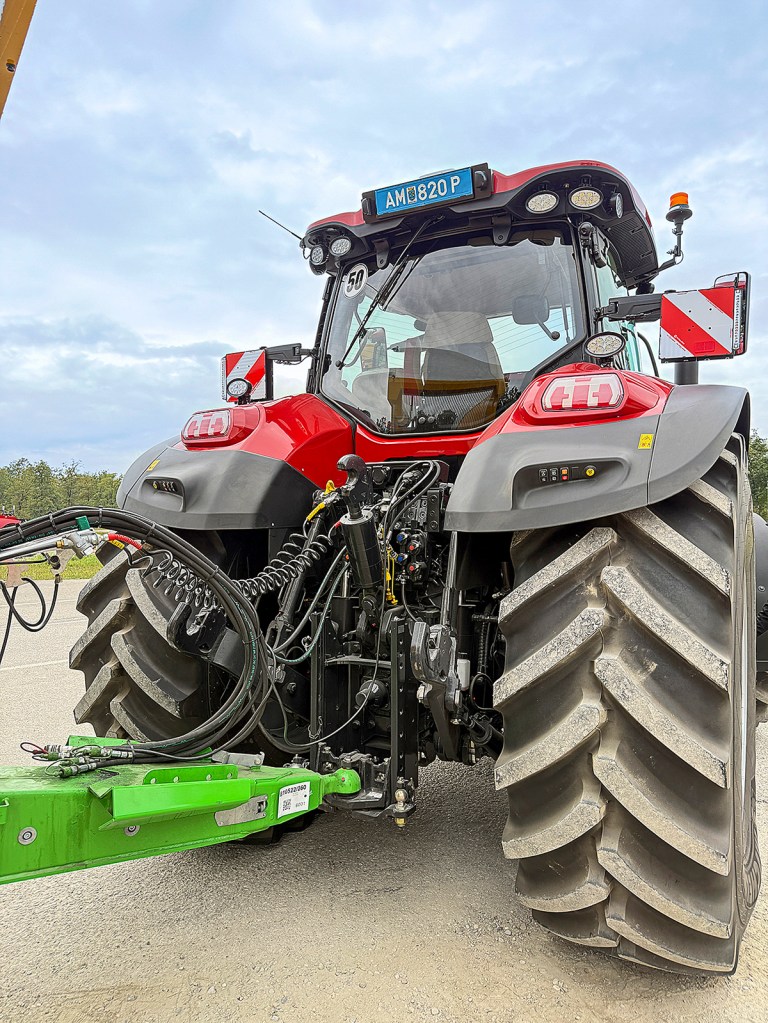
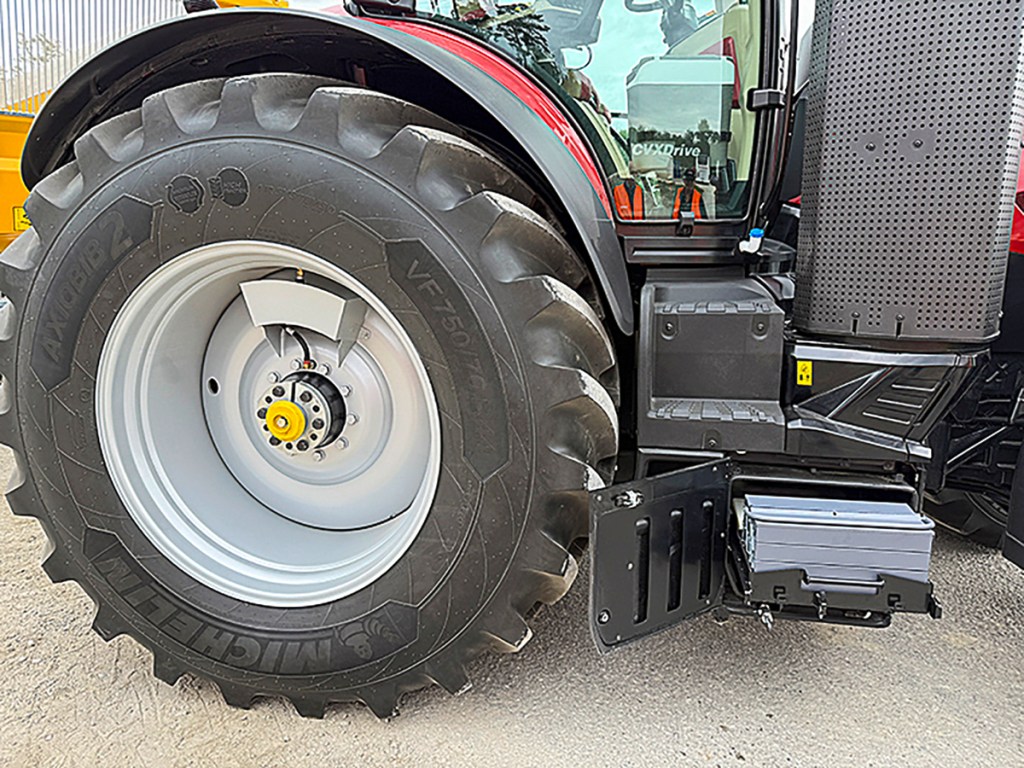
Tyres with a maximum height of 2.20m can be fitted at the rear (e.g. VF750/70 R44), and Case IH specifies the permissible total weight as 18t at 50km/hr. With a (true) unladen weight of around 13.5t, this leaves a payload of 4.5t, which is tight. For the first time, CNH has an optional integrated tyre pressure control system. Thanks to a flanged double-piston compressor, it can pump up to around 1.0 bar in just five minutes (710/ 75 R42).
Small but important details
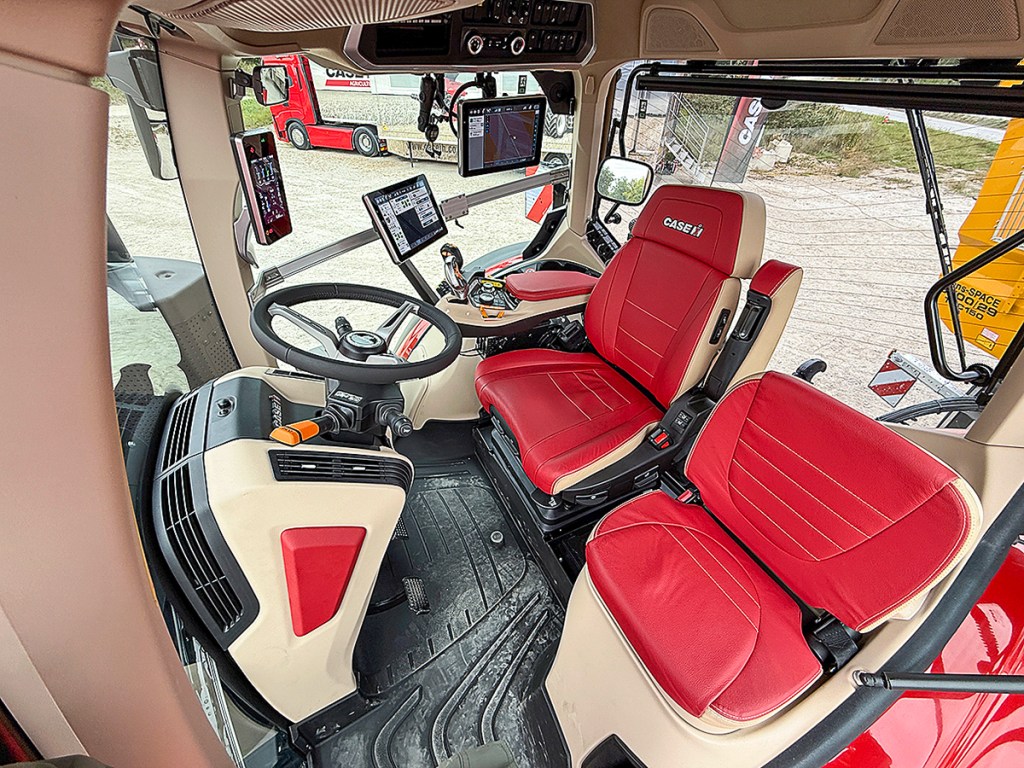
Case IH claims that the well-known Optum cab is super-quiet at 68dB(A); we just wish it could offer the same level of space as the roomy Magnum accomodation.

The cab access steps are integrated into the impressive 680-litre diesel tank, and on the other side there is a pull-out toolbox and water tank for washing your hands. LEDs have been integrated into the mudguards for lighting up the work area, too. In fact, there are a number of nice operator-friendly details around the big Optum, as well as a nod to the red brand’s heritage with the IH logo incorporated into the tail lights.
When it comes to precision farming, the new Optum naturally offers auto-steer including automatic turning, plus ISObus with TIM functionality as well as connection to the CNH FieldOps data platform.
Lifetime connectivity via a 4G modem and the option of remote display access are also standard features — providing the owner gives their consent.
More expensive than the Magnum?
Case IH range for 2026, we can talk money. The range-topping 440 is expected to be more expensive than the comparable horsepower Magnum … but by how much remains to be seen when these tractors make it to the price list later this year.
Hubert Wilmer
For more up-to-date farming news click here and subscribe now to profi and save.