
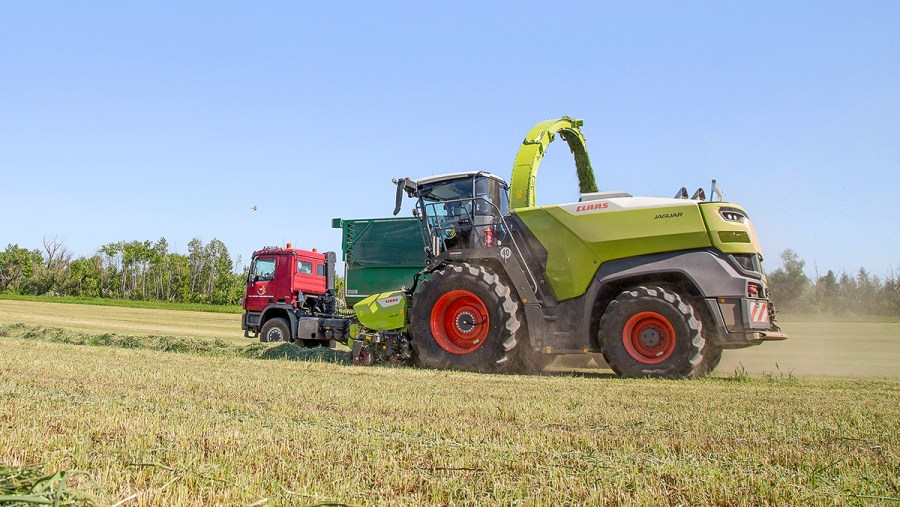
More power alongside more crop crunching capacity are not the only aspects Claas has focused on with the Jaguar 1000 series foragers. There’s a plethora of new features too, all aimed at making life better for the owner and the operator. We find out more.
KEEPING IT BRIEF
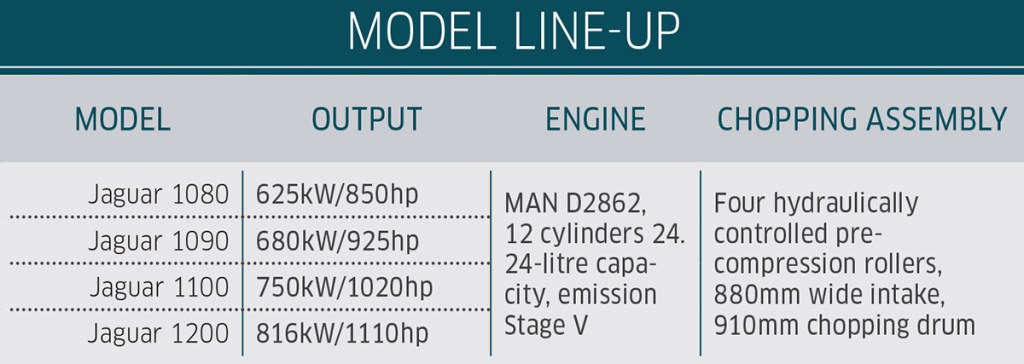
- There are four models in the Jaguar 1000 family, ranging from 850 to 1,110hp
- The entire intake system has been redesigned and is now 880mm wide.
- There were two pre-series machines operating in the UK last season.
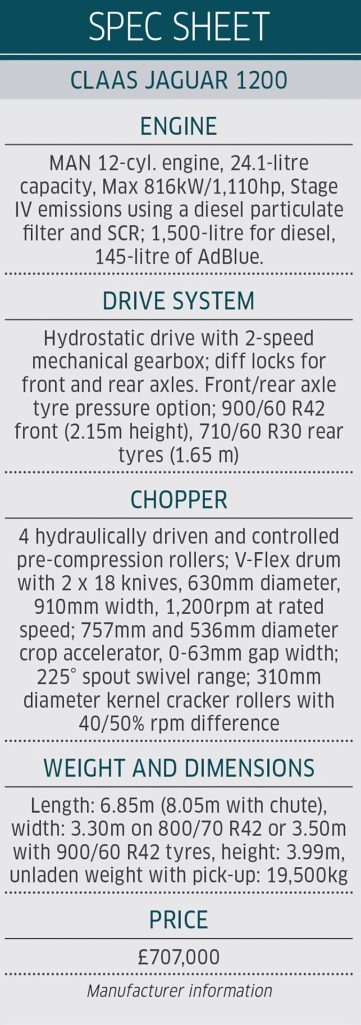
If you’re already a forager fan, then you will know why Claas has developed the Jaguar 1000 series. So let’s get straight down to business. In its backend sits the same MAN engine that has been fitted in the Jaguar 990. The MAN D2862, a twelve-cylinder, 24.24-litre motor, can generate up to 5,000Nm of torque at the crank while purring quietly at 1,400rpm. In terms of ponies in the biggest model, the Jaguar 1200, it maxes out at 1,110hp, which Claas says is enough to pump out up to 500t of material per hour.
Apart from the engine, which is mounted higher and farther back, the 1000s are a completely new design that has been six years in development. Designated the Type 507, there are four models, with the 1080 and 1090 overlapping with the Jag 980 and 990 — the same horsepower but a narrower 750mm drum.
Wide boy
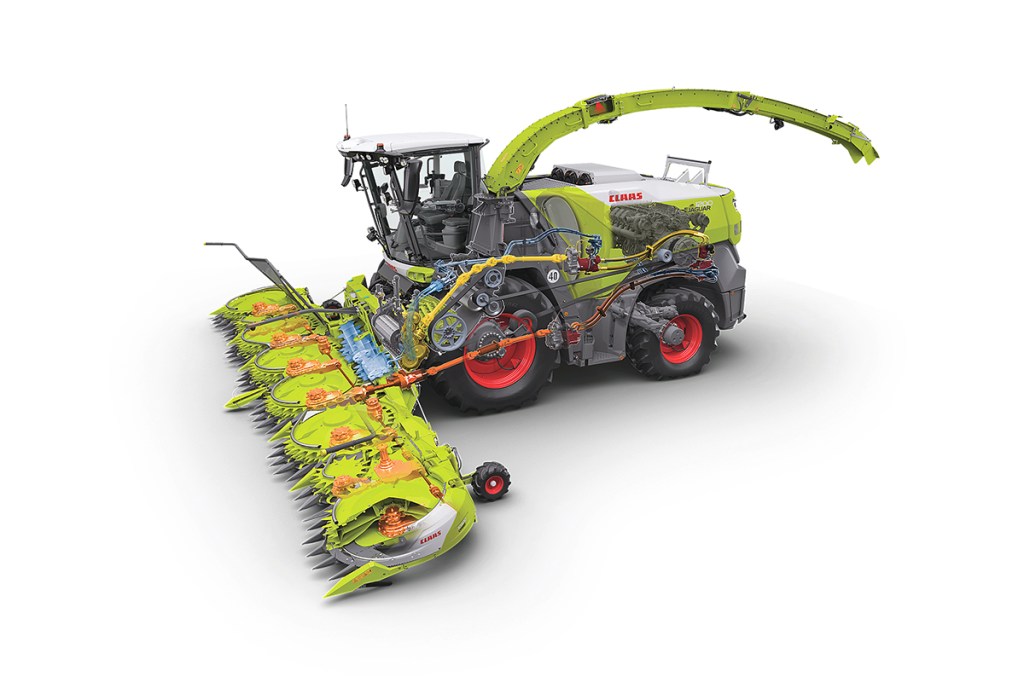
So, how have the Claas engineers been able to increase the feed rollers by 150mm to 880mm and still manage to contain the overall width to 3.30m (when on 800 tyres and a max 2.15m diameter). To gain the necessary extra space the drive system needed a rethink. On the 900s, the hydraulic pump powering the feed rollers and header are driven by a belt; whereas on the 1000s the pump drive has been integrated into the transfer gearbox at the rear of the engine.
This means the belt that is powered by the transversely mounted engine only has to drive the new, wider 910mm drum, the crop accelerator and, when in maize, the cracker rollers. The change in the drive system, means Claas has been able to stick with an eight-groove belt despite the increase in engine power.
Two hydraulic header drives are now fitted as standard. The drive runs straight through the front axle and transmits up to 300kW/402hp to the header, more than sufficient for even the widest direct-cut heads.
As you will have seen in profi 2/2026, Claas has also developed a new range of Orbis maize headers, up to 14 rows, to make the most of the new Jaguar’s impressive in-field performance.
The pendulum frame has been integrated in the feed roller housing. It can be operated actively or passively (floating mode).
The Jag’s four pre-compression rollers are hydraulically actuated. Regardless of the crop, conditions and crop chop length, the pre-compression pressure is automatically regulated, or it can be individually adjusted from the terminal.
Best accessibility
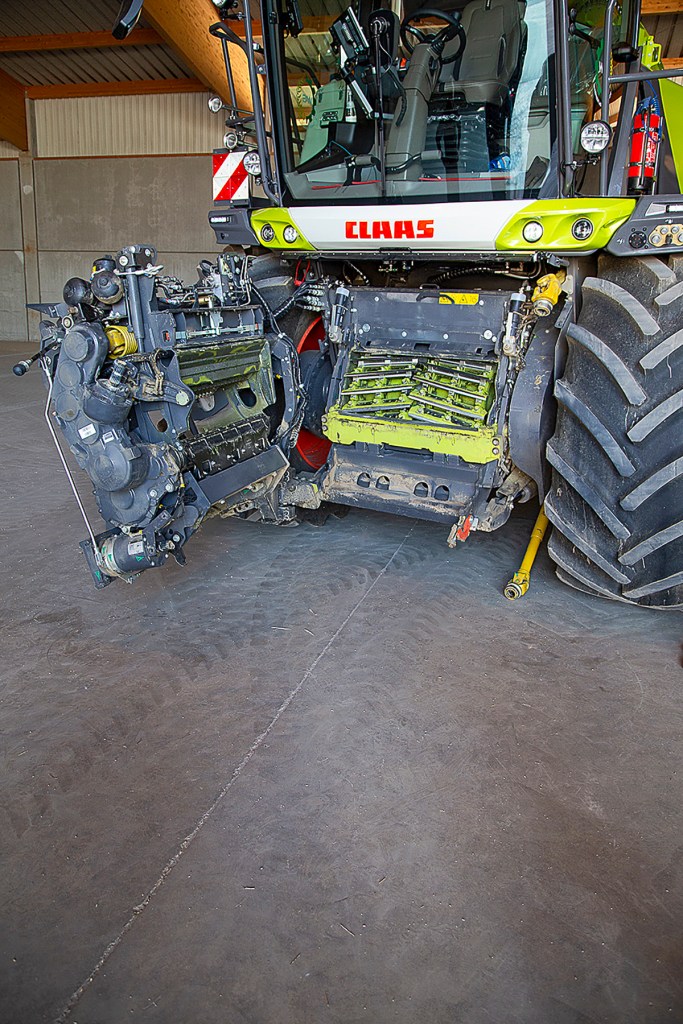
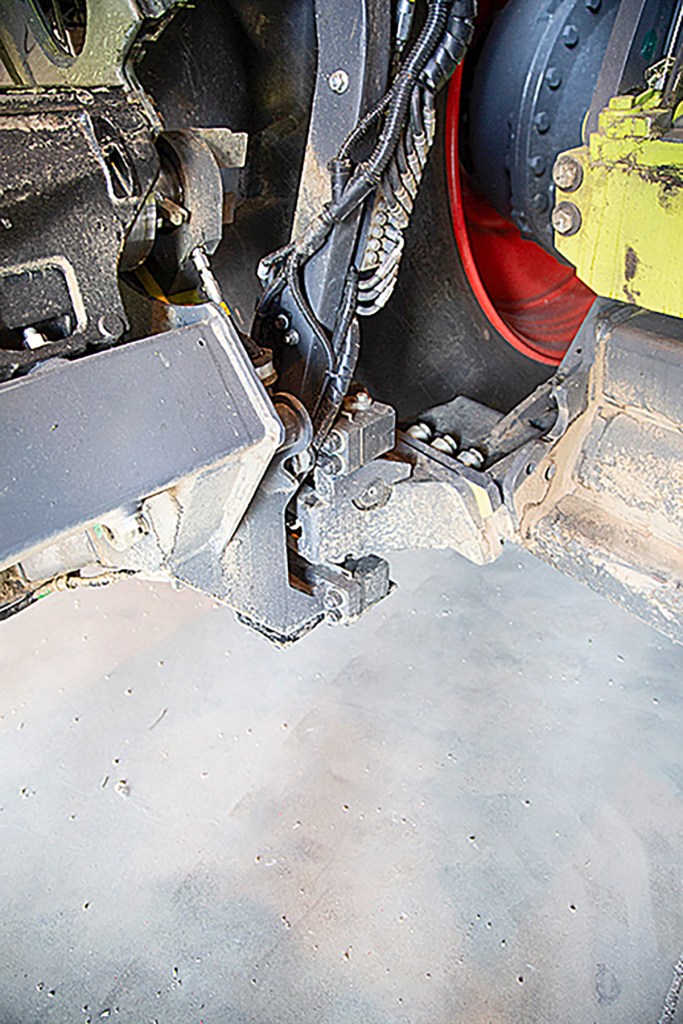
Despite the 880mm intake and the same overall external width, you can swing open the roller unit to the side to access the drum. Simply disconnect the drives for the header and pre-compression rollers, lower the infeed housing, attach a safety rope and open the hinge. When the unit is raised, a V-shaped gap opens and the pivot point of the hinge moves forwards with the linkage. This allows the large door to swing open almost at a right angle to the drum and be locked in place — brilliant.
V-Flex
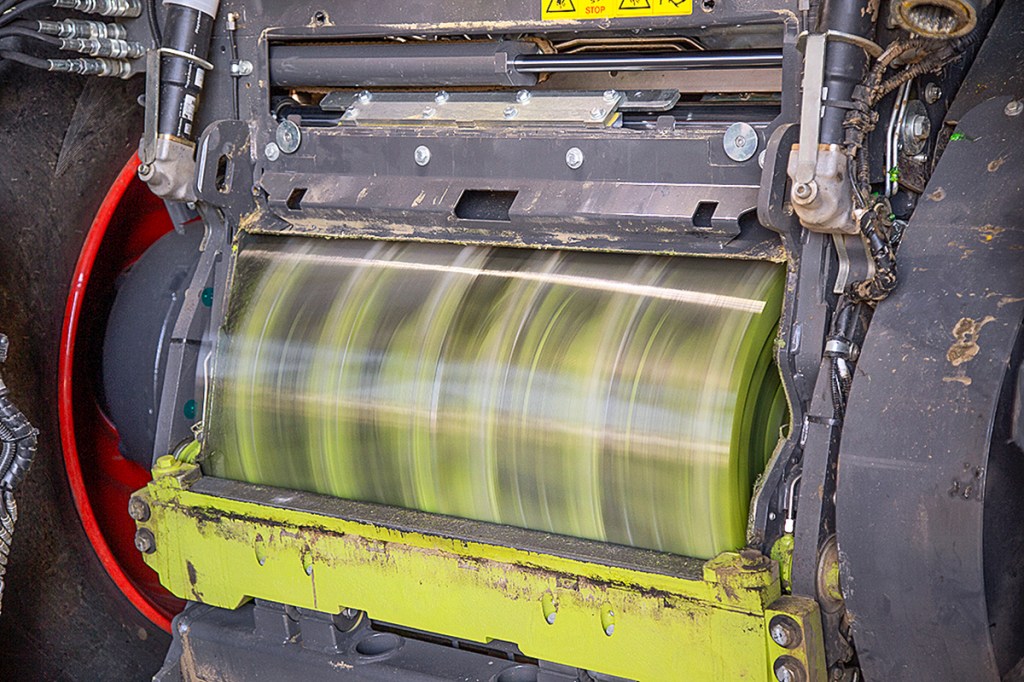
The 1000 Jaguar uses the V-Flex chopping drum that Claas introduced on the 900 last year (profi 02/2025). But on Type 507, the drum is 910mm wide instead of the Type 502’s 750mm. The knives are bolted down from above onto six conical rings. Drum options are 20 (5 to 26.5mm chop length), 24 (4 to 22mm), 28 (4 to 18.5mm) or 36 knives (3.5 to 14.5mm chop lengths).
Harvested crop then flows over the 752mm wide accelerator. Its rear wall clearance can be adjusted from 0 to 60mm, and then there is the massive chute. With a 14-row header, a 2XL extension is available for an unloading height of 6.60m. Even with the spout near vertical, the trailer can still be 1.5 maize rows away from the header.
Claas has made it a lot easier to fit the chute extension on these new harvesters. The extension is attached with a loader, and connectors make the assembly a breeze to complete.
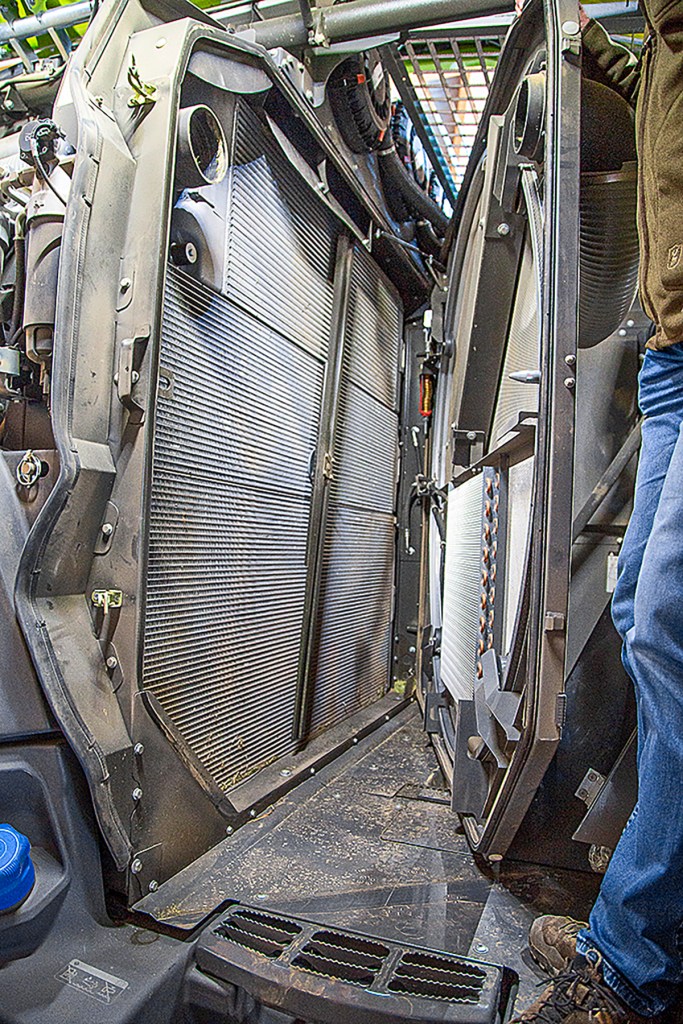
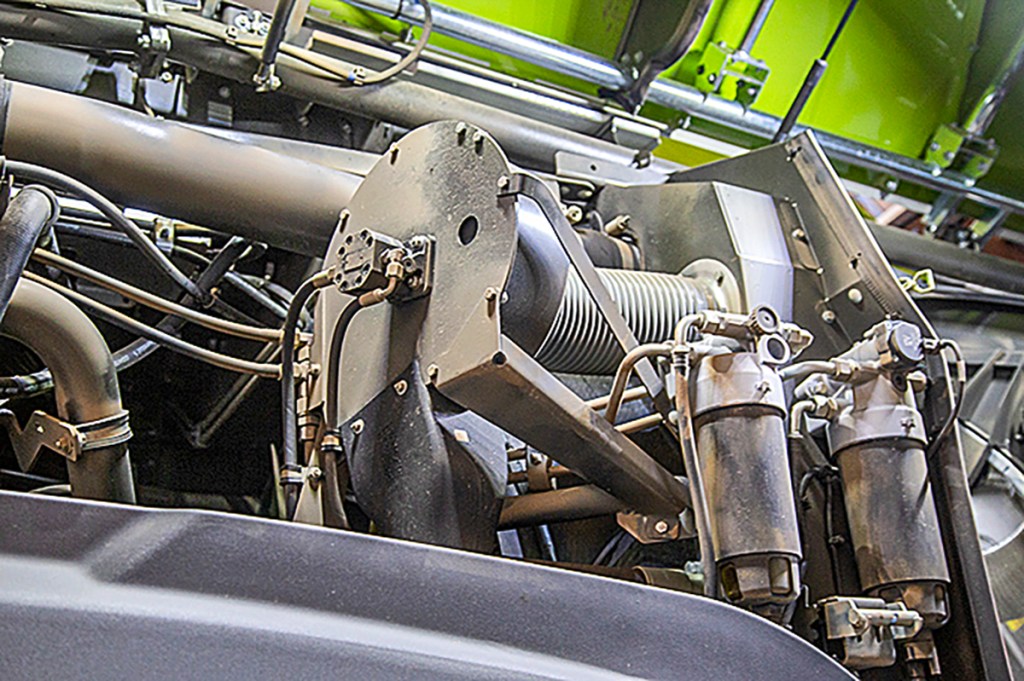
The rotary cleaning screen on the radiator has been copied from the Lexion combine. It is now kept clean by a hydro motor. The monster fan is hydraulically powered and adjusts its speed relative to the current engine heat.
Plenty of throughput?
We caught up with one of the 1200 units being operated by a German contractor last season while it was in a field of Triticale. The 2.0m wide and more than 60cm high swaths had been tightly packed by a belt merger.
With over 1,000hp on tap and the new pick-up up front, the Jaguar didn’t really have an issue with this challenge — unlike its ‘little’ brother Jaguar 990, which was clearly struggling in the same situation. The new pick-up, with its beefed-up drive and wider throat, really came into its own and gave the Jag 1200 a genuine headstart in terms of throughput.
Claas’s Stop-Rock system was doing its job preventing any aggregate getting in. The engine feels robust and yet runs smoothly. The machine’s potential — particularly the crop flow system — looks to be designed for even higher engine outputs.
Steering joystick
The cab is sourced from the Trion, but it’s been adapted. These nifty mods include the optional ‘Aquablade’ windscreen wiper, plus adjustable wipers on the door and the right-hand window. The wipers can be parked in a vertical position so operators don’t get showered with chaff and dust each time you open the door. The windows are 44% thicker — which largely explains why the cab stays pleasantly quiet.
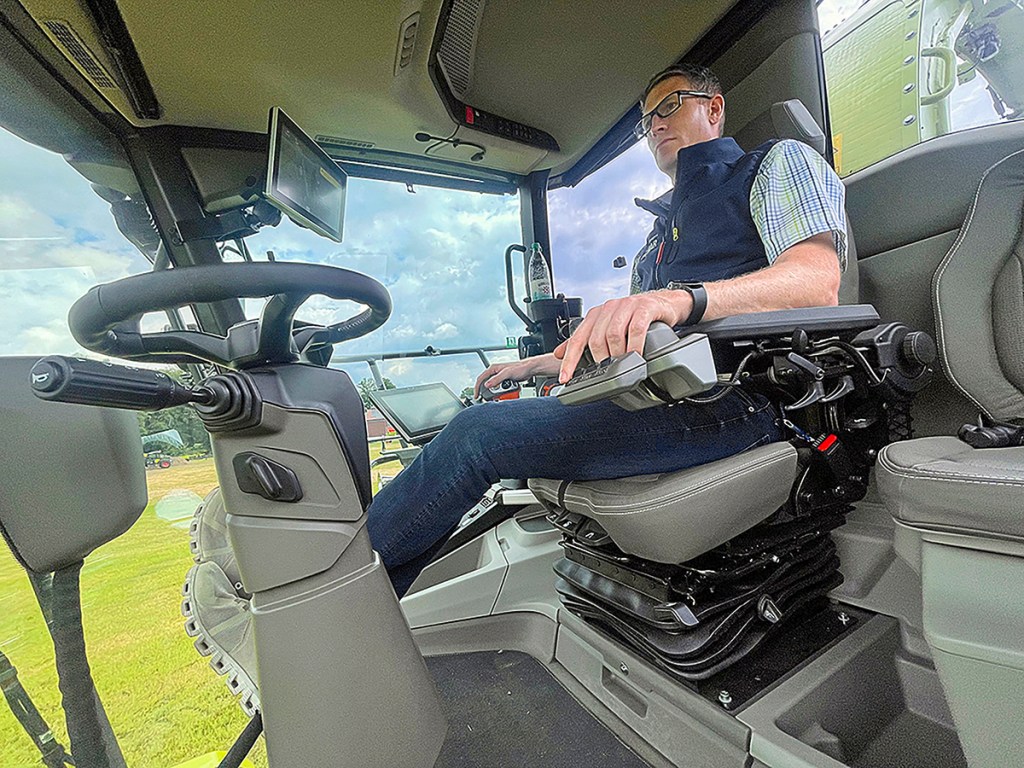
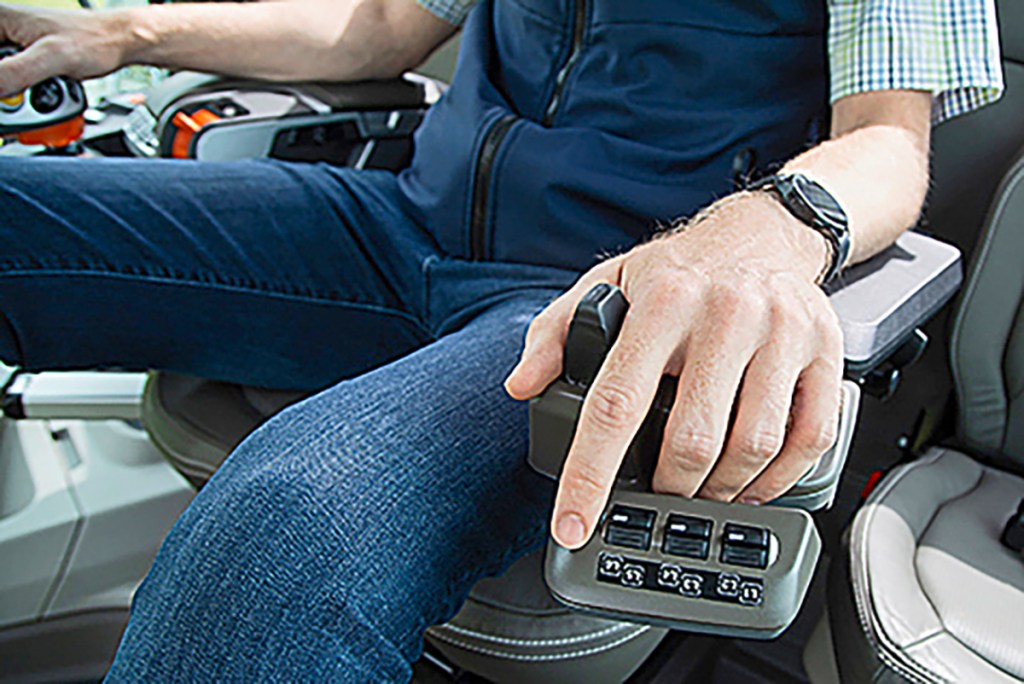
Claas has also rethought legroom. The seat doesn’t just swivel sideways — there are solid, comfy footrests and a joystick steering system like you find on wheel loaders: you rest your hand comfortably and securely on the left armrest and steer the big Jaguar with your fingertips. And there’s more —programmable extra buttons let you sound the horn or operate the radio, for instance. Yet, there’s still a steering wheel for opening fields and road travel.
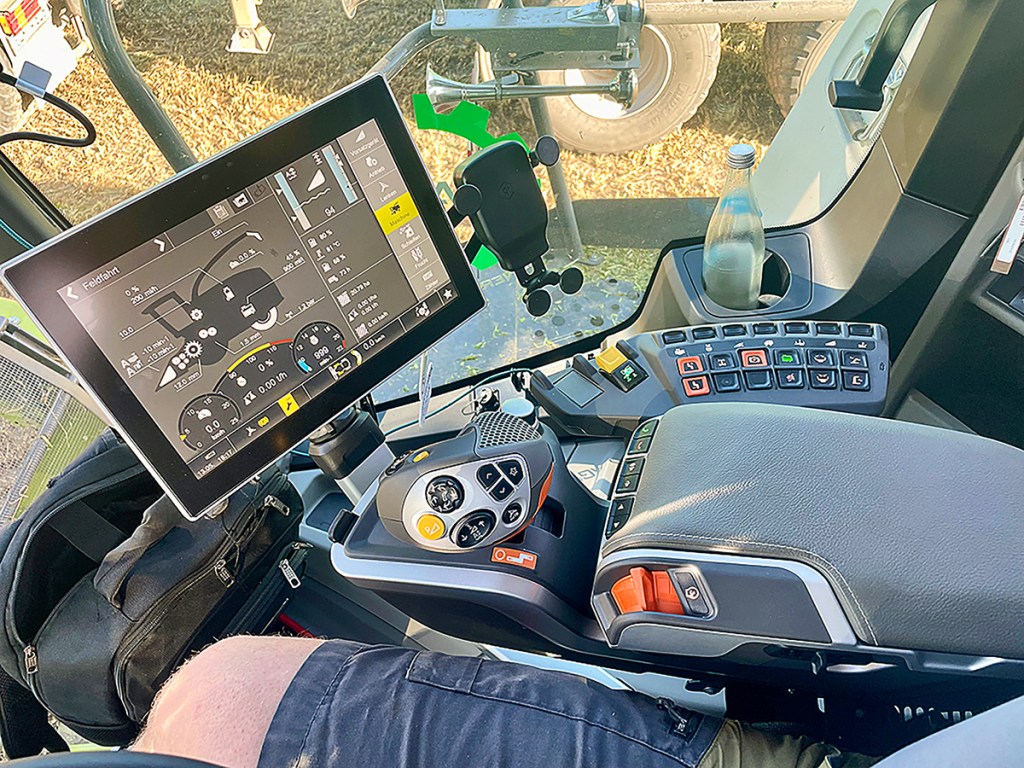
The CEMOS Auto Performance system does sterling work when operating the pick-up. Combined with Cruise Pilot, it not only controls the ground speed but also boots the power when needed. When demands are lighter, it scales back both power and engine revs.
Other details
- Knife sharpening is now a more rapid job: in particular, the shear bar moves faster into position. Grinding time is indicated on the CEBIS screen.
- The forager grindstone moves to a central position for servicing.
- An optional Actiliser tank holding 37 litres can complement the standard additive/water tank with 375 litres capacity. The extra-cost twin pump can supply up to 800l/hour of water.
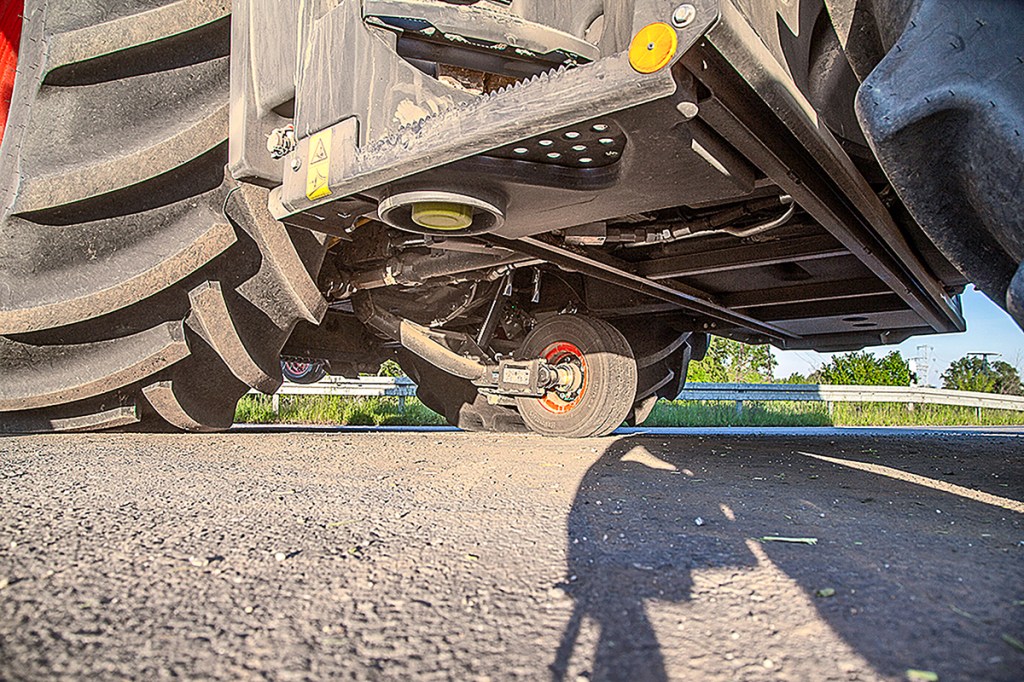
- With support axles both in mid-mounted position and under the Orbis header, the Jaguar 1000 doesn’t need any additional ballast at the rear.
- The Carraro rear axle is available with a mechanical diff lock. With a diff lock on the front axle plus tyre pressure control for front and rear, the Jaguar handles soft ground with confidence.
- The Terra Trac tracks won’t be available for the 1000 Jaguar.
- The NIR sensor Nutrimeter is now ISObus-compatible and can be used for other applications, such as on slurry tankers.
- With air connectors all around, the optional sturdy hose reel, the robust toolbox with dedicated slots for specialist spanners and the solid grab rails — these all reflect the engineers’ understanding of what Jaguar pilots will need.
- Even in basic trim, the Jaguar comes well equipped. Premium Line wear parts come as standard, as does Claas’s dual header drive.
Summary
The 1000 series is not a juiced-up Jag 900; it’s a very different beast with bigger crop gobbling bits to match the extra power on offer.
While the largest model, the Jaguar 1200, doesn’t outmuscle its competitors, it has been suggested that the big 880mm crop rollers and 910mm drum could easily cope with more power in the future. But for that we’ll have to wait and see.
Tobias Bensing
For more up-to-date farming news click here and subscribe now to profi and save.