
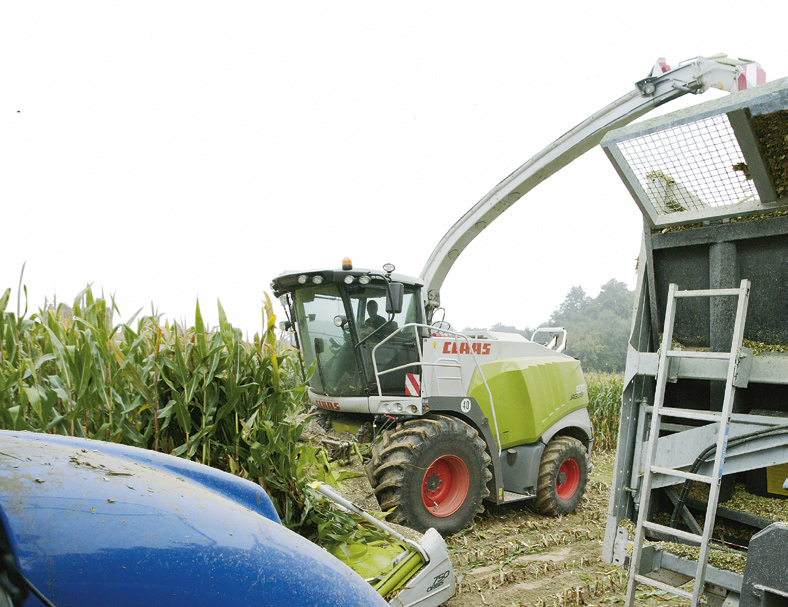
Practical test: Claas Jaguar 970 forage harvester Claas’s V-Max chopping system didn’t get off to the best of starts, so the designers went back to their CAD screens for a rethink. Now, after measurements and a field test, it looks like normal crop munching service is resumed.
We reported on the first curved-blade V-Max cylinder in 2007. feedback during the 2008 season suggested that its durability and chop quality weren’t up to scratch, so for last season Claas’s twin-engine, high-horsepower Jaguar 980 and 970 foragers gained a redesigned unit. Changes were aimed at reducing its twist under load: the cylinder was beefed up by an internal tube, closing it; the shear bar was stabilised by stronger brackets and extra bracing; and the software was re-worked.
Satisfied with the outcome after testing, Claas now fits the modified system to all new Jaguar 900 models.
In the new incarnation the original curved knives remain, albeit with minor mods. The drum can carry up to 20, 24, 28 or 36 blades, still arranged in a staggered V-format: standard UK spec is 20 blades, giving a 5mm-22mm chop length. We took a Jaguar 970 unit for our test. The smaller of Claas’s two high-end foragers, this one’s two six-cylinder Mercedes oM 460 LA engines put out a claimed total of 537kW/730hp (metric hp, eCe R24) at 1,800rpm. Claimed powers for the individual engines are slightly different, with the primary rear motor delivering 276kW/365hp and front unit producing 261kW/355hp. The main engine supplies all of the power in relatively light going, where fuel economy is the main focus, and looks after road transport.