
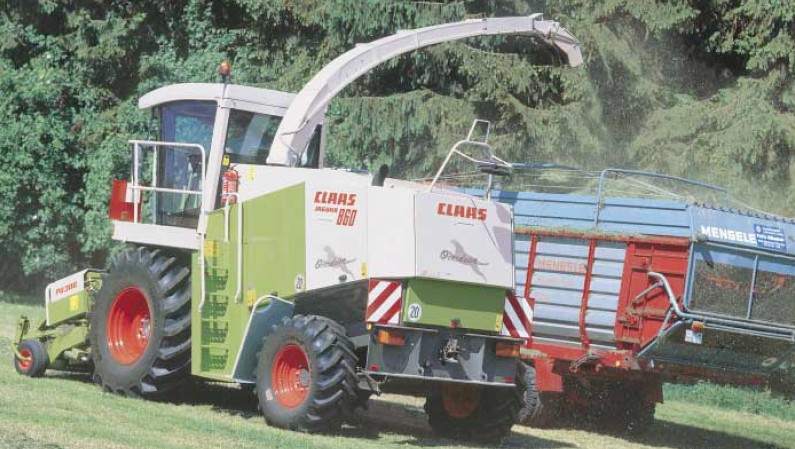
The UK launch of the all-new Claas Jaguar 900 forager is not just about yet more power and performance. The new forager’s OverDrive transmission is an interesting development in itself. Here we take a look at the system and its evolution from the system first seen on the Claas Jaguar 860. Two machines have spent the past three seasons in the UK as part of the development programme
Current Claas 800 series foragers have a hydrostatic transmission that offers three gear ratios; 3rd transport, 2nd normal working and 1st for slow and heavy conditions. The operator can vary the operating speed using the hydrostatic lever in the cab, but to cope with soft or hilly conditions, it is necessary to stop and change down to the lowest ratio.
OverDrive on the new Jaguar 900 overcomes this by reducing the ratios from three to two, coupled with a high and low ‘hydrostatic’ split for each ratio. Maximum speeds for the splits in each ‘ratio’ are 30km/hr and 20km/hr in High and 14km/hr and 7km/hr in Low.
On the pre-series OverDrive test system fitted to some Jaguar 860s, the operator uses a switch in the cab to alter the displacement of the hydrostatic drive motor to provide the ‘split’. On the 900, the system has been further developed to automate the process, so it is fair to expect this to be the system that Claas adopts for the future. A fixed displacement motor is used on all existing Jaguars 800s in the UK.
For more up-to-date farming news click here and subscribe now to profi and save