
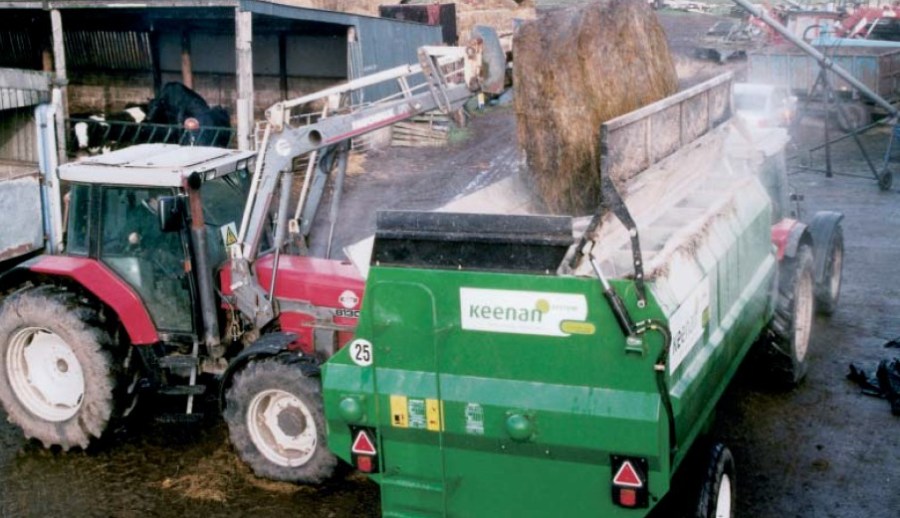
Last time profi looked at a Keenan mixer wagon was back in January 1997, in our Easi-Feeder 115 driving impression. Since then, the green machine has changed shape into today’s Klassik, with the latest development the recently introduced Bale Handler version. Martin Rickatson goes feeding
Keenan comes with a deserved reputation as one of the pioneers of the TMR feeder business. But the industry has moved on a long way since the simple diet feeders of the early 1980s – and so has the Irish company’s product.
The firm built its business on the concept of its original Easi-Feeder, a four-paddle mixer wagon. Then, in the mid-1990s came a small but significant step in paddle mixer development, with the introduction of chopping knives to the feeder barrel. Originally configured in a single straight row on the bottom of the machine, later versions saw a staggered layout introduced: Single plates, each holding a pair of knives,are arranged in a staggered line in the base of the mixing chamber. On these models, material is chopped as it is picked up by the paddles and then squeezed on through between the ‘notches’ in the paddles and the knives. Hence ‘the chop’.
The knife arrangement moved the Keenan feeder concept on further, giving the machines greater ability to process silage, hay, straw and roots, progressing the feeders’ role as simple ‘mixers.’
But while, in this design guise, the machines cope well handling clamp silage, with its short chop length and loose consistency, users whose feed systems are based on – or who prefer to make – bale silage have to tease out or cut bales into portions and then add them to the mixing chamber gradually to avoid jamming the rotor. The key problem here is that the machine tries to ‘swallow’ the bale whole, main reason being a tendency for bales to jam in the ‘corners’ of the four-paddle crossshaped rotor.
For more up-to-date farming news click here and subscribe now to profi and save