
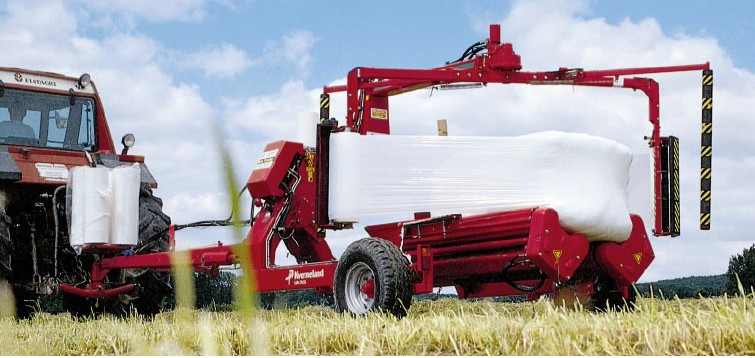
The single-film, Kverneland UN 7655 bale wrapper gained an extra wrapping arm in 1996. Did that doubling up of limbs boost performance and improve reliability, or was the operation little more than a clever piece of cosmetic surgery? We watched a 7655 working in the field to find out
The Kverneland UN 7655 is an old friend. We first met back in 1995 when we found the red wrapper to be a strong performer in round- and square-bale work – in short, a good all-rounder.
Not surprisingly, rectangular-section packages – Claas Quadrant, New Holland 1210 etc – proved a little more troublesome. As with all similar wrapper designs, the problem comes in giving a rectangle’s base the same number of wraps as its sides; when the 0.9m high sides, for example, are bound they get a bigger dose of plastic than the 1.2m wide base.
Why? Because when the bale is on its base on the wrapper, the film has to cover a greater length (1.2m) of end-face before the bale is turned. When the bale is on its side, however, it’s only there for a shorttime, hence receiving a thinner covering of plastic. In other words, the sides get the better deal.
To cure this problem, the latest 7655s are fitted with a bypass function: When the bale lies on its side – rather than its base –, roller speed slows down to allow sufficient wrapping of both bale top and base. Brains behind this rotation retarding feature is a microprocessor control unit within the hydraulic system. The processor is continually fed information about the bale’s position by analogue sensors fitted within the wrapper’s rollers. Sensing is carried out by roller pairs, with the processor using the gathered data to set roller speed, hence speed of rotation.
For more up-to-date farming news click here and subscribe now to profi and save