
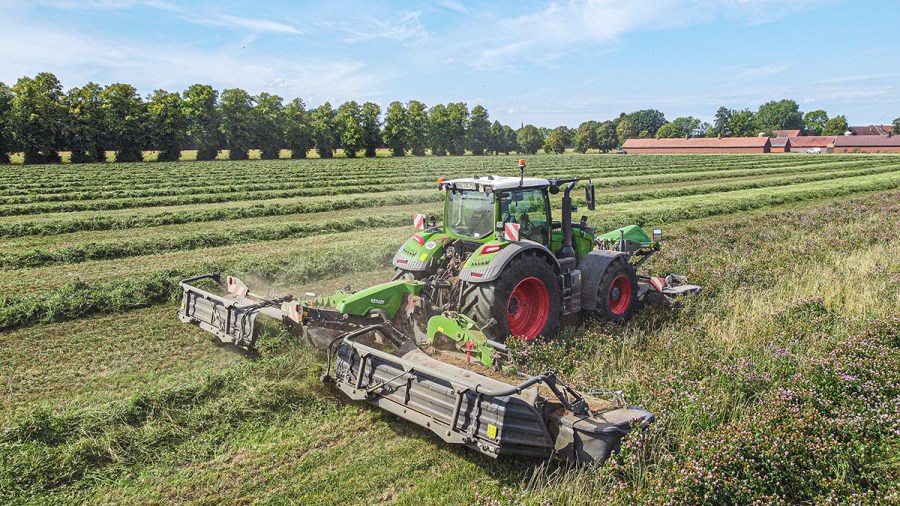
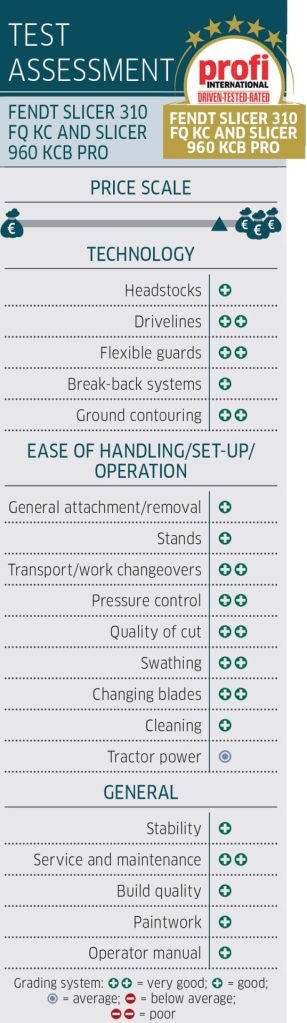
The latest Fendt Slicer 960 KCB mowing flagship can be kept simple. However, when you combine it with a TIM-compatible tractor, you get a much more integrated outfit, as we found out while covering over 1,000ha last season.
KEEPING IT BRIEF
- This combination has been developed by AGCO and is sold as a Fendt and Massey Ferguson product.
- When used on a Fendt tractor, you can access all the functions.
- The blades have a very good lifespan.
It is 15 years since AGCO took over Fella, and in that time the engineering team has been busy. One of the new bits of kits from the grassland specialist is its top-of-the-range triple mower conditioner outfit, the Fendt Slicer 310 FQ KC and 960 KCB Pro or Massey Ferguson DM316 FQ HD and DM9614 TL HD. Among the initial goals was to come up with a contractor-speed mower conditioner with a merger. And that’s what the designers have done.
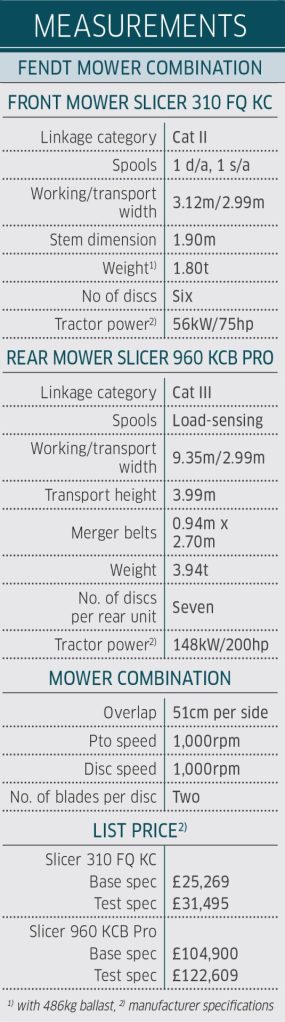
To keep things simple, and because that is the machine we had on test, we’re going to use Fendt language here. The Slicer 960 KCB Pro is ISObus- and TIM-compatible and mows just over 9.30m (or 9.60m when shifted out to its widest pin position). Completing the outfit was a Slicer 310 FQ KC front mo-co.
Updated front mower
Firstly, decoding the Slicer 310 FQ KC name: Slicer refers to the Fendt disc mowers; 310 refers to the working width; FQ stands for pull-type configuration with 3D suspension; and KC for tine conditioner.
If you are going to use the 310 with a TIM-compatible rear mower, Fendt recommends fitting the optional hydraulic comfort pack. This means you only need one double-acting spool (side-shifting function and operating the mower side guards) and just one single-acting connector (raise/lower or suspension). Our test machine had this £661 package. We also had the hydraulic folding end guards (£872).
Another extra fitted to our front mower was an additional hydraulic cylinder for the side-shift function, which has 20cm of movement to either side. This costs £1,210 and allows you to manually or automatically (£1,811)adjust the front mower’s position, to ensure there are no strips left uncut in tight turns. It also helps avoid strips when working across a slope, the automatic system receiving a signal from a tilt sensor on the mower.
The 310 FQ has direct mount Cat II couplers for the tractor’s front linkage. The parking stands have good handles and are held in place by spring-loaded pins, making them easy to use. In front of the parking stands is a new option, the 27kg wafer weights. Our test machine had nine on either side, adding 486kg to help counterbalance the 3,940kg rear mower complete with merger.
There are no complaints with the suspension system which is described as 3D kinematics. This provides ample vertical travel (20cm down, 45cm up). Lateral oscillation is up to a maximum of +/-13°, and it can also tilt in the direction of travel from –6° to +15°. The hydro-pneumatic TurboLift suspension is activated on the ISObus connected terminal.
3.0m wide and six discs
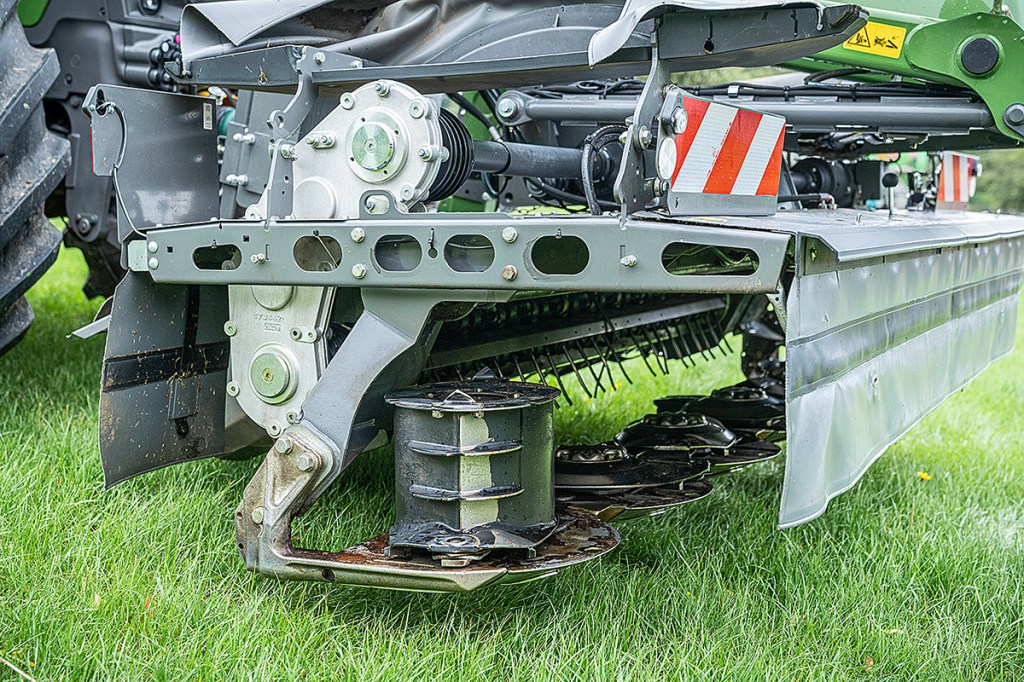
A Walterscheid pto shaft transmits tractor power to the central T-gearbox which splits the power flow, directing it left to the cutter bar though a right-angle gearbox with over-run slip clutch, while the right-hand uses a gearbox for the spring tine conditioner.
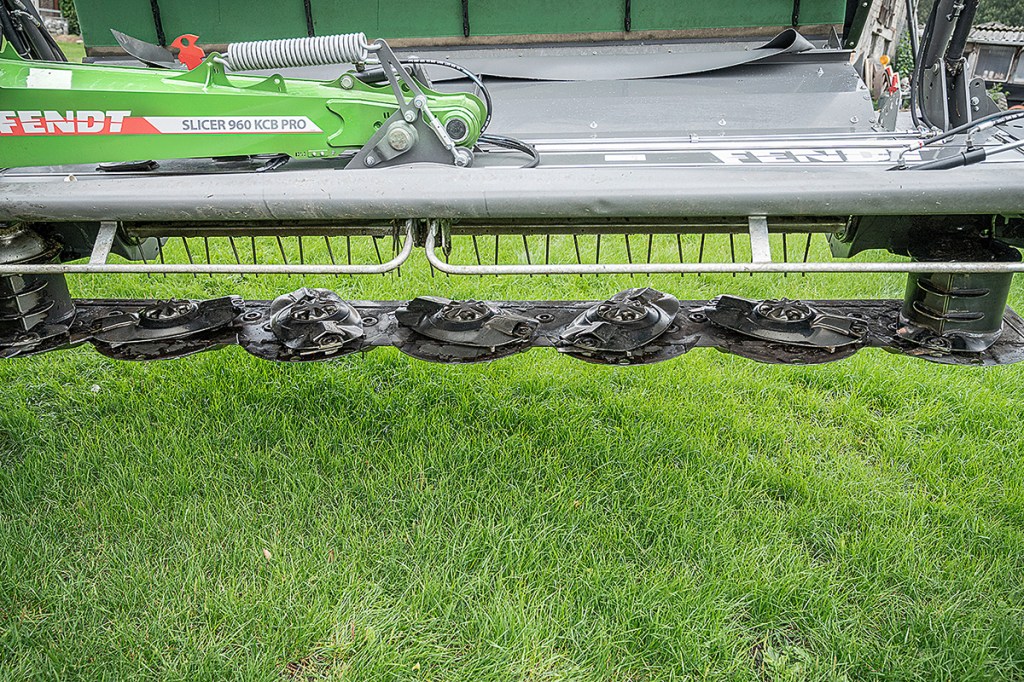
In the ‘Streamline’ mower bed, drive is via spur gears. On this 3.0m model, Fendt uses six discs instead of the usual seven. The discs (and also the spur gears) are a bigger diameter. The three discs on each side each rotate towards the centre.
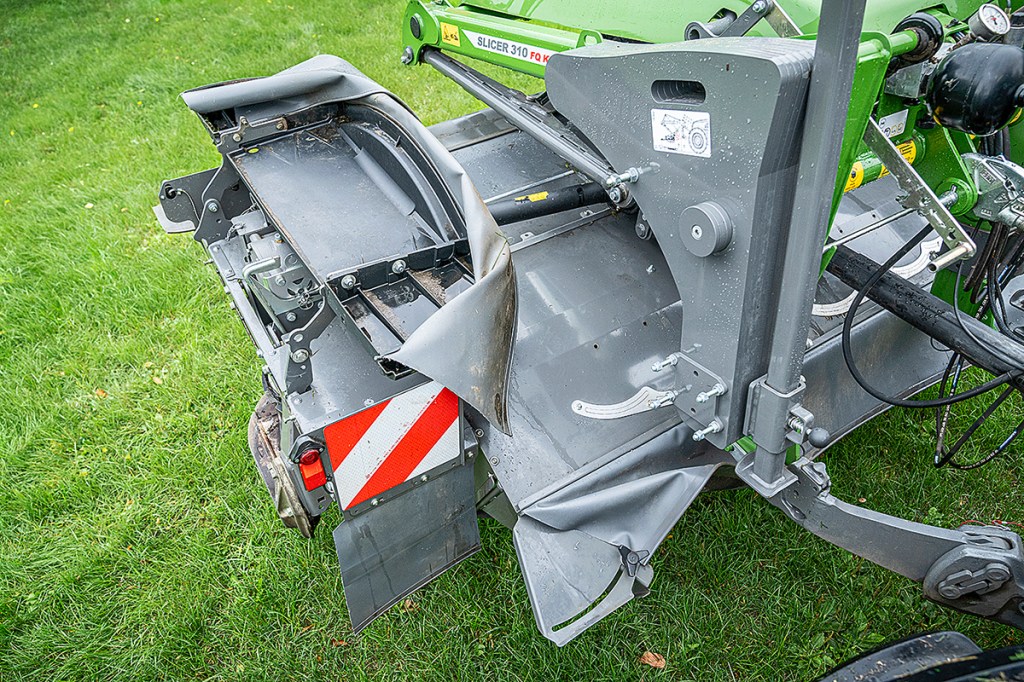
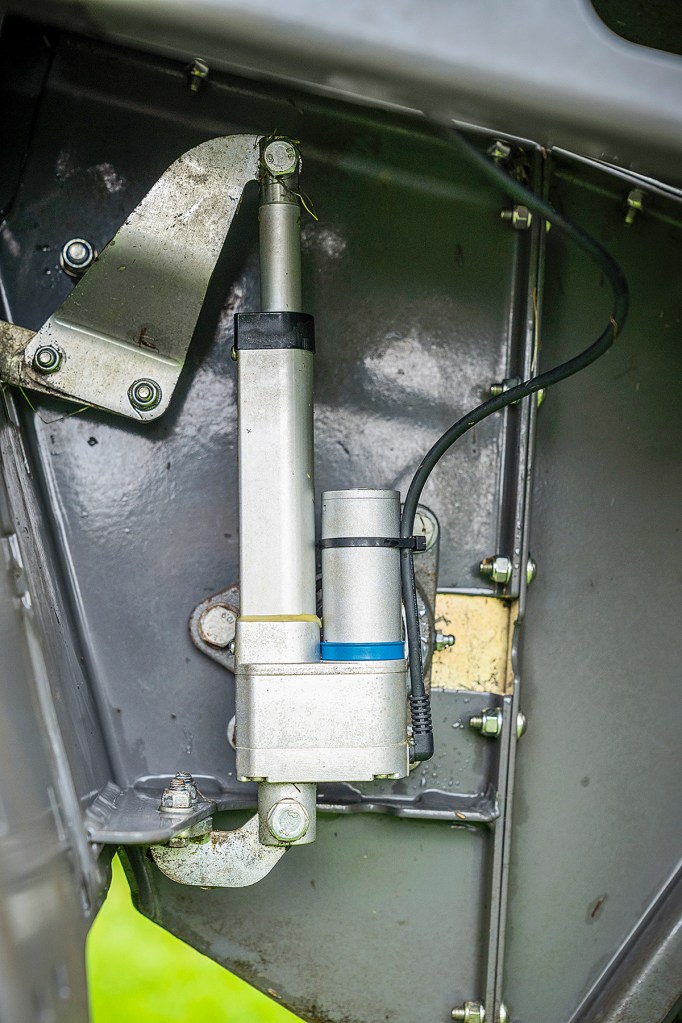
The short driveshaft connected to the tine conditioner gearbox has a shearbolt for overload protection. On the standard front mower, the conditioner hood is adjusted by refitting a pin to one of four positions. Ours had the optional electric adjustment using a servomotor to control the hood position — more on this later.
Measured from the lower link couplers to the leading edge, the front mower sticks out 1.90m. That’s manageable, but Fendt does offer some practical wing mirrors for around £234 extra. As you would expect from the premium brand, there’s also a good camera alternative.
We liked the quality of cut. The swath doors can be adjusted without any tools and allow the row to be placed between the tractor wheels.
Large choice of rear mowers
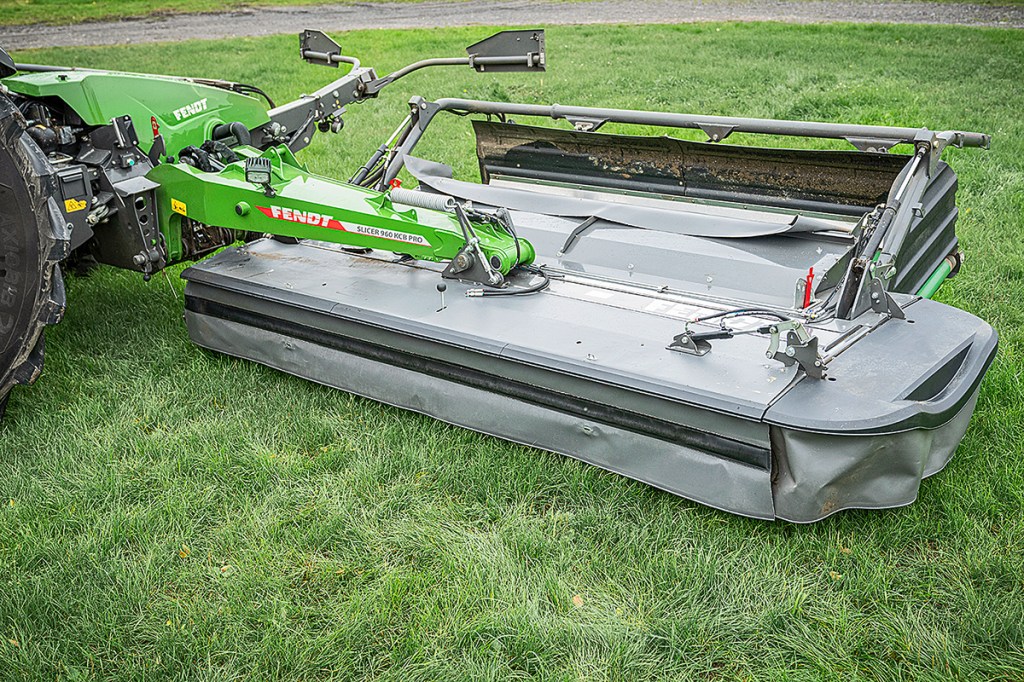
With the Slicer 960 KCB Pro, Fendt tops off its rear-mounted triple mowers — it now has 16 variations with working widths of up to 10.10m. KC again stands for ‘tine conditioner’ (RC would be for roller conditioner), B for the merger belts and Pro specifies ISObus and TIM compatibility (options).
Although Fendt has gone all out on various features, it is up to the operator to get to grips with the technology and the numerous settings and controls. Basically, anyone who has used triple mowers will be able to work the 960 Pro, but to fully exploit its potential you’re going to need to dig a little deeper.
Everyday technology
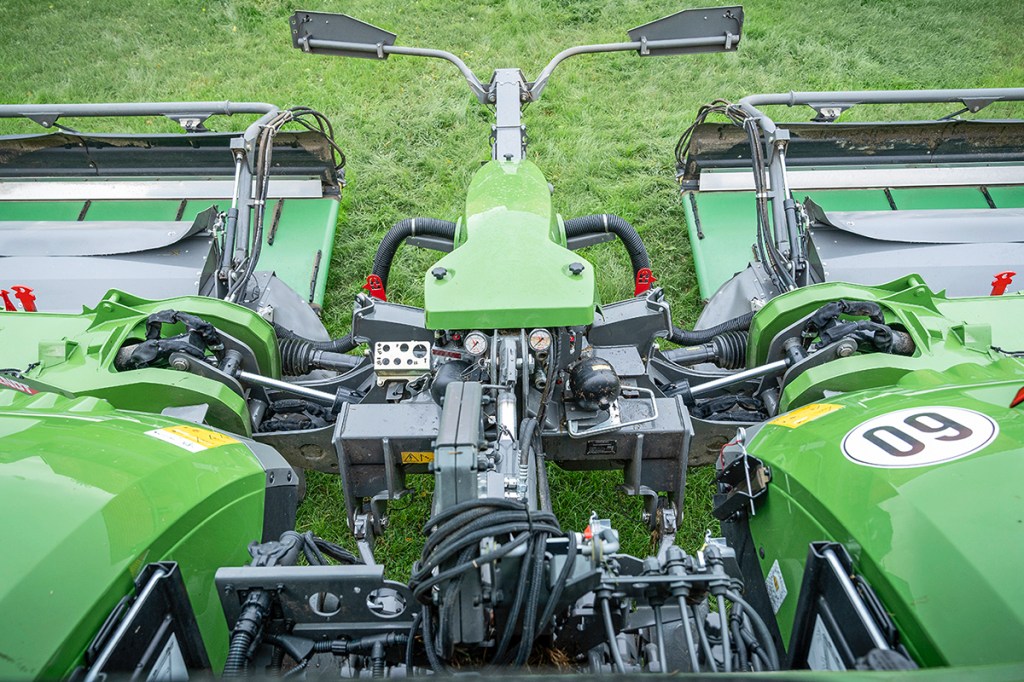
Fendt has reinforced the mower headstock, adapting it for the wider working widths and extra weight that comes with it. The shape of the arm supporting the centre pivoting mowers means they sit close to the tractor, though there is still ample room around the headstock for hitching the 960 on and off. Two small rams keep the mowers stable when they are lifted at the headland.
Impact protection is mechanical, using pre-tensioned elastomer blocks. On impact, the mower pivots rearward by up to 20° and rises upwards by 62cm before automatically returning to its original position.
Good ground following
We were impressed with how well the rear units followed the ground during our test. Combined with hydro-pneumatic TurboLift suspension, we had no complaints here.
The design allows the 3.94t relatively hefty machine to travel up to 19° downwards and 26° upwards.
This good ground following, regardless of our forward speed or field conditions, is largely due to the optional, forward speed-related control (only on ISObus compatible machines). We’d recommend this feature if you have variable crops and conditions.
Straight drivelines
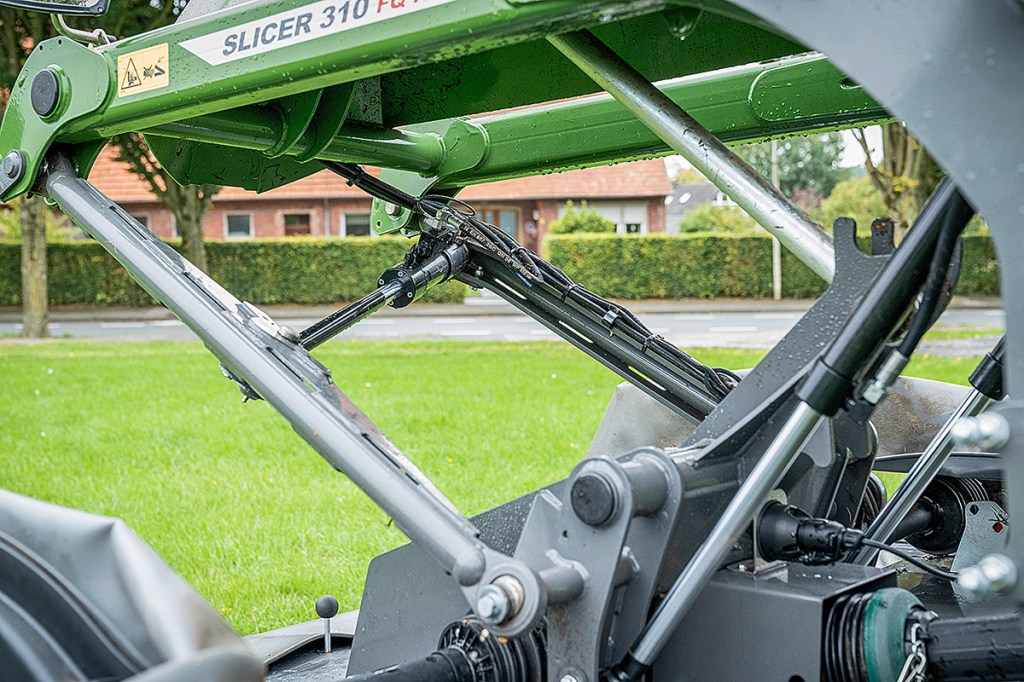
Fendt has kept the power flow design pretty straightforward. The shafts are supplied by Walterscheid. Each of the discs sports two blades that can freely spin on the retaining bolt, so it is worth checking the blade pin for wear. In our experience, the blades have a really good service life; however, they are over £€1 each, which is expensive compared to others.
We did find that a lot of crud would build up on the bed, especially in wetter conditions, increasing the torque needed to get things moving when restarting the mower.
Although the slip clutch is rated at 2,100Nm, this clutch actually tripped once on us. So, we removed the trays behind the cutterbars and found the mowers started up better, and crop losses when using the merger were still acceptable.
Rub it, don’t crush it
AGCO has stuck with the tine conditioner developed by Fella. There are four rows of tines, and the conditioning intensity is set by a comb that moves in between the tines — which is supposed to increase the rubbed surface area.
As mentioned on the front mower, the rear mowers had the electric, infinitely variable conditioner control system (which adds nearly £4,600 to price of the front/rear unit).
The next upgrade is an automatic, forage-dependent conditioner control £951. But to use this, you will need to create a field map using service provider ConGra (congra.info). ConGra uses satellite data to calculate the settings to best produce an as uniform quality as possible across all parts of the field. We tested the system and it worked, with the comb adjusting itself depending on the crop. We didn’t analyse the wilting time and results, but this is something we will do in a separate article.
Flexible swathing
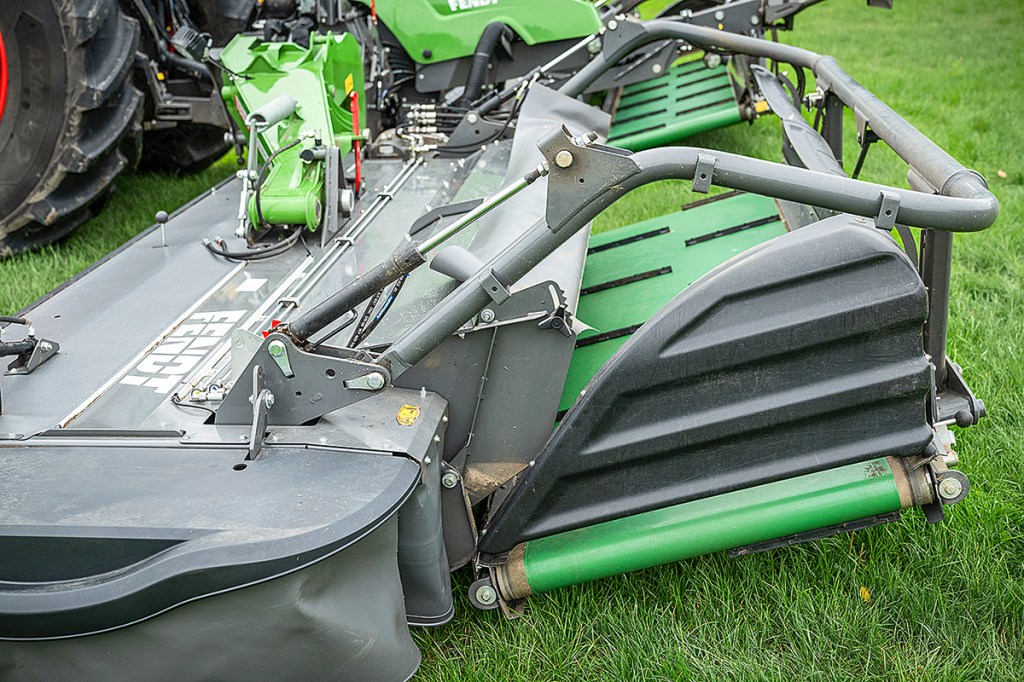
Fendt has significantly redesigned the rear merger belts. They’re 94cm deep and 2.70m wide. Instead of the previous vulcanised full width conveying bars, these are now bolted on and split in half so they can be offset.
This design change is said to improve the merger performance in drier, lighter crops. Belt speed is infinitely variable from the terminal, and the ‘BeMove’ function allows the belts to be hydraulically shifted 60cm in either direction. This enables row widths of 1.80m to 2.80m, depending on the crop and the width requirements of the following operations
Thanks to a tilt sensor unit and the ISObus integration, the belts shift automatically on slopes, and the belt speed on the uphill or downhill mower adjusts accordingly. Even when driving around a corner, the belt speed automatically changes so that you always get uniform swaths.
The right-hand merger suspension did break during the test. Fendt has already modified and strengthened this part so it shouldn’t be an issue.
Comprehensive controls
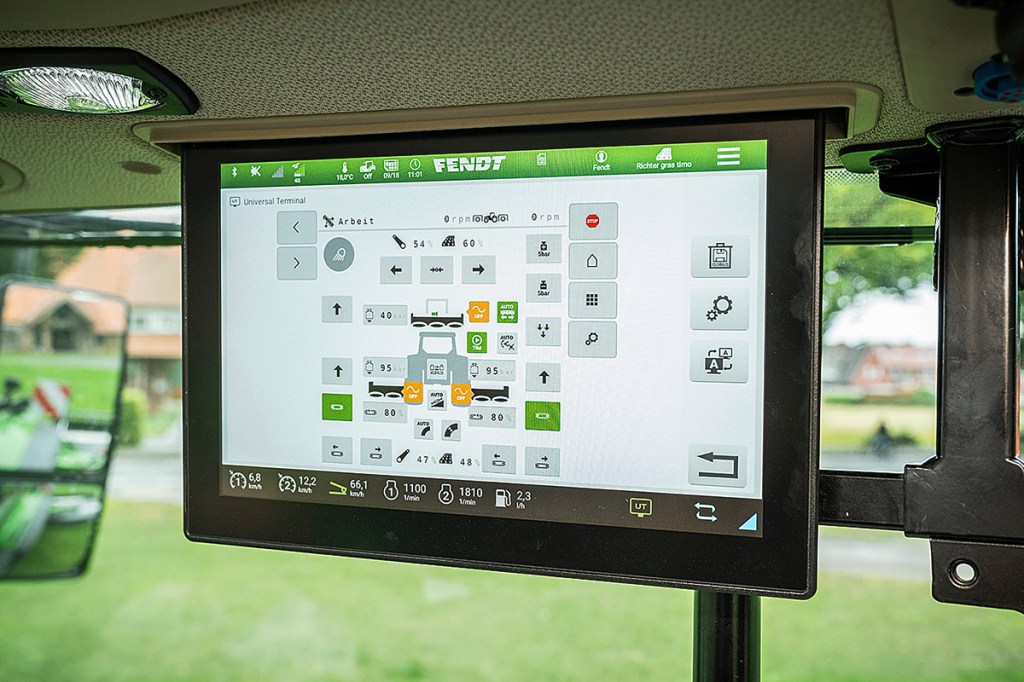
The Pro mowers are equipped with ISObus. The user interface and menu structure are based on the Fendt-One concept. All key information such as speeds or pressures are logically shown around the clear pictogram. Currently active functions are highlighted in green. All of the regularly used, essential functions are included as standard.
The Pro version includes TIM functions and Section Control capability (for an additional £752). This automatically raises and lowers the mowers at the headland and also when reversing — we really appreciated this nifty feature.
The TIM function allows the tractor to be integrated with the mower functions. This saves a separate connection between the front and rear linkage. Another very practical feature is the ability to control the linkage when mowing large swaths, increasing the lift height up beyond the regular headland position. TIM can be genuinely useful, but you need to get your head round activating it and assigning all the hydraulic functions. Fendt knows this and is continuing work on making TIM integration easier to use.
Field work
We worked with the Slicer combination all of last season. Initially, we used a Fendt 936 Vario and then a 728 Vario. The heavier, more powerful 936 was spot on in first cut, having plenty of power in reserve for cutting green rye. For the later cuts, the 728 was a good fit. It made a very manoeuvrable outfit with the mowers; and with all the automatic functions, it was almost like operating a self-propelled. The mowing and conditioning quality were always top-notch.
Once you’ve got the hang of it, working with the combination is genuinely nice. Folding it up is quick thanks to the overrun clutches. You can still operate the mower combination without all the auto functions, controlling it manually, so less experienced drivers can run the machine; they would just be missing out on its full potential — a bit like having a Fendt tractor and not using the various auto functions.
Summary
With the Slicer 960 KCB Pro, Fendt definitely has something for the professional user, or at least that is what we found after using it to cover around 1,000 hectares. We’ve got very little to criticise. The complexity of operation is serious — but it does deliver the potential for very good, consistent results. Lots of technology obviously has an impact on the final list price; our tested triple moco combination is £154,104.
Christian Brüse
For more up-to-date farming news click here and subscribe now to profi and save.