
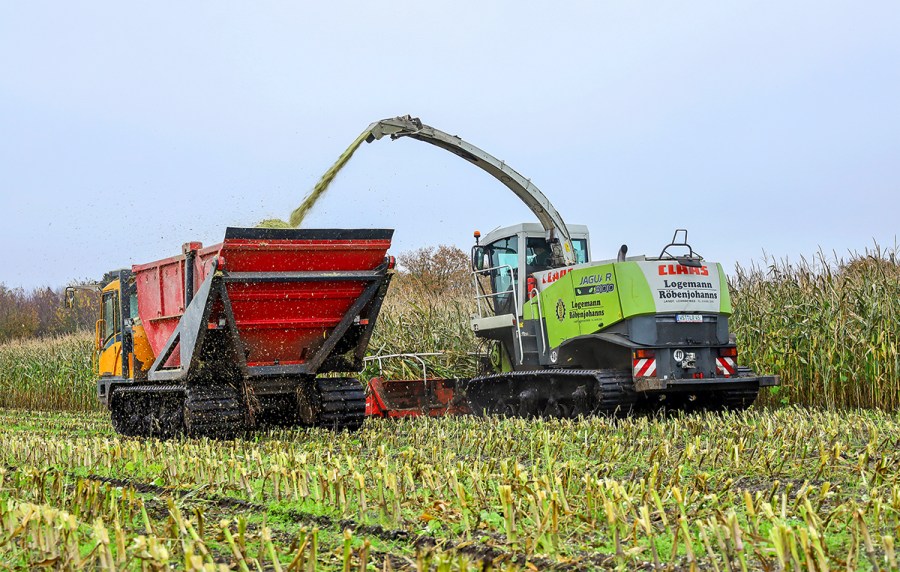
German contractors Logemann and Röbenjohanns not only kitted out a Claas Jaguar with tracks, but they also modified a pair of dumpers that can tip into hook-lift containers.
KEEPING IT BRIEF
- The conversion was carried out by owners Christian Logemann and Volker Röbenjohanns.
- Nine rolls of welding wire and seven bottles of gas were used.
- The track units for the forager are from a self-propelled dumper.
Discreetly put together in the corner of a machinery shed, just six people were directly involved in this novel project to convert a wheeled Jaguar into a tracked machine capable of lightly travelling over sodden ground, chopping maize. Nobody was to find out about the forager project until the machine was ready for the field, so the work was carried out in the evening and at weekends.
Two entrepreneurs, one idea
Christian Logemann had put a lot of thought into exactly how he could do a better job of harvesting maize when ground conditions were less than ideal. But he knew this was a project he couldn’t tackle himself, so he approached Volker Röbenjohanns four years ago. Volker runs a repair shop for cars and farm machinery, so he had ready access to the space and know-how.
Together, they took the plunge and bought a used Claas Jaguar 900 back in early 2024. Following a short test run in grass, to check all was well with their forager, the Jaguar disappeared into the workshop where they wasted no time getting to work with the gas torch. A few hours later, the forager was dismantled, and they could then proceed with fitting the tracked running gear.
But the harvester wasn’t the only part of the project. Two Bergmann tracked dumper units were also on the pair’s shopping list and were duly picked up second-hand for a reasonable price.
No one can put a figure on exactly how many man hours went into modifying the three machines for their new roles. But the welding alone took two people more than 600 hours — they used a staggering nine rolls of welding wire and seven cylinders of gas — that’s the same as Volker normally uses in an entire year!
Converting the dumpers
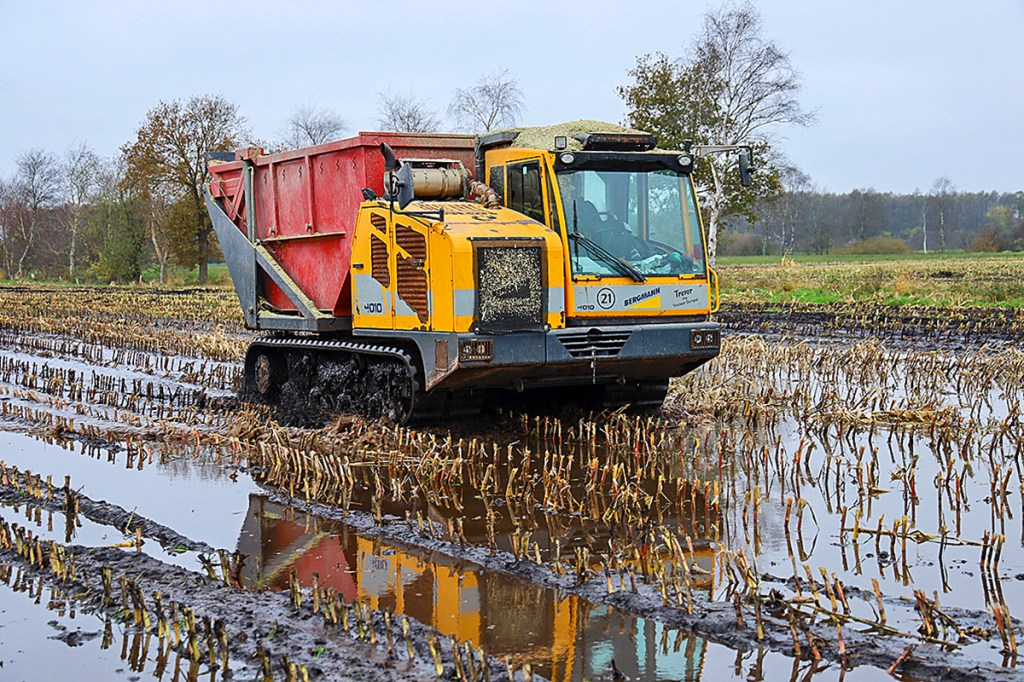
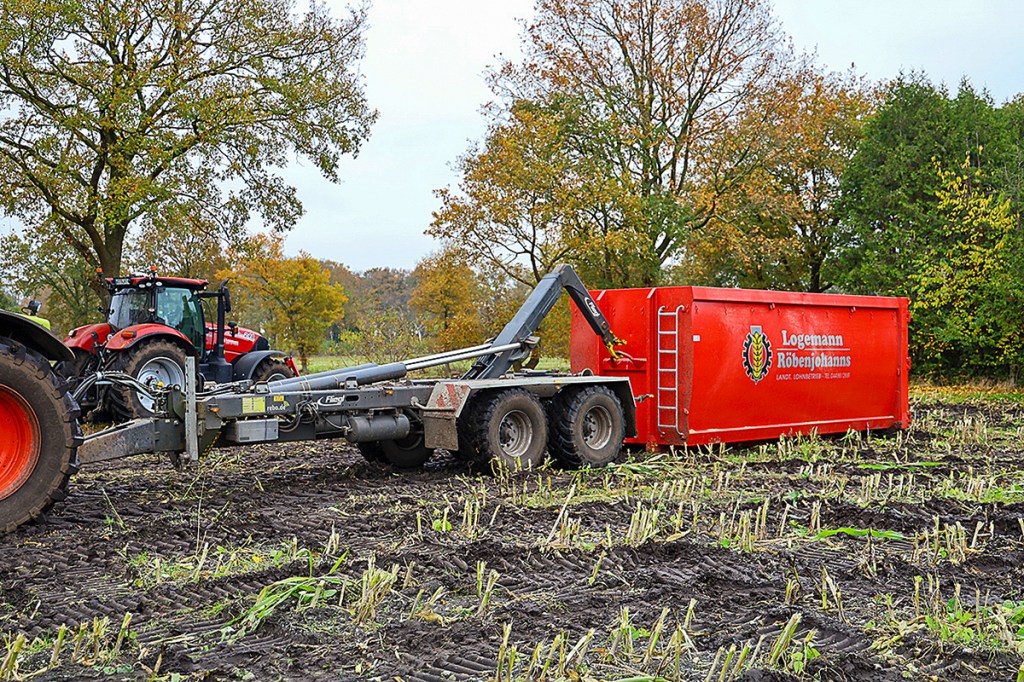
As a first step, the used dumpers had to be checked for wear and tear before getting a full service. Next, the team fabricated and fitted the new high-tip bodies. These were made from roll-off container bodies that were cut in half and widened to increase their carrying capacity to about 15m³ at water level — when heaped, they hold about 18m3 of forage maize. The pair of dumpers can fill one of the 40m³ roll-off containers — these are used to get the silage to the clamp — in two tips.
The high-tip dumpers are matched to the 2.65m loading height of the company’s own roll-off containers. They can also be used to tip into standard low body tippers. A rubber lip on the edge of the body helps bridge the gap between the dumper and trailer, reducing any silage spillage. A camera at the rear assists with getting the various components lined up.
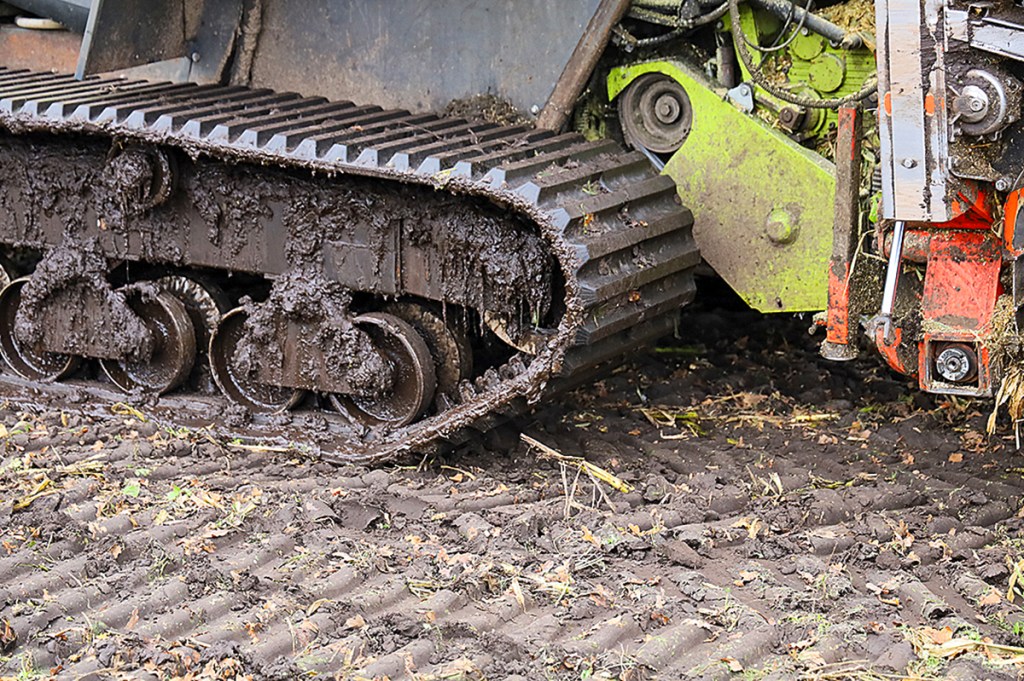
Tipping the scales at 15t, the 225hp dumpers are nimble in the field. The large contact area of the tracks helps to protect the land and provide sufficient traction. The tracks are sloped upwards at the front and rear, for climbing up and out of the rut if they start to sink.
From wheels to tracks
Back to the forager. A pair of track units were sourced for the Jaguar, and, although they are very similar to those on the two Bergmann dumpers, they are actually from a Morooka dumper. This means it has the same rut-climbing ability and can also match the dumpers’ forward speed. Christian and Volker reckon the service life for the tracks is in the region of 1,000 to 1,500 hours.
They did consider going with tracks from an excavator, but the required size is usually in a steel track … so not ideal for roading a short distance to a nearby field. Excavators also tend to have a much slower top speed, in the region of 7km/hr, while the dumpers can do up to 15km/hr max. When it comes to moving longer distances, the contractors load the harvest fleet onto low-loaders.
The electronics and hydraulics of the 600hp forage harvester were also modified, but Volker and Christian were understandably a little more guarded with the details and wouldn’t let us into the cab to see the final tailored controls.
A surprising performance
Although you might think that harvesting in tricky going would also dramatically dampen output, the owners point out this is not the case. Christian says the hourly output is 1.7 to 2.3 hectares with an eight-row header. Chopper operator Frank Elbers reckons the average is 2.0ha/hr over the season and fuel use is 70 litres/hour which is comparable to a regular wheeled machine’s. The dumpers are quite frugal, sipping their way through about 15 litres per hour.
The contracting job is charged at an hourly rate, with flat rates for set-up and travel times. As far as the hectares per hour are concerned, the tracked harvesting fleet is not much more expensive to operate than conventional foraging outfits.
The original plan was to construct a forager with a rear bunker. However, that concept was quickly put to bed when they crunched the numbers and found that there was a significant output per hectare penalty. The goal was always to set up a harvest chain that, in terms of price and performance, would come close to a standard machine’s. The team seems to have reached their goal.
Field work
We were able to watch the crew harvesting 60 hectares of maize, chopping it to 5mm for a large dairy herd. The maize was still a little green in mid-November — due to the wet conditions in the spring of 2024 it had been sown late. Before Christian told the farmer about the new harvesting fleet, the farmer was starting to worry about being able to cut any of the fields.
The specialist maize harvesting crew are slick operators and were quickly set up. The crop is hauled by three hook-lift trailers using six 40m³ container bodies. Running like clockwork there is no waiting time for the forager or for the tractors. On this job they were averaging 2.2ha/hr. Although most of the fields were not bad considering the time of year, some patches were so wet that we could hardly walk on them.
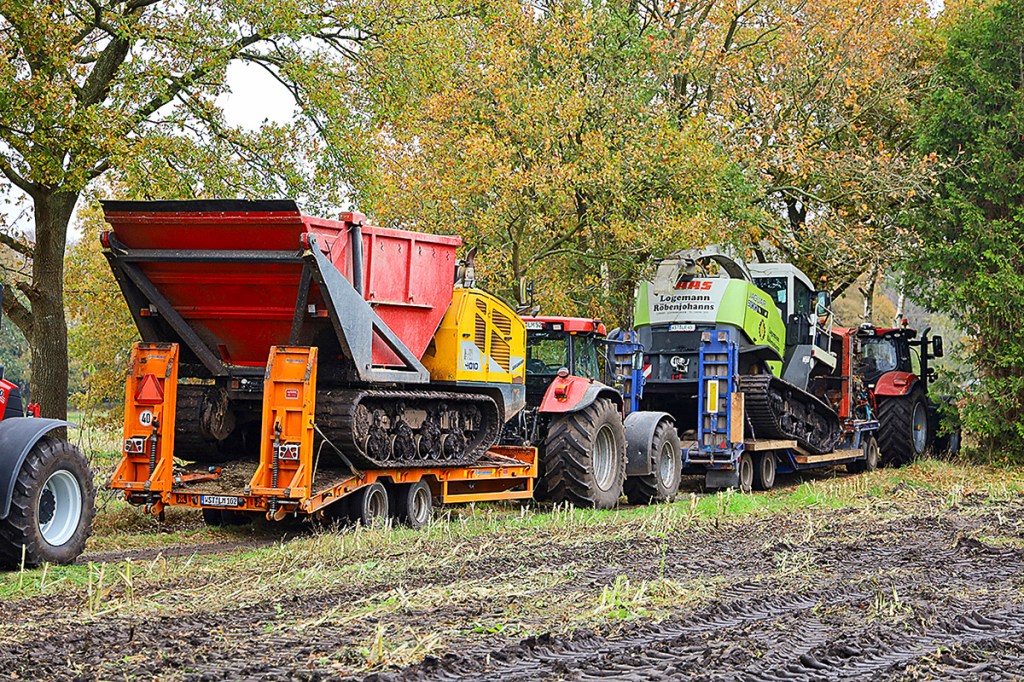
Once this farm was done, the three tracked machines were loaded onto low-loaders in just 15 minutes; and then the gang set off to the next customer. It is impressive how quickly the well-coordinated routine gets the fleet on the move. Even refuelling from the bowsers at the headland is seamless.
Potential for optimisation
During last season, the main team gained valuable experience harvesting around 400 hectares.
As is usual with such a conversion, there is still potential for further improvements to the machines — for instance, making them better balanced.
These small mentioned tweaks have been made over the winter to further simplify harvesting under extreme conditions in the 2025 season.
Summary
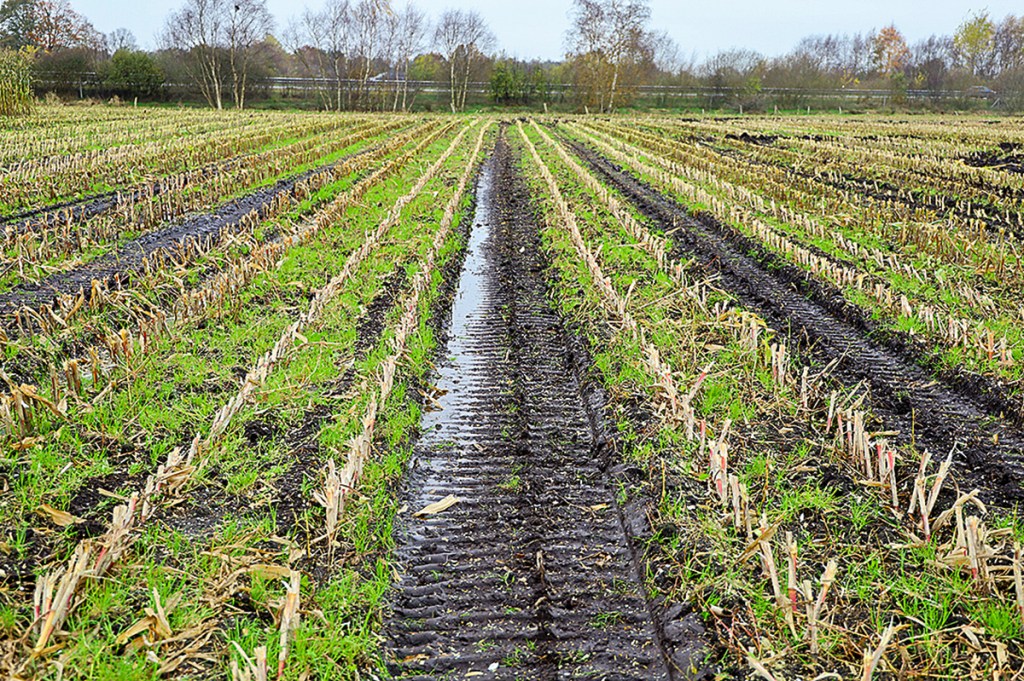
Project designers Christian Logemann and Volker Röbenjohanns have succeeded in creating a powerful forage harvesting set- up for difficult conditions and yet kept an eye on the costs. Because the three field machines are better equipped for treading gently, there are fewer wheel ruts to contend with in the spring.
Sebastian Rüther
For more up-to-date farming news click here and subscribe now to profi and save.