
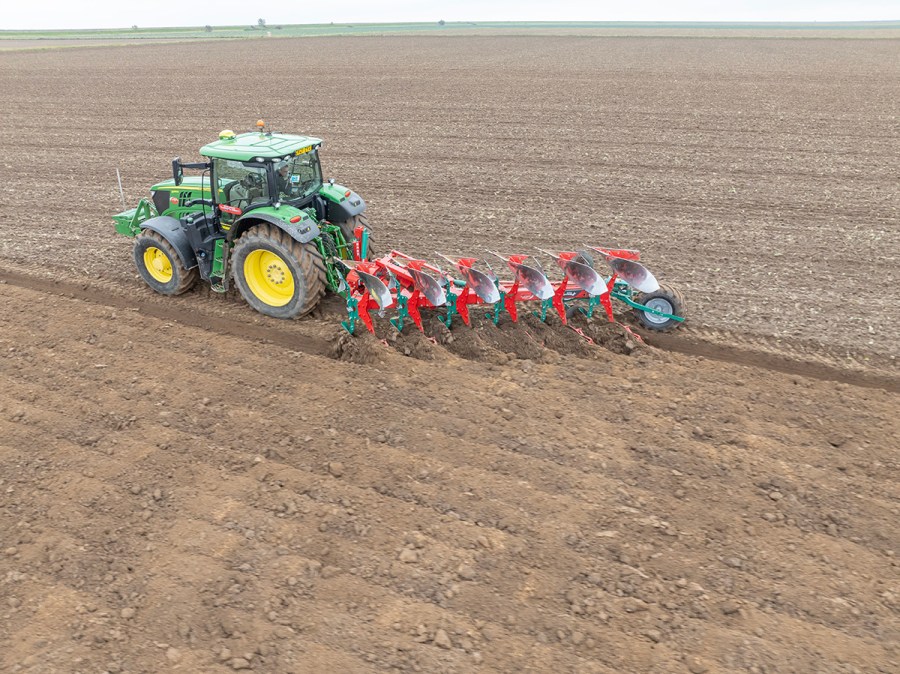
There are tweaks and changes a-plenty on Kverneland’s latest generation B-series shear bolt ploughs. We took to the field with a six-furrow model from the 3400B range which features a host of improvements over previous versions, including a new leg and shear bolt assembly.
KEEPING IT BRIEF
- Dished Variomat plate improves beam clearance
- Twin push/pull bars on Variomat linkage
- 30mm longer frame bolts apply increased torque
Kverneland rolled out its latest shear bolt ploughs at Agritechnica featuring a host of improvements including a new leg and shear bolt design for each body, along with an all-new four-way combination adjuster for the skimmers.
Several of the improvements found on the B-series could already be found on the auto-reset S versions since 2019, so are well-proven by now. Among them was the Trailer Transport System (TTS) and a hydraulic rear depth wheel with a clever pivot that allows the wheel to hang in its working position as the plough rotates above it.
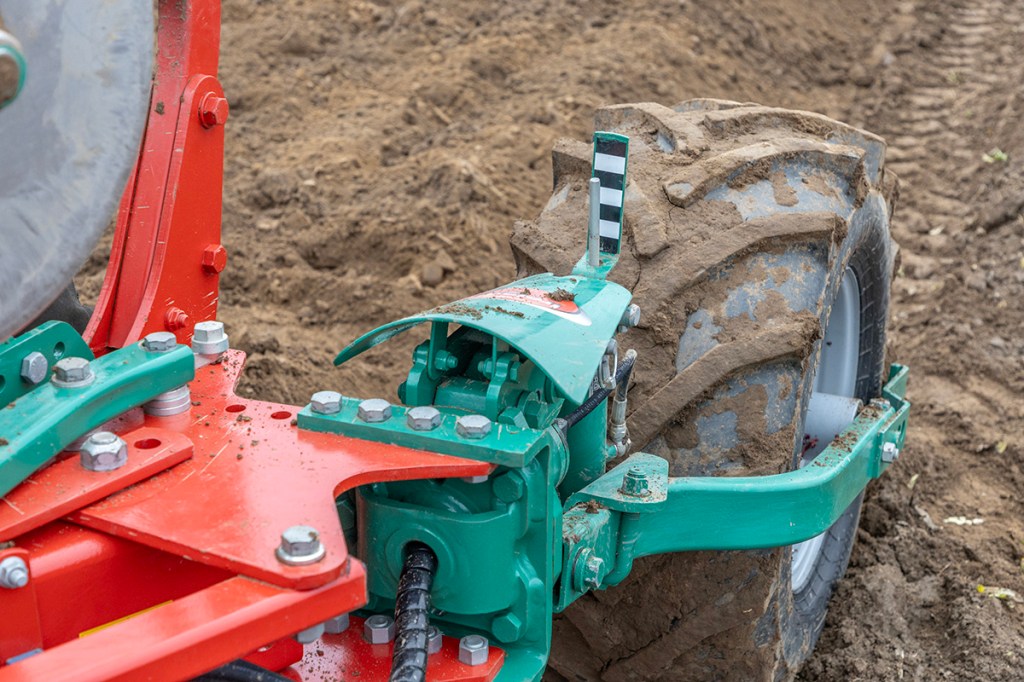
Compared to some other depth wheel designs, this one takes away all the crash and bang from turning the plough over, improving longevity.
Bigger family
Kverneland’s fully-mounted B-series includes several ranges, there is the 2300B in-furrow with three- to five-furrows with a headstock rated up to 250hp; the 3300B, also an in-furrow that extends from four- to six-furrows with a headstock suited for tractors up to 350hp; and lastly, the 3400B and 3500B which can operate on-land and in-furrow, and both are five- to seven-furrow builds, with a headstock capable of handling up to 380hp.

The 3500B has been introduced as an ISObus-equipped smart-plough, though the best-seller, according to Kverneland UK’s plough specialist Adam Burt, is expected to be the on-land/in-furrow 3400B. Hence, this is the model we’ve chosen to focus on for this driving impression and is likely to eventually replace the existing LO model. But for the foreseeable future, the two ranges will run side-by-side.
Like the LO, the 3400B can be used either as an on-land or in-furrow plough, which extends the appeal to a wider range of customers. And changing between the two needs little more than the tug of a hydraulic spool lever.
Point to point clearance is 85cm as seen here, or buyers can choose a much longer 100cm option, increasing the distance between bodies but creating a much longer, mounted plough. Underbeam clearance is fixed at 80cm, making this a high-clearance plough.
Solid leg with twin-plate shear
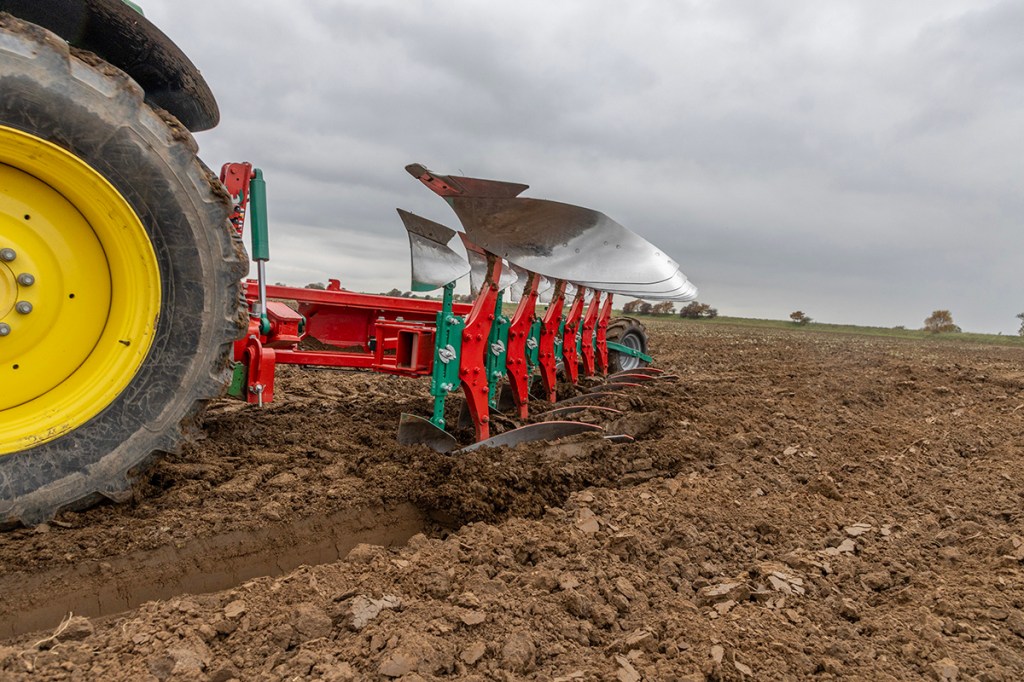
A new shear bolt design has been created to work with Kverneland’s all-new plough leg for the B-series. That leg is of solid construction, and is now sandwiched onto the plough beam using two plates, which the firm calls its Sharp Shear System. The LO for example, had each leg simply bolted on one side of a heavy-duty carrier plate.

Kverneland says that using two plates to support both sides of the leg creates a clean shear when an obstruction is encountered. As the leg is tripped, the shear bolt is cut into three pieces, rather than stretching the bolt or creating leg deformation under pressure. It also means that the amount of force needed to break the shear bolt is now higher, and is typically 5,000kg for the 3400B, compared to 4,500kg on the LO.
The shear bolt carries two pre-cut grooves in the shank that align with the side plates when installed, defining the breaking zone of the bolt. As such, these grooves create a clean shear when leg loads are exceeded. This cleaner break also makes it easy to remove the broken pieces, and to realign the holes when installing a replacement shear bolt.
Replacement bolts are stored on the headstock, where a drilled plate holds up to nine, plus two larger holes to carry the TTS locking pins. It’s an arbitrary number, and one that should perhaps carry an even number of bolts, given the collective total of reversible bodies in-play.

Also on the headstock is an oil filter cartridge and somewhere to stow the removed hoses. Speaking of which, there are four double-acting services, catering for turn-over, rear depth wheel, hydraulic furrow width and on-land/in-furrow offset and front furrow setting. Each service now gets a colour-coded grip marked ‘+’ and ‘-’ highlighting oil flow.

4P skimmer assembly
Correctly-set skimmers have a direct impact on ploughing quality, and to make this easier Kverneland has come with its 4P skimmer design, offering four ways of adjustment. A central linkage with locking bolts is used for the simultaneous depth setting of both left-hand and right-hand skimmers, and each depth position uses an indent.
Skimmer assemblies can also be repositioned fore/aft through a choice of three positions on the mounting plate, and by moving the mounting plate inside or outside of the leg, skimmers can be moved closer to or further away from the furrow wall. The fourth and final adjustment is to angle each skimmer individually, through eccentric bolts.
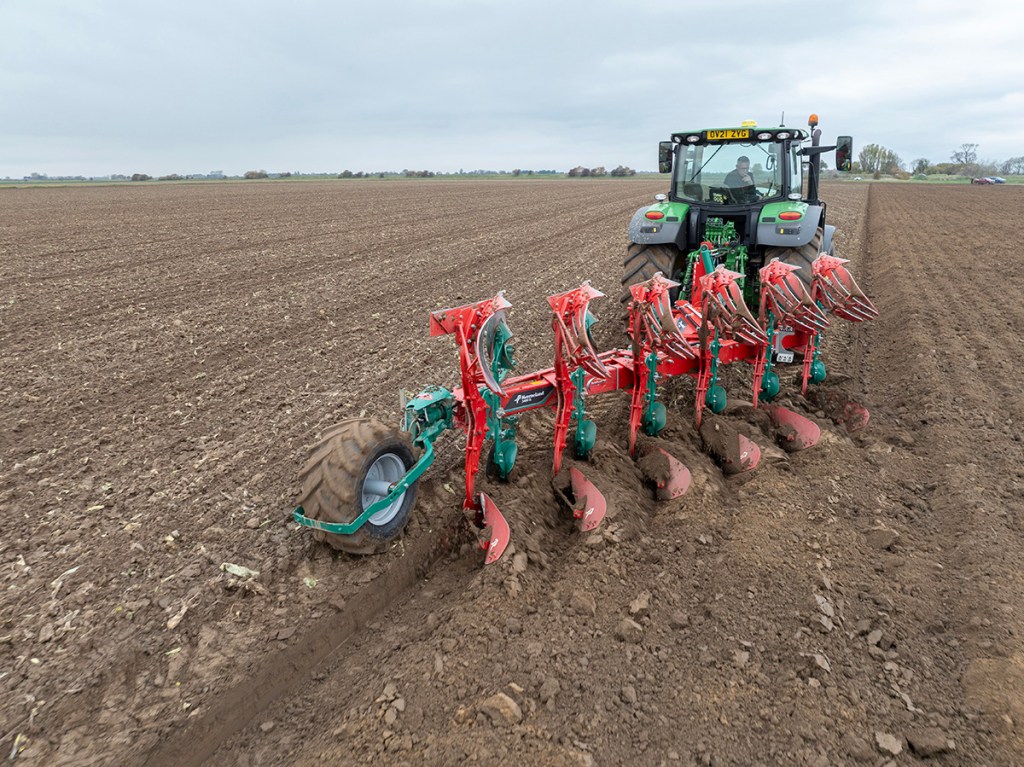

As an on-land/in-furrow plough, the 3400B uses the firm’s proven parallelogram linkage that connects the beam to the headstock. It’s a system that was introduced on LO models and means the plough can be offset far enough to put the tractor on-land and then engage the auto-steer.
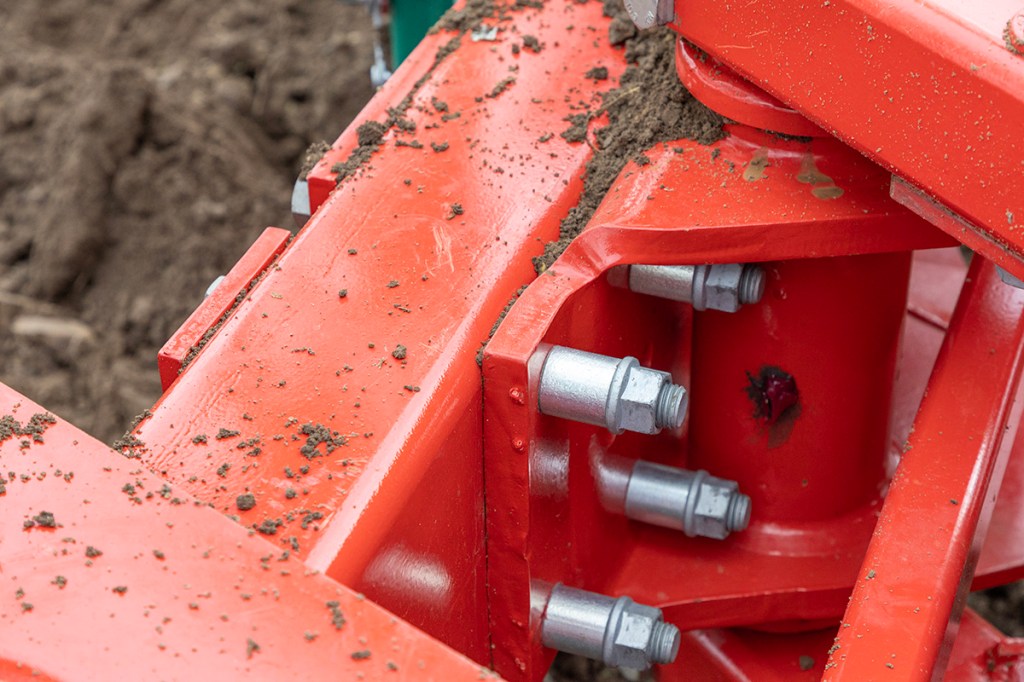
Activate the spool valve and you can reset the plough to in-furrow work. Once set, a double-ended cylinder automatically fixes plough alignment and front furrow width, to correspond with tractor position, known as Kverneland’s Auto-Line system. This process also keeps the plough aligned when changing furrow widths.
Safer road transport
The Trailer Transport System (TTS) is also part of the 3400B, and allows the plough to be towed like a trailer, which makes it much easier and far safer to tow down the road. A seven-furrow 3400B with 100cm point-to-point clearance for example, is a very long, fully mounted plough. So wouldn’t it be great if it could follow like a trailer, reasoned the plough maker.

Key here is a pivoting cross-shaft that is allowed to slide forward when locking pins that hold the cross shaft in its working position, are removed. This unlocks a 45-degree steering angle, so the plough simply follows the tractor like a trailed implement.
Putting the plough into its transport position requires the unit to be butterflied, then remove its cross shaft locking pins before lowering the plough, so the combination depth/transport wheel is on the ground. Doing so enables the cross shaft to slide forward into its steering position, after which the top link can then be removed from the headstock, so the plough can also follow road contours.
A mechanical locking pin also holds the depth wheel in a fixed vertical position too, eliminating the risk of it swinging left or right should the plough bounce during transport.
Once in the field, refitting the top link into its slotted hole and lifting the plough off the ground will reset the cross shaft into the work position at the back of the headstock. It can then be secured in place by inserting the locking pins. Removing the depth wheel locking pin then lets the wheel function correctly for turn-over.
The cross shaft design also has a secondary steering position for use with twin-track tractors. Used in-work, this 8.0-degree steering position allows twin track machines to apply corrective auto-steer movements through the three-point linkage, without trying to fight the plough when it’s in work.
The depth wheel can be raised and lowered hydraulically, simplifying adjustment of the plough, with its working depth easily marked on a black and white scale that can be seen from the cab. And by dropping the front end into work first, then lowering the rear – a technique mastered by many semi-mounted plough operators – this capability can be used to good effect to keep headland V’s short.
A memory function is also built into the ram, so the pre-set working depth is maintained, even when extending and retracting the ram to make the most of the hydraulic depth wheel function to keep the plough level. Using a wide-profile 420/55-17 tyre helps keep it on top in wetter conditions, where bodies can pull in much deeper than required. Where this is encountered, the hydraulic depth wheel can also be brought in to play, to keep the plough up.
In the field
We chose to operate on-land, simply because keeping our John Deere 6R215 horizontal meant all four wheels grip equally, and it’s also a far more comfortable sitting position for the operator. The on-land setting also moves the plough forward, bringing weight closer to the tractor.
Setting into work was effortless, with an A-B line set to suit the plough’s working width. In this instance, we settled on a 37.5cm (15in) furrow width which created a 2.25m working width with every pass. Our working depth was 20cm in a field recently cultivated to chop stalks and residues from a vegetable crop, before full inversion to create a clean seedbed.

Skimmer depth was tweaked – a single bolt moves each pair – to run them shallower.

The plough’s offset was positioned to run the tractor as close to the furrow as possible, without breaking the edge of the wall so the rear disc could leave a tidy cut.
If was effortless work for the Deere, which could have travelled much faster than the 8km/hr forward speed that was set through the AutoPower transmission. Alternatively, a wider furrow at the same forward speed would have increased our output, along with a corresponding tweak to the working width necessary to match-up with guidance.

Summary
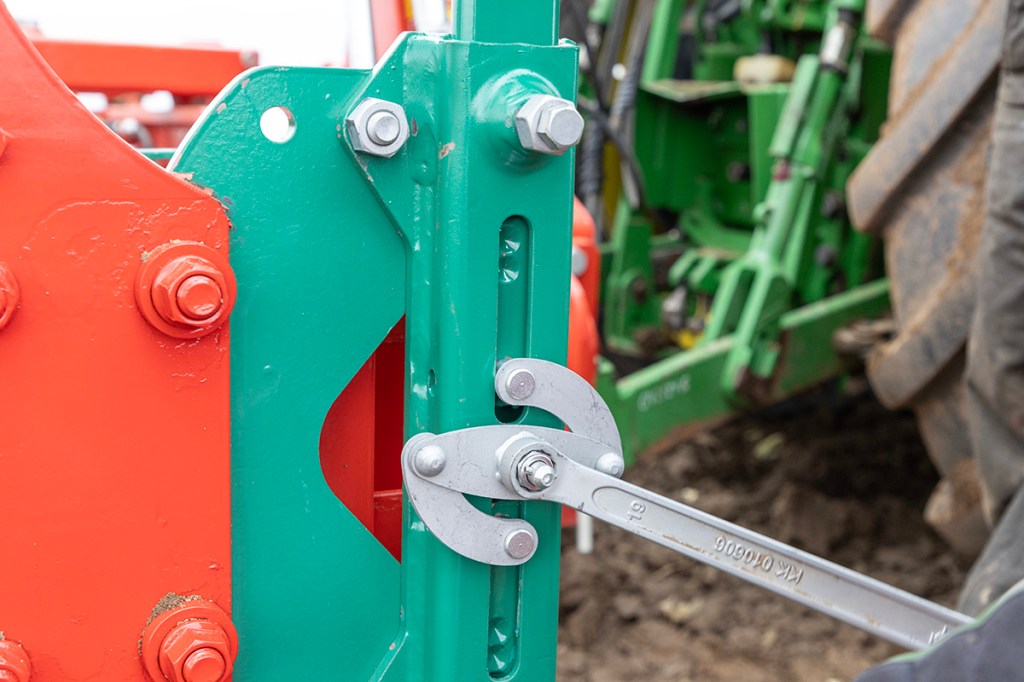
There’s little to fault on this latest plough series. Plough adjustment is pretty much effortless, with the basic settings carried out from the cab, and any tools needed to make finer adjustments supplied with the plough – that’s two spanners.
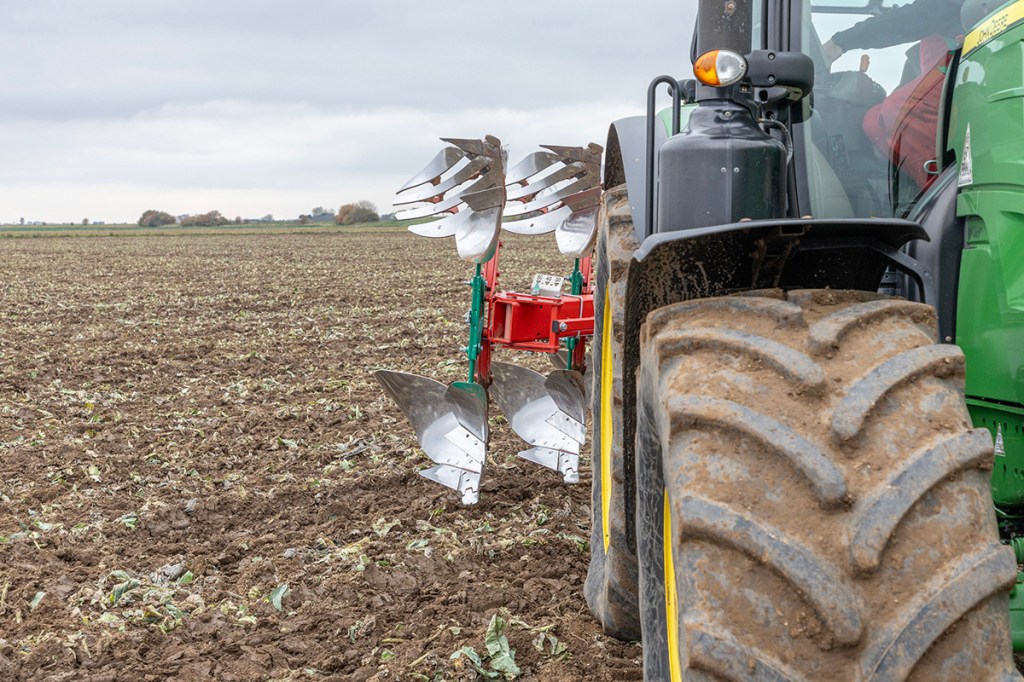
Matching-up worked out perfectly, and trash burial was total. Sharp-eyed readers may have noticed two different body types in use. The popular No.28 mouldboard on right-hand bodies was joined by the recently developed No.40 slatted mouldboard on the left-hand side. It gave a chance to assess the finish left by both types.
Where the 28 left a traditional ridged finish highlighting every furrow, the slatted 40 created a less pronounced set of ridges and the surface left behind them was easier to walk across without sinking in.
Turn-over was smooth, and the new depth wheel design is no longer a distraction during that headland process. Having an extra half-tonne of force needed to activate the Sharp Shear System combined with the soil we were ploughing, meant we weren’t unlucky enough to break a bolt and put the new design to the test.
Bill Rushton
For more up-to-date farming news click here and subscribe now to profi and save.