
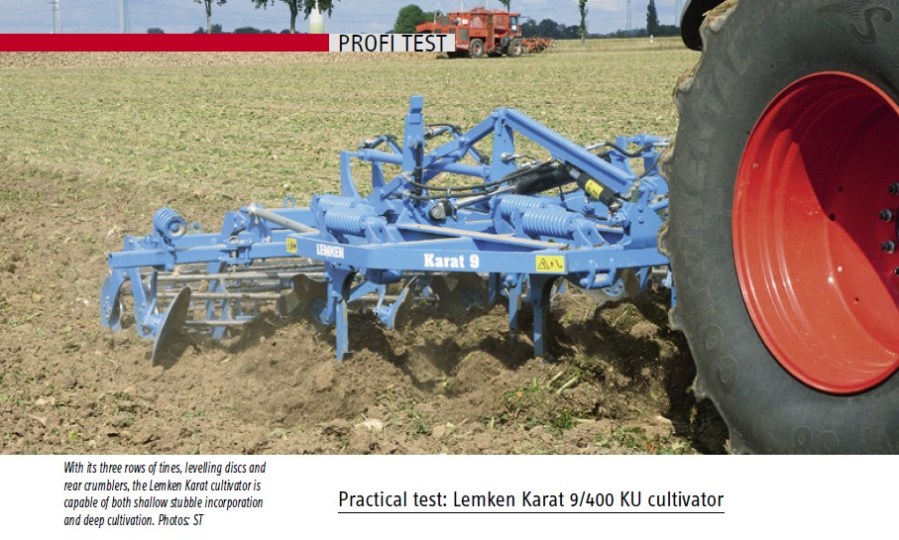
Practical test: Lemken Karat 9/400 KU cultivator Lemken debuted its Karat mounted cultivator at Agritechnica 2007. Designed to replace the existing Thorit range, the first production Karat models reached the market in 2009, which was when we had the chance to really put a 4.0m model through its paces. So how well does the Karat perform?
Cultivator manufacturer Lemken must have pretty much exhausted the lists of gemstone names for its implements. The featured Karat unit, for example, describes the purity of precious stones.
But never mind the label’s origins; what we’re more concerned with is the quality of work and performance. Our test cultivator, the Karat 9/400 KU, has a nominal working width of 4.0m. Tipping the scales at 3,500kg, the test unit was fitted with a Cat III linkage bar with a choice of height settings. Cat III N or Cat IV N hitch points are offered as an option, with all the Karat variants having four mounting holes for the top link.
A useful stowage bracket is fitted to the headstock to accommodate the required four hydraulic hoses, lighting socket and the tool supplied for swapping the quickchange feet. Clear markings make it easy to identify exactly which hose does what, our only complaint being the holder itself: it was a bit too flexible for our liking.
The main cultivator frame is made from 10mm box section steel, with the three tool-carrying sections spaced a uniform 700mm apart; on Lemken’s previous Thorit series, the spacing was uneven at 700mm and 900mm. This new Karat spacing, in combination with its 14 legs, provides a minimum inter-point clearance of 750mm, with an 820mm clearance from the frame base down to the ground. In work we had no real issues with blockages when breaking
up set-aside fields and working maize stubble. This changed, however, when it came to the sterner test of incorporating mustard trash into light soil at a shallow depth. Here the Karat did block up, but to be fair it was less of a problem than with some other designs that we also tried at the same time.
Lemken’s tine legs are attached to welded brackets on each of the three tool bars, with four legs on the first bar and five on the second and third, respectively. Though this layout geometry could lead to a theoretical offset to one side, we didn’t notice any substantial side pull during our field tests. We also worked out that the actual between-legs lateral distance is 283mm to give a ‘true’ working width of 3.96m.
For more up-to-date farming news click here and subscribe now to profi and save 47%.