
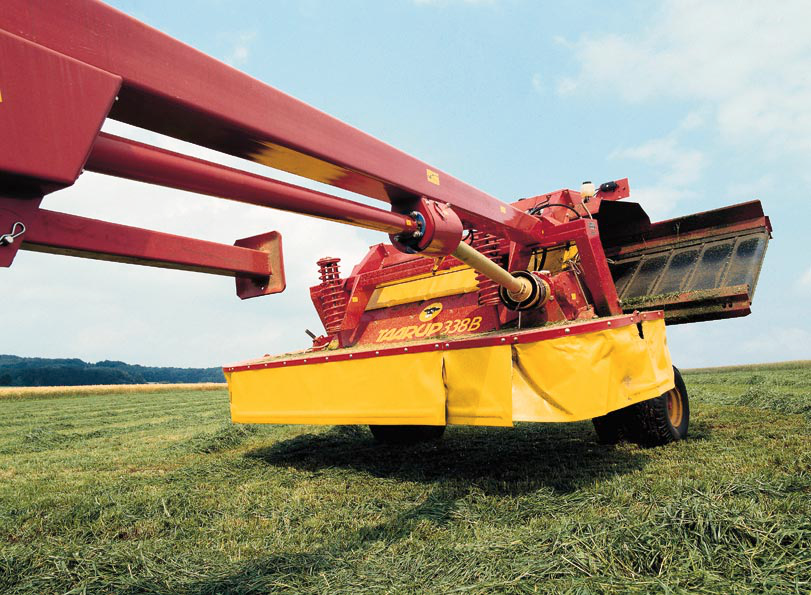
The Taarup mower/auto-swather has attracted much interest from farmers and contractors looking to increase swath size without having to row-up ahead of the forager. This practical field test shows how this popular trailed disc mower performs in the field
The most eye-catching feature of the Taarup 338 B disc mower is the high guard at the back. But this hides what is actually the mower’s most interesting feature – the conveyor that allows it to also be used for a range of swathing jobs. With the flick of a toggle switch on the remote control in the cab, the operator can swap the conveyor belt to discharge to the left or right. At the same time the conveyor automatically switches sides. The conveyor speed is set by two separate knobs, with the speed in each direction also set individually.
This flexible swathing system allows the mower to be used for a range of operations. Swaths can be laid in the middle or at either side, resulting in single, double or, on a third pass, triple swaths. The swath width and how far out the grass is discharged is controlled by adjusting the conveyor speed.
Our first impressions were positive. With the drawbar offset, we mowed the headland in a clockwise direction, with the swath set to come out of the centre of the mower. The 3m wide headland, where the tractor had run, was then cut in the opposite direction with the swath being discharged to the side, next to the first one. This left a 4m wide area of cleared ground on the headland.
One of the first tests was to assess the conveyor’s effect on the rate of wilt. We discovered the mower, like other machines, needs the help of extra rakes and swathers to produce fast wilt rates. In the second cut of rye grass, the crop which had been laid in double swaths (without extra treatment) wilted to a dry matter content of 19.4% in 30 hours. In the triple swaths the dry matter content was only 17.9%.