
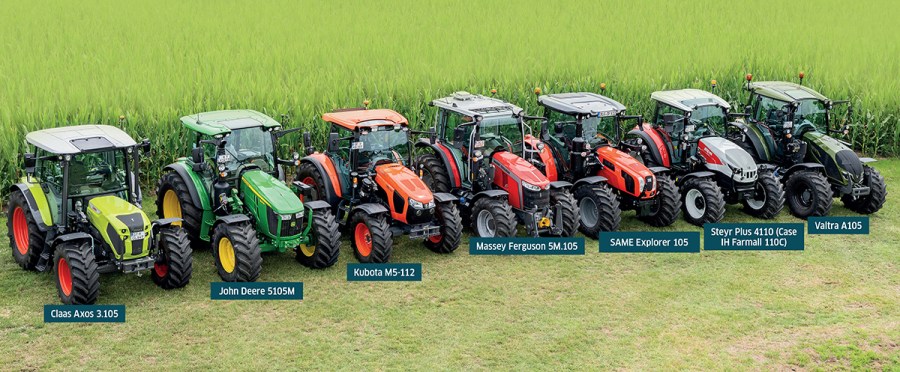
We have pulled together a group of seven 100hp tractors to see how they stack up. In Part 1 of our comparison we look at engine power, fuel consumption and other performance specs.
KEEPING IT BRIEF
- All seven of the tractors were supplied with a loader.
- The characteristics of the four-cylinder engines differ, which obviously affects how they drive.
- We will look at the details of the individual tractors in the May issue of profi.
- We know the Steyr Plus better as the Case IH Farmall C
There is a sizeable market for 100hp tractors across Europe, especially in countries such as Turkey. Even in Germany last year, there were over 5,000 tractors sold in this power bracket. Meanwhile in the Republic of Ireland, the 50-120hp sector represented over 19% of the more than 2,000 tractors sold there in 2025.
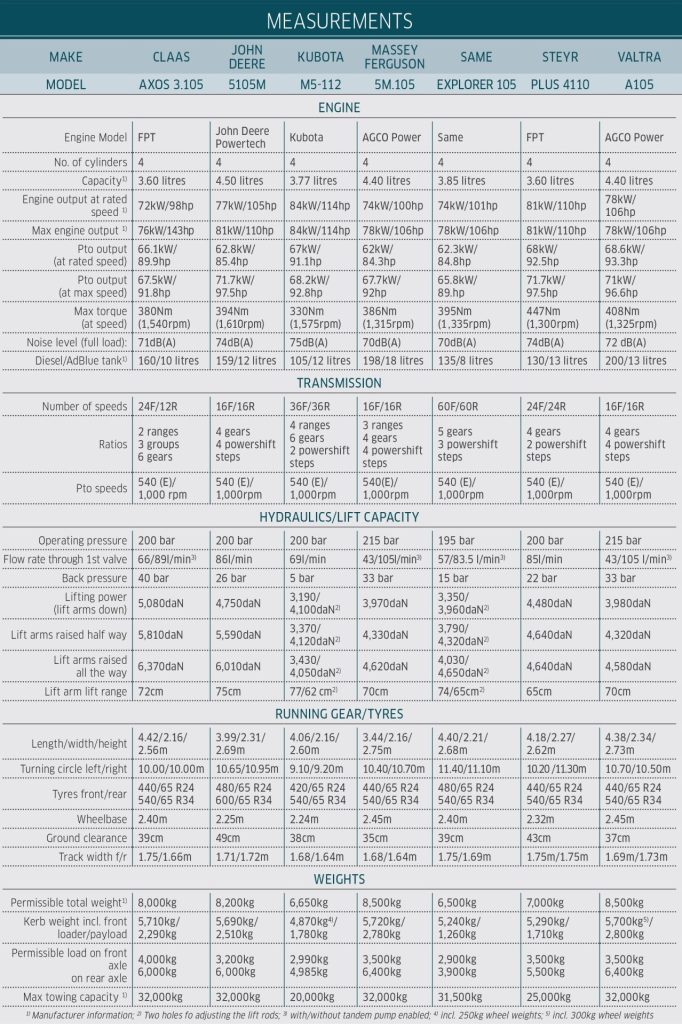
The reason is simple, versatility — from the array of specs and builds to the type of work they are expected to take on, from jobs around the yard to chores in vegetable fields. Last summer we took a close look at seven models, and the initial results of our test can be found overleaf within the table that outlines the main performance stats.
In this first part of our test, we primarily focus on engine performance. In the May issue, we will critique each of the seven tractors, while within part 3, in the June magazine, we will turn our attention to the front loaders.
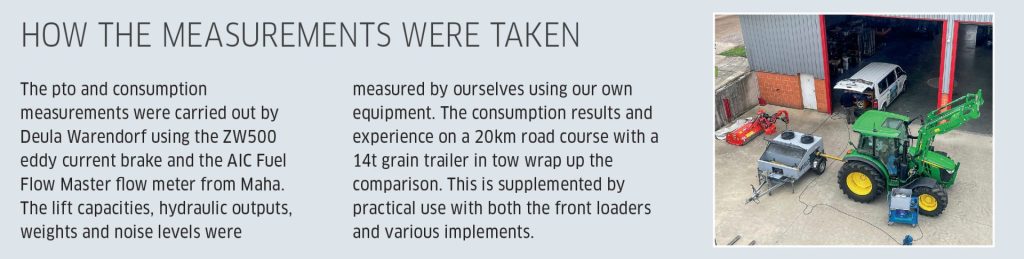
Four cylinders plus turbo
All seven models are powered by four-cylinder engines ranging from 3.6 litres (Claas, CNH) to 4.5 litres (John Deere), and they are all Stage V compliant using various forms of exhaust after-treatment. They all have AdBlue.
The test group isn’t entirely like-for-like. For instance, the Kubota M5-112 fits the group in terms of its horsepower, but it is lighter than the rest. Then again, despite being fitted with wheel weights, it has more payload (1,780kg) than the SAME Explorer (1,710kg). More on that later.
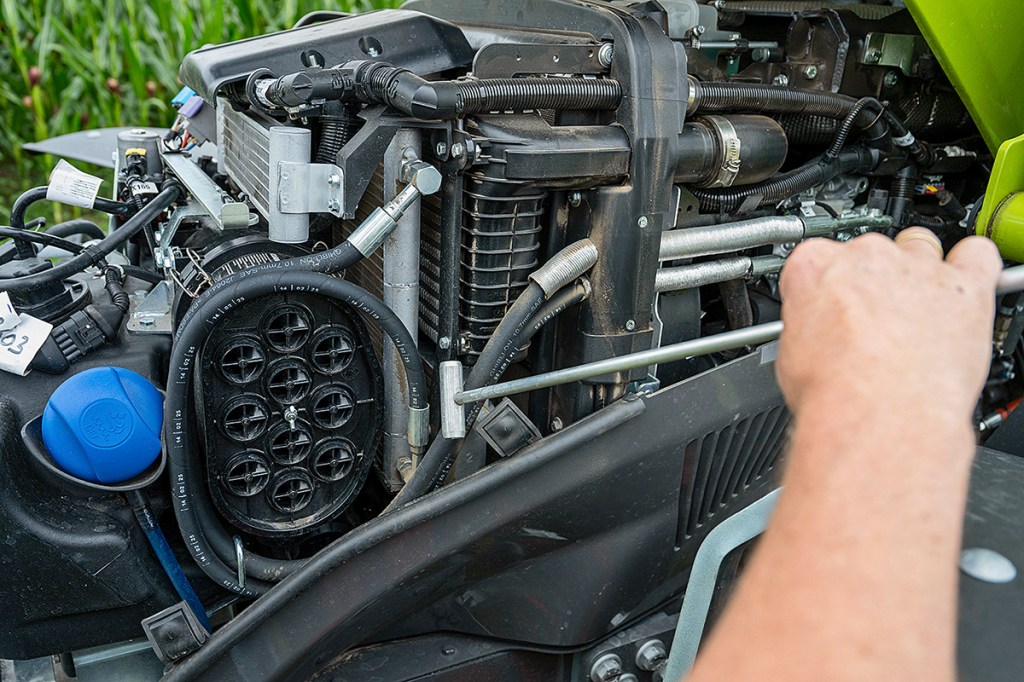
Accessibility to typical service points varies considerably. For example, the radiator in the Claas Axos 3.105 is practically hidden away. Not only is the AdBlue tank tucked away under the bonnet, but so is the access point for cleaning the radiator. The Italians (the Axos is built by Agritalia) are aware of this issue and have therefore supplied a compressed air comb to make blowing out the cooling pack that bit easier.
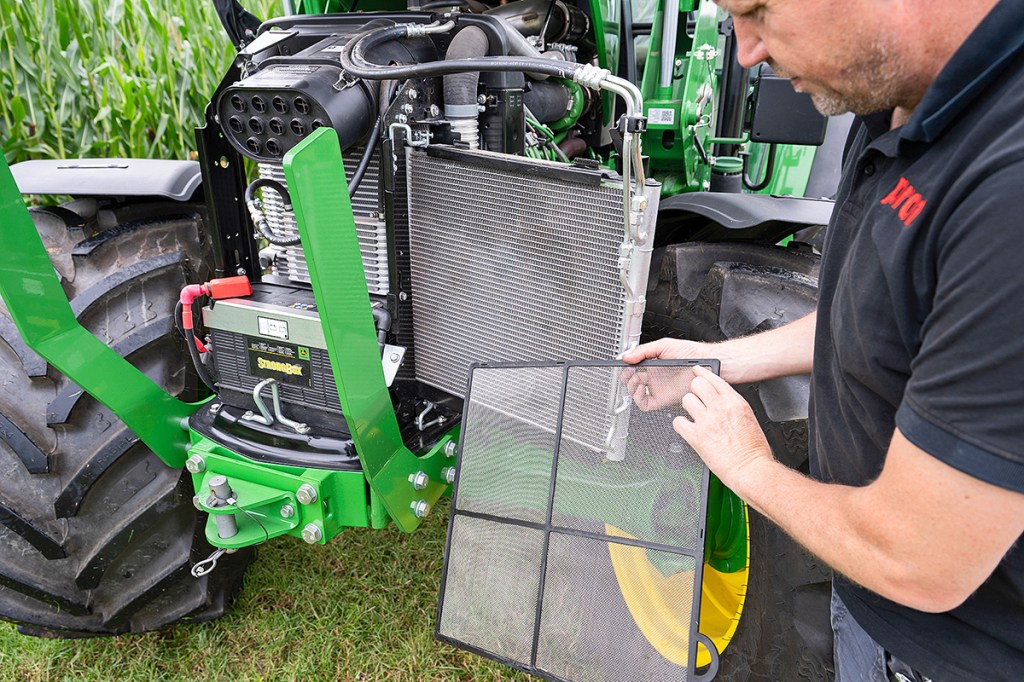
By contrast, the rad pack on the Steyr (CNH) and John Deere fold out, making cleaning quick and easy. Incidentally, all seven of the manufacturers install removable cleaning screens. We preferred the ones on John Deere, SAME, Steyr, Massey Ferguson and Valtra, which pull out to the side, to the one on the Claas Axos which pulls up and that on the Kubota which is a cloth-like screen.
But before we get lost in the details, let’s go back to the most essential question: Do the tractors deliver the promised power, and are they fuel efficient?
Revs go down
Using the manufacturers’ spec sheets, the rated power ranges from 98hp (Claas Axos) to 110hp (Steyr Plus) and 114hp (Kubota M5). As you can see, not all of these are the 100hp that we initially set out to compare, but that is because not all of the models perfectly match. For example, the lighter Steyr Plus despite its power advantage is nippier than the Claas Axos. The maximum pto power for the Steyr and John Deere is 71.7kW/97.5hp — that’s a good 88% of the stated engine power.
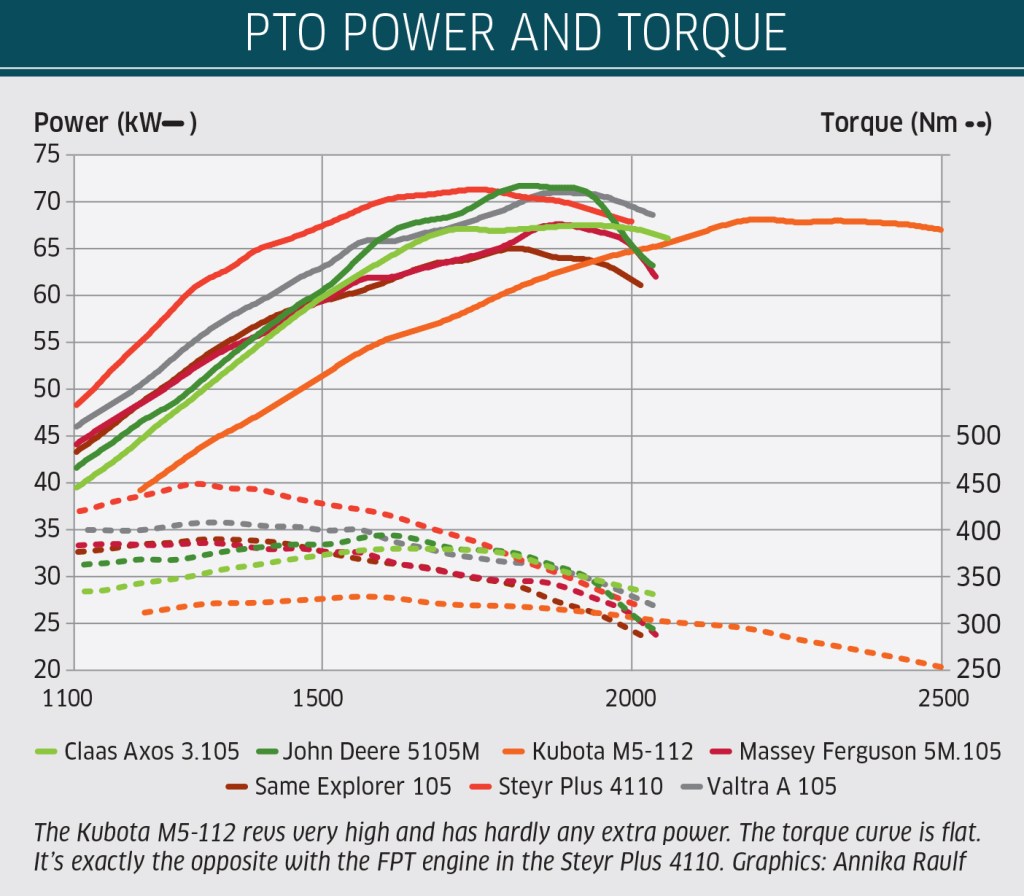
This figure is only surpassed by the Valtra A, whose drivetrain transmits more than 91% of the power. The Kubota M5 shoves up to 93hp to our pto-powered test dyno. However, at just 330Nm, we measured the lowest amount of torque in the comparison. This affects both overall pulling power and stamina.
The Japanese tractor also needs the engine to be revving at up to 2,600rpm to deliver its full power. By comparison, the Steyr Plus (max 446Nm) performs strongly even at lower engine speeds.
And speaking of engine characteristics, in hardware terms, the MF 5M.105 and the Valtra A105 models are identical (engine, transmission, chassis). Nevertheless, the 5M.105 felt slightly less responsive, which Massey Ferguson puts down to the tractor’s short running-in time.
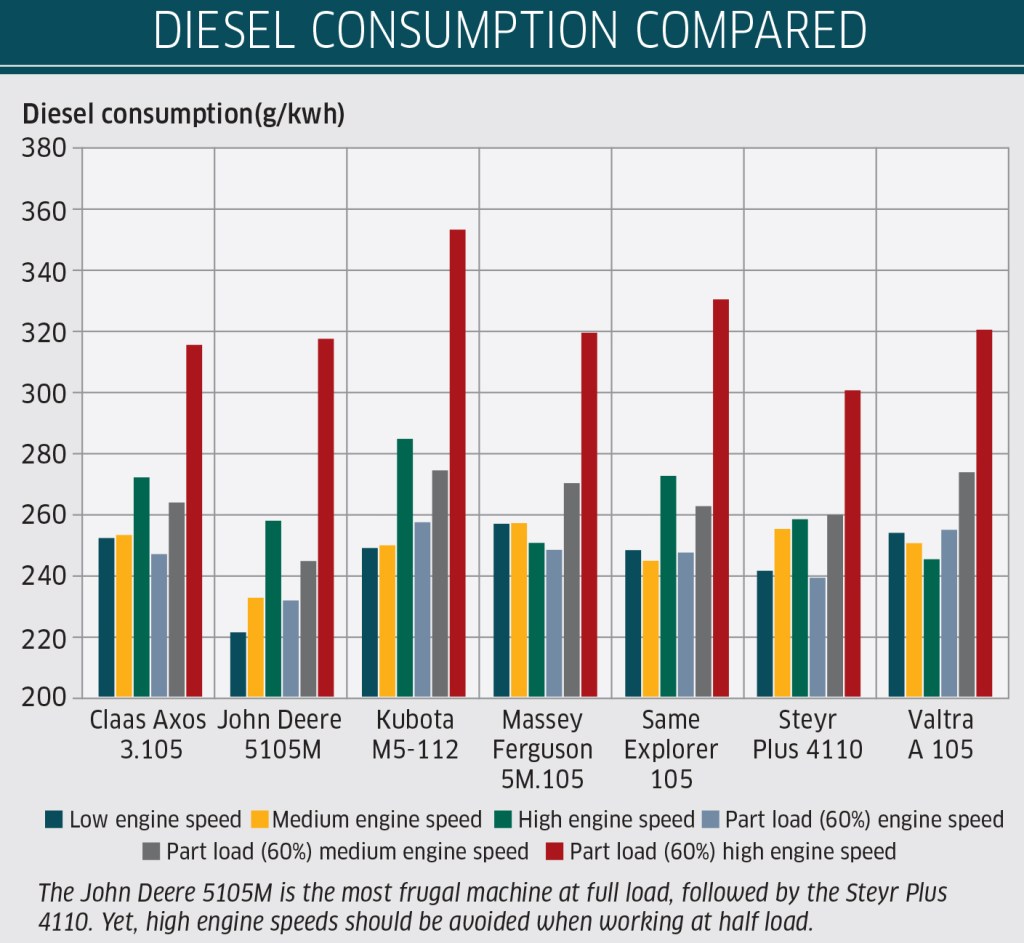
For diesel consumption (see graph: ‘Diesel consumption compared’), John Deere wins — both at full load and part load. What all seven have in common is that they are best used with mid to low revs, otherwise they will start to chug their way through the cherry. Diesel consumption per kWh rises exponentially for every tractor. The winner here is Steyr, with 301g/kWh (14.4l/hr); the loser is Kubota at 354g/kWh (16.9l/hr). All the others are closely bunched in between.
Another important parameter is the right pto speed for your implements. Here SAME offers four pto ratios (540/540E/1,000/ 1,000E), while Kubota drivers have to make do with just two speeds (540/1,000). All the others offer three speeds (540/540E/1,000).
Quiet or loud?
At full load, the noise level meter confirmed our subjective impression: the SAME and Massey Ferguson cabs are the quietest at 70dB(A). It’s noticeably louder inside the Kubota (75dB(A)) and John Deere and Steyr (74dB(A) each).
What’s important for these all-rounders is a good shuttle and a powerful hydraulic system for front loader work. We really liked the shuttle on the Kubota, John Deere and SAME, including the feel of the lever. The clutch responds quickly yet smoothly.
The clutch on the Claas Axos may respond quickly but, when attempting to change direction, our testers often ended up in the park position when shuttling.
By the way, the Steyr is the only tractor here not to have a détente to hold the shuttle controller, which means that you can change direction either under the steering wheel, from the MultiController or the front loader joystick — very good. A nice solution on the Massey is the small shuttle control on the left under the steering wheel, which also shifts through the gears — convenient on loader work.
Very different transmissions
Even though all seven models do 40km/hr at their reduced engine revs, they differ significantly in level of specification. From the simple 24/12 transmission with high/low speed range (forward only) on the Claas to the electro-hydraulic shifting for the four ranges with four powershift steps on the Massey Ferguson and Valtra, everything’s available. The six gears in the Claas Axos are a bit notchy to shift but otherwise work well. This is just as good on the Kubota and even better on the SAME (which also scores with three powershift speeds). Here it’s the range shifting that’s the weak point.
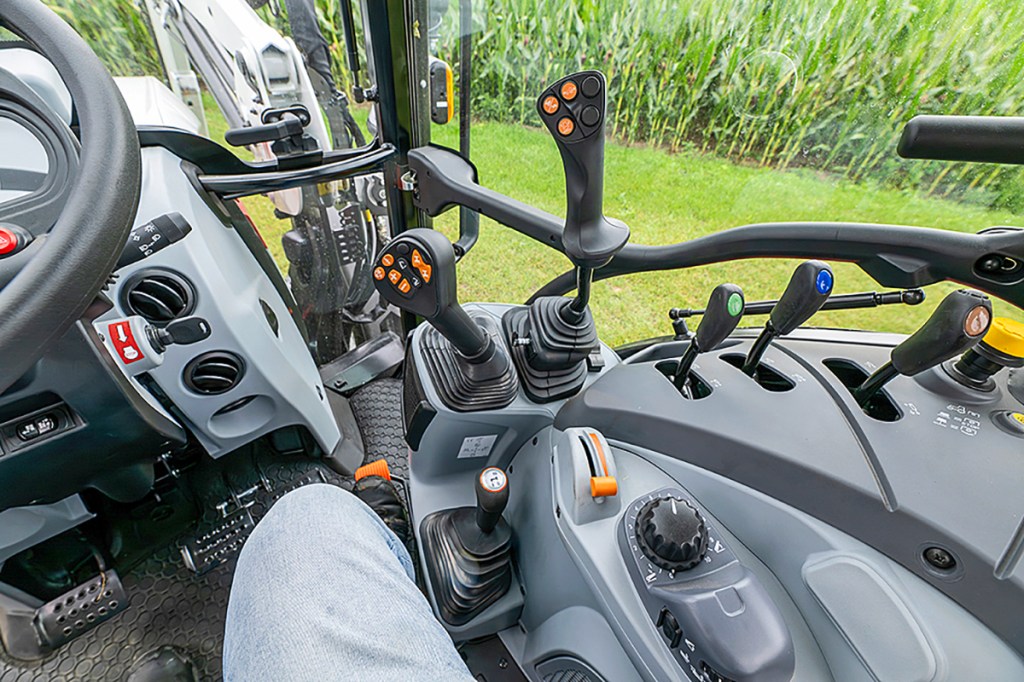
The John Deere 5105M does have four powershift speeds that shift smoothly. But the ranges are extremely notchy and hard to find with the long lever. This is due to the integrated park lock system: its gate isn’t precise so you often get stuck. The Steyr gears engage well, but the position of the MultiController grip is disastrous. You don’t know where to put your hand. More on that next month.
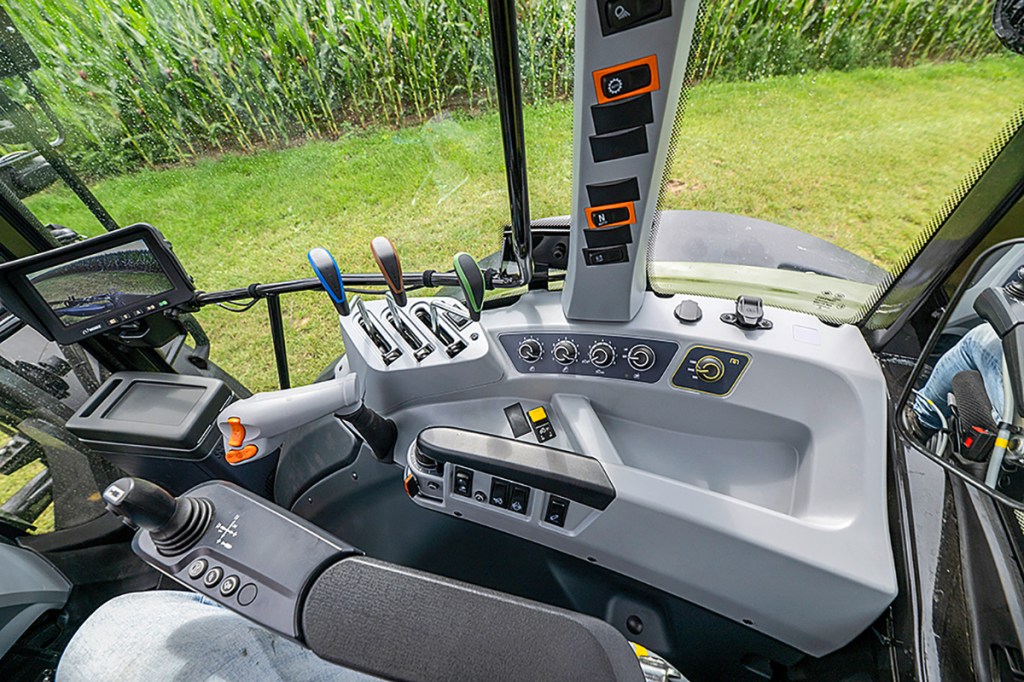
The Valtra and Massey transmissions are buttery smooth. On the Valtra A, your hand sits more comfortably on the controller than on the Massey Ferguson 5M, where the gears are numbered and the powershift speeds lettered — it’s simply something we didn’t warm to.
The 100hp tractors offer plenty in terms of hydraulics: Valtra and Massey with the same hardware have a selectable tandem pump. This increases the oil flow from 43l/min to 105l/min. Claas offers this feature on the Axos (89l/min) as does SAME with the Explorer (85l/min). With the second pump activated, faster front loader cycles are possible. Even without a tandem pump, the John Deere 5105M delivers 86l/min and Steyr’s Plus 4110 produces 85l/min, while the Kubota M5-112 makes do with 69l/min.
Bowden cable operated spools
Apart from cross controls for front loader operation, there are traditional Bowden cables for operating the rear spools. Only SAME has an electric spool (black/white) for a possible hydraulic top link.
The Bowden cables on the Valtra and Kubota are easiest to operate. This applies to both the arrangement and modulation. On the Claas Axos, we noticed the valves don’t always stop when at the mid-position. A little bit of fine tuning would certainly be helpful here.
Not all spools have a float position. And usually only one spool’s oil flow can be adjusted by a mechanical restrictor. John Deere offers something special here: on the first spool, you can operate a dial to choose between continuous pressure, float position and detent on counter pressure.
Category II
All manufacturers offer ELC (electronic hitch control) for the linkage. If you want to regularly operate heavier implements then you should opt for the Claas Axos 3.105, because it has the highest lifting capacity of more than 5.0 tonnes, closely followed by the John Deere 5105M (4.75 tonnes) and Steyr Plus 4110 (4.5 tonnes).
Kubota and SAME have two holes for the lift arms. Depending on the selection, lift capacity can be increased, but at the cost of lift height, which is reduced (62cm on M5-112, 65cm on Explorer). At 75cm, the John Deere 5105M offers the largest lift range and the Steyr Plus 4110 the smallest with only 65cm.
Kubota makes the tightest turns in this pack
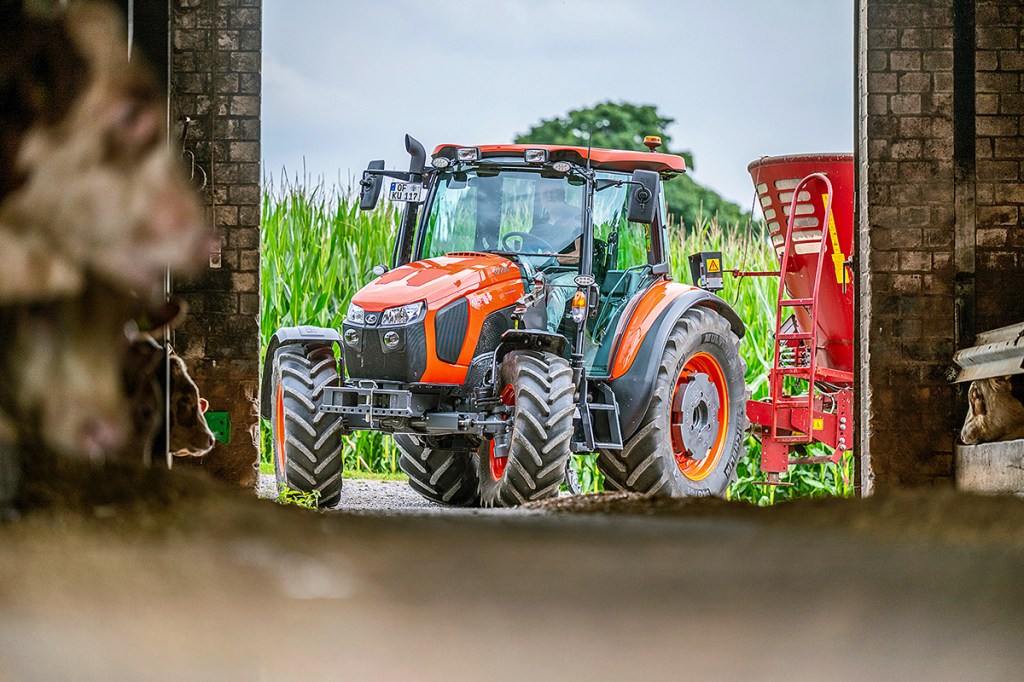
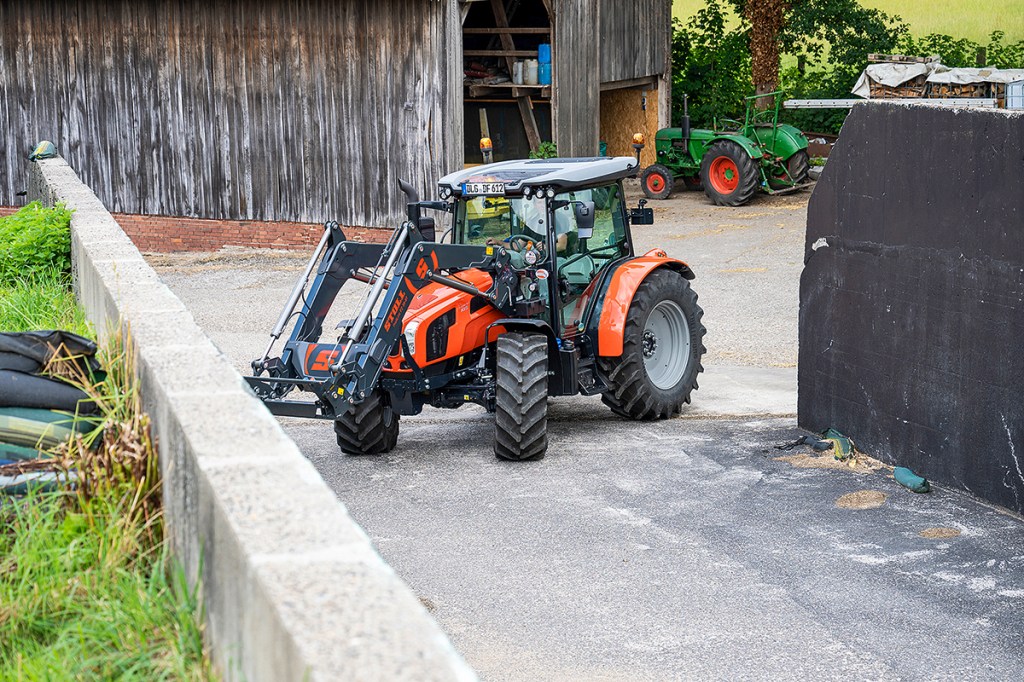
In terms of the running gear, the Kubota M5 model has the shortest wheelbase at 2.24m. Because of this and thanks to its portal axle, the Japanese tractor turns through a tight radius of 9.10m. The Claas Axos 3.105 has a noticeably longer wheelbase at 2.40m but can still make 10m turns.
For the tyres, we’d agreed to clad all the tractors on 440 front and 540 rear wheels, but the SAME showed up on 480 front tyres and turned through 11.40 metres. On the Steyr Plus we found that the left and right turning circles were noticeably different, so we checked the steering stops, though it appears that the four-wheel drive coupler or the front diff was not disengaging fully.
Dimensions and weights
The tractors weigh in at between 4.9t (Kubota) and 5.7t (Claas, Massey Ferguson and Valtra) with a front loader. But it’s not so much the units’ unladen weight but the permissible gross weight that makes the critical difference. With only 1.2t of payload, SAME loses out significantly in the group: even with the loader and bucket fitted it is already overloaded. Steyr and Kubota also fall short of a 2.0t of payload. Here Massey Ferguson and Valtra offer significantly more (around 2.8t) with 8.5t permissible weight — despite having wheel weights (Valtra) and a front linkage (MF).
At 2.56m, the Claas Axos is the lowest tractor in the comparison. However, the driver certainly notices this in the cab. More on that in the next part of our test, where we’ll focus more on the tractors’ cabs.
Summary
All the test candidates have 100hp and deliver it, too, albeit with different engine characteristics and sometimes different consumption. As all-rounders, all models should be driven at the lowest possible engine speed to be economical.
The hardware differences within the group are also large: the Kubota M5-112 was the lightweight and entry-level machine and the Valtra A105 the comfortable tractor. This same ‘difference factor’ applies to operation and servicing.
Tobias Bensing
For more up-to-date farming news click here and subscribe now to profi and save.