
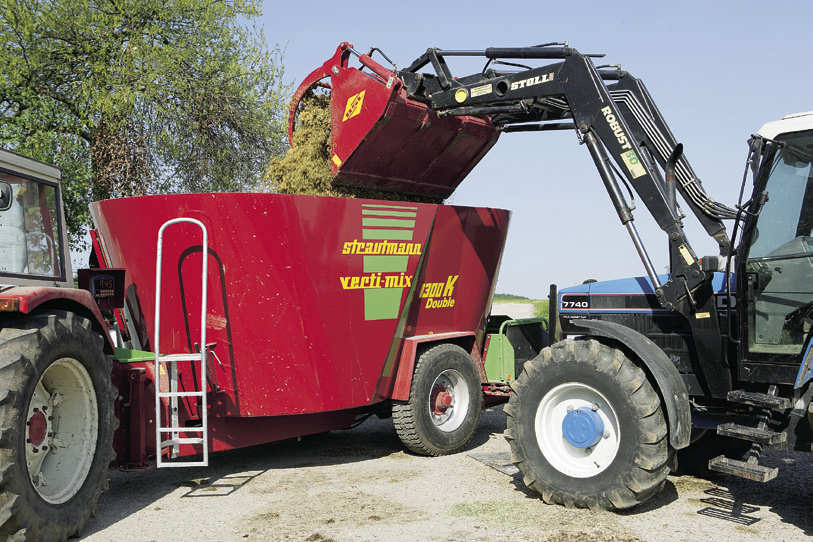
Practical test: Strautmann Verti-Mix 1300 Double K feeder Build height has long been a criticism of vertical-auger feeders when mounted over conventional running gear. Strautmann’s solution? To develop the Verti-Mix Double K, a machine that combines compactness of construction while still retaining a decent 13m³ capacity and substantial footwear beneath. Here profi’s test team picks out the pros and cons of the design
Not all livestock farmers, both in the UK and across mainland Europe, revel in the luxury of working on a greenfield site complex. Vast expanses of power-floated concrete flooring, tall and airy buildings, and inviting 6.0m+ wide passageways. The stuff that dairy dreams are made of.
Now that’s the ideal world, yet sadly one in which few of us actually reside. Even today, it’s still much more come common to drive into yards that have developed piecemeal, a new shed tacked on to an existing one as and when circumstances – and funds – have allowed. Logistically, it’s far from perfect and, for that matter, efficient. Yet for many it’s the only affordable way of growing their business.
Which is where the featured Verti-Mix 1300 Double K feeder comes into its own – in and amongst older building layouts that would see many other vertical-auger machines struggle to gain access. Taking into account its two vertical augers and 13m³ tub, the Verti-Mix 1300 stands out as a surprisingly compact feeder – 2.36m high, 2.27m wide – vital stats that have been achieved without resorting to the use of skimpy tyres; standard spec are amply proportioned 315/80R22.5 boots. Even the largest model in the line, with its 21m³ tub and 385/65R22.5 footwear, measures at 2.95m high and 2.45m wide, according to the manufacturer, which lists the full Double K model range as offering 13, 15, 18 and 21m³ wagon capacities.
Key to the above tightly packaged body dimensions is that the two main mixing chambers – one chamber for each auger – are of different diameters. In the front chamber, the 20mm thick floor diameter stretches out to 2.15m, whereas the rear equivalent limits itself to just 1.49m, thus enabling it to accommodate those tallerthan-is-customary tyres. Main advantage of the chunkier rubber is that it is better able to handle heavier wagon loads and also gives smoother road travel between sites – an important factor for some.
For more up-to-date farming news click here and subscribe now to profi and save