
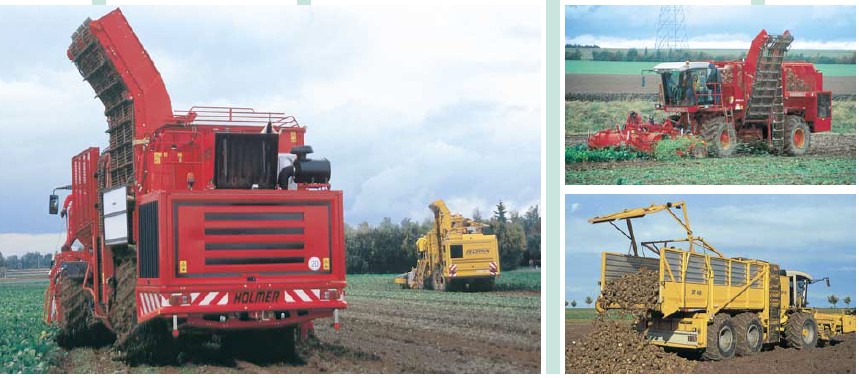
Every four years, the association of sugar beet growers in the Wüerzburg region of Germany arranges an international demonstration of sugar beet harvesters. Before the demo is open to the public, the Agricultural Machinery Institute at Bonn University tests the machines to standards devised by the I.I.R.B
German weather last autumn was not that different to that suffered by UK farmers. The resulting adverse harvesting conditions presented a big obstacle to the manufacturers of the six-row and eight-row harvesters on show. Higher yield losses and damage levels, poor topping quality and soil separation were the order of the day.
To say soil conditions last October were not ideal is a considerable understatement. An average soil moisture of 27% on both days was not helped by 10.5mm of rainfall on the morning of the first day, and 1.9mm on the second. Soil separation was much more difficult on the first day, but as the second day progressed so conditions improved. As a consequence, machines with high ‘start numbers’ achieved better results.
This means it’s only possible to make a limited comparison between the test machines. To make the results more fair and meaningful we have included the machines’ start number and soil moisture content in the Test Results table. Some manufacturers also say row spacings were inconsistent, and one claims this varied between 46cm to 52cm on one plot. This too can affect the results.
Nearly all the 12 machines and systems were six-row harvesters, with tank capacities ranging from 15m3 to 40m3 (see ‘Technical Data in Comparison’). The two-stage Gilles combination system with a front-mounted flail topper and rear-mounted lifter, working with a self-propelled tanker loader, lifted eight rows at a time. The other two-stage system comprised a six-row topper/lifter from Kleine on a reverse drive tractor working with a trailed Bleinroth tanker loader.