
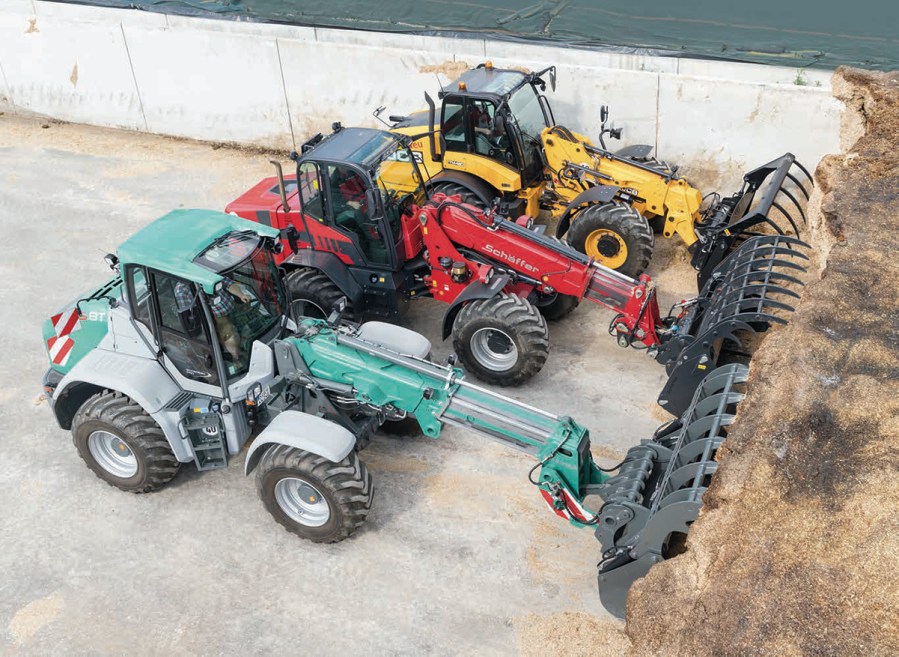
There’s more choice now than ever before in the central cab, 4.0t plus telescopic wheeled loader market. In our practical test we compare the performance stats of the three top models from JCB, Kramer and Schäffer
In recent years telescopic wheeled loaders have been given a capacity boost with a selection of 4.0t plus capable machines now on the market. We’ve brought together three prime examples from the sector for our group test:
- JCB TM420 Agri
- Kramer KL55.8T
- Schäffer 9660T
We also invited Weidemann to supply its pivot-steer 9580T to the test, but the firm preferred to hold its machine back until just prior to Agritechnica.
For the trio we did get our hands on we’ve listed all of the measurements and key specification in the ‘Measurements and test results compared’ table overleaf. We used the supplied machines to fill diet feeders, digesters, shift gravel, roll the clamp and stack bales as well as road work and other jobs. Interestingly the JCB and Schäffer are articulated units whereas Kramer has decided to stick with its rigid-chassis, four-wheel-steer concept.
So, on to the results. As the booms sit at a shallow angle with relatively short lift rams, their max lift force only comes into play when the boom is clearly raised beyond 2.0m. Top of the pecking order for maximum and continuous lift capacity was Schäffer, developing 6,627daN at 3.98m and 5,088daN throughout its lift range. It is closely followed by fellow German, Kramer, with a continuous lift force of 4,911daN and a maximum of 5,902daN at 4.02m. The KL55.8T can also strong-arm an impressive 5,396daN near the ground. The JCB was the smallest machine in the group, and this shows with 4,284daN of continuous lift and a maximum 6,215daN at 4.07m.
For more up-to-date farming news click here and subscribe now to profi and save