
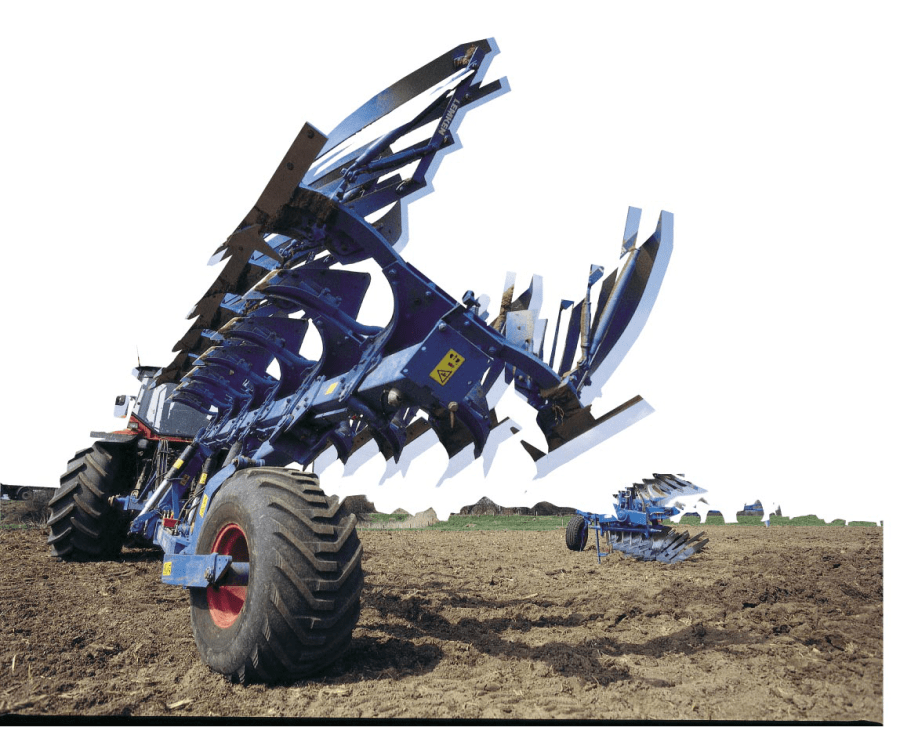
Practical Test: This question may well be irrelevant to smaller reversible plough buyers, but it is a serious consideration if you are looking at a six-furrow plough or larger. Should you stick with a mounted plough, which most users are familiar with and will initially cost less? Or is it better to invest in a more expensive and cumbersome semimounted plough? These can be a lot easier on the tractor and reduce certain running costs. Here we test both types to help you make the decision.
If you stick to using a four-furrow plough there is no need to bother weighing up the benefits of moving up to a semi-mounted version. But as soon as you consider buying a five- or six-furrow reversible it is worth taking the time to look at the advantages and disadvantages of both types. And this is essential if a six furrow plough is being considered.
The decision to move to a semi-mounted plough is particularly difficult if you have always used a small and “simple” mounted plough. The main difficulties associated with semi mounting are the fact the ploughs are harder to operate and they need wider headlands. But, despite the many advantages of sticking with a fully-mounted model, a six-furrow mounted plough does inflict quite a lot of stress on both the tractor and the plough.
We compared two Lemken ploughs, the mounted Lemken DLV 141 and the semi-mounted Lemken SMV 160.
Both were equipped with:
- BS slatted mouldboards
- M2 skimmers (for heavy surface trash)
- Hydraulic furrow press arm
The semi-mounted plough was standard except for the options listed above. The mounted plough, however, came with a memory cylinder (to adjust the furrow width and fold-in the frame) and a single depth and transport wheel. The list price of each plough as tested was £20,390 for the mounted version and about £26,960 for the semi-mounted.
For more up-to-date farming news click here and subscribe now to profi and save 47%.