
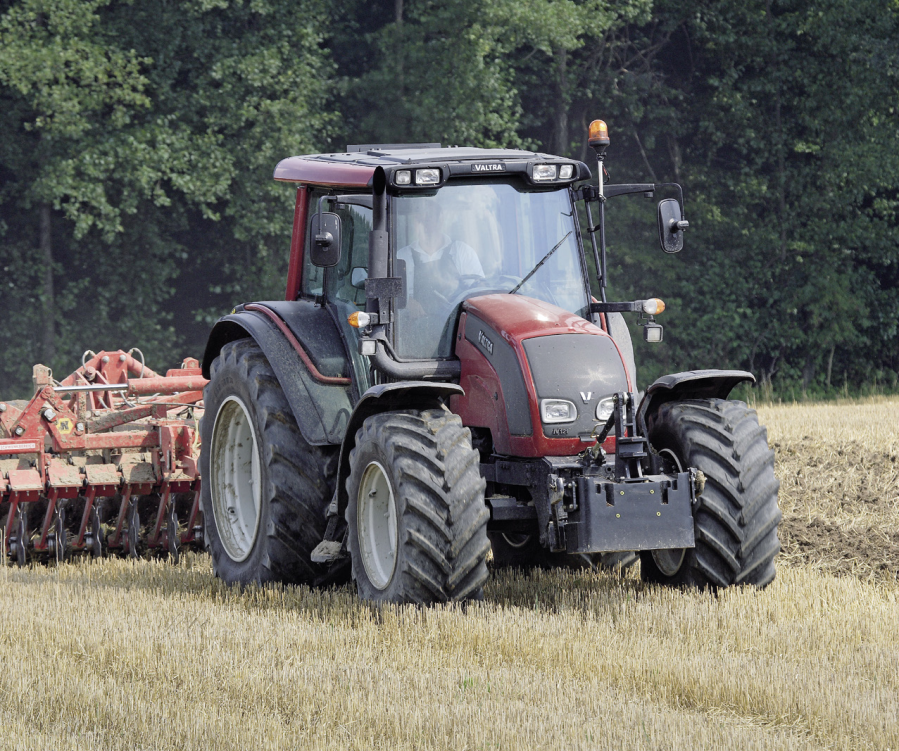
Tractor test: Valtra N121 HiTech The Finns went off on a design tangent with the N series when it was launched back at the tail end of 2005. For this is a Valtra tractor line that positions its four-cylinder engine behind, rather than over the top of, the front axle. As a result, the N represents something of a departure for this colourful brand from the icy North. We test the 93kW/126hp N121 HiTech model (ECE R24)
If decision making comes difficult to a particular tractor buyer, then he is almost guaranteed to find the Valtra experience a little frustrating…… but not half as frustrating as it used to be. Not that this is a major criticism of the Finnish brand; it’s just that the firm offers so much choice. Admittedly, today that choice has been substantially rationalised when compared with the line-up’s crossover period of 2005/2006. Back then, it was distinctly confusing. First up were the old-style 6000 models, which were then further complemented by the ‘C’, ‘M’ and ‘T’ lines. Surely, no more? But there was – assuming the intriguing XM pivot-steer was considered sufficiently mainstream to form part of the mix.
For 2007, however, confusion has made way for clarity. Today’s 100-150hp Valtra listing runs to the tested N series, where the buyer prefers to source his hp from four pots, and the T-series for advocates of six-cylinder motor muscle. Even so, it’s still not quite that straightforward. Within these two tractor lines, the buyer then has to pick from Classic, HiTech and Advance specs, depending upon whether he prefers, say, to work his spool valves mechanically or electrohydraulically.
The main point is made – there’s plenty over which to ponder. So, what did we do when it came to selecting a suitable N series test candidate? ‘Middle of the road’ probably best sums up our approach. We went for the middle model – the N121 – and the middle spec – HiTech. Which, in turn, brought a claimed 93kW/126hp (ECE R24) rated output and features such as electronic management of the three-step semi-powershift transmission coupled with mechanically controlled spools. Had we gone for the flagship Advance, this would have replaced the tested 73-litre/min hydraulics with a 115-litre/min loadsensing package, but then the bill would have soared by an additional £4,000, too. Clearly, the big advantage of all the above tailoring is that it maximises the chances of the buyer obtaining – and paying for – exactly the spec he requires.
For more up-to-date farming news click here and subscribe now to profi and save