
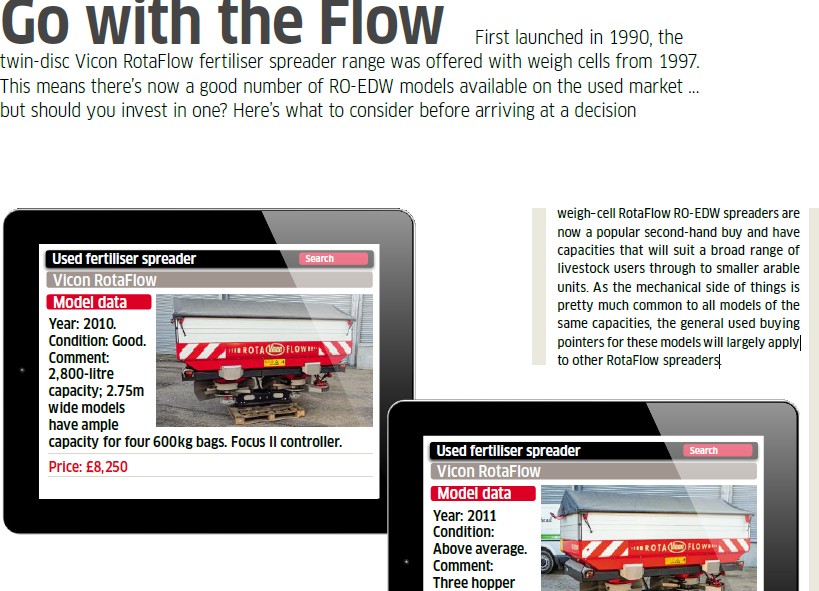
First launched in 1990, the twin-disc Vicon RotaFlow fertiliser spreader range was offered with weigh cells from 1997. This means there’s now a good number of RO-EDW models available on the used market … but should you invest in one? Here’s what to consider before arriving at a decision
Vicon RotaFlow fertiliser spreaders come in seven basic model groups, starting off with the RO-C models with hoppers of 700-1,400 litres in capacity and a spread width from 9-18m. Next are the RO-M and RO-M GEOspread ranges with 1,000-2,000-litre hoppers that will spread from 10-24m, followed by the RO-XL with hoppers of 1,500-3,900 litres and a spread width from 12m up to 54m. None of these machines have load cells.
Further up the spec line are the RotaFlow RO-M EW with a single 10t load cell, compared with the four 5t load cell RO-EDW models, which are broadly offered with the same capacities as the non-load-cell models (see RO-EDW specification table). The rangetopping RO-EDW GEOspread has the same core stats as the EDW but at present will be a rare used find; for the reasons why, see the separate section outlining core features of these GPS-enabled spreaders (p57). The weigh–cell RotaFlow RO-EDW spreaders are now a popular second-hand buy and have capacities that will suit a broad range of livestock users through to smaller arable units. As the mechanical side of things is pretty much common to all models of the same capacities, the general used buying pointers for these models will largely apply to other RotaFlow spreaders
For more up-to-date farming news click here and subscribe now to profi and save