


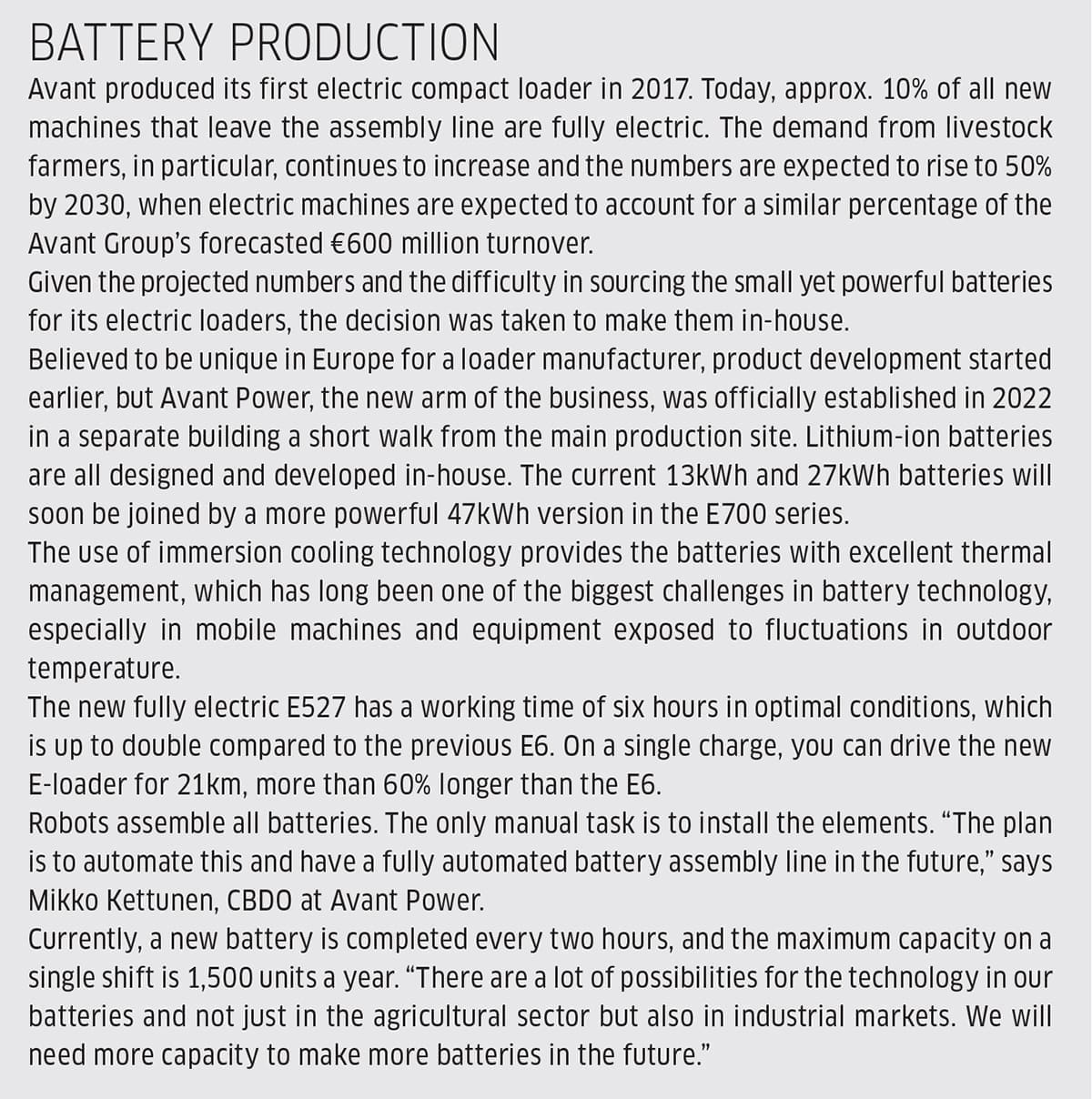
Avant is a big player in the compact articulated loader market, but many will know little about how and where its machines are made. We travel to Finland to find out more about the 35-year-old business.
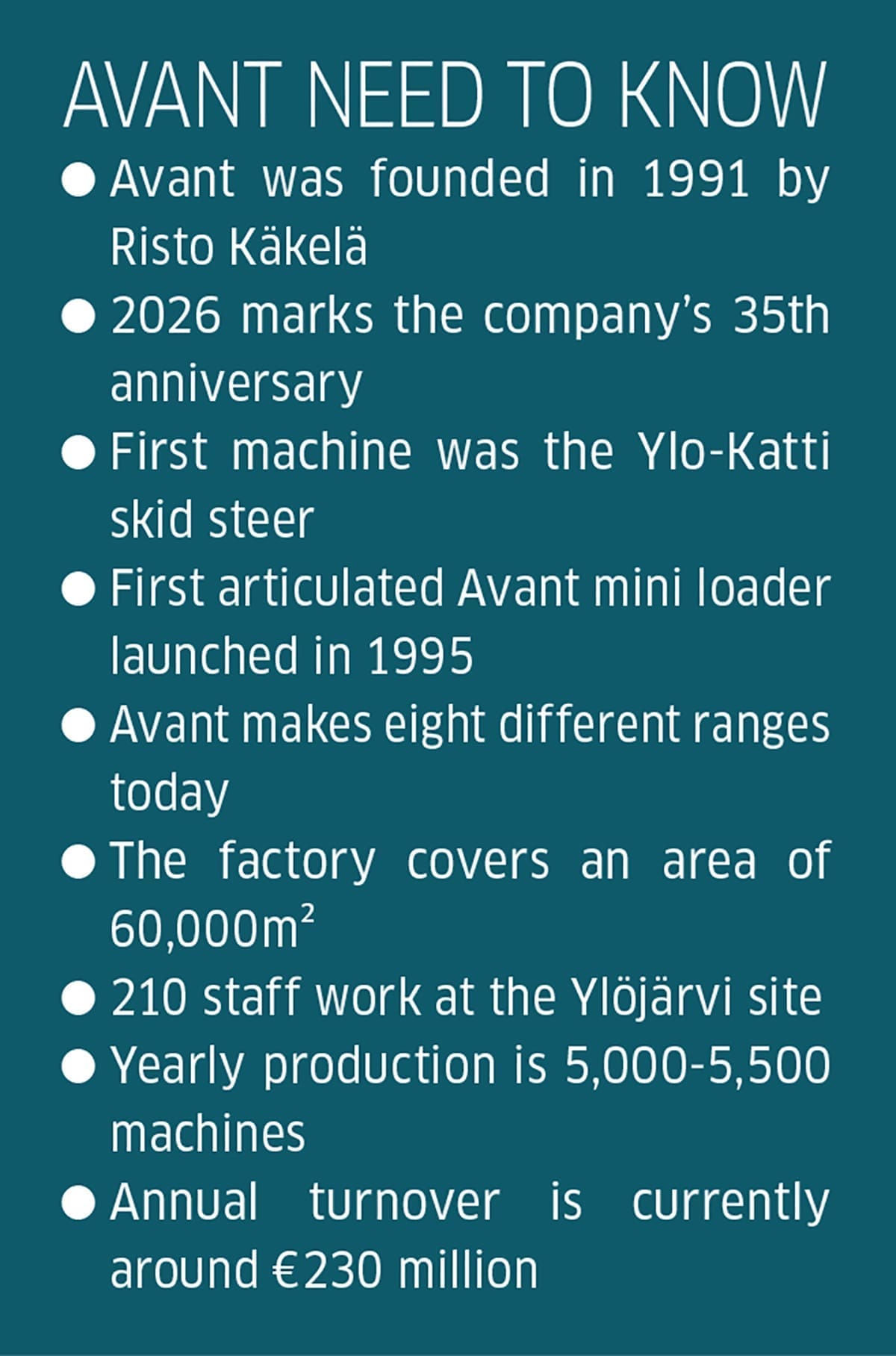
Avant’s HQ is on the fringe of an industrial estate on the outskirts of the small town of Ylöjärvi, a short drive from Tampere, north-west of Helsinki. Avant Tecno, as it is officially known, has grown significantly since producing its first skid steer in 1991, to replace a wheelbarrow and shovel on dairy farms. Today, it makes 5,000 to 5,500 machines a year and will soon reach the milestone of the 100,000th Avant loader.
Claiming to hold the leading position globally in the compact market, an essential strategy has always been to keep all stages of the production process from R&D and design to manufacturing and final testing in-house. All six diesel-powered ranges (200, 400, 500, 600, 700 and 800) and the two full electric (E500 and E700) models are designed and made at the Ylöjärvi site. Spanning lift capacities from 320kg to 1.9t, lift heights from 1.4m to 3.5m and engine power from 20 to 56hp, they are all made inside the same building, but the smaller 200 series is assembled on a separate line with production averaging around eight machines a week.

Behind the scenes
I was not sure what to expect but was not prepared for the size of the facility (60,000m²) and the high level of automation. The Avant Group has invested €10+ million in recent years in the plant. Robots were installed in the fabrications building, the assembly line has been tweaked, and a state-of-the-art lithium-ion battery production building (see page 73) was opened.

Around 80% of all the steel components used to make an Avant loader are manufactured in-house. This includes key components such as the front loader frame and telescopic boom. Three lasers cut their way through over three million kg of sheet metal per year with thicknesses varying from 2-15mm. The oldest of the trio dates from 2018, the newest was installed in 2024.

All bending and welding is also done in the fabrications building, and in addition to the three manually operated presses, we enjoyed watching a robotic arm delicately pick up parts of the centre plate for the front frame, placing each one into the press.
The front frame is one of the most complex parts of an Avant loader, and there are five manual tack welding stations alone for this crucial assembly. The frame components have been welded by robots since 2007. There are eight automatic robotic welding stations today, and the company reckons to be close to the goal of fully automated welding.
When finished, the important frame parts are collected by one of the plant’s three automatic guided vehicles or AGVs for short. Capable of shifting irregular-shaped heavy welded components weighing up to 1.6t and stacking parts up to a height of up to 10m, the AGVs, which arrived in 2022, collect front and rear frames from the welding department and transport them to the paint processing area.

Paint on
All parts are then put through a chemical pre-treatment process to improve corrosion resistance and paint adhesion. The next stage is a single powder coat of the iconic green colour. There is no primer. It is then into a 200˚C oven for an hour to cure the powder. Painted parts are then collected by an AGV and taken to a warehouse and, finally, to the assembly line.

Working a single shift from 7:00am to 3:30pm, a total of 80 employees work in final assembly, which includes a 36-station J-shaped assembly line operating in a single shift, while some supporting sub-assembly operations run in two shifts.

The sub-assemblies for the likes of the cab, engine and boom are added to the loader as it progresses through the assembly process, with the line advancing at 12-minute intervals.

The assembly line was upgraded to a semi-automated system in 2020 where loaders are built from start to finish on one of 44 specially developed AGVs. Designed for weights of up to 2.5t, the AGVs improve ergonomics and loader movement along the line, over the manually operated assembly carts they replaced.


Navigating via magnets embedded in the floor, at the end of the line, the vehicle takes a new loader to the final station where the hydraulic oil and other operating fluids are added.



At the end of the line, the loader is driven under its own power to the next station while the AGV automatically returns to the beginning of the assembly line.


The markets
Only 10% of new machines made at the plant remain in Finland. The other 90% are exported, and Avant has importers in place in 70+ countries. In addition, it has subsidiaries in Brazil, Germany, the UK and North America, the latter being the single largest export market.
The construction sector takes a large chunk of production. So too do the demolition and amenity sectors, with many other machines used for landscaping and groundskeeping purposes.
Just 10-15% of the 5,000-5,500 new machines produced each year are destined for the agricultural sector, and the 500 is the most popular ag machine. Delivered mainly to livestock farms, most are used to handle bales, shift manure, and feed livestock.
The home market is a big one for Avant, and many other 500s end up on farms in Denmark and Sweden. Belgium, Germany, and Switzerland are sizeable markets as are numerous central European countries. The Finnish manufacturer is keen to get more Avants onto UK farms. The company views the UK as a potential market for the future for the 500 and E500.

Steven Vale
For more up-to-date farming news click here and subscribe now to profi and save.


