


Cheshire farmer John Allwood has been continuously expanding the herd since taking the reins nearly 30 years ago. Based just outside Chester, the farm makes the most of its location to add value to its milk and smooth out fluctuations in processor prices.
Huntington Hall Farm has steadily expanded since 1997, when John Allwood took over from his father, with the business now at 1,000 milking cows. The farm is always moving forward, and, at 61, John doesn’t seem to be slowing down, either.

In Spring 2026, a 72-point GEA rotary milking parlour was switched on for the first time. One of the most significant upgrades to the farm’s infrastructure, the new milking set-up replaced a 20-year-old, 40-point rotary that was bought second-hand from a nearby farm.

The parlour is now located in the middle of the farm as it stands now, which has meant a drawback for another element of the farm. John’s son Jack Allwood started Mootrition in 2023 after taking a non-agricultural route with higher education.
Jack studied business at Newcastle University and came home with some ideas that would keep him on the farm, but out of the milking parlour. “He likes farming, but has a different view to me. I knew he wasn’t going to be milking cows when he came back from uni,” explains John.

Jack’s business
Mootrition is the public facing side of the business: the two entities are separate from a financial perspective, but are inexorably linked by milk and location. The Mootrition milk bar is housed in an extension on the old milking parlour building. Spread across two storeys, the ground floor has a raw milk vending machine, where customers bring their own Mootrition 1-litre bottles to refill. Cleverly the machine will only accept the glass bottles sold on the farm.

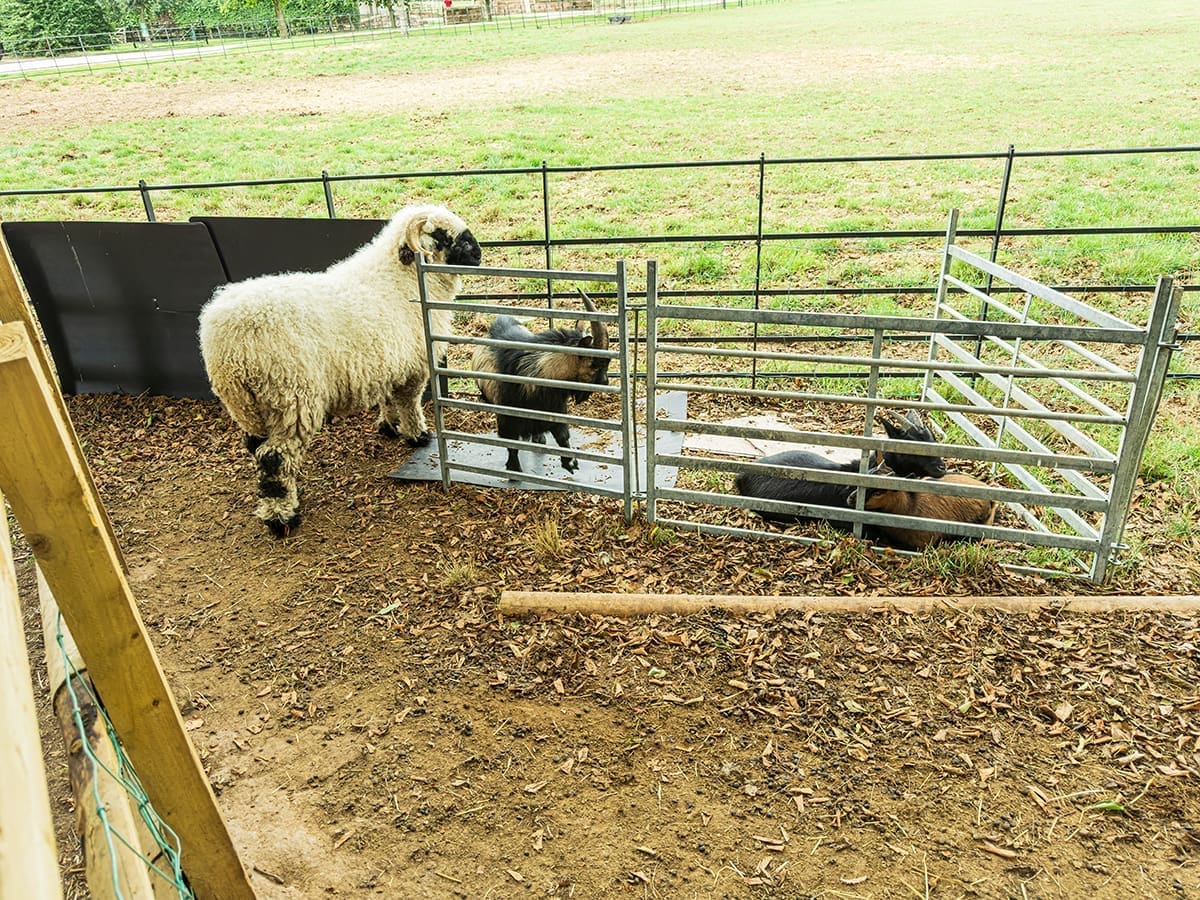
There is also a coffee machine, dispensing milk-based drinks, lattes and cappuccinos but the biggest draw for new customers is the milkshake machine which currently has six flavours. A large milkshake is going to cost visitors £2.90 (as of August 2026). With free parking and outside seating with a view of the livery yard horses in the adjoining paddock, it’s not a hard sell.

It’s fair to say that this model won’t work for everyone. However, the drawbacks of being land locked by Chester city on one side of the farm does pay dividends with footfall from the public, and there are excellent road links from Cheshire and North Wales.
“We had some visitors from Sheffield, which is about 80 miles away,” points out John. “But for £10-15 of milkshakes, they could have a look around the animals at the front of the farm; it’s a cheap afternoon out for a family.”
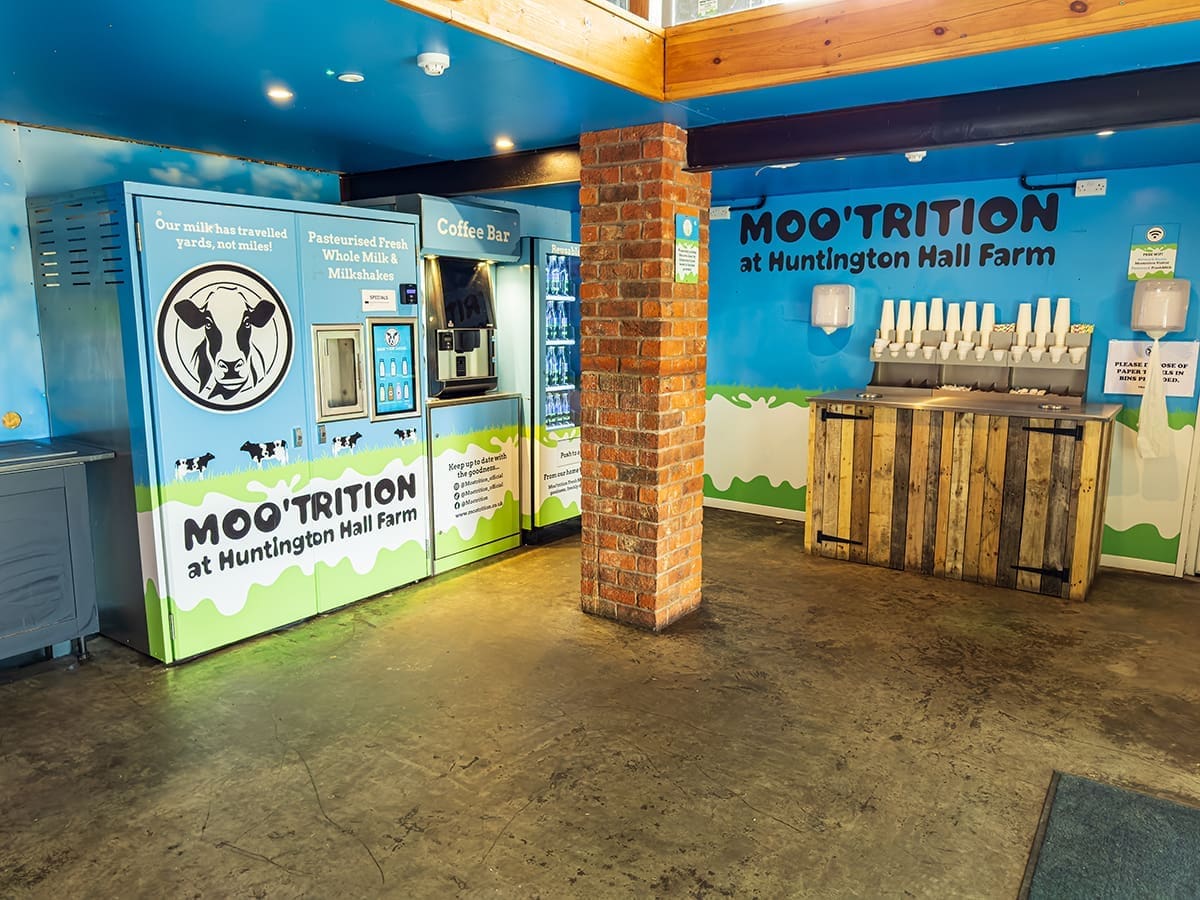
Over the last year Mootrition had 250,000 card transactions, which equates to selling about 500 litres of milk in different products per day. A one litre refill of milk is £2.50, which is bought from the farm at 50p/litre.
The second storey of the Mootrition part of the building used to look over the former 40-unit rotary parlour.
“This was a big draw for the public, but unfortunately when we put the new parlour in, we knew we’d lose that element, and it has knocked footfall by about 10 per cent,” explains John. “The plan is to have a set of pens for fresh calved cows to be viewed instead, but we need to get the old parlour out first.”

New ride
John has been visiting the USA for the past 20 years or so, partly on holiday, but mostly looking at farms. His model is scale and efficiency. “I knew back in the late 90s that the 150-cow herd would be a dwindling model. The UK sector has lost about 10,000 individual producers every decade since the 1980s. Scaling up isn’t easy, though it takes some of the stresses out of being a dairy farmer.”
In 1997 when John took over from his dad, there were 275 cows, but in two yards; these were brought together at Huntington Hall soon after. The next evolution of the farm began by increasing head count. Also, the parlour was out of date, and John heard that a local farm was going to stop milking and would be selling its 40-point rotary. Though this was still going to be a sizeable investment, he committed to buying it, and, with some help, got it installed in 2008.

This massively increased efficiency, but by the early 2020s it was starting to creak, and something needed to be done. With some enquiries to manufacturers John put his name on a 72-unit GEA rotary that was a cancelled order. “It’s a bigger parlour than we needed; it could handle three times more cows than we currently have. It’s comfortably twice the output of the old system, but we now have the capacity for easy expansion when the markets change.”
The parlour features the latest digital system from GEA, with LEDs helping to monitor milking progress, linked to a screen on the wall, with each cow sporting an ID tag. The parlour can tell the milk yield of each cow, which stall they were milked in, and their condition at that time can be seen in real time.

At full capacity the parlour can milk 400 cows an hour as a spot figure. On our visit it was clocking just under 300.


“If you keep the collecting yard and backing gate tight, you can do 400,” says John.
But with plenty of capacity letting the cows take a more steady approach, the parlour sometimes has an empty stall, as it’s quicker to leave a miss than it is to stop the system if a cow is slow getting on the platform.

On its current settings it takes 11 minutes to do a full revolution. By about two thirds of the way around, clusters are starting to come off, and by three quarters most cows are milked.
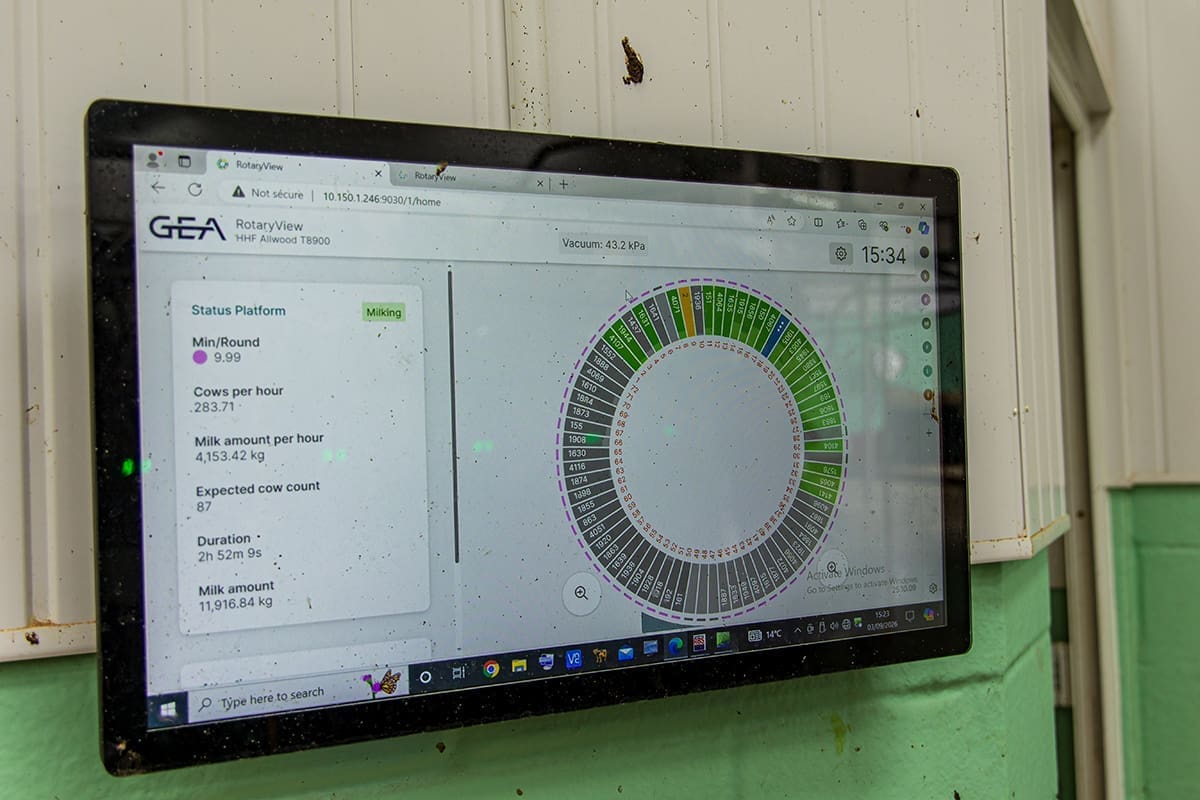
It takes about three hours to milk a thousand cows; this happens three times per day. As an onlooker, the whole operation seems very calm: there is one person washing teats with a Northern Dairies teat scrubber, and the handheld water-fed brush also disinfects as it washes. Another person puts clusters on. And for one of the three milkings, a third person sprays teats post milking while also checking the cows as they are finished. For the early and late milkings this is done with the automated GEA teat wand. A fourth operative looks after loading and unloading.
The cows for the most part get themselves loaded, but, as mentioned, there is the odd dawdler, and a stall gets missed.
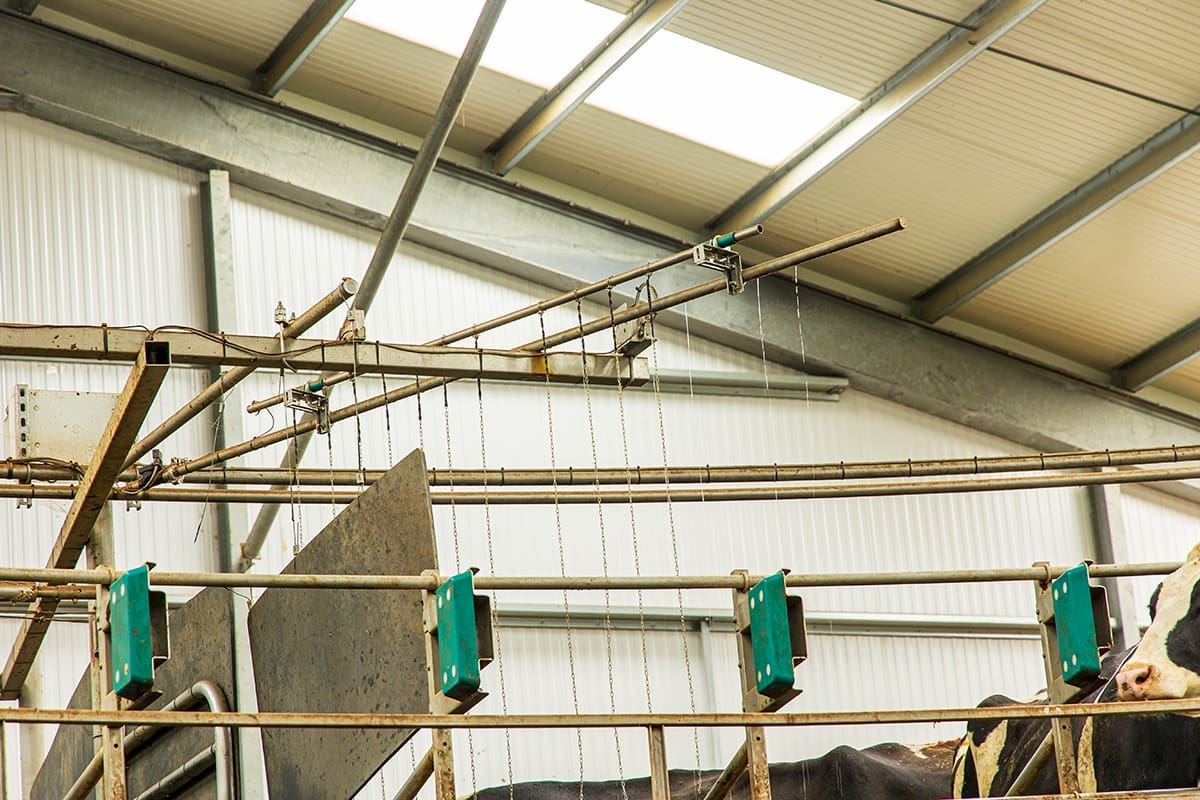
Getting the cows off can be a far bigger challenge. The original solution was a dribble bar with water: if an animal goes past, she gets cold water dribbled on her back.

In the many warm days of 2026 this was more of an incentive to stay on to enjoy a refreshing shower, so some chains dangling connected to a low power fencer unit were added to encourage the parlour passengers to disembark — only switched on when they get a bit lazy on exit.
Yield is 13,000l/cow, with a 34% replacement cycle. Calves are kept at one of the yards until weaned when they’re moved to another farm for their next stage in life. The herd is Holstein Friesian, with replacements coming from within the herd using sexed semen for cows and heifers.

Young stock
Though there are some more traditional buildings for calves, the next evolution for housing them is the ‘optimum climate calf barn’ system from Chesire-based The Calf Company. This takes calf health forward and segregates them in microclimates to reduce spread of disease.
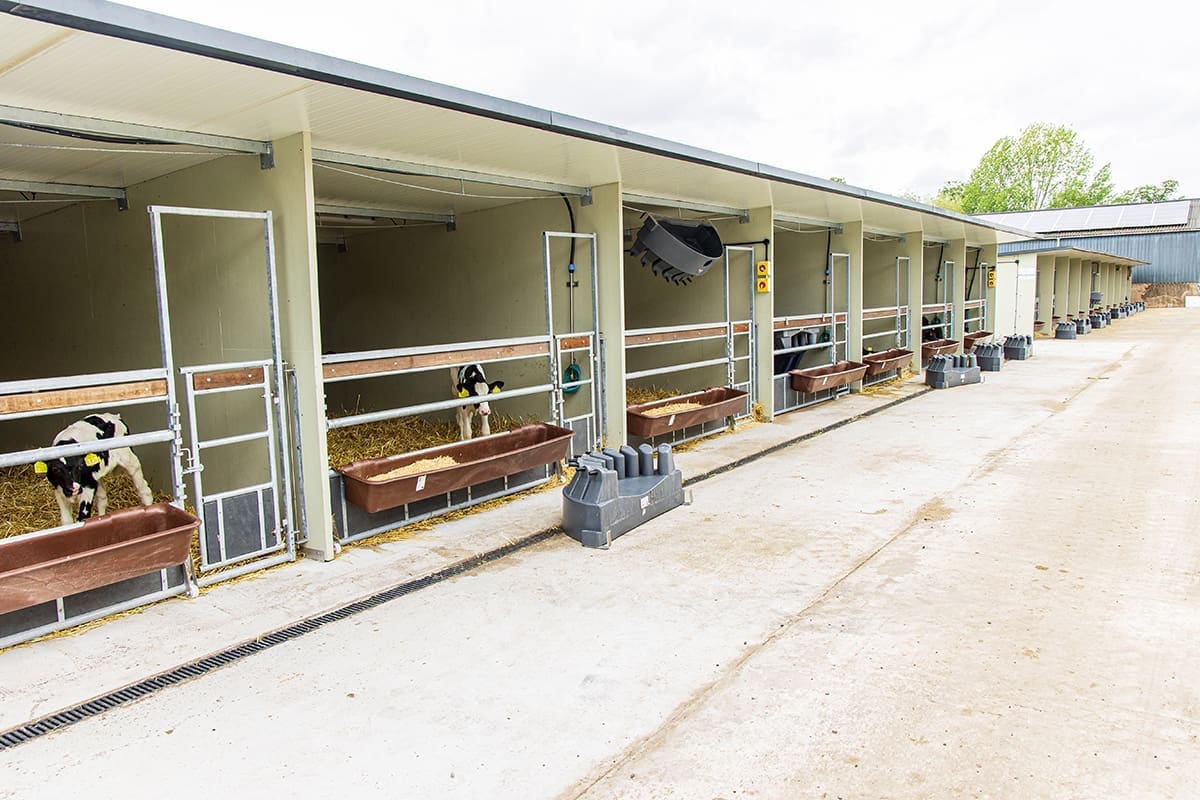
With estimates of about 60% reduction in pneumonia, the pens are saving on medicine and vets bills. John costs them at under £1 per calf over ten years, working on seven batches of calves per year.
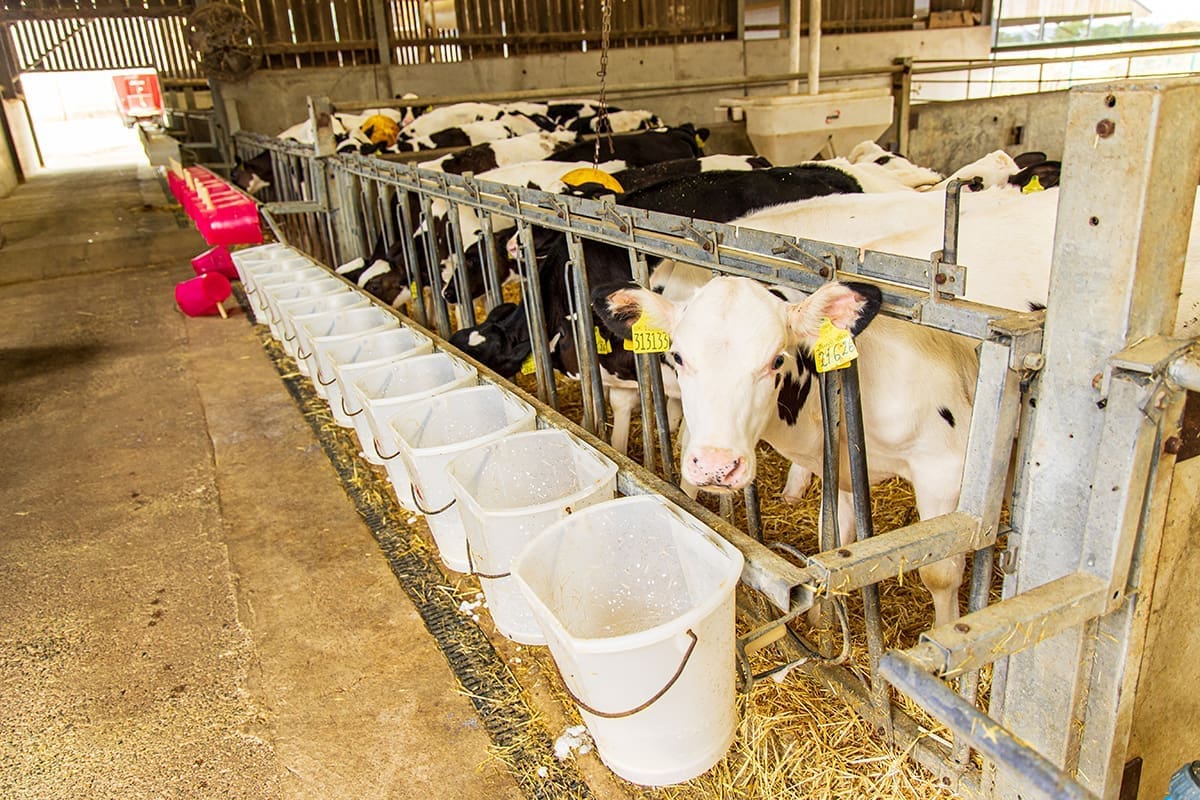
The new calf habitats are reckoned to be warmer in the winter but then require more labour to bed down.

What goes in…
The business farms over four bases all in a radius of about 10 miles. Renting a whisker over 560ha, much of the fodder is produced close to Huntington Hall Farm, where most of it is consumed by the dairy herd.
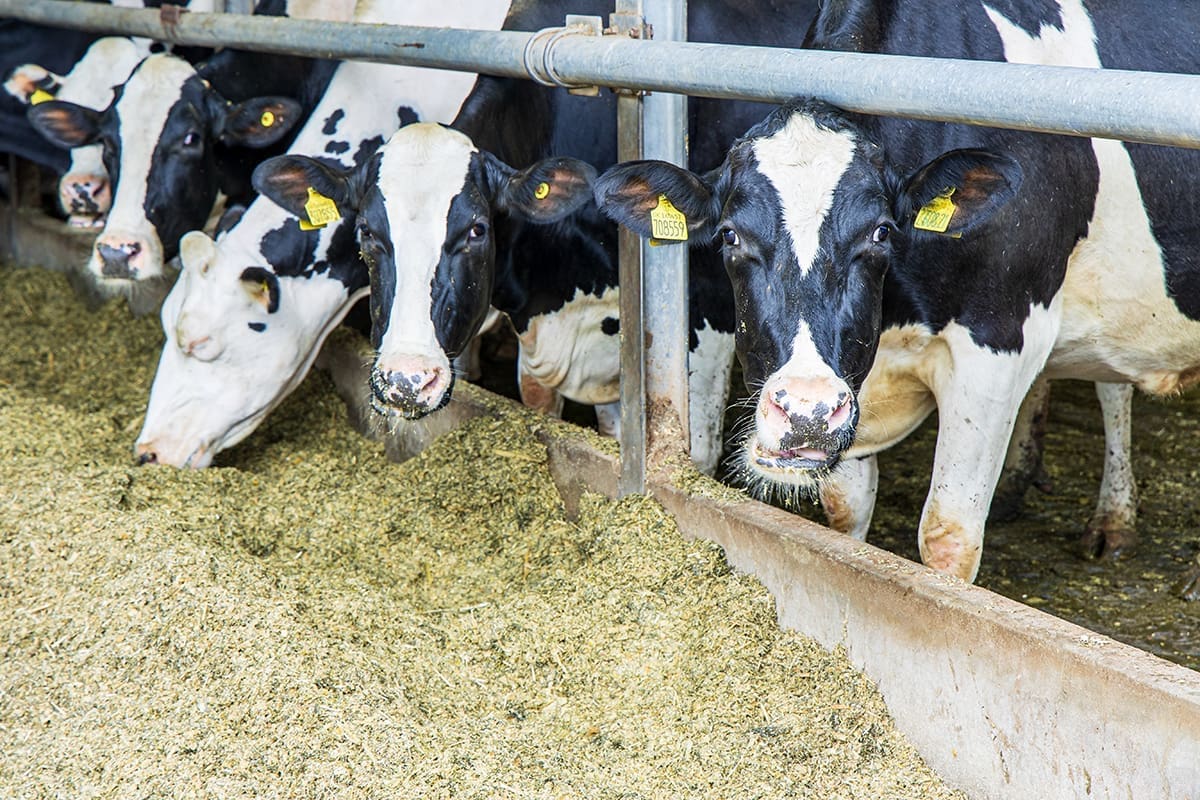
Grass is the mainstay of the TMR system, with maize giving an energy boost. Growing feed wheat for grain and straw rather than wholecrop gives some land rotation, which ties in with local potato growers. Where John finds he is following their crop with wheat and then grass, this generates a good portion of fresh grassland each year … and generally results in better grass yields.
Though the 2026 growing season has been a challenge, three cuts of grass were made in the spring and early summer before the prolonged dry spell kicked in, which meant a three-month break from making silage in the summer. The local heavy ground held moisture well, from the establishment of maize into the growing stage.

The silage clamps are open at both ends.While there may be a compromise having two faces open, the reality of 1,000 cows eating is the face doesn’t stay untouched for long. It pays dividends for farm logistics, when filling the clamps, as the harvest crew can be kept away from feeding operations.
Feeding is done twice per day, and pushing up is manual; the farm had tried a robot, but it proved incapable and has been retired. A 1990 Ford 6410 Gen II tractor and operator shared between feeding and pushing up rations has proven to be a better solution than automation, in part due to the farm’s layout and how it has evolved.

…must come out
A tanker is used to manage the slurry level when the silage is off, but the lagoon gets dropped properly with an umbilical system. The cows are bedded on sand as John’s milk contract stipulates it as a requirement, using 6,500 tonnes per year.

This has been the case for a number of years and John has found his own way of dealing with the sand. “We don’t actively separate the sand, or the slurry at the moment. It will come at some point, as we need to be able to export P&K and get the water to a usable state rather than dirty water.”
Currently the working system is two lagoons: one which all of the slurry is deposited into; and a secondary lagoon that the first flows into, leaving most of the sand in the initial lagoon. With some heavier solids, slurry is drawn from the second lagoon, which still has some sand, but largely that is left in the reception lagoon.
“We dig the first lagoon out once a year. It doesn’t take long, and the sand is good on the soil around here as it’s quite heavy clay. Recycling the sand seems a slow process, and you still end up with dirty sand.”
Around the yards a tractor-mounted scraper is called on, though more recently a Kubota R090 loader with a hydraulically adjustable scraper has replaced the tractor for most of the muck movement. With the scraper driver looking forwards while working, mistakes are reduced, plus it’s four-wheel drive.

“We have found with sand that automatic scrapers can be quite costly to run, so we took them out and now use a machine and person. They cost about the same, with no downtime.”
The cable-operated slurry handling system from the buildings out to the lagoon saves having to move slurry across yards, which is good for both cleanliness and time saving. These units are significantly more robust than passage scrapers and have proven to give little trouble.
In the middle with machinery
Milking at this scale often sees farms either largely relying on a contractor or operating a large fleet … or somewhere in the middle like John. Opting to do some of the work that ag contractors are better able to flex around, and being in direct control of certain operations, makes decision making easier such as when to mow.

The dairy farm doesn’t have a regimented replacement schedule for tractors; the latest arrival is a 6R185. This replaced a 6145R which had just ticked over 18,000 hours doing mainly fieldwork and has now shifted to feeder chores having been turnkey reliable. With trade-in bids horrifically low it was judged to be better keep it on the farm.
There is a 6R215 which does the heavier jobs like mowing and power harrowing; as mentioned, the farm does the middle bit of work — no deep cultivations or chopping grass, but mowing, tedding and raking are in house. John still enjoys some field work: “It’s nice to get out away from the farm. Modern tractors are so quiet and comfortable that mowing for a few hours is very peaceful!”
The highest pressure wheeled machine is probably the JCB 420S. At less than three years old and with over 9,000 hours, like many farm loaders it’s always on the go. This is a machine that’s routinely replaced, Feeder tractors can be swapped out easily, but loaders aren’t quite as well substituted on many farms.

Data
The cows are fitted with an ENGS ankle tag that monitors heath and movement — the cow Fitbit as many call them. Their monitoring and algorithm aid health and wellbeing in the herd. The system utilises a wire in the ground to know exactly how much time the cow is spending at the feed barrier.
Temperature monitoring has also become a key metric, especially in 2026 with four to five heat waves to deal with. There are two lots of fans in the high yield cubicle house. With one set operating autonomously from the temperature data received from the tags, it also knows where the animals are in the shed, so, if one end is empty, those fans will not switch on.
“We’ve had so much warm weather this year, the fans aren’t cutting it. We’re looking at water misters which will be the next step in cooling them down.”

Summary
Since 1997 John has scaled his farm to a 1,000 milking cows, modernised and, with his son, diversified. The dairy unit isn’t as automated as some, but John analyses each element financially, and, for his business, knows where automation works and where it doesn’t. He understands that sometimes a human is better and more cost effective than a machine with failure points.
Ken Topham
For more up-to-date farming news click here and subscribe now to profi and save.


