


Back in January at LAMMA 2026, Bateman launched its latest self-propelled sprayer models. A key development was the introduction of a new control and joystick layout but, under the skin, the latest models have numerous other developments which we look at here.
KEEPING IT BRIEF
- The outgoing RB26, RB35 and RB55 are being succeeded by the RB30, RB40, RB50 and RB60.
- Devon farmer Richard Bateman built his own self-propelled sprayer in 1976.
- Numerous detail changes to the chassis, spraying hardware and the electronics.
At first glance, the latest generation Bateman RB models look much the same as the old, but look closer, and you will spot new tank designs plus less obvious developments to the booms and chassis as well as changes to the plumbing, to boost fill speeds and cleaning. This is all before you get to the most obvious change, the new controls and joystick.

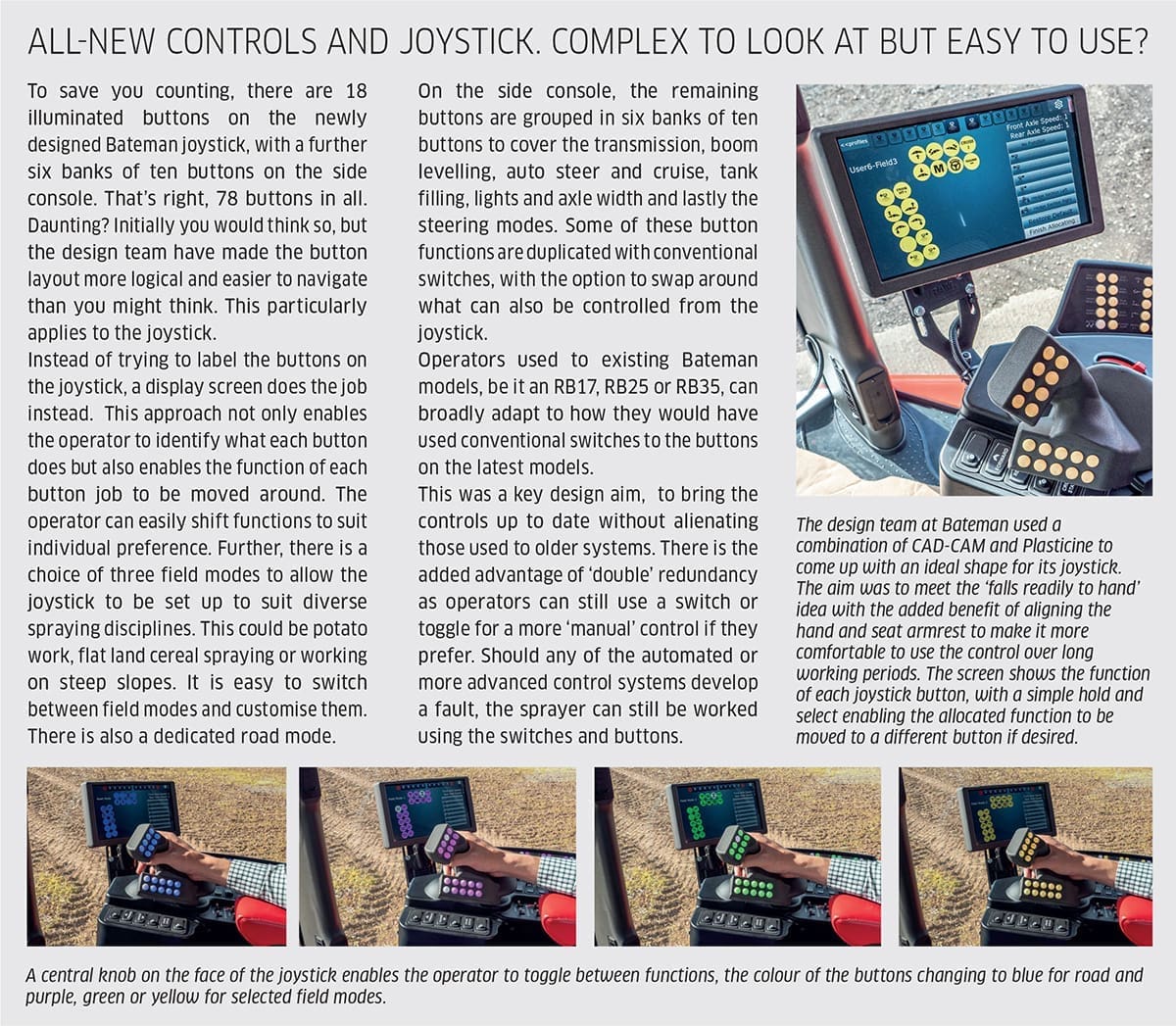
The latter has a unique design that incorporates a large side rest that allows the operator to easily use their thumb to press any joystick button. Each button function is shown on a separate joystick display which we will get to.
The other changes
Before moving on to the other RB changes, it is worth pointing out that the previous generation, introduced back in 2000 with the then new VG booms, were themselves subject to numerous upgrades. The most notable physical change arrived in 2017 with the introduction of the in-house designed and built Bateman Panoramic 3 cab. This cab remains a standout feature on current models, a wide curved front screen and profiled side windows affording good visibility to the front and sides so you can see the boom.
The outgoing RB range could easily have justified a ‘Mark 3’ model moniker, but this terminology was never actually used. This could mean some of the changes introduced with the RB30, RB40, RB50 and 70cm longer wheelbase RB60 will be more noticeable to those with a pre-2000 models. An example is the new Gen 4 VG, Variable Geometry, booms. You will need a keen eye to spot the nips and tucks made to these well-proven booms if looking at the outgoing models but compare them to a 2000 era sprayer and the developments are more obvious.

Boom differences
The key aim has been to improve overall duty strength without increasing the boom’s weight. Bateman still offers a choice of nozzle spacing, but now there are two ‘standard’ options of either a close 25cm or 50cm. The hydraulic break-back at each boom pivot point, not just at the tips, has been tweaked with improved protection should the boom get caught in a tall crop, not to mention if something gets hit.
As before, the VG boom can be fitted with BBL boom levelling, with updated Capstan AG Pinpiont III PMW pulse width modulation and AI powered spot spraying options. VG booms are available in widths of 14m, 28m and 42m, with specifications to include 12m, 24m to 36m units that can be worked in variable widths to suit end user needs.
Both the RB30 and RB40 can be fitted with a simpler Contour Boom. This will span widths from 12 to 24m and has a self-centring break-back system and 50cm nozzle spacing.
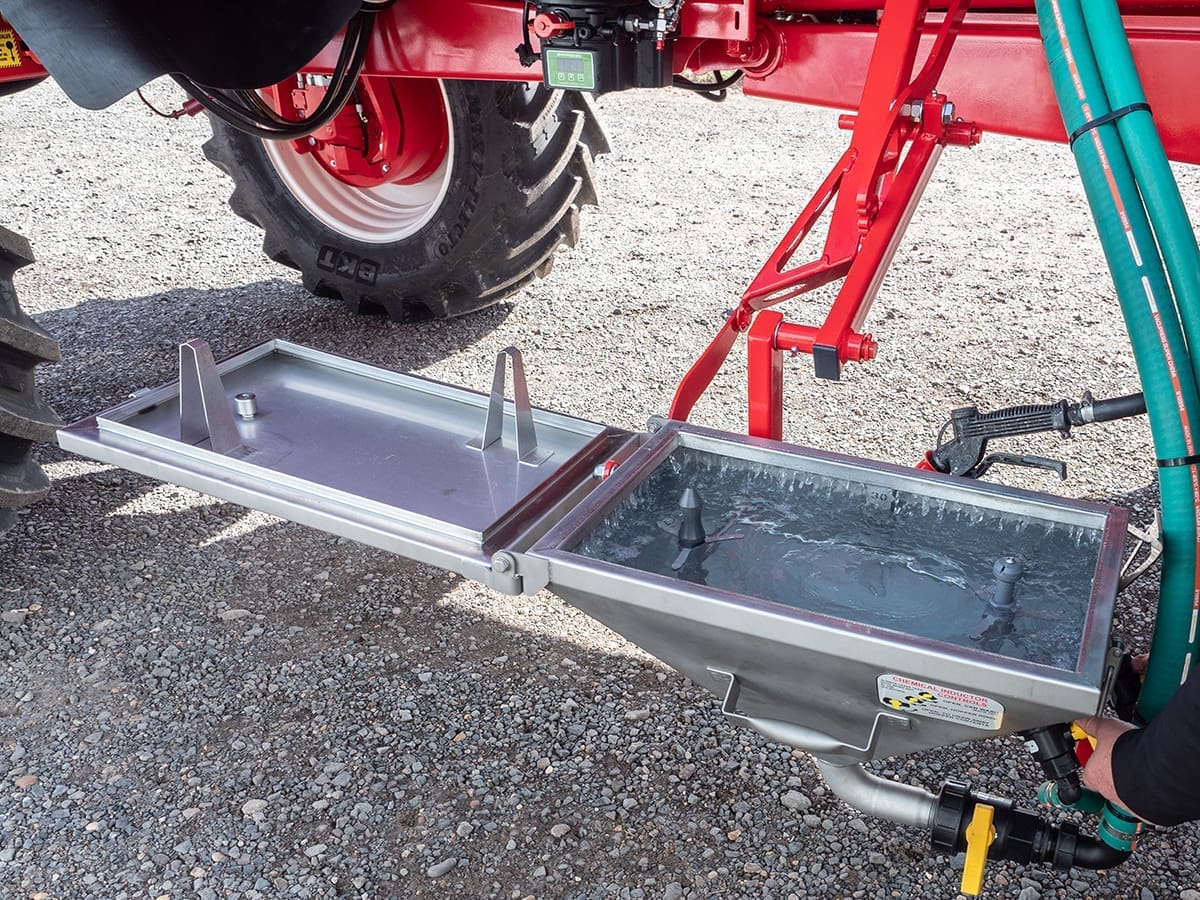
The plumbing system has upgrades to the induction hopper and fill systems. As you would expect, the end user can specify what is fitted but pacer 2in and 3in fill pumps can be fitted to speed filling. The new high-capacity 30-litre fill hopper (25l on the RB30) features a revised assisted lift system to make pulling out and pushing it back in easier.
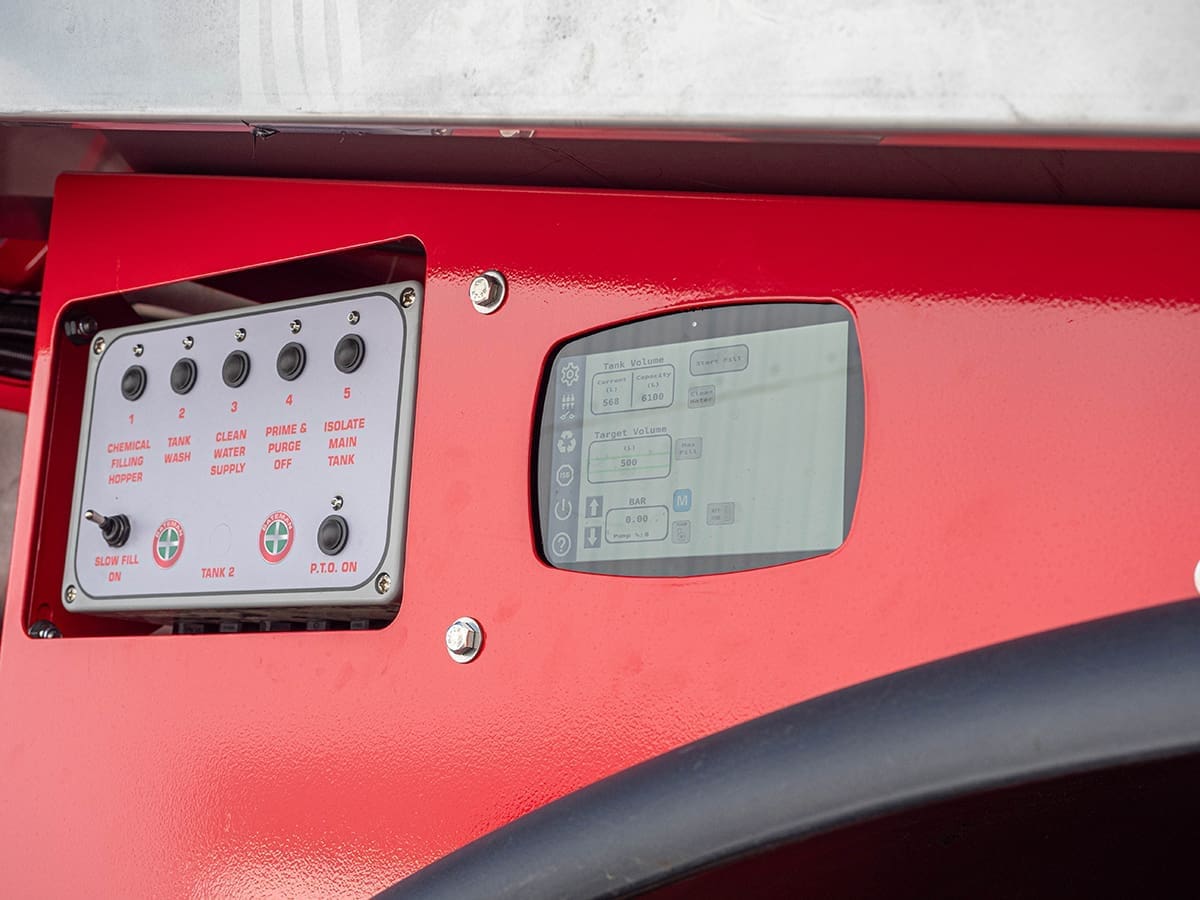
Autofill+ is now offered as an option on all models bar the RB60 where it is standard. This makes it easier to mix and add chemicals, with a display both in the cab and on the side of the tank adjacent to the fill controls.
Same design, updated tech
Moving to the skid unit’s chassis, this is substantially revised in its design detail if not actual layout. The King pins are enlarged from 45mm to 50mm chromed pins, with centralised 22 point greasing an option on all models, the flagship RB60 getting the system as standard. Adjustable track width remains standard, with in cab control as an option.
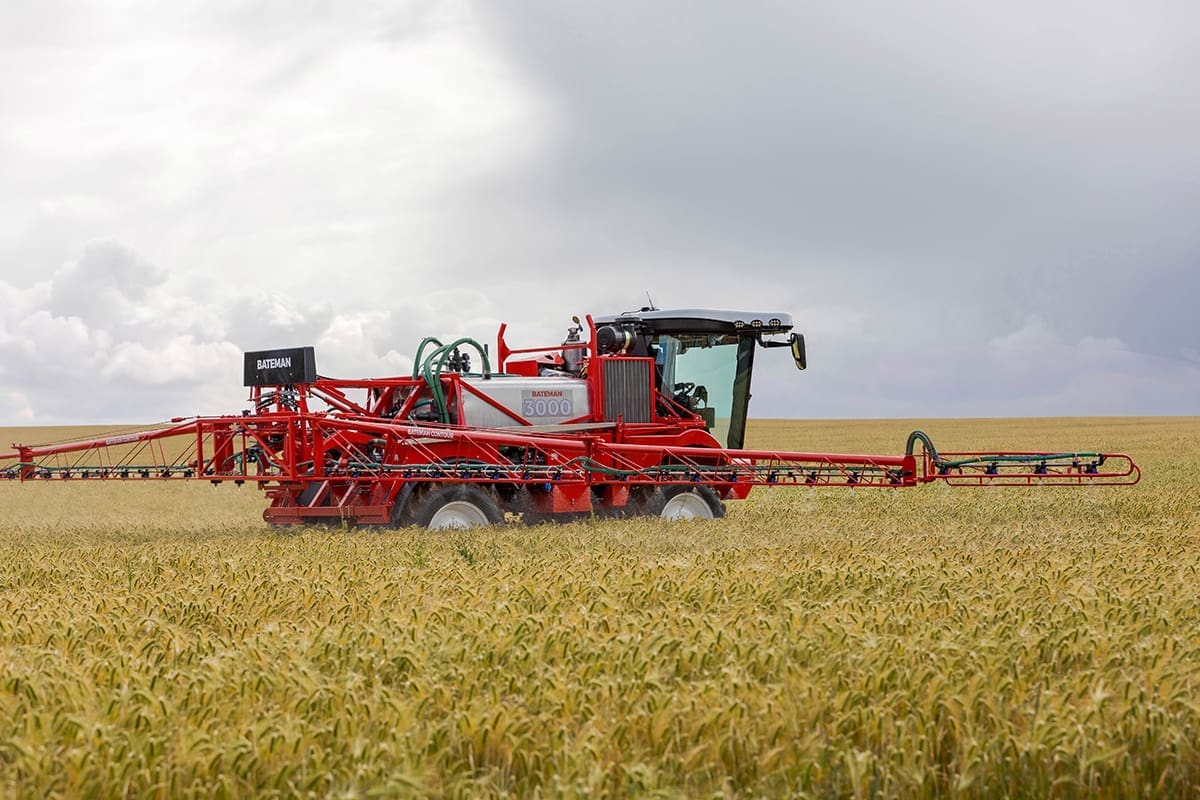
Crawl underneath the chassis, and those familiar with a Bateman sprayer will notice numerous small design changes, such as various brackets having a changed profile or bend, longer radius arms etc. A key challenge has been to increase the strength of the skid unit to accommodate higher capacity tanks without compromising the overall weight of the sprayer. Look through the spec sheets, and the unladen weights of these sprayers are listed from 7,980kg for the RB30 through to around 9,700kg for the RB60.
Bateman do not shy from the fact that these figures can be a bit misleading as there is no such thing as a standard sprayer but even fuelled up and ready to go, a fully specced RB60 with 36m booms will not tip the scales at a lot more.
Now to the drive
We got to try an RB50 with the E-Drive E+ transmission. In broad outline, this is an automated variant of the Bateman four-speed 4S+ design. In automatic mode, which most will default to using, the transmission allows two different cruise control speeds to be set and allow for a separate headland turn speed. In cruise, the transmission looks after the gear ratios according to terrain and the engine speed is altered only as is needed to deliver more power. In level going, the sprayer will amble along at a relatively low engine speed to conserve fuel.

Up a steep slope, the transmission gears down the hydro drive, upping the engine speed if more power is needed to retain the desired forward speed. Although the cruise speed cannot always be expected to be maintained in the steepest of going, the drive will maintain a forward speed that is as near the target as is practical, with traction diverted to the wheel or wheels with the most grip in slippery conditions.
By enabling the operator to concentrate on just the spraying side of the job, this E+ drive will no doubt be the favoured choice. According to Bateman more sprayers now leave the factory with E+ than without.

PWM updates
The sprayer was also fitted with the Pinpoint III pulse width modulation system. Developed by US firm Capstan AG, Pinpoint works by adjusting the droplet size produced by the nozzles. This is achieved by managing the flow and pressure independent of the flow rate to the nozzle, allowing the droplet size to be adjusted regardless of speed. In work, the output from each nozzle can be seen to pulse between alternate nozzles to ensure even coverage across the boom width. What you cannot detect is that the droplet size can be increased to counter drift to the point where you can see any drift getting knocked right back. The system makes it possible to keep spraying in conditions that would otherwise stop work.
Another option fitted was AI-powered Smartstrike X spot spraying technology. Produced for Bateman by Carbon Bee, this system does exactly what it says it will do, selectively picking out plants that need targeting by herbicide. On stubble, the system was set up to spray randomly distributed markers in the field. These were detected by the AI-powered spot detector linked to individual boom nozzles to allow them to apply a dose of spray but without triggering all the nozzles on the boom in the process. Again, this was easy to see working from the cab, with a physical marker check subsequently showing it had indeed been ‘hit’ whilst the surrounding stubble was dry.

Summary
Bateman sprayers have now been offered for over 50 years, the company initially concentrating upon a skid unit that could tackle steep going with a light footprint. As working widths got wider, development resources were poured into boom suspension and levelling, with future investment in spray controllers and application accuracy.
The latest joystick controller is the headline development on the latest RB models, but it is in some ways the easiest to overlook. Why? Simply because the user will just take it for granted as it works so well.
James de Havillant
For more up-to-date farming news click here and subscribe now to profi and save.


