

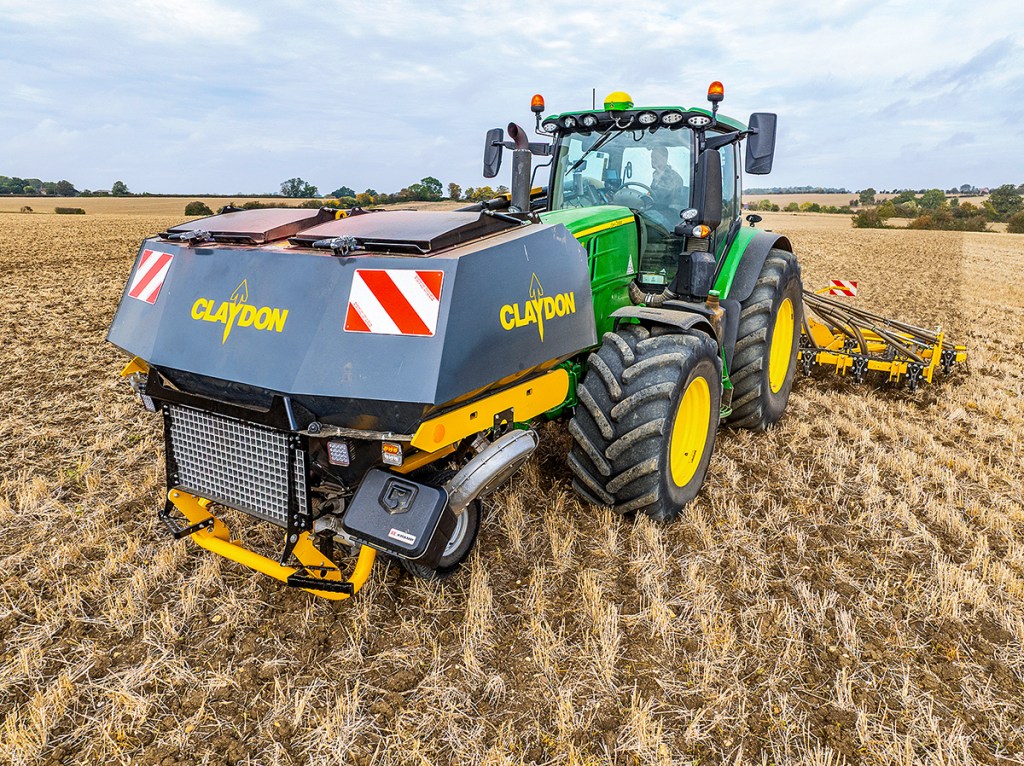
To better balance wider working drills, Claydon has developed a front hopper, rear toolbar version of its Evolution drill. We headed to the field with the 4.5m wide M4.5 to learn a little more.
KEEPING IT BRIEF
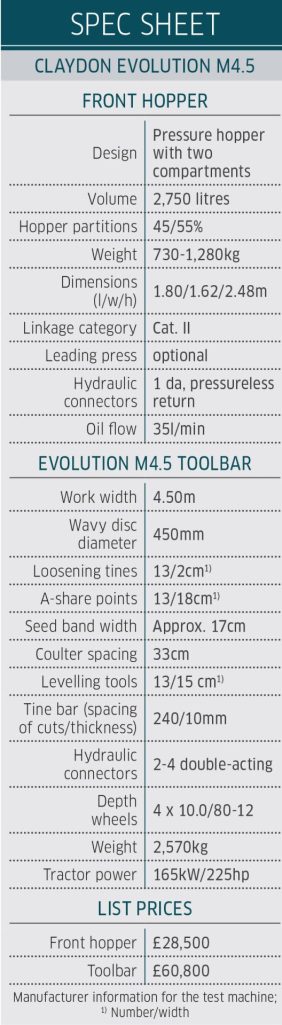
- This M-Mounted Toolbar version is available in working widths of 3.0, 4.0, 4.5, 4.8, 5.0 and 6.0m.
- The front hopper is available as a 2,000-litre or split 2,750-litre version for two products.
- Continues with the drilling system introduced by Claydon in 2003; loosening tine, followed by seeding tine.
Several drill makers offer a front seed hopper, rear sowing set-up, and that list now includes Claydon.
The Suffolk-based arable machinery maker has added an additional range so it now has all the bases covered: the trailed Hybrid T, full rear-mounted Evolution M and, the machine we look at here, the split front/ rear Evolution M Toolbar.
This new six working width model range is essentially the rear-mounted Evolution M drill with its hopper removed. Instead, the seed is stored in a front tank, which it has developed in house. We will get to this new front hopper in a bit, but for now let’s have a recap of Claydon’s drilling set-up.
Two tines
Just as it has done from the start when it introduced the original V-Drill in 2003, there is a leading soil loosening tine working the ground ahead of the coulter tine; in a way it combines strip-till and direct drilling in a one-pass operation. This sticks to the Claydon mantra of working the soil as little as possible, but as much as necessary.
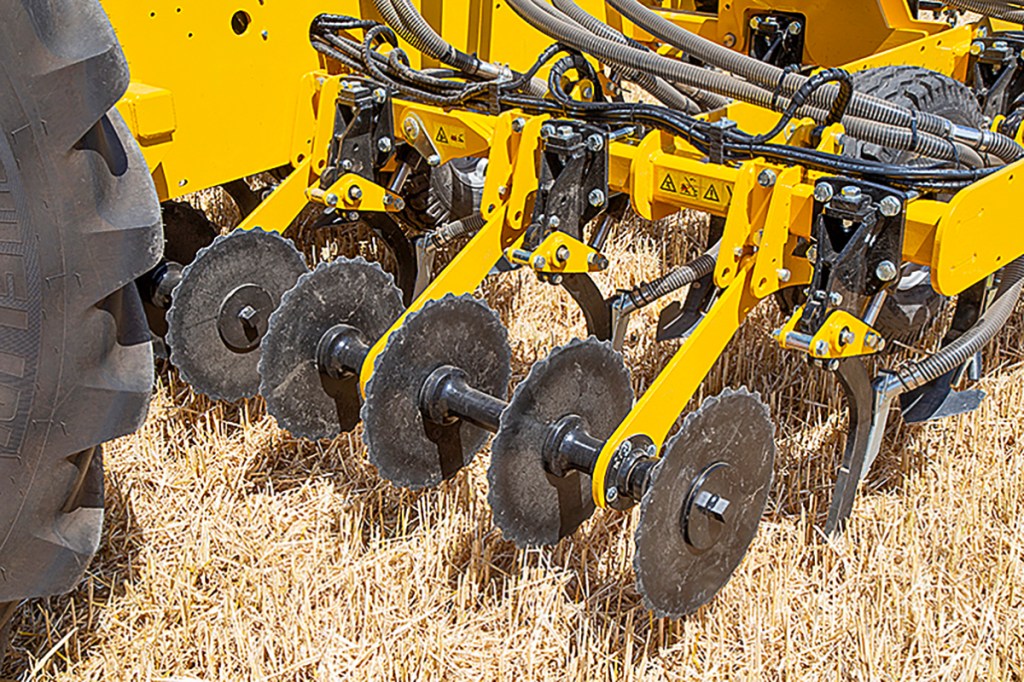
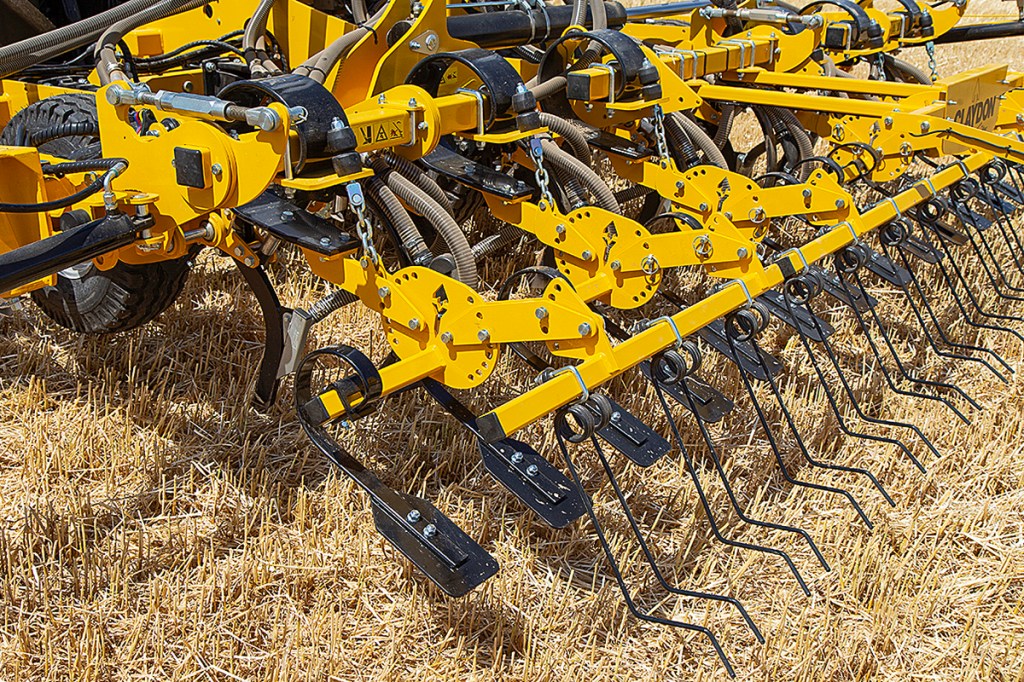
To kick things off, there is a choice of front tools. In our case, that was a row of serrated discs that run directly ahead of the soil loosening legs, cutting through any trash up to a couple of centimetres deep. If you don’t need the cutting discs, they can be raised hydraulically out of work.
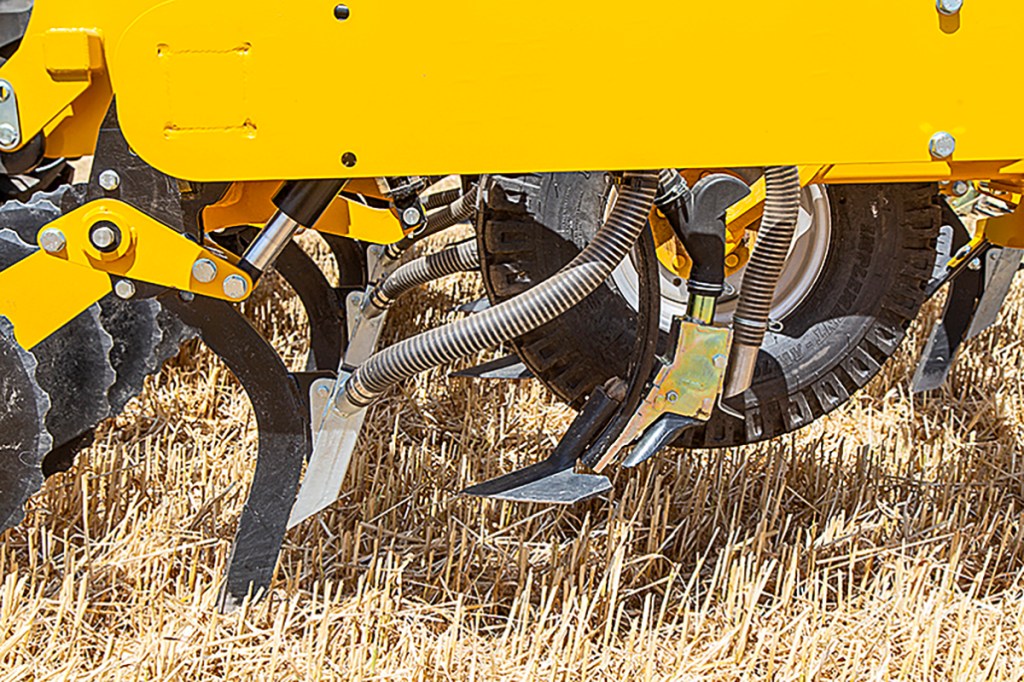
On our 4.5m wide drill there are 13 of the 2cm wide soil loosening tines. Following 28cm behind are the spring tines each fitted with a coulter. This is usually an 18cm wide A-share that places the seed to both sides to create a band.
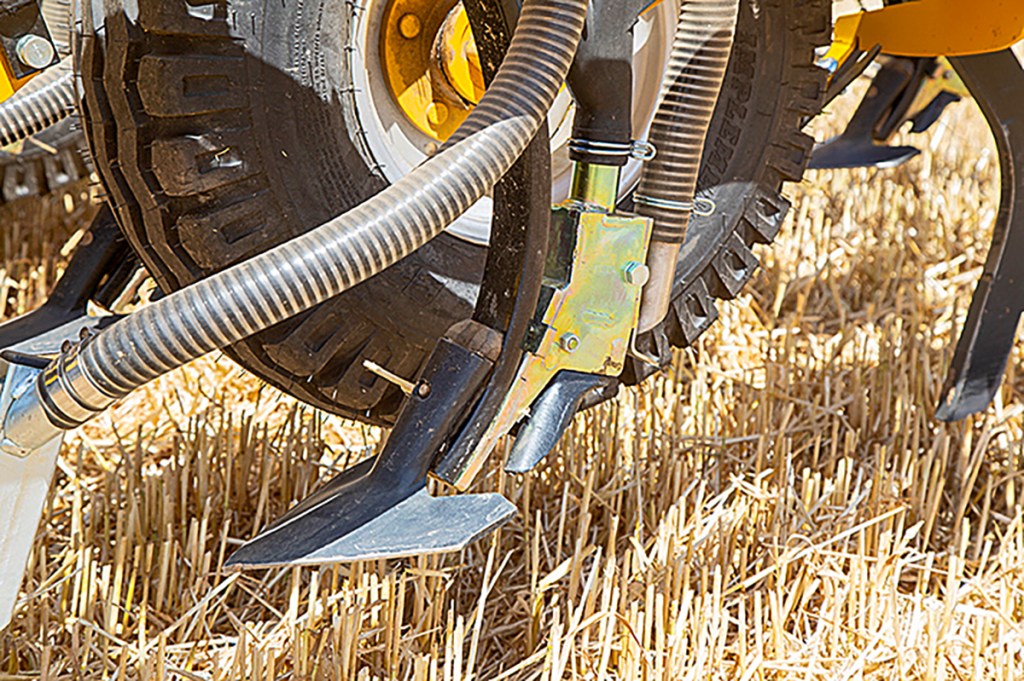
There is also a choice of following tools — levelling paddles, various types of harrow tines, press wheels or cage rollers. This particular drill was fitted with the levelling paddles and a following harrow.
The hardware
In the field, the drill rests on four depth wheels (10.0/80-12). A hydraulic suspension system allows you to alter the frame height and therefore the sowing depth, with clip- on shims for the pistons acting as the mechanical stops. Maximum frame height is 42cm.
The depth of the leading tines is individually adjusted by refitting pins to one of several holes. Working depths of up to 20cm are possible, but 8 to 12cm is the usual ballpark when drilling cereals. These tines always come with hard-wearing tungsten-carbide tips, and standard overload protection is by shear bolts.
For stony soils there is the extra-cost option of hydraulic auto-reset for each tine. This offers a trip force of up 600kg at the tine tip. Fertiliser or even beans can be placed in the shadow of these front tines, although the placement accuracy is not on a par with that of the following tine coulter.
The seed coulters
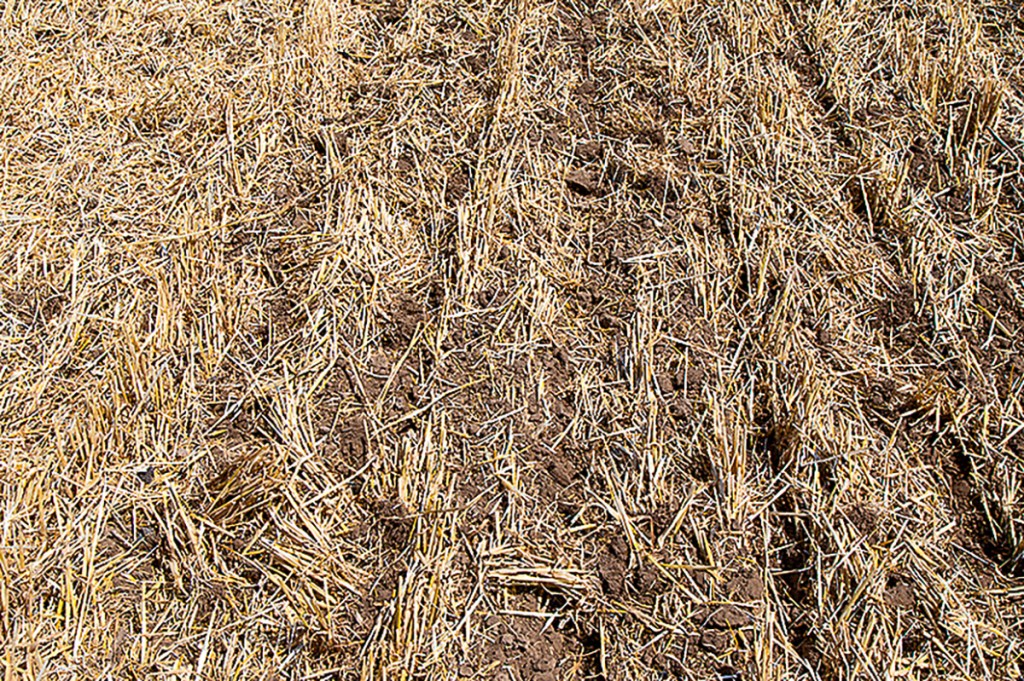
The 18cm A-share can be swapped out for a 12cm version or a 70mm spoon. Claydon sources these components from Bourgault, including their tool-based quick-change system. You can use various seed boots that are bolted to the back of the tine. With the 18cm share, for example, the seed is placed in a roughly 16cm wide band behind the tine. The tines can be followed up by splash plates for applying starter fertiliser or microgranules.
This 4.50m wide toolbar has its 13 tines arranged at 33cm spacings for 16cm seed bands with 17cm wide gaps. These gaps can be filled with cover crops using additional outlets supplied by an optional 240-litre seeder. These outlets are placed just ahead of the levelling tines.
The Claydon does leave a rough-ish finish, which in a very dry time may lead to a loss in moisture. To overcome this, the company recommends rolling the field if needed.
Large front hopper
The featured combination came with the 2,750-litre front hopper which is split 45:55. Alternatively there is a single bin, 2,000-litre version. The hopper does seem well thought out, as good as any of its competitors’, the only fly in the ointment being the relatively small, round lids. But these have since been changed to larger rectangular openings that will make filling an easier task.
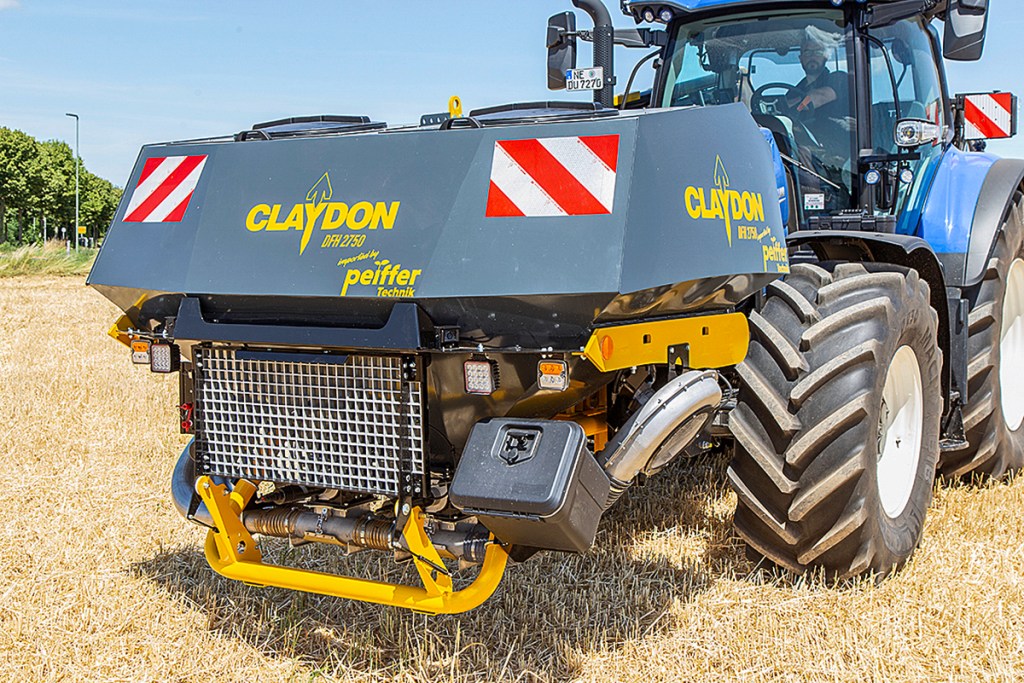
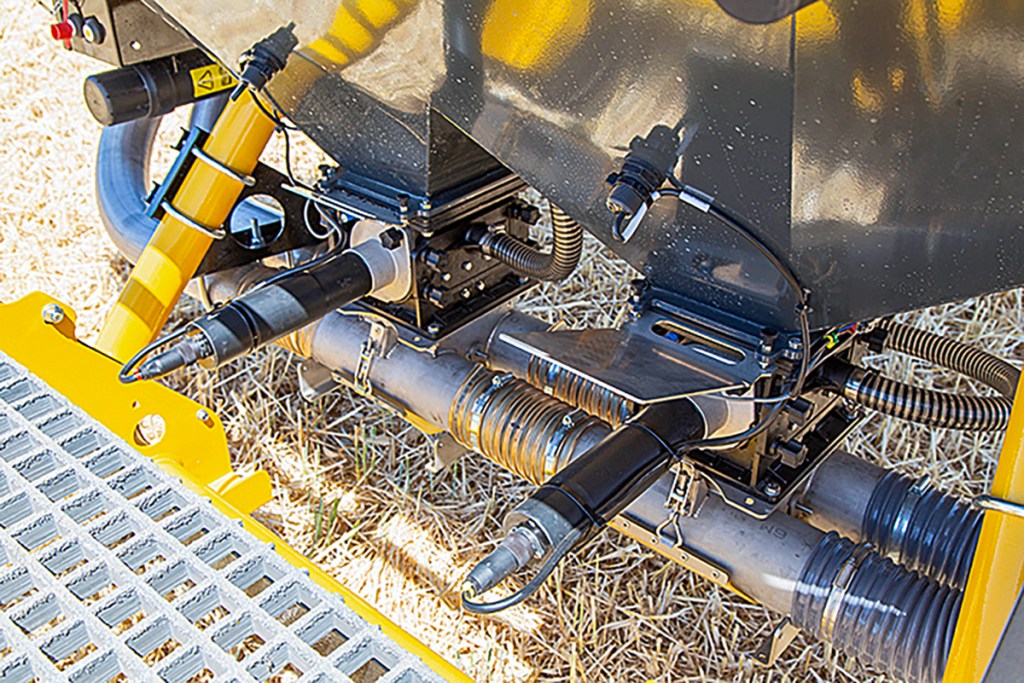
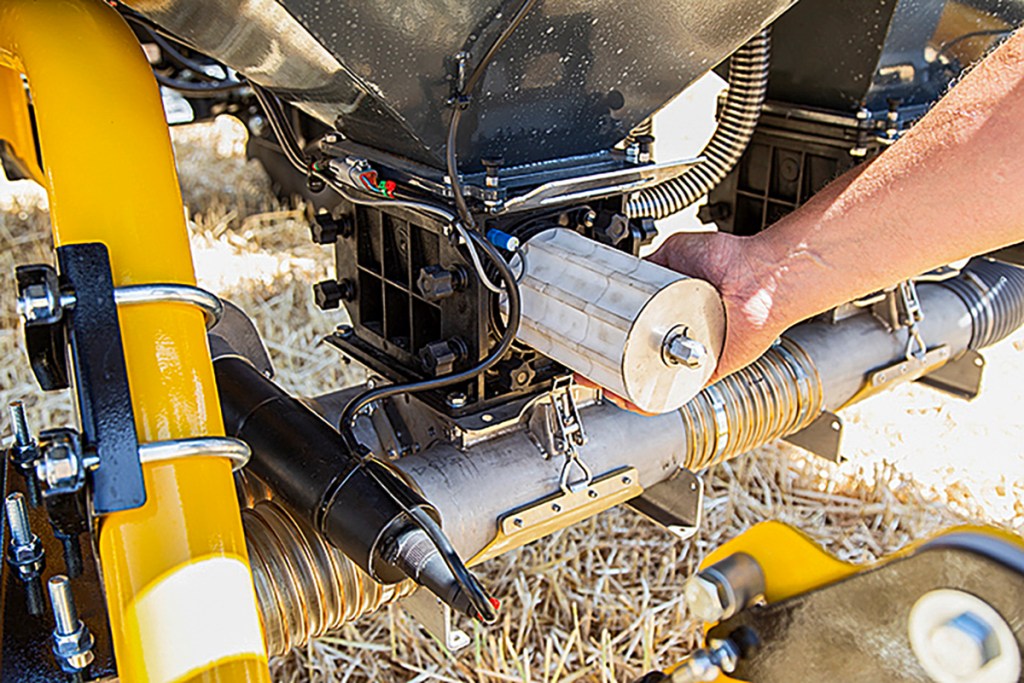
At the front there is a convenient folding platform. Behind it sit the electric metering units with interchangeable metering rollers. Seed calibration is done in the usual way by pressing a button on the hopper and then entering the results into the cab terminal. Swapping the rollers is straightforward and nothing out of the ordinary.
Each compartment has a shut-off slide as well as two fixed level sensors and one empty tank sensor. Options include interior lights and cameras inside the hopper.
Metering options
Material can be blown either into one single delivery line or the flow kept separate into two lines. Air flow is controlled by a diverter valve. The empty hopper weighs 730kg, and there are optional ballast weights of up to 550kg. A steered tyre packer (4 x 7.00/12) is also available.
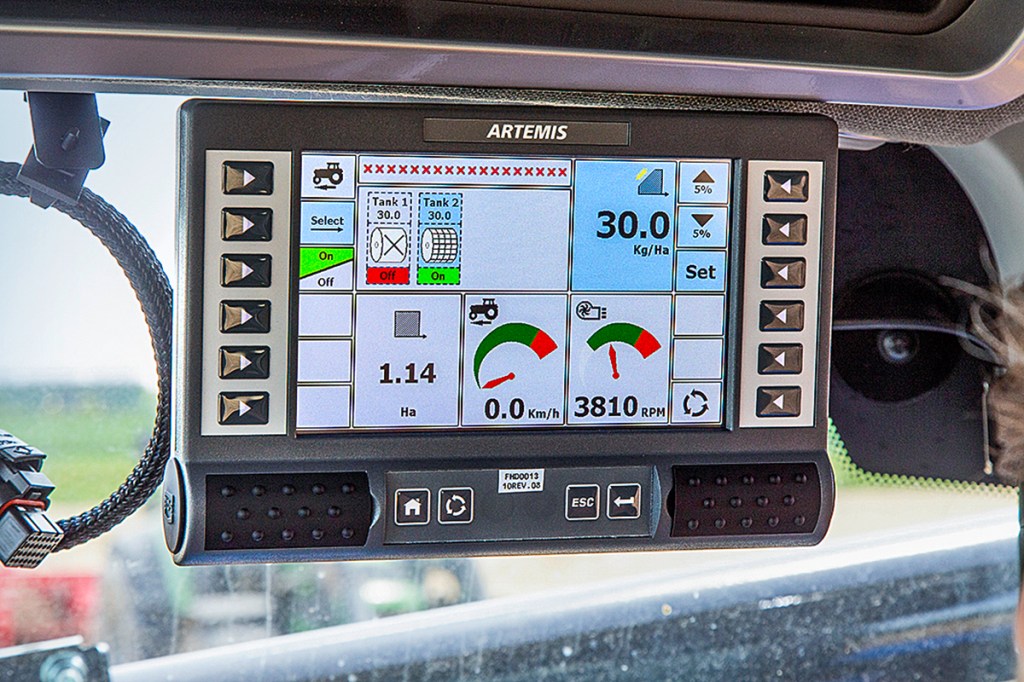
The front hopper is controlled from the standard Artemis terminal. ISObus control is also available as an option. In both cases, variable seed rate is possible, for example using prescription maps; section control is also possible with a task controller.
Supplied with two switches
When used with ISObus, the metering units start and stop automatically utilising the drill tractor’s linkage position as the signal. Without ISObus, there is a toplink switch. A second switch is included as standard so the front hopper can also be used — on a cultivator, for example.
For the front hopper the tractor needs a freeflow return line plus one double-acting spool. The rear toolbar requires two to four additional double-acting spools, depending on spec (front discs, working depth, folding and bout markers).
Prices for the front hopper start at about £26,847. In the specification tested here, the hopper price rises to just over £28,500. As for the 4.50m wide M4.5 Toolbar, this starts at £44,327.
Then when you add the leading discs, three seed placement levels and the rear levelling board with a following harrow and auto-reset system, the rear half of the model seen here costs around £60,800. In total, the tested combination comes to just over £89,300.
Further details in a nutshell
- Using discs ahead of the tine field doesn’t alter the length of the rear toolbar.
- The bout markers have car-type tyres for smoother running.
- The seed distribution heads can be fitted with seed-flow sensors and up to four tramlining flaps on each side.
- Other extras include double discs between the leading and seeding tines.
Summary
Introducing a new toolbar and front hopper, Claydon is targeting those customers who are seeking optimum weight distribution and the flexibility of using the front hopper on multiple implements. Overall, Claydon’s cropping philosophy seems to address the topical issues: cutting costs by reducing the number of passes, limiting soil disturbance and applying several products in the one operation.
Fundamentally, the Claydon system focuses on loosening the plant rooting zone while thoroughly clearing the seed slot of surface trash.
Sönke Schulz
For more up-to-date farming news click here and subscribe now to profi and save.