


4Disc has come up with a completely new way of drilling crops with its ‘hollow principle’, and we have been to the field to find out more.
KEEPING IT BRIEF
- The design combines full-width cutting with the drilling operation.
- Initial 3.0m and 4.0m versions, but semi-mounted and front hopper variants are planned.
- Depending on the preceding primary cultivations, the seed is placed on a moist layer free of organic matter.
The 4Disc Shift definitely falls into the quirky category of farm machinery. The German manufacturer has taken its already unusual Acticut cultivator (see profi 3/2025) and turned it into a seed drill, which may well be what some farmers are looking for.
Indeed, the maker suggests that the Shift’s spinning disc drilling technique offers the capability to conserve moisture even when there is only a moderate amount of organic matter to contend with. And if that wasn’t enough to fight for your attention, it can still be used for full-width, shallow cultivation or mechanical inter-row weed control.
4Disc was founded in 2019 when a group of mechanical engineers and fruit growers came together. At Agritechnica 2023, it took its first steps outside of the specialist sector with the Acticut, a shallow cultivator that relies on hydraulically driven discs that cut the soil across the full working width of the machine. The idea first came to the now 12-strong team from their experience in growing strawberries, where the design was already being used to lift the plastic sheets.
Shift takes it further
With sales of the Acticut now said to be in the hundreds, the manufacturer is taking a step further by introducing the Shift. While this retains the fundamentals of the rotating disc design, it has reworked the rotating disc and given each one its own depth control system.
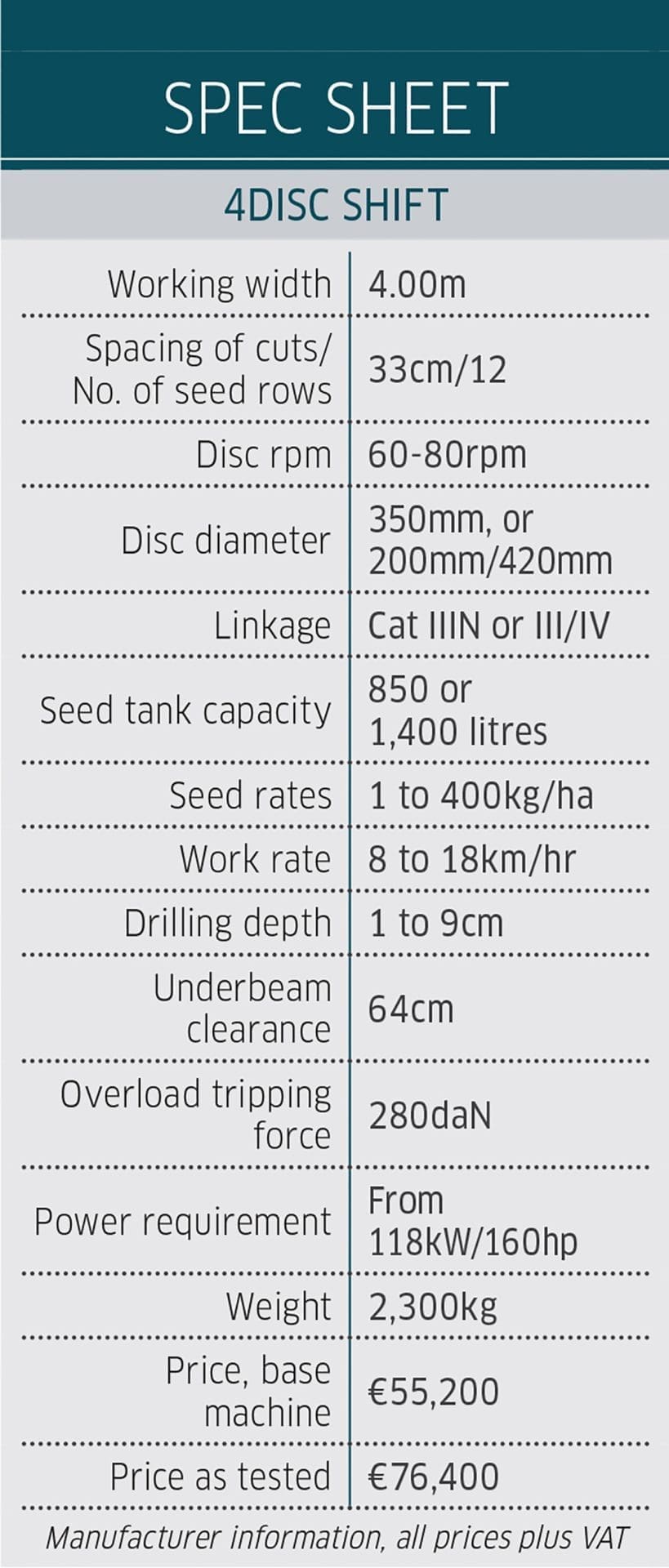
The discs assemblies are spread across three rows, resulting in a 33.3cm row spacing. Each of these disc units has its own Danfoss hydraulic motor which uses chains to rotate the hollow shaft that has the seeding disc on the bottom. These typically spin at about 60 to 80rpm, preventing soil from building up in front of the discs. There are plans to change the chain drive to a fully enclosed gearbox in the future.
Unlike on the Acticut cultivator, the Shift uses hollow 70mm diameter (12.5mm thick) driveshafts, which also double up as the seed delivery tube.
Two bearings support each shaft, and on-farm replacement sounds feasible, at least in theory. As of yet, 4Disc says wear has not been an issue thanks to the low disc speed. Three bolts fasten the discs to the driveshaft and there are various seed or cultivating discs available ranging from 200mm up to 420mm in diameter.
For sowing, 4Disc recommends the 350mm wide discs, which produce a seeding band of around 20cm in width, helping minimise overlaps. When not drilling, it recommends the wider manganese boron steel discs.
Integrated into the centre of each disc is a replaceable fixed cone as well as a scraper. The fixed cone spreads the seed across the band, like a splash plate, while the scraper prevents blockages. The hollow driveshafts are angled at 5°, helping the front edge of the disc bite into the soil. The elements can also be pressurised hydraulically, with two springs each with a trip of 280daN helping to protect each unit from being overloaded.

Parallelogram mounting
Unlike on the Acticut, to improve the ground following, each unit on the Shift has a neat parallelogram linkage connected to a large 460x140mm gauge wheel. Drilling depth can range from 1 to 9cm, and this is adjusted hydraulically via a spool valve. Alternatively, adding deflector plates allows the seed to be placed on the surface. Buyers can opt for an optional weight transfer frame for the lower links to aid penetration.

Field experience
Drilling at a depth of about 3cm, the Valtra T215 up front didn’t break a sweat. Even when we temporarily dropped the Shift to its maximum working depth, the tractor still had plenty in reserve. Lifting the drill at the headland, we felt the front axle going light, so front ballast is worth having. We worked at around 12km/hr, and there were no signs of blockages in the winter-killed cover crop — even on the levelling or harrow tines.

Speaking of the levelling tools and depth control, each section has to be adjusted separately in two points by refitting pins. A more convenient adjustment would be nice. As an extra-cost option, you can adjust the harrow hydraulically from the driver’s seat, but height control remains a hands-on pin refitting operation. The drilling depth and harrow angle adjustment job is made slightly easier with large, durable scales.

Tank with distributor head
The 850-litre seed hopper with its roll-up tarp cover tucks in behind the headstock. Hopper extensions are available, increasing the overall capacity to 1,400 litres. As the machine weighs 2,300kg when empty, it’s good advice to tailor the hopper size to the tractor. With the low-profile hopper in place, rearward visibility was still acceptable, but, if you are tempted to add the greedy board extensions, it’d be worth fitting a reversing camera, too.

The distributor head is inside the hopper. For the 12 coulters we found a head with 24 outlets. Each row is fed by two hoses placed side by side — opposite one another would be better for hillsides, for example. The manufacturer quotes seed rates of 1 to 400kg/ha. Spelt and beans shouldn’t pose a problem.

The bought-in electrically driven metering unit is very similar to the Accord metering unit. For calibration you have to disconnect the delivery hose — fair enough, but several other manufacturers have since found much neater solutions.
The actual volume of the metering wheel is adjusted on an easily accessible spindle. A supplied insert is used for metering small seeds. A flap for emptying larger quantities of any leftover seeds, a simple-to-reach calibration button and a defined hanging point for the scales supplied round off the metering system.

When it comes to the control box, 4Disc uses a terminal from Müller Elektronik, (now PTx Trimble). This ISObus unit looks after the tramline flaps and monitoring the delivery tubes. The user interface is best described as functional.

Other details
- The frames that carry the seeding units are spaced 76cm behind each other.
- The company quotes a machine ground clearance of 64cm.
- 4Disc says that trials so far have shown there is less weed growth between the rows thanks to the shallow cultivation.
- The tested machine needs three double-acting spools: for folding, working depth and the harrow. On top of that, a single-acting valve plus a return line is needed to drive the fan and, in parallel, the drill’s seeding units. An oil flow of about 40l/min is sufficient. When the machine is used without the drilling function, the fan can be shut off with a ball valve.
- 4Disc welds and assembles the machine in-house. The paint finish is carried out by partner firms.
- When using the machine as a weeder, the tractor has to drive at an offset from the original wheelmarks — quite a compromise when it comes to working the outside rows.
- The direction of rotation of the seeding units is selected depending on their position and for making sure that no soil is thrown out of the machine or into the depth control wheels on the sides. The finish looked good.
- As there is no traditional seed slot, no trash can end up underneath the seeds. But they can be covered with quite an amount of organic material.
- On price, the 4.0m Shift starts at around €55,000 without a seed hopper but with the distributor head. With the hopper, the listed price climbs to €70,350, and tank extensions cost around €2,800. Seed flow monitoring adds about €4,000 and the weight transfer frame €1,700. Hydraulic harrow adjustment is priced at €400 and markers are available for €2,300.
Summary
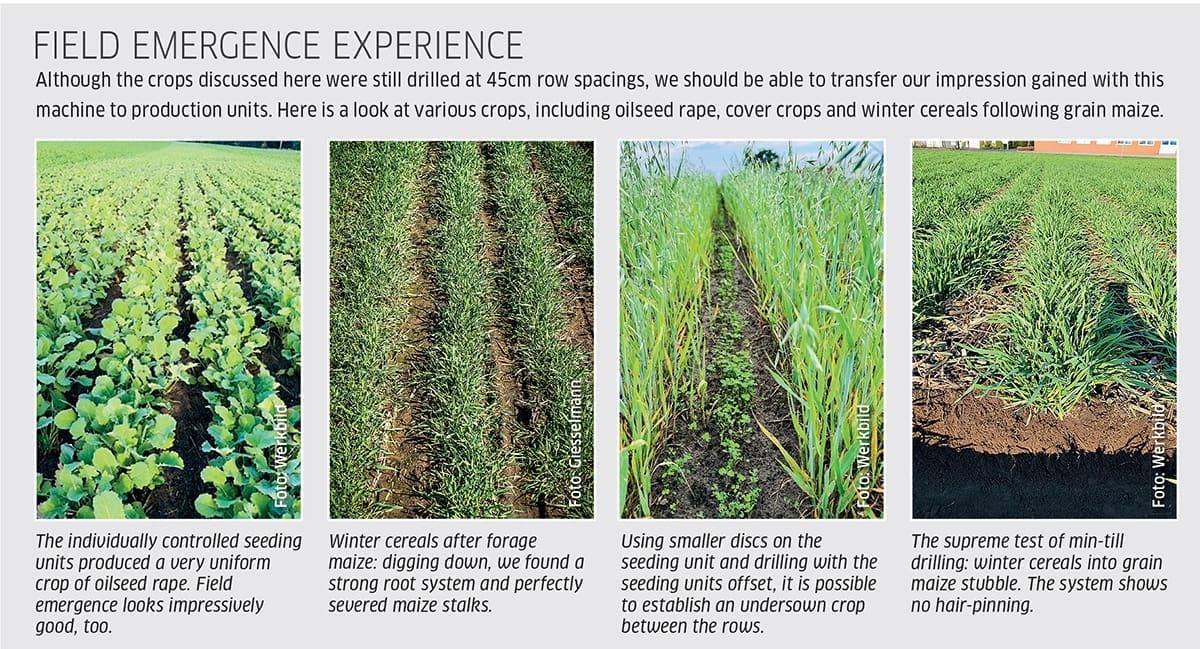
This is basically a rather straightforward design, and once you see the established crop you can see the 4Disc logic. The first-rate depth control of the seeding elements leads to an extremely uniform emergence.

Another intriguing aspect about the Shift is its versatility. It can still be used as a full-width, shallow cultivator and as a kind of direct drill for establishing cover crops or cereals. The results look very promising even after grain or forage maize. We see the roughly 6.5cm wider row spacing as having little bearing on yields. On price, the 4.0m model is attractive, especially if you already have a front-mounted hopper.
Sönke Schulz
For more up-to-date farming news click here and subscribe now to profi and save.


