


Increasing machinery prices are opening the door to less familiar names. We have been using Unia’s Cross II cultivator to see if it is a genuine alternative to the mainstream players.
KEEPING IT BRIEF
- Our test spec cultivator lists at around £16,000.
- With coil spring leg protection and a ring packer it is capable of tackling heavy and stony ground.
- A few details take the shine off an otherwise good impression.
A tine cultivator can be a universal tool, an arable Swiss Army knife if you will.
Dressed up with the appropriate wide-wing points, it can be used for shallow soil and surface trash mixing or, with its wings clipped, for some deeper digging. This is exactly what we expected of Unia’s Cross II, which we worked for several months last season.
As the name suggests, the Cross II supersedes the Cross, which we previously looked at in profi 6/2022. With the significantly lighter Cross II, Unia is pushing hard in Germany where this type of cultivator can be found on most farms. Over in this corner of the world, Unia’s distributor is Manterra and Vegcraft for the UK and Egmont Agri in Ireland.
2,240kg on the scales
We put the Cross II to work on an organic farm incorporating stubble after cereals, soya and maize as well as working the ground a bit deeper ahead of oilseed rape. Depending on the terrain type and chosen working depth, we ran the 3.0m cultivator on either a 150 or 200hp tractor. Both had the required lift capacity to handle our auto-reset machine with V-ring packer plus the with hydraulic depth control.
When fitted with the winged points it tips the scales at 2,240kg. On our John Deere 6195R, this removed 2,360kg from the front wheels and increased the load on the back axle by 4,760kg, so front ballast is a must.

Room for improvement on the cultivator’s headstock
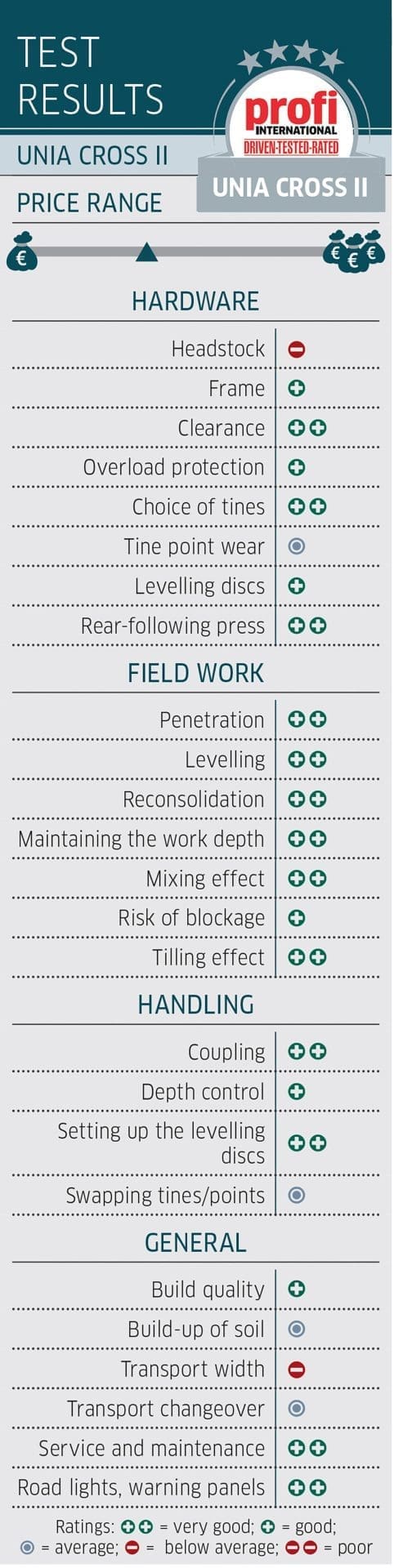
The headstock has holes for both Cat II and Cat III couplings, but the pocket the hook ends sit into would be better with a bit more room. As for the geometry, we also reckoned the top link holes could be higher allowing the top link to be set at a steeper angle, which would improve the line of draft and provide more ground clearance when the machine is lifted. Likewise, a shorter top link would allow the rear of the cultivator to lift higher. On steep gateways, the 6195R sometimes lacked enough ground clearance, and it’s not a small tractor. Unia agreed and has since made these changes.
We liked the tilt-adjustable marker board with LED lights, but were less keen on wiring that is held in place with plastic clips glued to the frame. These offered little protection to the cable, and the same applies to the junction box located on the headstock. In fact, clay clods soon damaged the wiring. Unia says the cable routing has since been improved and the junction box moved to a more sheltered spot — good to hear.

As for servicing, there are 10 grease points on this cultivator — four for the tine depth adjusters, four on the levelling discs and one each side of the packer — all easy to get at.

Solidly built
The main frame is made from 8mm thick, 100mm box. Ten tines are spread across three rows in a three, three, four format, resulting in a 30cm tine spacing, which is the norm in this class. With the 37cm wings, the overlap is 7cm.
On our machine, when the winged points were fitted, the overall width measured 3.05m. Luckily the tines are clamped onto the frame, so that they can be repositioned to help stay within that crucial 3.00m transport width.
Our test cultivator was the auto-reset unit, a £3,300 extra. Each tine has a pair of coil springs, one inside the other with a specified trip force of 600daN.
Narrow and wide tine points
Unia also treated us to their longer wearing ‘Durum’ metal, the 7cm points which are hard-faced with tungsten carbide tiles. The points have a quite steep 40° angle which helps the pull into hard ground. Above the point is a twisted deflector plate; not only does this protect the leg but it also helps incorporate trash. Unia also supplied bolt-on wings, extending the cutting width by 30cm.
The winged tines are fitted with two carriage bolts, which go into square holes, so you only need a spanner or impact gun for the nut. Unfortunately, the nuts stick out past the tines, so the flow of soil will wear the protruding thread over time.

One important point: the wings start about 3cm above the point tip and rise towards the rear. We measured 7cm between the point and the top edge of the wings. In other words, if you want a full-width cut 3cm deep, you’ll have to run the points 10cm deep — worth bearing in mind when choosing tines. Going deeper wasn’t an issue, down to 30cm.

Hydraulics, clips and handles
Depth control on our machine was achieved by the hydraulically operated roller. Flip- over shim clips limit the stroke of the rams, so you can briefly reduce the working depth from the tractor at any time. If you want to work deeper, you’ll have to hop down and flick some of the shims out of the way.

Between the tines and the roller sits a row of scalloped 460mm levelling discs. These are mounted in pairs and protected against overload with rubber sausages. The frame for the discs is directly linked to the roller frame by two spindles, so adjustments are only required when you make significant changes to the tine depth. The two spindles are connected so they can be operated from one crank handle.

Outboard discs run at a steeper angle in the direction of travel. They can also be adjusted individually for height (seven positions) and shifted outwards in 3.5cm steps. That works well, as long as any soil and/or crop residue doesn’t collect between the inner and outer sections. There’s no hydraulic adjust option.

Unia supplied the test cultivator with a 600mm ring packer. Between its 20 rings sit leaf-spring scrapers, which keep the packer running free and help crumble the soil. Their angle can be set in four steps.

Packer performance in the heavy soil was constantly impressive, doing a top job of breaking down clods and reconsolidating the tilled soil.
Field work
The Cross II gave us barely any cause for complaint in the field. Once you have got a feel for the interplay of working depth, position of the outboard discs and forward speed — as with any cultivator — it’s an easy machine to use.
Incorporating oat stubble, we were running at about 9cm, which we considered to be the realistic minimum working depth. For soya trash, we went about 15cm deep to take out combine wheelings. On both occasions we were surprised by how easy the machine was to pull. After soya we felt the finish was actually better without the winged tines in terms of mixing and crumbling.
To get a good go at perennial weeds, we left the wings on for deeper work down to 25cm. Even so, we still managed 8.5km/hr on clay loam with the 200hp John Deere, creating a crumbly, almost too fine surface.

We never once blocked the Cross, though tough crop residues frequently accumulated over the deflector plates and around the bearings of the levelling discs.

Interestingly after a total of about 40ha, the winged shares were showing clear signs of wear. The eroded metal was most obvious on the wings, which, due to their position, are the first to meet the soil. The tines on the following tool bars are far less affected in terms of wear.


Summary
Unia’s list price for our test spec Cross II is £16,000 for the auto-reset machine with ring packer, making it well suited to working stony, heavy clay land. The base version starts at £10,700. That’s a saving of a few thousand when compared to more familiar household names. In many respects the Cross is on a par; there are just a couple of areas such as the headstock geometry and wear on the wing fastening bolts that need refining. Unia has already sorted the cable routing for the lights.
When it comes to build quality, Unia has nothing to hide, either. On the odd bolt and its matching hole, we even found that the manufacturing tolerances were a touch too tight — a little more leeway would actually improve operator friendliness.
Andreas Holzhammer
For more up-to-date farming news click here and subscribe now to profi and save.


