

With an operating weight of around eight tonnes, the midi excavator offers huge flexibility for farm use, and with a decent selection of attachments it can become much more than just a tool for cleaning ditches. We take a look at some popular choices, for those thinking about adding a midi excavator to the fleet.
KEEPING IT BRIEF
- Check hydraulic oil for colour and smell
- Tracks, rollers and sprockets are wear items
- Inspect pins and bushings – can they be replaced without line boring?
- Battered panels suggest a hard life
- Look for service history
I
f ever there was a machine that had a misleading nickname, then it has to be the ‘digger’. While digging holes was once the primary focus of the humble excavator, there’s now a whole industry of attachment makers keen to help operators get much more from their tracked excavators.
Beyond a simple selection of digging and ditching buckets, the venerable digger can be used with hydraulic breakers, grabs, grapples and thumbs, tree shears, compaction plates, crusher buckets, screening buckets, tilting buckets, forestry rakes, earth augers, rippers and flail mowers, to name just a few.
You can even buy an excavator-to-telehandler adapter that is compatible with JCB’s Q-Fit attachments.
Excavators are available in a wide range of sizes determined by operating weight. At one end of the scale there are micro and mini excavators with operating weights from 800kg up to around three tonnes, and the polar opposite would be heavy earthmoving machines weighing around 80-100 tonnes.
For this buyer’s guide, we’ll be focussing on midi excavators weighing around eight tonnes. It is a weight category that offers enough reach for most on-farm digging and draining needs, combined with good hydraulic performance to operate oil-hungry attachments.
At eight tonnes and shod on rubber tracks, this size of excavator easily delivers with yard manoeuvrability, and can also be moved with relative ease via low-loader trailer when needing to reach outlying blocks of land or satellite yards.
The list of players in this sector is extensive, and this is now a weight class that has become increasingly popular in recent times with house building companies. As a result, there are many different options and configurations to sift through. Machines can include blades, offset booms, triple-articulated booms, fixed booms, steel or rubber tracks, conventional and zero-tail swing designs – the latter have a reduced rear overhang, which makes them easier to use in confined spaces. However, access for servicing and repairs can be far more challenging on these versions.
In addition to the usual checks surrounding power units, the midi excavator simplifies checking pin and bush wear by placing the bucket on the ground and gently moving the joysticks to ease load on and off the machine. Alternatively, slewing side-to-side will highlight any excess movement in the boom and stick pivots that may need attention – while some models use replaceable bushings, others may need more complex engineering solutions to remove excessive wear.
It’s also important to check the safe operation of a hydraulic quick hitch, which most machines are now likely to have. This will ensure attachment security, for those constantly swapping between work tools.
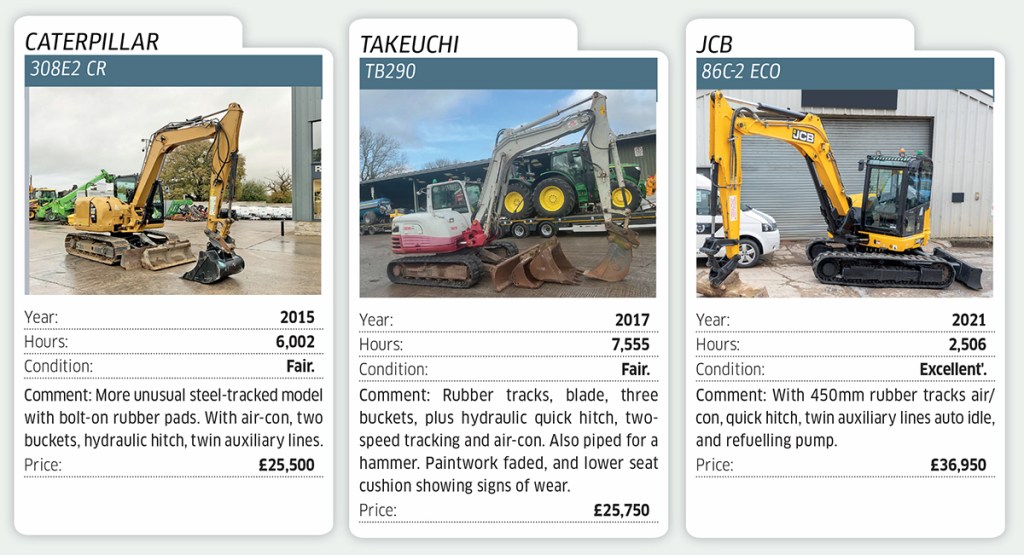
Our choices featured in this guide came down to some of the more popular models on the market, comprising Takeuchi, Caterpillar, Kubota, Doosan and JCB.

JCB 86C and 85Z
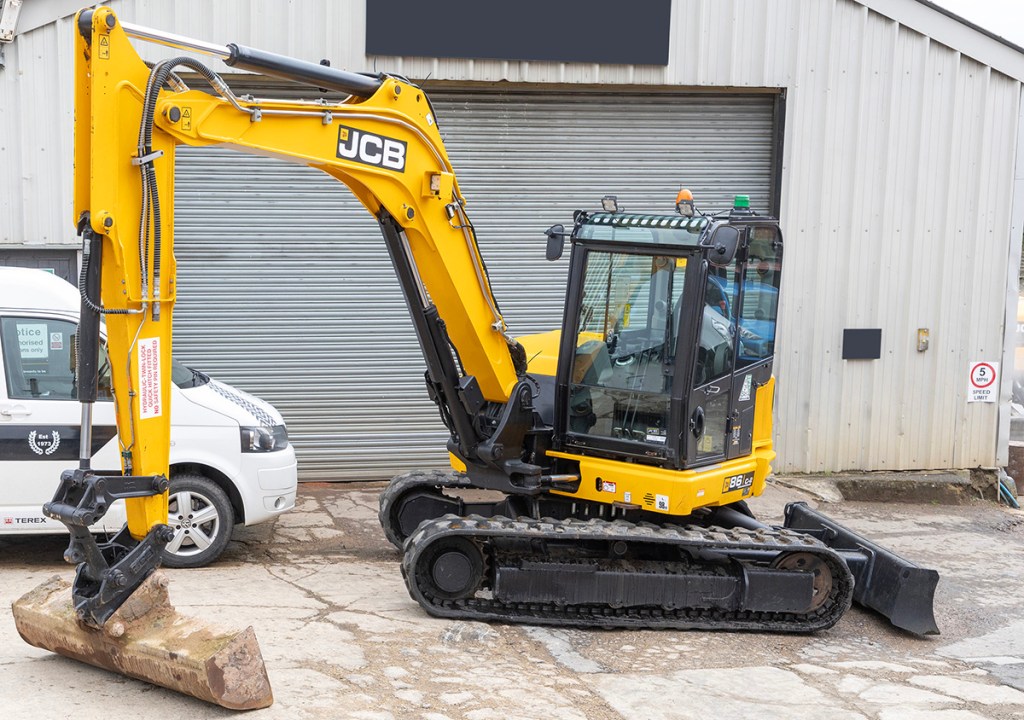
British maker JCB introduced its 64hp conventional 86C-1 and zero-tail swing 85Z-1 models in 2014. Both tip the scales at around 8.5 tonnes, and offer decent working envelopes that could suit most farms’ needs for reach and dig depth.
A new cab brought 6% more space and 11% better visibility than on previous JCB midi excavators. These models also gained an H-pattern track frame carrying longer tracks for improved stability, and an increase in travel speed from 4.2km/h to 5.0km/h. Steel body panels replaced plastic items while 500-hour greasing intervals contributed to lower operating costs.

Later Dash 2 versions arrived in 2019, and while engine power remains unchanged, it meant EU Stage V emissions compliant engines arrived with an integrated DOC and DPF package.
Dash 2 models also saw a number of refinements added, including the arrival of a new 18cm in-cab colour display, a working range indicator, machine health check screen and eight additional tie-down points to improve security when being moved by low-loader.

Inside the rear counterweight is a Kohler diesel engine. This four-pot turbo diesel pushes out 64hp for the 86C. Being a Dash 2 example means there’s an integrated DOC and DPF emissions package, where earlier models brought slightly less complexity. There’s no need for DEF.
In addition to the usual checks to determine oil and coolant levels, and any associated leaks, also check for signs of exhaust system cracking, which may be caused by vibration.
Early models were Stage II emissions compliant meaning less fuss, and perhaps greater long-term reliability with reduced cost. Expect newer machines to be supported by service history, with older models needing greater diligence when it comes to assessing overall condition.
In addition to auto idle functions, the newer Dash 2 gains an auto stop function, with a 30-second count-down timer leading to engine and system shut-down if controls are not used for extended periods.
JCB’s 86C carries a total of 118-litres of hydraulic oil, with 66 litres held in the hydraulic tank, accessed under the right-hand side canopy. A sight-glass lets you assess the oil level and colour – the latter being a good indication of oil condition. Dark hydraulic oil suggests it might have over-stayed its welcome, and is also an indication that oil has become hot.
Bosch Rexroth hydraulic valves along with Nachi slew motors and track drives are used, with JCB using a reduced-loss hydraulic system. Operating with reduced back pressure, eliminating parasitic losses, the firm says its hydraulic system puts less demand on the engine, reducing fuel consumption.
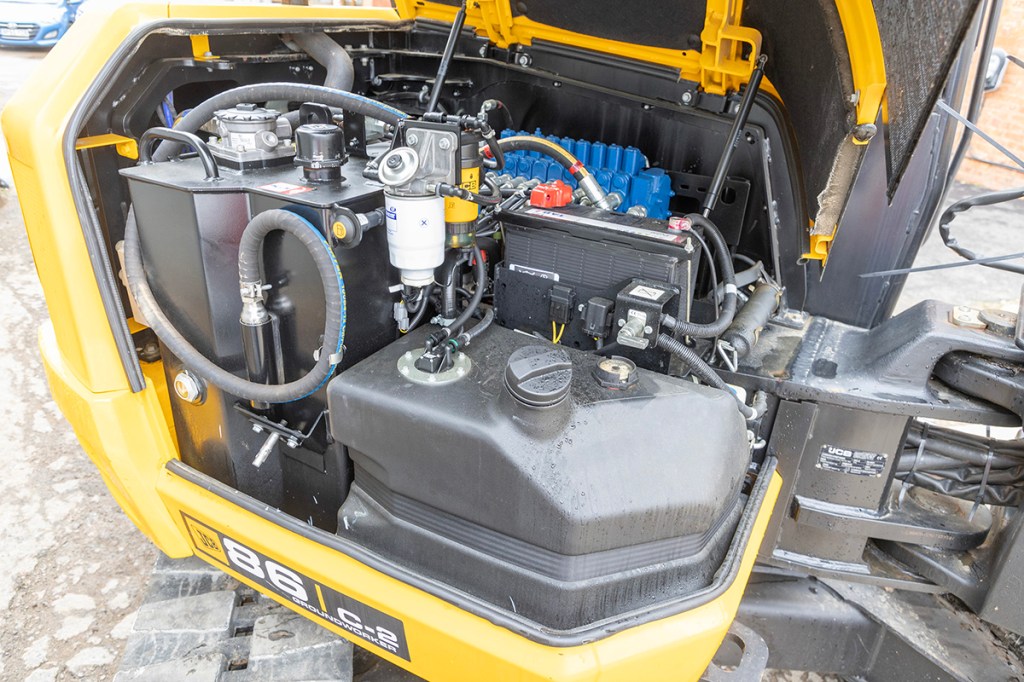
This 86C comes with a built-in refuelling pump, making it easier to refill from drums when working in remote locations. The tank holds 112 litres of diesel.
Operator space and comfort was improved when JCB introduced its 86C and 85Z models in 2014, with a claimed 6% more space and 11% better visibility.
Air conditioning was optional on the ROPS/FOPS structure, and the standard adjustable suspension seat could be replaced by an optional, heated, air suspended seat.
Scroll through the monitor and check its functions work correctly. It provides 10 selectable flow rates for hydraulic attachment compatibility, along with selection of single or double-acting auxiliary flow.
JCB’s 2GO authentication requires two safety control inputs to operate, which reduces the risk of levers being operated from outside the cab. The front windscreen offers a 70/30 split, with the top part raised and stowed in the roof space for those who want to bring the outside, in.
JCB’s 86C sits on an H-pattern undercarriage using five lower rollers, and one upper. It rides on 450mm Bridgestone rubber tracks, though some can be found with 450mm or 600mm steel tracks or GeoGrip road liner options.
Pay attention to track condition, as replacement rubber belts, if needed, are likely to carry a price tag of around £1,000 each. Check for cracks and splits, and assess tread depth – new items come with around 40mm of tread.
Lift a track slightly clear of the ground by pushing the boom and arm down, to simplify inspection of rollers, and to see how the track motors respond to speed changes.
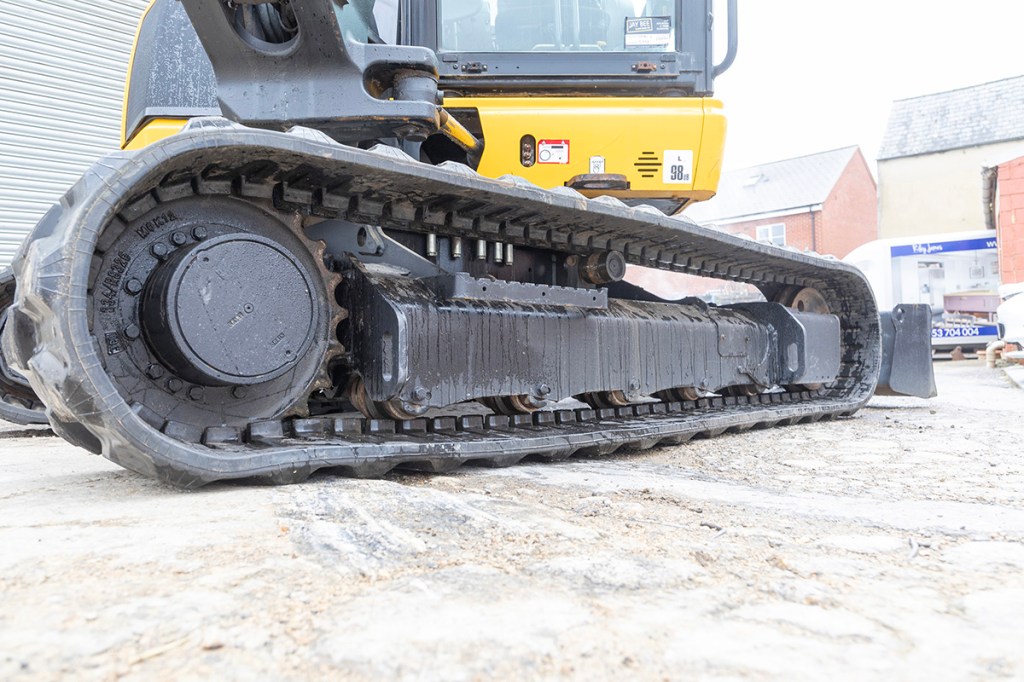
Sagging tracks may need tensioning, which can be checked by lifting the front idler off the ground by pushing the blade down. There should be 5-7.5cm of sag at the middle roller. Add tension by pumping grease into the track tensioning cylinders – if the grease seals are failing, track tension will slacken fairly quickly after being tensioned.
JCB uses a graphite-based pin and bushing system on the 85Z and 86C’s boom and arm, which means a 500-hour greasing interval. The zero-tail swing 85Z uses a 2.9m boom, while the 86C gets a 3.36m boom. Arm options differ too, with 1.65m, 2.1m and 2.25m versions available. At best, the 86C can achieve a maximum horizontal reach of 7.2m and a maximum dig depth of 4.5m, so it out-reaches and out-digs the 85Z by up almost 400mm and 800mm respectively.

Cat 308CR
Caterpillar’s first eight-tonne midi appeared in 2000 with the arrival of the 308B. The original machine was a short radius design with reduced tail swing and pilot hydraulic controls, featuring an EU Stage II compliant engine. Four years later, the 308C was launched with an EU stage IIIA emissions compliant engine plus improvements to the cab, focussed on improving visibility and operator comfort.
By 2008 Cat’s 308 was available as a D-series machine along with several big updates including an EU stage IIIB compliant, four-cylinder, 55hp Mitsubishi engine plus improved hydraulic system with refined joystick controls.
There were two versions of this Japanese-built machine – 308D CR and 308D CR SB. The latter is a swing-boom version offering boom offset of up to 50 degrees left and 56 degrees right, adding yet more versatility to the midi excavator. The SB model was given extra counterweight, raising machine weight from 7,850kg to 8,400kg, enabling both models to have near-identical working envelopes, stability and lift capacities.
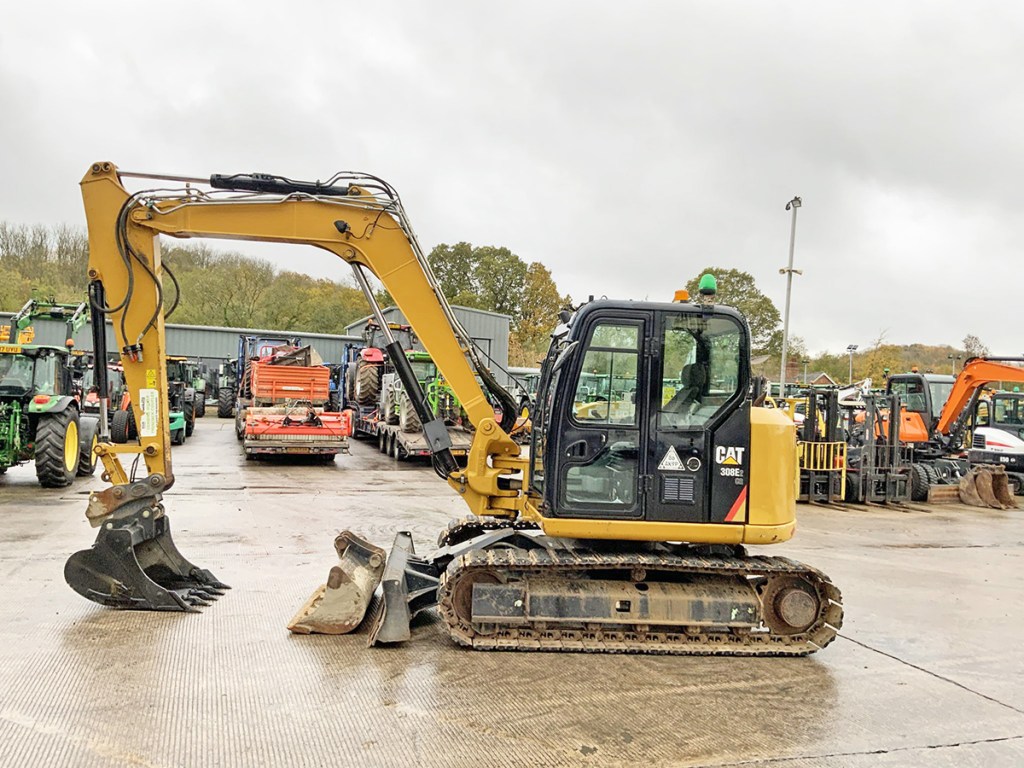
In 2014, the 308E2 series met EU stage IV emission standards using a 65hp Cat C3.3B engine and saw a digital display called the Compass control panel introduced, along with a variable angle boom option. This model paved the way for the US maker’s Next Generation models which arrived in 2019 to meet EU Stage V emissions.
Electronic engine control saw the arrival of features such as auto idle and shut down, along with improved controls focused on fine tuning and advanced grading capabilities. Alongside machine information, the in-cab monitor allows customisable operator settings.
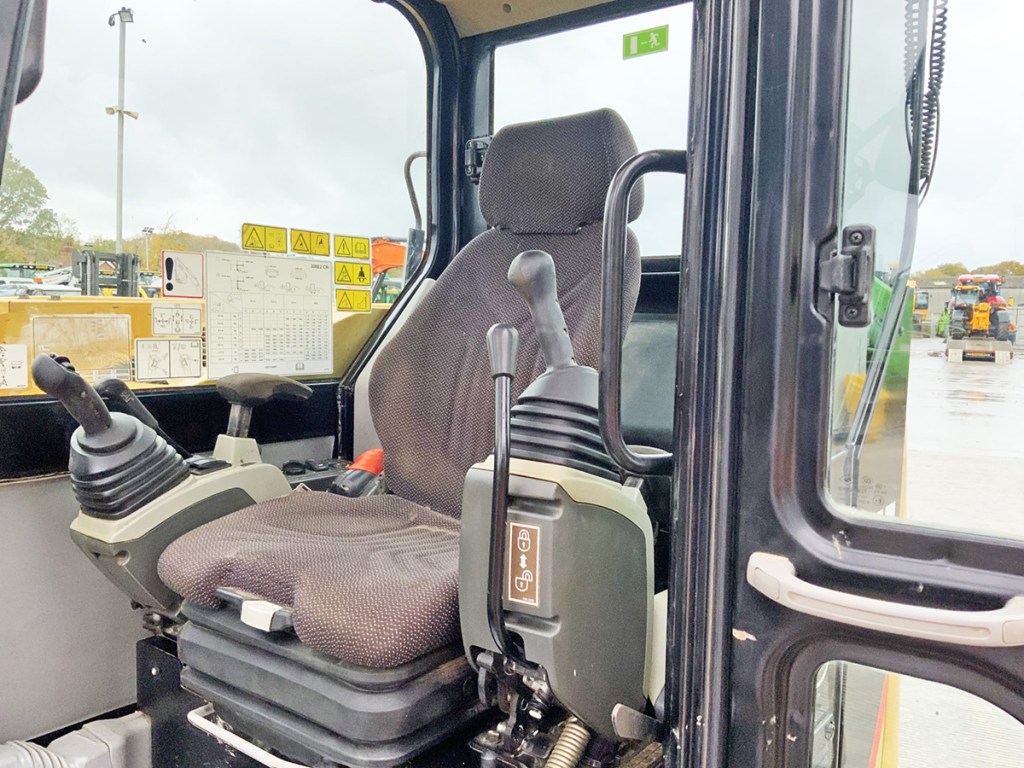
Needless to say, cab comfort and convenience were high on the list, and inside the now sealed and pressurised cab were advanced touch screen displays, jog dial controls, built-in radio and Bluetooth, plus improved security options.
A third aux line option helps with tilt-type buckets, and the introduction of a 309 model – almost the same as the 308 – brings a dedicated pump and hydraulic circuit to run power hungry high-flow attachments. This boosts hydraulic flow from 167 to 233l/min. There is also the option to share a wider track option from the larger 310 model, to boost stability.
A well-documented service history on younger machines should be essential reading, particularly with extended service intervals on the Next Generation 308CR model. Here, 500-hour engine oil changes and 3,000-hour hydraulic oil changes are the norm.
An improved load-sensing hydraulic pump with electronically controlled, load-sensing variable displacement pump is fitted. The standard auxiliary hydraulic system affords one-way, two-way and continuous flow capability to suit attachments.
Machine security is managed through a numeric code, and a control pattern changer lets operators adapt the excavator to their preferred joystick movement.
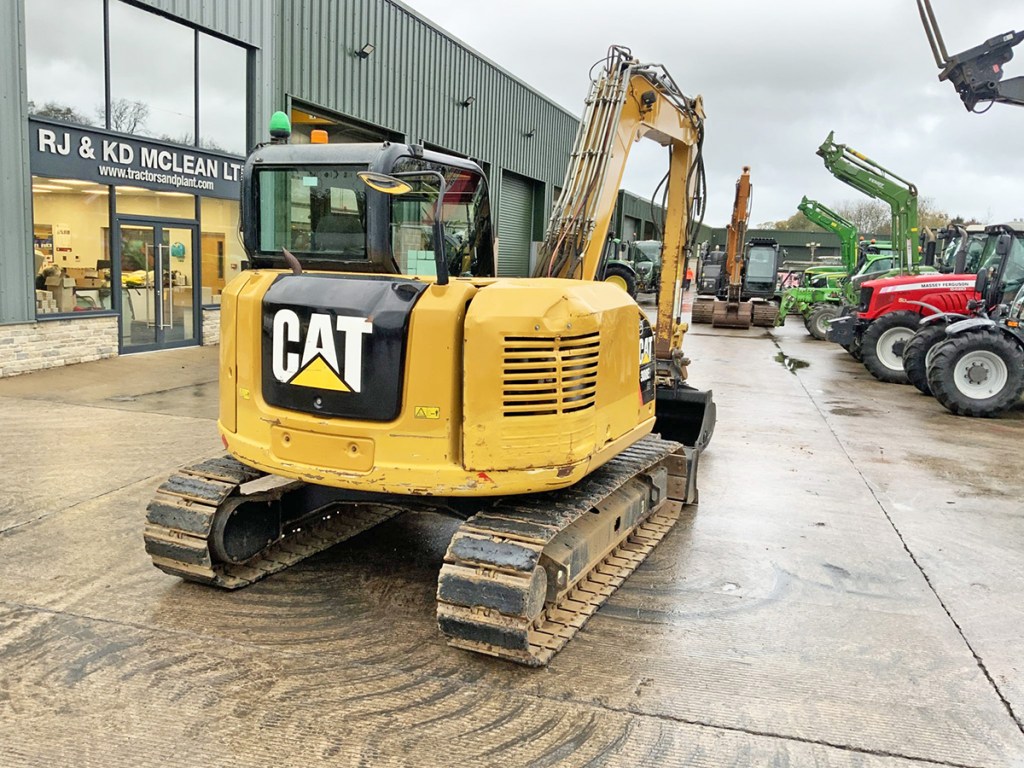
Common structural wear points can include the condition of tracks, sprockets, idlers, and rollers. Check for uneven track wear or inability to hold proper track tension. Similarly, look for excessive play on all pivot points from the base of the boom to the bucket linkage.
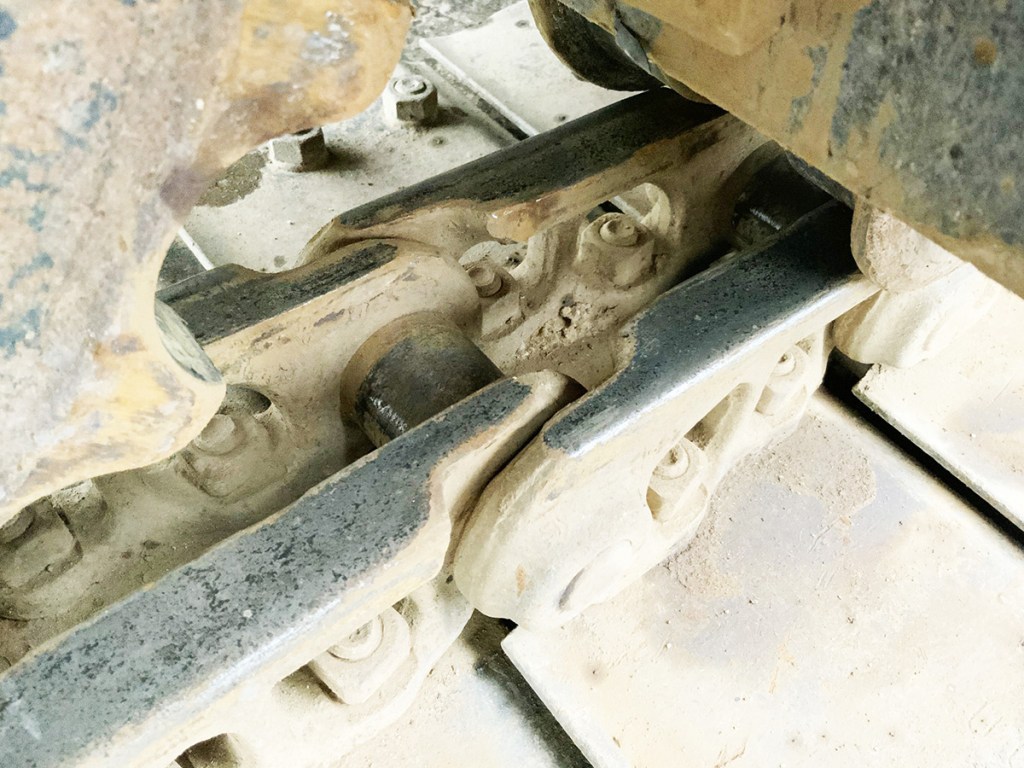
With any reduced tail-swing machines, packaging is tight so components can be difficult to access, which could also mean that maintenance and cleaning can become over-looked.
Cooling packages need to be clean to ensure good airflow to avoid over-heating.
On 2011 or newer models, the 308 is likely to be fitted with a DPF (diesel particulate filter). Newer Next Generation models are equipped with a ‘fit for life’ DPF, with electronics managing the regen cycles for the 69hp Cat C3.3 engine.
Some models also came with a blade that uses an optional, bolt-on reversible cutting edge, suggesting it’s capable of as much with its blade, as its boom and attachment.
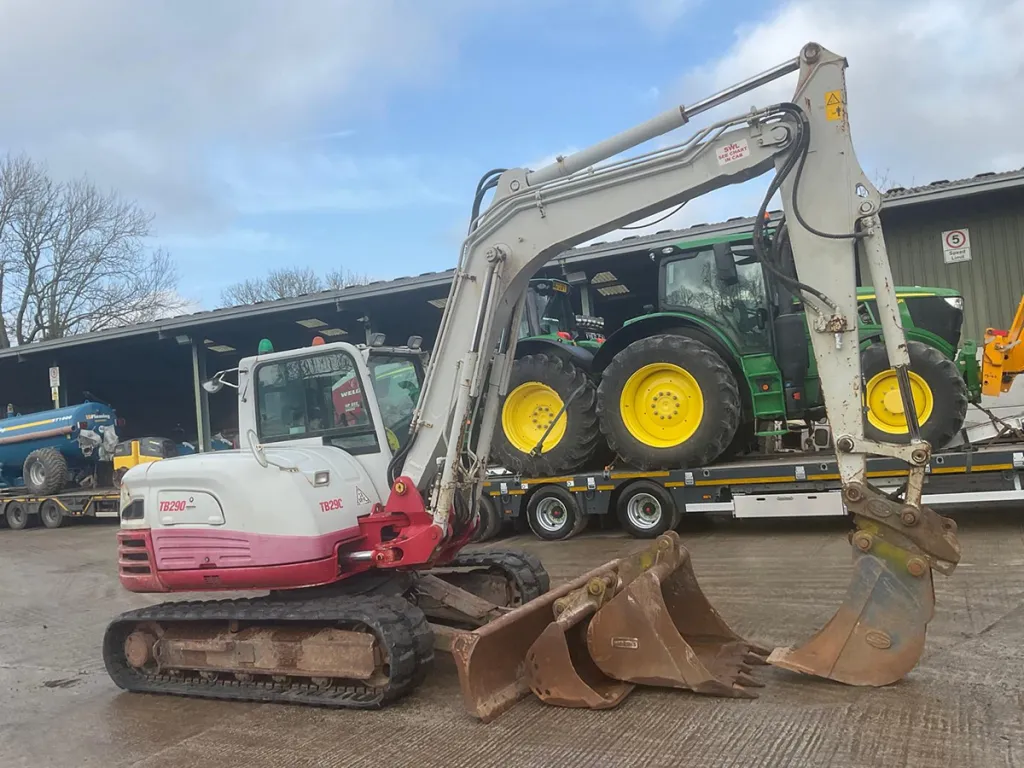
Takeuchi TB285 and TB290
Takeuchi’s midi excavator reputation was built on its TB175, an early machine dating from 2000-2012, which is said to have built the firm’s reputation, particularly in the 8t class. Many of which are still at work, such was the durability of the early machines.
As an early benchmark in hydraulic performance, Takeuchi machines found favour with operators thanks to their smooth, controllable hydraulic system and overall machine balance.
It marked the Japanese maker out as a grand master in square-edged, rugged, no-frills designs, as the TB175 weighed around 7.5 tonnes and packed a 60hp punch from a Yanmar engine. Easily straightened steel panels, 450mm rubber tracks with a steel track option and 250-hour service intervals are what you get from the TB175.
This early machine was replaced by the TB285 from 2012 to 2017, and joined by the heavier TB290 from 2014 to 2019, which pushed operating weights close to 9 tonnes. A bigger cab with adjustable wrist-rests and proportional thumb controls for auxiliary lines was joined by a new monitor with an Eco mode that peels 200rpm off the maximum engine speed, and can make the TB285 feel lazy.
The TB285 remained with Yanmar power, but the 3.3-litre four pot was tweaked to 67hp, and had been turned by 80-degrees compared to the earlier TB285. This exercise in packaging resulted in better access to almost all of the ancillaries, though the starter motor had to be accessed via an insulated panel in the back of the cab.
The machine’s cooling pack was tucked into what would be the right-hand rear corner, and hinging the a/c condenser forward lets you clean the main radiators with ease. Below the radiators is the battery, and there’s space in the same compartment for a grease gun.
The newer TB290-2 arrived in 2019 meeting EU Stage V emissions regulations, and with it comes most cost and complexity.
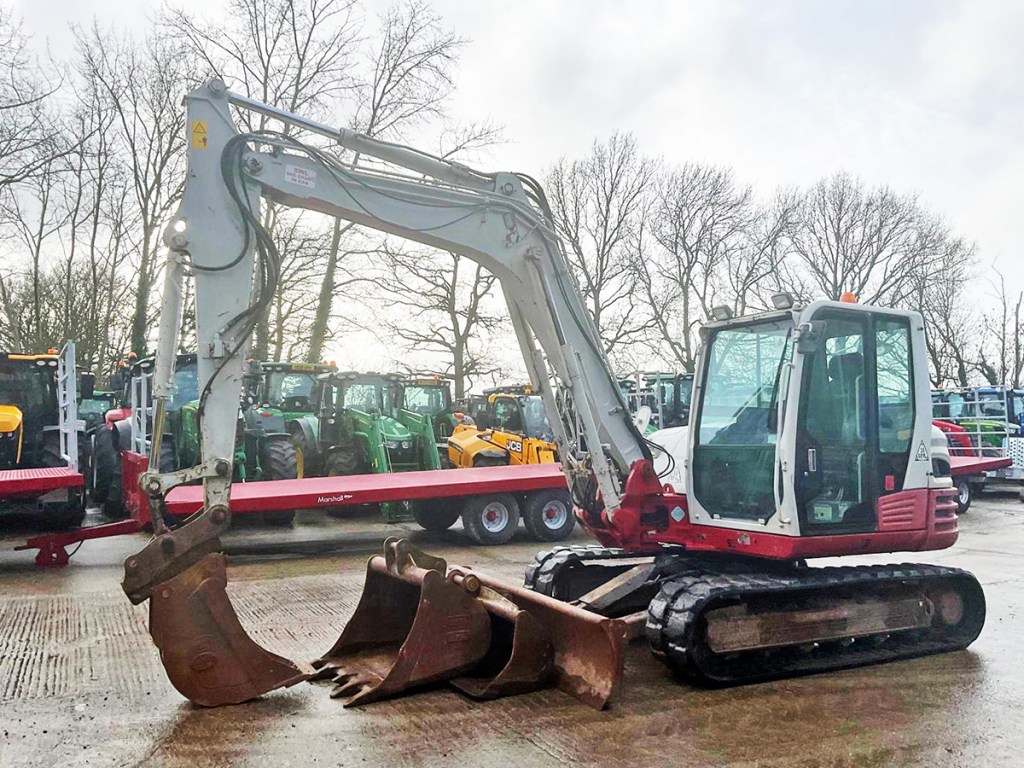
An FR derivative pushed the operating envelope for physical compactness, by offering a reduced front radius from a side-to-side offset boom configuration. By moving the boom’s mounting point hydraulically, this design gets the machine closer to walls on either side of the machine without loss of dig depth or reach.
Working in tight spaces is where FR comes into its own with a reduced rear tail swing. The boom can be folded right up and back to the offside, within the machine’s footprint. Older 8-tonne FR machines include TB180FR, which was replaced by the TB280FR in 2014.
Given the short radius design of the FR models at both ends, the conventional TB290 derivatives offer a larger, more spacious cab.
Steel or rubber track options were available, with 400mm rubber tracks being a standard installation. Wider tracks could be fitted, improving stability. Expect to find a heavy-duty undercarriage with five triple-flanged rollers either side, and a single top roller to ensure positive track retention.
Both the TB290-2 and earlier TB290 have as standard, an on-board refuelling pump. This electric pump also operates with auto-shut off, to prevent over-filling
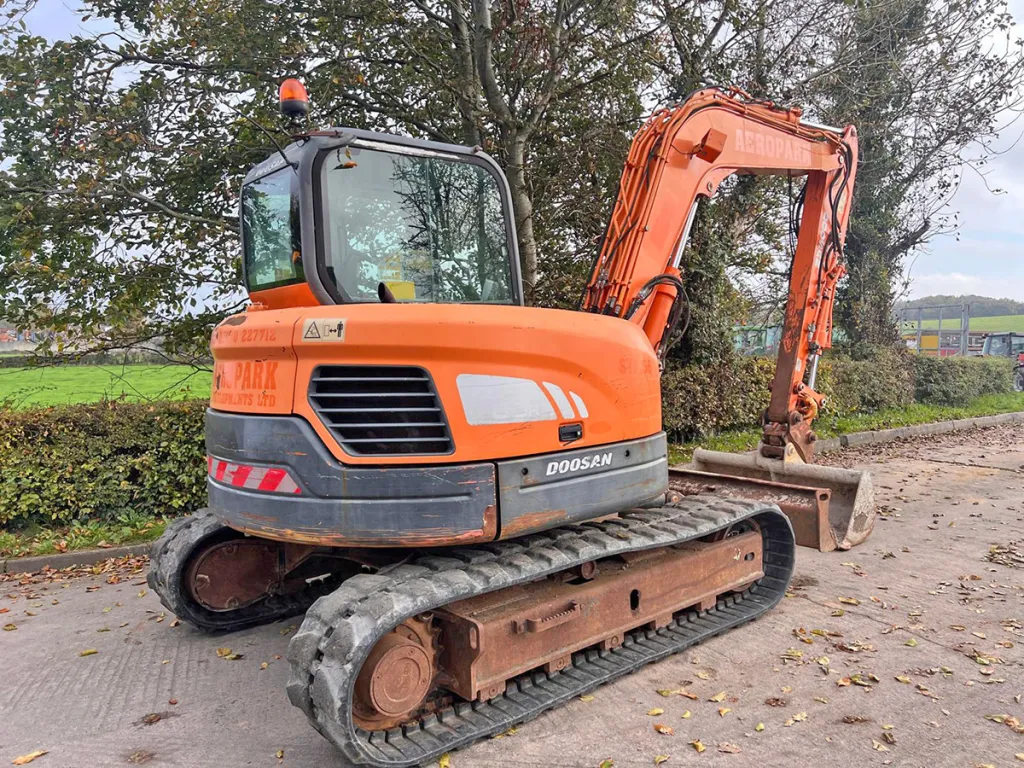
Doosan DX80R
Doosan, a south Korean maker, may be better known as Develon and is now part of HD Hyundai, the owner of Hyundai construction equipment.
Its eight-tonne DX80R appeared in 2008, and was produced for five years before being replaced by the DX85R-3 – the newer model gaining more complexity in the exhaust after-treatment department.
Being an older model in this round-up of options, the DX80R could be the more cost-effective route to midi excavator ownership for occasional use. It gets a side-mounted engine, not one squeezed in the back. As a result, this layout does largely resolve any servicing and maintenance issues, for those with fingers larger than tweezers.
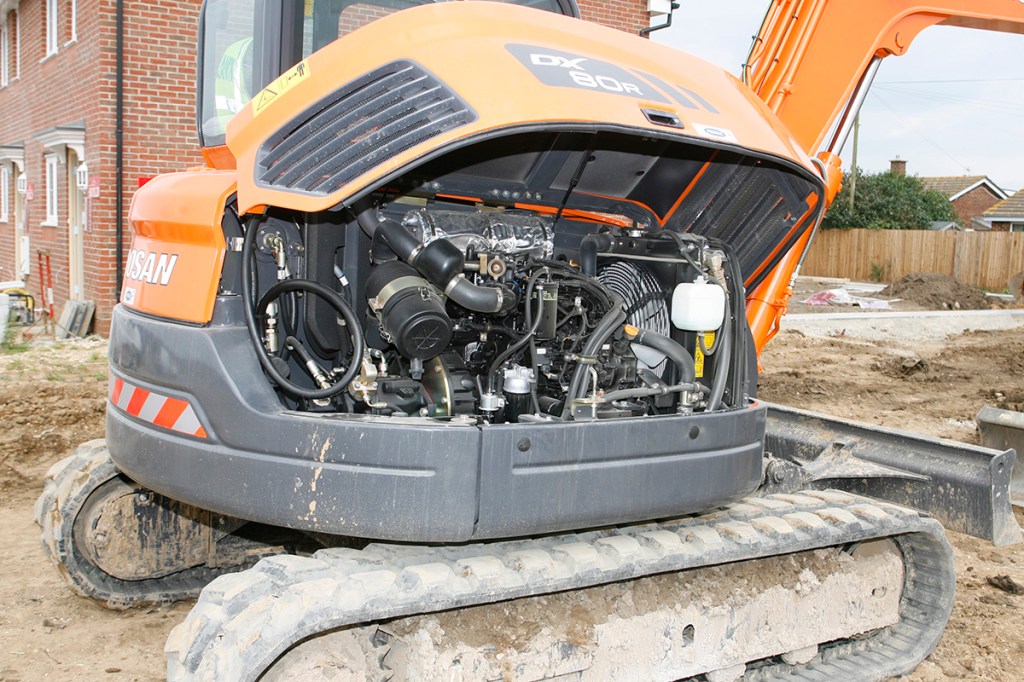
Importantly, there is no requirement to climb over the machine to make daily checks, as everything can be done from ground level.
A full-length engine canopy can be raised to give generous access to components. Its wrap-around lower steel skirt can be unbolted from the frame to allow access to the air conditioning compressor and battery compartment – the latter is found at the front of the machine, below the radiators.
The Doosan’s fuel tank has an auto-refuelling pump, and the tank neck can be reached behind the cab, for those using more traditional filling methods.
Power comes from a Yanmar 4TNV98 engine, which provides 54hp at 2,000rpm from its 3,319cc, four-cylinder diesel, which uses electronic engine speed control and electronic EGR control. Despite this, the DX80R is free of selectable operating modes, which means the monitor displays coolant temperature and fuel level.
Behind the engine is a tandem-type variable displacement hydraulic pump and a smaller gear pump for the servo control levers. This is a load-sensing system and the main pump delivers 144l/min of flow while the smaller pump supplies 22l/minute.
In front of the engine is the cooling pack, which sees the oil cooler and engine radiator stand side-by-side, with the air conditioning condenser located in front of them both, along with a fuel cooler.
Machine configuration sees an offset kingpost pushing the boom foot slightly ahead of the cab, and there’s a storage compartment between the engine bay and the cab which also provides access to the slew motor.
UK-spec should see a one-piece 3.38m main boom and a 2.25m stick, giving the Doosan eight tonner up to 4.67m of dig depth and 7.48m of horizontal reach.
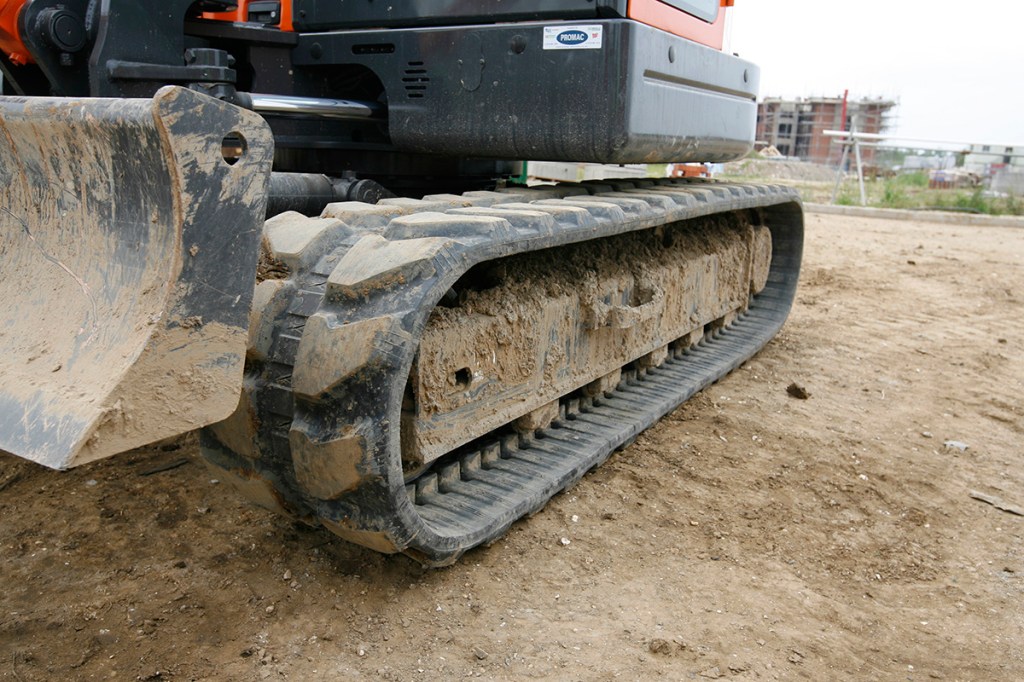
Underneath the DX80R is a rubber-tracked undercarriage, using 450mm tracks, though identical sized steel alternatives could also be fitted. There is one upper roller, and five lower rollers.
Aside from regular greasing requirements, service intervals for the DX80R revolve around engine oil and filter changes every 250 hours. Fuel filter and air cleaner elements need changing every 500 hours, along with the hydraulic oil return-line filter, while hydraulic oil changes can be extended to 2,000 hours when using Doosan’s own-brand oil – otherwise, it’s a 1,000-hour change period.
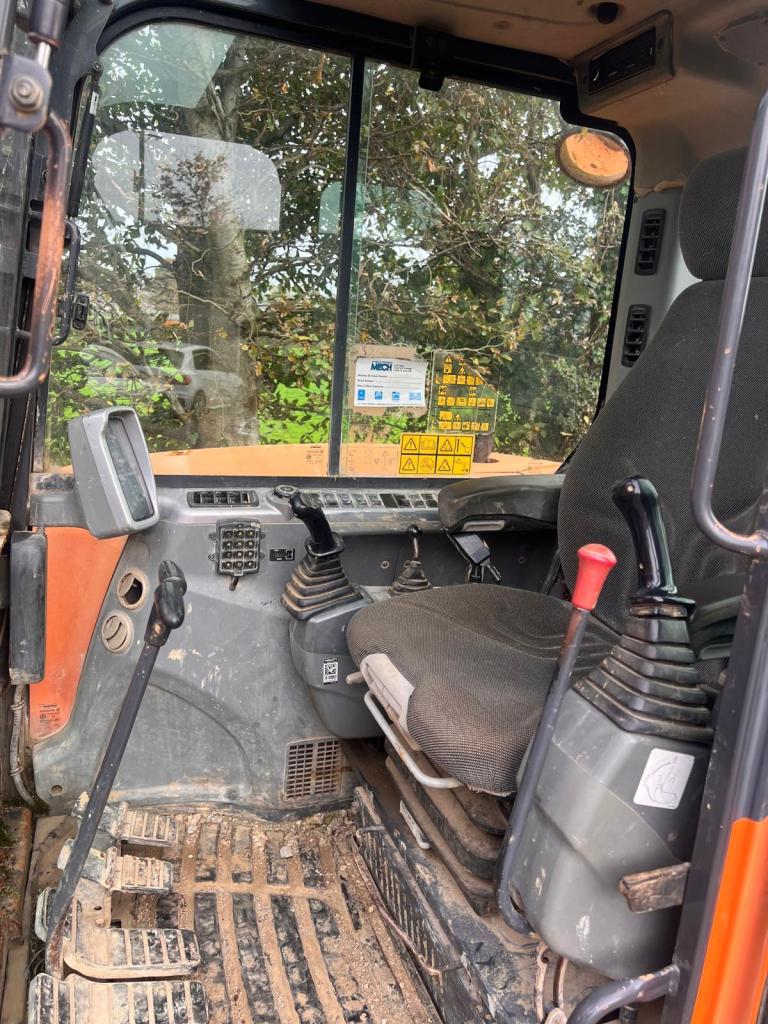
In 2013, the firm replaced the DX80R with the EU stage IIIB compliant DX85R-3. With it came EGR and DPF after-treatment technologies, though the newer version was claimed by its maker to be 10% more fuel efficient while boosting digging force by around 12% over the out-going DX80R.
Expect a reduced working envelope from the newer reduced tail swing radius machine, compared to the DX80R.
Kubota KX080
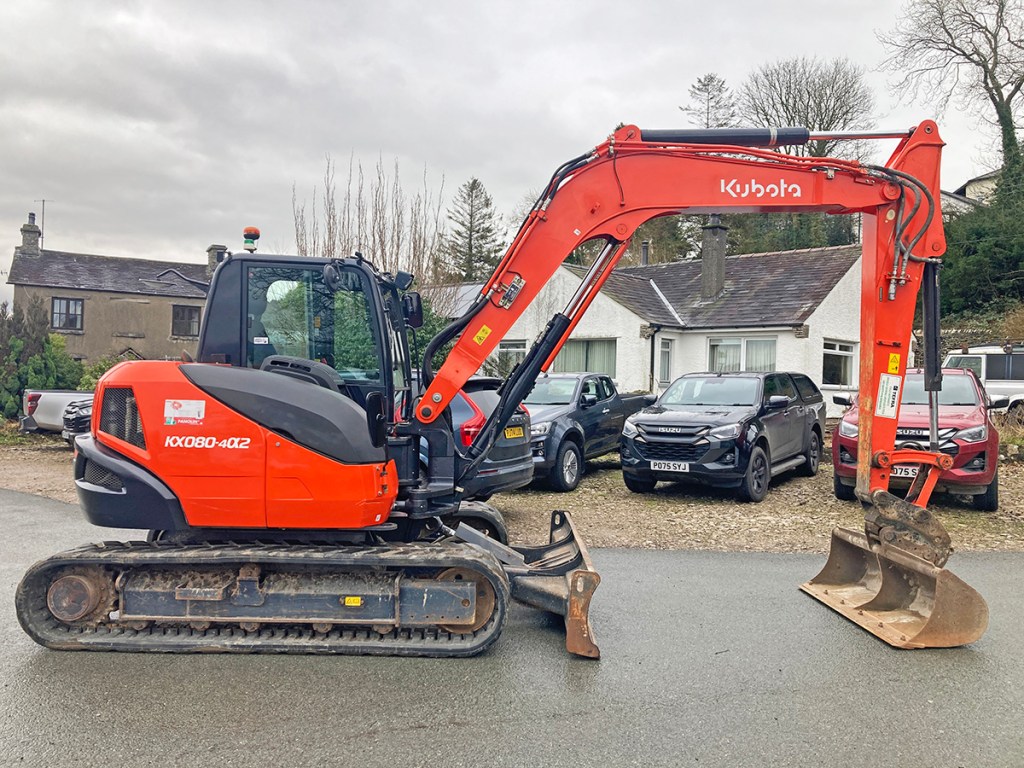
Kubota claims to have been the market leader in compact excavators up to 10 tonnes, for more than 27 years. And its eight-tonne offering, the KX080, first appeared in 2006 as a dash 3 model.
It paved the way with specification and featured the Japanese maker’s unique key system, auto idle, air conditioning, twin auxiliary hydraulics, auto kick-down for travel motors and an integrated refuelling pump.
Since 2006, the KX080 platform has undergone a number of improvements, with six major model updates over the last 20 years. Where model numbering gains the letter ‘a’ denoting Alpha, this highlights a significant update within that model generation.
Early KX080-3’s were commonly referred to as the ‘white cab’ models. Power came from a Kubota mechanically-fuelled V3800DI engine. This four-pot 3.77 litre lump delivered 64hp and was free of any emissions paraphernalia.
A triple-pump load sensing hydraulic system saw pumps one and two each provide 72l/min, with pump three serving up 67l/min.
In 2008, the KX080-3 acquired its Alpha markings, with updates focussed on durability and performance enhancements. Traction force was increased by approximately 9%, improving overall pushing performance.
New bucket bushing material and additional grease points were joined by added protection to the blade’s lift cylinder and beneath the engine compartment. A new engine, the Stage IIIa compliant V3307DI-T maintained a 64hp output, with the four-cylinder, 3.3 litre direct injection turbo engine offering improved fuel efficiency.
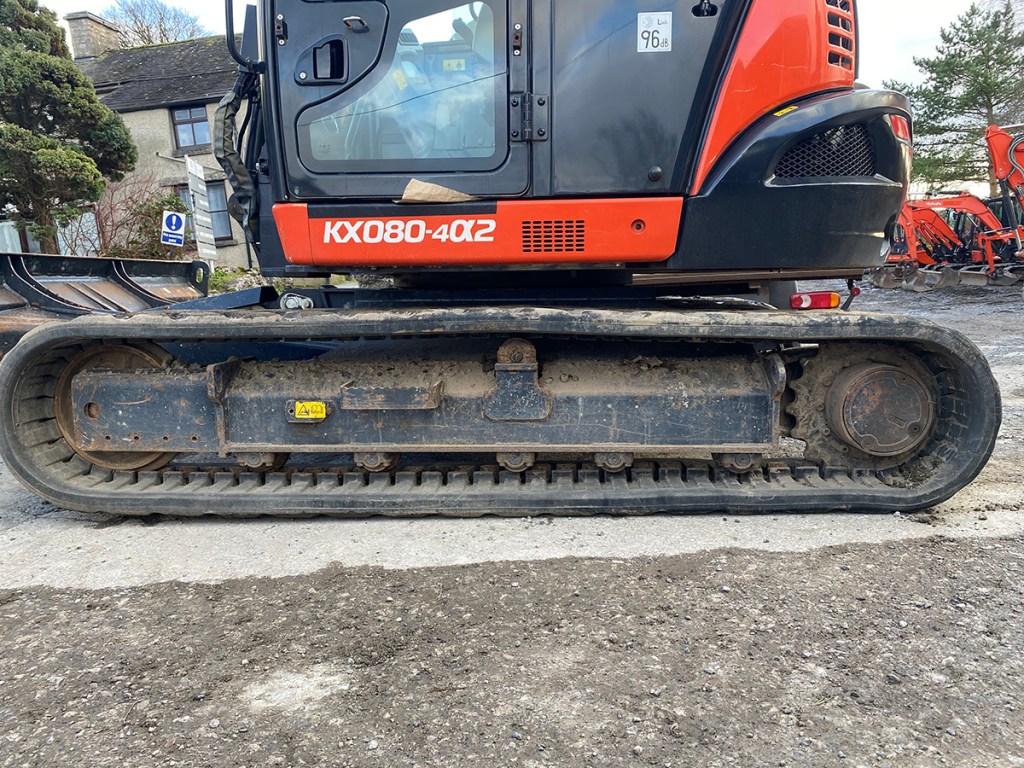
In 2016, the KX080-4 arrived and is easily identified by its black cab with revised interior. Largely emissions driven, a V3307-CR-TE5 common rail engine – again at 64hp – brought with it a DPF with a 3,000 hour service interval. This model maintained the firm’s traditional three-pump hydraulic system.
Just one year later, the KX080-4 morphed into an Alpha derivative. Further improvements were made to the hydraulic system to enhance simultaneous operation with more complex attachments.
This upgrade resulted in a twin-pump, load sensing hydraulic system with increased flow rates of 84.6 litres/pump. With it came a new valve chest, replacing the earlier mono block design with a segmented valve block. Like tractors, this individual spool construction provided the opportunity to replace slices, rather than the whole valve block.
Blade float became part of the specification.
The KX080-4a2 was introduced in 2019 to address EU stage V emissions and importantly does still not required AdBlue. Latest changes saw a doubling of the DPF service interval to 6,000 hours, along with tweaks to the hydraulic system to improve finesse, before the latest generation – the KX085-5 – arrived in 2022.

This -5 model is distinguished by its black engine bonnet, and includes significant improvements to the hydraulic system for smoother operation and improved attachment control.
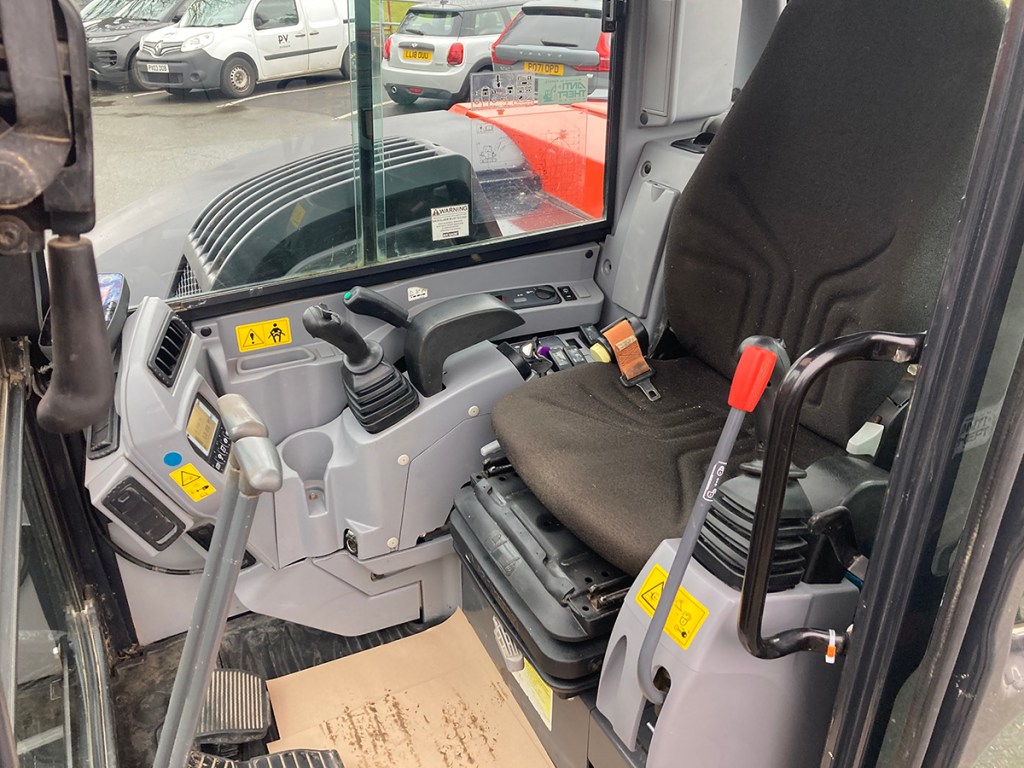
A redesigned cab interior and double-adjustable air suspension seat, plus three decibels noise reduction, adding to operator comfort. A new counterweight saw an increase in operating weight, providing greater stability. Improved visibility and safety came through new mirrors and an integrated rear-view camera.
With thanks to: RJ&KD Mclean, R McAllister Tractors, Leah International Plant Sales, World Tractors, and PV Dobson for their help with featured machines and images.
Geoff Ashcroft
For more up-to-date farming news click here and subscribe now to profi and save.