Compared to the Axion 8 and 9, the new Arion 5 and 6 have only been given a mild makeover. Our focus here is on the CVT-only and biggest four-cylinder model, the Arion 5.180 Cmatic.
KEEPING IT BRIEF
- Our test tractor is the largest model in the Arion 5 range and only comes with a CVT.
- Fuel consumption is average, but the tractor is economical on the road.
- Ride comfort is superb, but the payload is far too low.
Claas has continually developed the Arion 500 ever since the moniker first adorned the seed green bonnet nearly 20 years ago. In that time, we have seen a CVT join the ranks in 2013 followed by a thorough overhaul in 2017, with lots of new software and the familiar Carraro independent front axle suspension replaced.
With the new Claas Arion 5 badge there are further updates for the three models in the line that have max outputs of 145hp, 165hp and 180hp. They are easy to recognise with the redesigned bonnet. But underneath there still lurks the 4.5-litre, four-cyl Deere engine, which in our test 5.180 is rated at 170hp (max output of 180hp). And as there is no boost, this power is always on tap.
Good power curve
First port of call was to see how this familiar motor would prove itself at the DLG’s Test Centre.
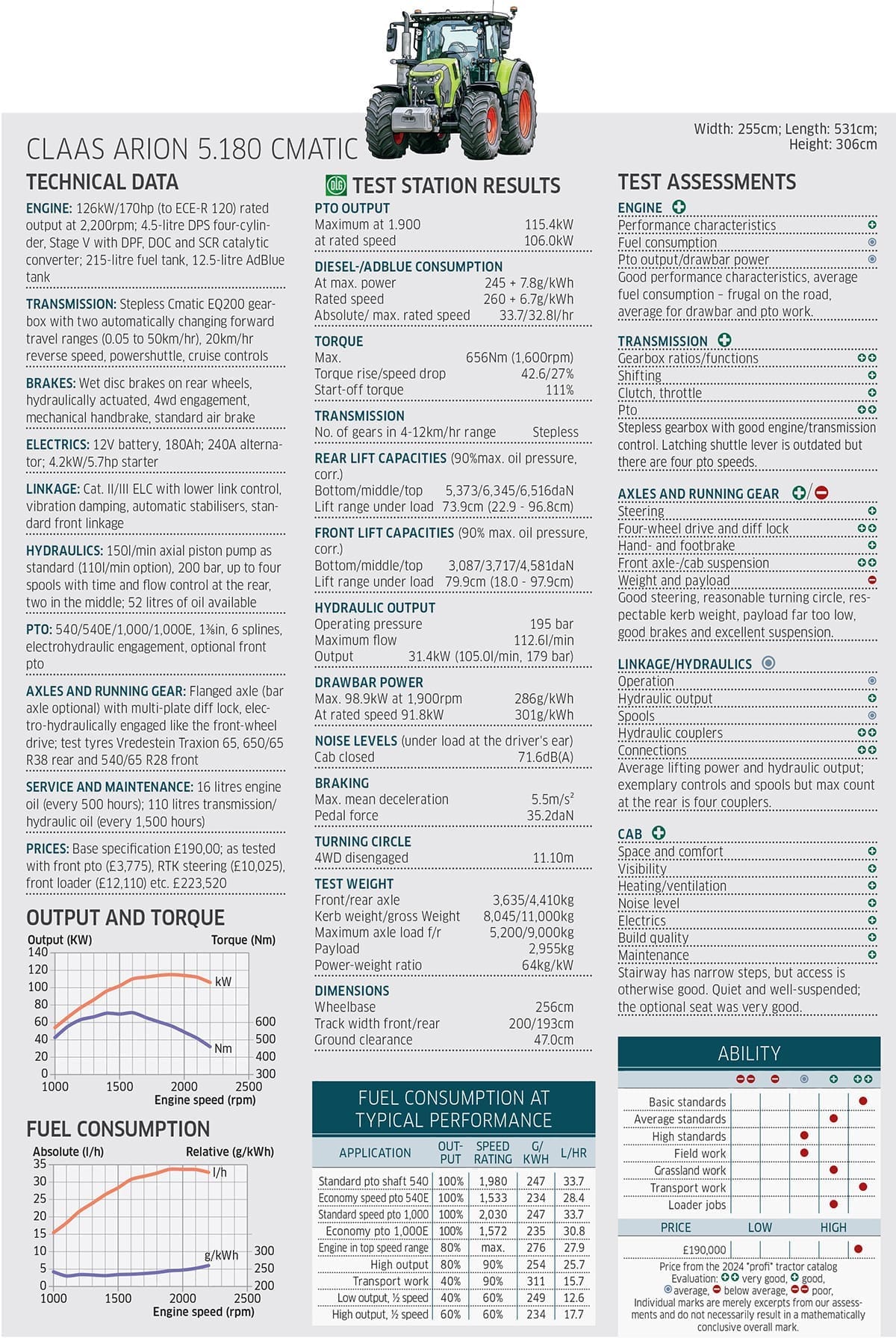
The test needle stopped at a maximum pto output of 115.4kW/154.7hp, which is 87% of the engine’s quoted maximum power. This suggests that the engine was not over-tuned. Nevertheless, the 5.180 performance characteristics were impressive; a torque rise of over 42% and only a 27% drop in its engine speed along with a maximum torque of 656Nm.
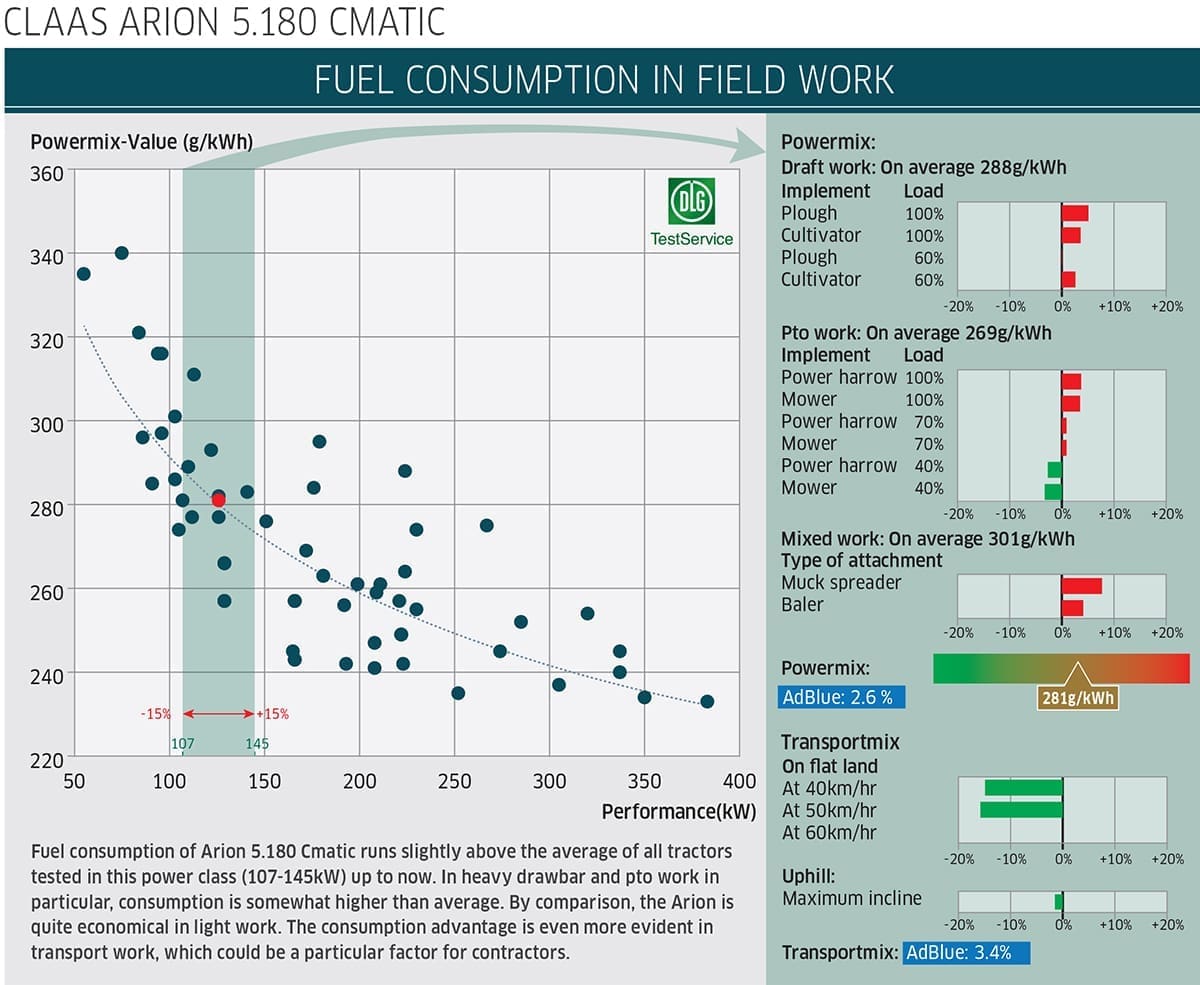
Things get more interesting when we put fuel consumption under the spotlight. Here, our rather more real world Powermix measurements illustrate that the 5.180 Cmatic achieves an overall figure of 281g/kWh. This is only slightly above our average for all of the tractors tested in this power class. It is only when it comes to heavy drawbar work that the consumption is somewhat higher. For lighter work and even more so when undertaking haulage tasks, it is sometimes significantly better than average.
This data is also in line with the maximum drawbar power: up to 98.9kW/132.6hp finds its way to the wheels with a specific consumption of exactly 286g/kWh. And even though the engine’s AdBlue use is comparatively low throughout, sadly these are not what we would call record-breaking fuel efficiency figures.

Automatic load detection
The biggest innovation here is what Claas calls Auto Load Anticipation, where the clever on-board tractor brain automatically recognises recurring operating situations, such as when a plough or cultivator is being lowered into work. Instead of the usual momentary drop in revs and dip in forward speed while the system sorts itself out, the tractor’s engine/transmission management responds faster, pre-empting the increase in load and adding revs to keep things moving when returning to work from the headland turn.
Out in the test field, this is where we spotted a weakness: when the Arion is working at half load, with only a small amount of engine speed in reserve, a sudden change in the load can cause problems.

The second new feature on the Arion 5 is the front loader mode, which is supposed to improve the throttle response when driving into a heap. At first, the system failed to impress us, but this turned out to be down to an incorrect acceleration setting within the 5’s transmission menu. Other illogical response time settings for the front loader remote spool made precise joystick operation impossible. Now it did work well once everything was fettled but it underlines just how complicated it is to set up the controls correctly. This needs to be easier…
Even though the familiar detent position powershuttle lever has disappeared on the Axion 8/9, it is still used on the Arion. This means you can’t swap between the lever and the joystick buttons. For some this may not be a big issue, but if you have grown used to chopping and changing between the shuttle controls like we have, then it can be a bugbear. There is no clear audible warning when the tractor fails to shift because the lever on the left is in the detent. On a more positive note, the right-hand controls are nicely positioned.
Back to the transmission itself: when on the road in particular, the engine speed and transmission control are outstanding. We also liked the four pto speeds for all-round versatility.
Which transmission to choose is no longer up for debate. Unlike its predecessor, the Arion 500 with the well-known Hexashift, the Arion 5 is only available as a Cmatic CVT. This is still Claas’s own EQ200 box, which has a speed range of 0.05 to 50km/hr; the latter can be achieved at 1,500rpm.

Hydraulics and linkage
Standard fitment is a 150l/min axial piston pump. And this is a good thing because the pump installed on our test tractor delivered a flow of 112l/min and maximum hydraulic power of 31.4kW. Those stats are just about adequate results for this power bracket in today’s market.
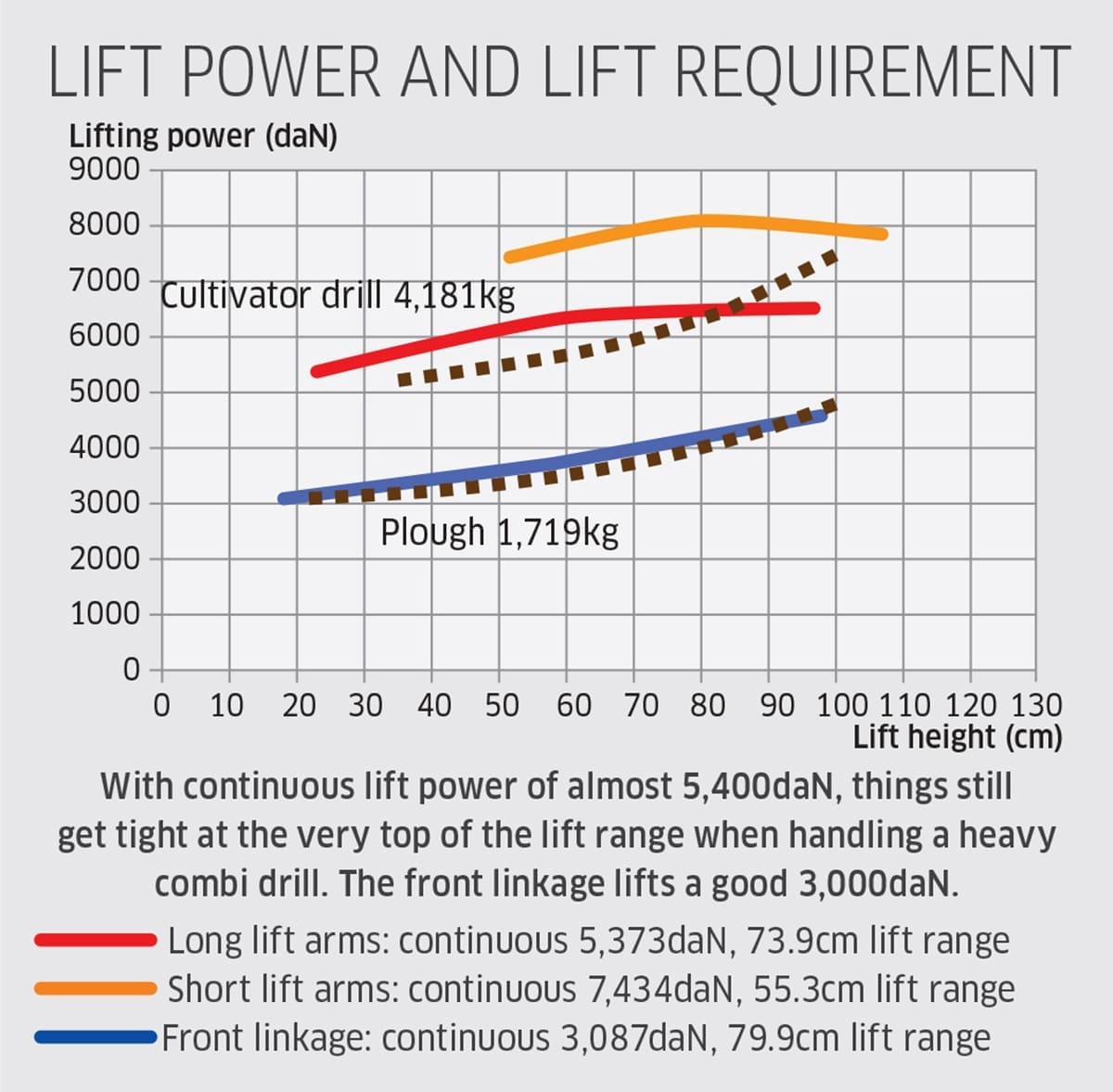
Better news with the linkage: with almost 5,400daN of continuous lift power, things only get tight at the very top of the lift arc, if at all. However, we must mention another issue, the payload of less than 3t. But more on this later…
Claas now offers a nice way of switching the lower link spacing between Cat II and III. Yet the comparatively short adjustment range of the hydraulic top link is a downside, and there’s no room between the hydraulic couplers for a longer ram.
Speaking of hydraulic connectors: thanks to the very welcome pressure relief levers and new, self-closing caps, the Arion 5 is certainly not lacking in this department. We also appreciated the programming and the proportional control, even when the time control is active.

Quiet cab, great seat
Next stop, the cab. To get there, though, you have to navigate some narrow steps. Given that the door opens nice and wide thanks to the fifth cab post, the location of the diesel filters at this very point is even more baffling.

Once inside, the noise insulation is good with just 71.6dB(A) under full load. We also really liked the Isringhausen seat with its electric adjustment, a massage function and memory profile settings for up to three drivers.

The armrest with its Cmotion lever needs no introduction. But unfortunately there is still one terminal on the armrest for tractor functions and a second on the window for the steering system. And there is no hand rest for making setting adjustments. That said, we can vouch for the tractor’s very smooth ride, especially on the road.


Too little payload
The trailing arm front suspension does a very good job, although a loose contact on the height sensor did put the system out of action on one occasion. Our test 5.180 was sporting 540/65 R28s at the front end and 650/65 R38s at the rear. This is not overly generous for 180hp, but according to Claas, dealers can retrofit wheels up to 1.95m tall which is more like it.
With a measured turning circle of 11.10m, the Arion is also good for front loader work around the yard. But this brings us back to a real weak point: its hefty 8,045kg unladen weight without front pto and front loader brackets is a tad lardy. And as the gross weight is only 11.00t, this leaves a meagre 2,955kg of payload. This is nowhere near enough when you think about the sort of implements a 180hp tractor is likely to be carrying.
The Arion’s brakes could certainly handle more weight: the deceleration of 5.5m/s² is very good. And the same goes for the new trailer brake assistant, which automatically activates the air braking system when the transmission detects it’s being shoved.
Easy maintenance
Not only are the radiators on the Arion very easy to access, but, even with a front loader fitted, you can still reach the air filter — nice! Not so nice was the fact that the rear wheel valves are once again on the inside — they need two holes drilled! On the other hand, we did like the automatic battery isolator switch. This stops the battery from going completely flat when a non-Claas driver turns the ignition key all the way back.
How much!
In base specification, the Arion 5.180 costs just under £190,000. In test specification — our tractor had front linkage and front pto (£3,775), plus RTK steering including terminal (£10,220) and the front loader (just under £12k) — you arrive at a hefty £223,520 … albeit this money does get you a comfortable, manoeuvrable four-cylinder CVT tractor with average fuel consumption. It’s frugal in transport work, but its payload is far too small for road work.

Hubert Wilmer
For more up-to-date farming news click here and subscribe now to profi and save.