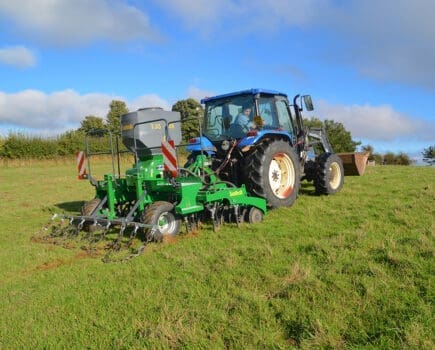
The Finns have managed to retain Valtra’s identity while still pleasing the AGCO bean counters with the common platform T6. We caught up with some of the first T236s to land this side of the water as part of the firm’s demo tour.
KEEPING IT BRIEF
- The badge number on the six models gives a very conservative hint of the available horsepower.
- Production of the range-topping T236 with the CVT transmission has already started; the rest of the range starts rolling out of Suolahti in the New Year.
- Just two spec levels; Active 2 and SmartTouch 2.
When the machinery mothership wants its core brands to adopt a common platform, there are always winners and losers. Yet that doesn’t seem to be the case with Valtra’s T6, which shares the majority of its under- pinnings with Massey’s 7’S Mark 2 (see profi 11/2026).
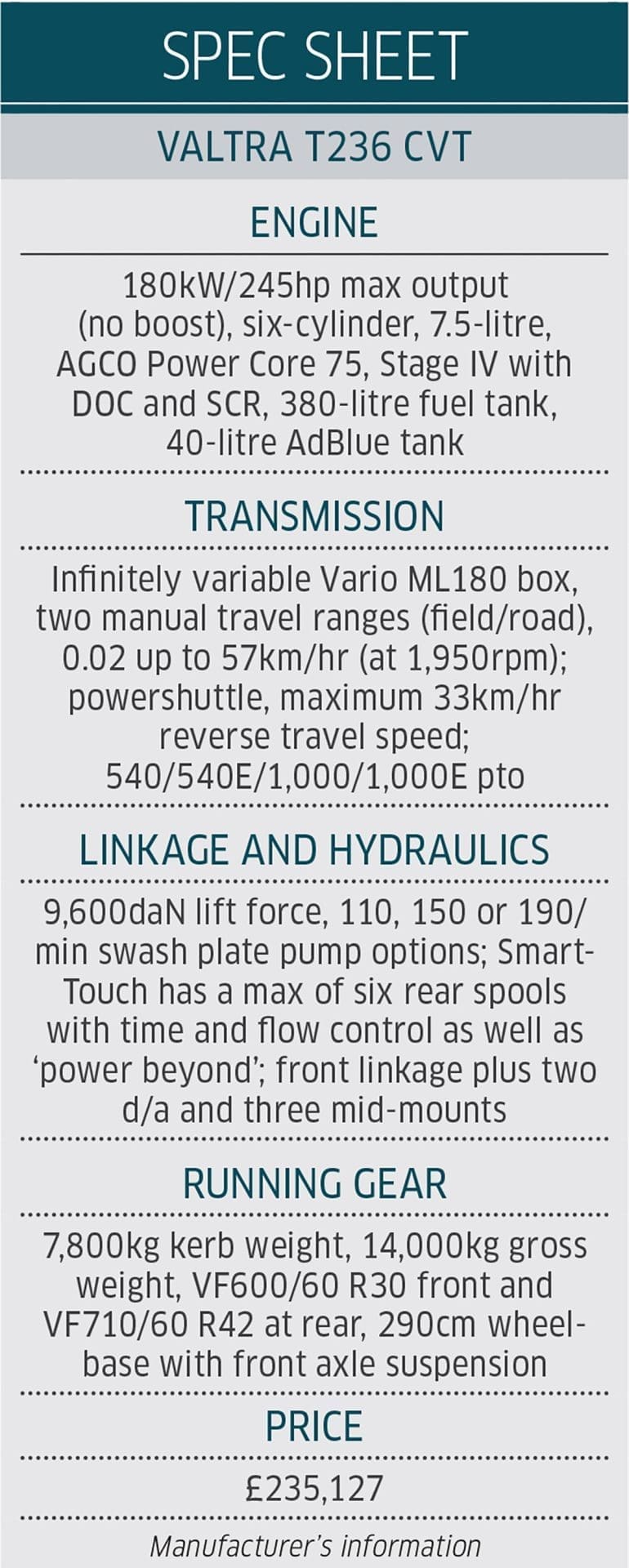
There are several differences between the two brands beyond the cabs. For instance, Valtra has retained its pneumatic front axle suspension, and the fuel tank is marginally smaller as it sticks with 1.95m tall back tyres such as a 710/60 R42

It may be a common platform, but there is most certainly rivalry between the brands. Team Valtra is quick to point out that the primary development work relating to the N and T series (MF 6S and 7S) is done by the engineering team in Finland. And although the engine and transmission may now come under the AGCO umbrella, the powershift is made in Finland, and ML180 Vario production could make its way north.
Brand differences aside, existing T4 and T5 users are treated to a full overhaul; even in the cab there are new screen and armrest options as Valtra simplifies its line-up. The HiTech, Active, Versu and Direct spec lines have been whittled down to just Active and SmartTouch, so the buying decision should, in theory, be more straightforward.
Both Active and SmartTouch will be offered with the 10-step powershift plus the CVT transmission, with Valtra getting particularly excited about being able to pair mechanical spools and a stepless transmission. The five- speed powershift is Active only.

AGCO commonality
All six models use the AGCO Power Core 75, 7.5-litre block which is said to be 5% better on fuel. The structural sump holds 24 litres (the 7.4-litre in the bigger T5 models was 19) that need dropping every 600 hours. The timing gears are at the back of the engine, creating more room up front; there is less component stripping to access the water pump. The air-compressor is now driven by the timing gears, and there are two versions — 310 and 800l/min — the latter being used with the optional tyre inflation system. Tractors with bar axles can have the plumbing for the back wheels fully integrated whereas flange axles have the pipework on the outside, the same as on the front axles.
With regards to power, the number on the bonnet is closer to the pto/drawbar power than the actual rated, maximum or boosted outputs that other makes like to use, which is rather refreshing. For instance, the entry level T146 is 140hp but maximum power at the engine is 170hp if you want to compare with others. Considering that Valtra Valmet came up with the idea of an engine boost when it introduced Sigma Power back in the mid-1990s, the new T6 doesn’t have a boost function. However, the software will add some extra grunt if there is sufficient load on the hydraulics or pto, but Valtra says this is not the same as boost.
A flatter torque curve means the engine does not need to rev as hard and there is a 40% torque rise. In the big model, the T236, the max torque stat is 1,184Nm.
Transmission wise, the primary focus at the demo tour was on the stepless box simply because the initial first batch of tractors now coming off the line are the T236 CVT in SmartTouch Gen2 guise. Although the order book is open for all models, production of the other five models and the powershift tractors kicks off in January.

On the T6, Valtra is replacing its own ‘Direct’ unit with AGCO’s ML180. This is the well-known two-range (field/road) transmission which will have a top speed of 57km/hr. Here the T6 relies upon five brake discs in each trumpet housing plus the nine discs on the transmission’s cardan shaft to provide the necessary stopping power. To keep operation simple, Valtra gives the operator the choice of three driving modes (eco, normal and power) rather than letting you play around with droop settings.
With regards to a powershift, the Finns are quick to put their hand up to say that they developed the T760, a 10-step powershift with a total of 20 ratios. Then again, you can still opt for Valtra’s familiar four-range, five- powershift ‘5PS’ box. These can reach the top speed of 57km/hr at 1,820rpm (the CVT needs 1,950rpm), and there is the option of adding disc brakes in the front hubs.
Both the powershifts and ML have separate transmission oil circuits, but the CVT’s 75 litres of exportable oil are considerably more than the 55 litres available for tipping big trailers on the T760. Powershift owners also need to decide which three pto speeds they want (540/540E/1,000 or 540/1,000/1,000E) while CVT tractors come with all four.
There are three piston pump options: 115, 160 or 200l/min on the powershift; 110, 150 or 190l/min for stepless. But this also looks after the steering as well as the hydraulics, so the base pump is a bit lacking for this power bracket. On Active tractors, max rear spool count is five (four manual, one electric) while the SmartTouch gets six and the added benefit of pressure relief. Operators can now configure which of the two spool valves is operated from the mudguard buttons.

Detail differences
While the front axle beam is the shared Dana unit, Valtra has held on to its own pneumatic suspension. Like the N5, this now uses just the one, but bigger air bag. Not only does this have more travel, but it can also handle about a tonne more weight, which has allowed the front linkage to handle more.

The turning circle has improved too; it’s now 9.80m which is around 70cm less than a T5 when on 600 front tyres. This is also partly due to the rejigging of the cooling pack with the engine sitting farther back. A bigger steering ram has also made turning a gentler operation.
There is a choice of pneumatic or mechanical cab suspension. Changes to the front bushing mean there is less chance of them bottoming out, while the angle of the springs/air bags has also been tweaked to give some more movement.

Mission control
The cab frame is the same as before but the electronic architecture and the ventilation system have been given an overhaul. Cat 2 HD and 4 filtration are on offer; the latter will be of interest to sprayer users and those spreading lime.
As mentioned, there are two spec levels which now move to Gen2. On the Active the A-pillar display shows the main information, and for changing settings there’s an encoder dial on the armrest … for scrolling, adjusting and confirming changes and assigning the function buttons. The mechanical spools can be complemented by a joystick for the front spools and mid-mounts. It also incorporates a shuttle button.

We took a CVT Active model for a spin with a loaded trailer. The transmission control stick is almost camouflaged into the armrest but the user can seamlessly change to pedal driving, and then there are the two cruise control options. The little button for changing between the eco, normal and power driving modes doesn’t lend itself to a thumb tap without hitting one of its neighbours at the same time; it needs a more precise finger poke, but otherwise it’s all intuitive and you can add a large screen to the monitor rail for auto-steer and ISObus. I’d really like to spend a day with this tractor to get a proper feel for it, especially that control stick.

The all singing and dancing SmartTouch uses the more familiar but further refined multi-function armrest. But it is in the display that users will find the biggest difference over the old T5. The screen is just that, a screen, as the processor has been tucked under the panelling of the side console. Not only is it faster and sharper, but it can also do more. You can add up to 16 tiles to each page and then tailor what’s there — tractor data, auto-steer, ISObus or a feed from one of the four cameras. Tap the tile and it expands to full page. You can also set up different profiles to marry with different implements and jobs and, once they’ve been added to favourites, just pick one from the top of the screen.


Other details
- The wheelbase is 2.95m, 40mm less than the T5.
- Model numbering is said to closely hint at the available drawbar/pto power.
- The lift rods on the SmartTouch tractors are angled for better access to the spool couplers. The pick-up hitch is still sourced from Dromone and has an extra dedicated spool for extending out/in.
- The lower link arms have an additional hole. It shortens the range but increases lift capacity by about 500kg.
- Added insulation in the floor and other areas have reduced the in-cab noise level to 68dB(A).
- Two-door cab is still available.
- Extra wide rear mudguard extensions have been added to give better protection with 710 tyres.
- Larger wing mirrors, already used on the Q and S models, are now on the T.

Mervyn Bailey
For more up-to-date farming news click here and subscribe now to profi and save.