


Opico wasted no time in adding some of its seeder know how to the Simtech grass stitching drill. We try out the new TJG.
KEEPING IT BRIEF
- Opico took over the Simtech drill in November 2025.
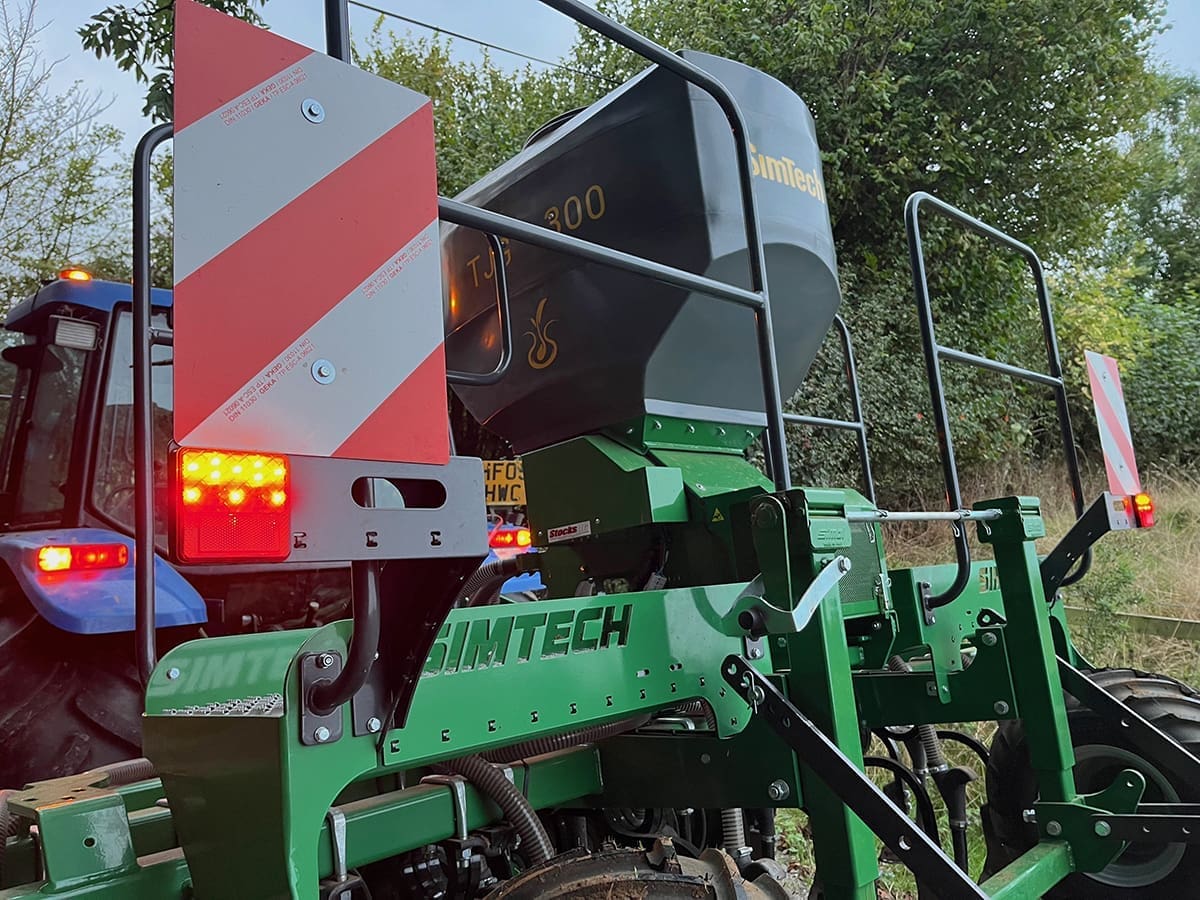
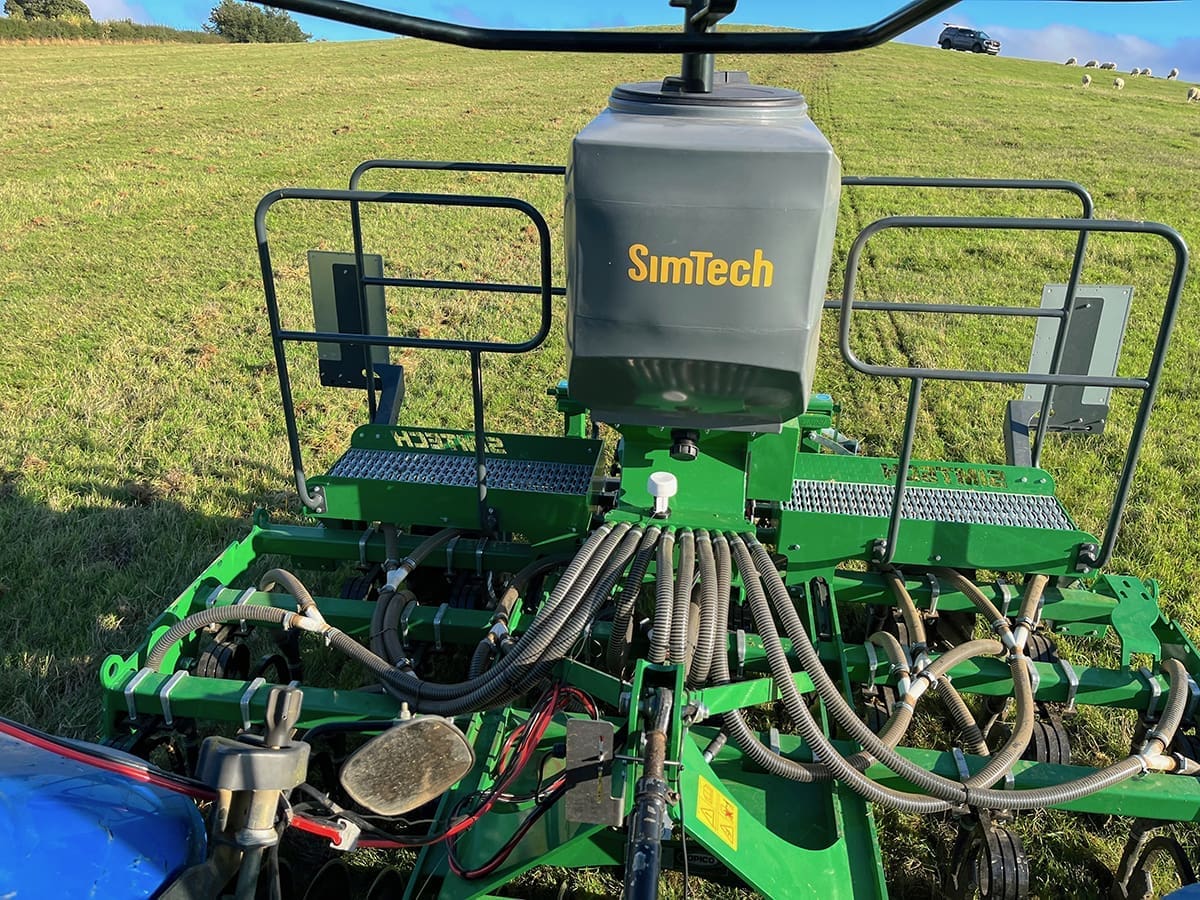
- A Stock’s TurboJet seeder sits on top of the familiar Simtech ground engaging bits.
- Prices for the Simtech TJG start from £23,298.
It was at the backend of 2025 that Opico announced it had taken on the manufacture and distribution of Simtech drills, promising new developments on the grass and crop establishment front.
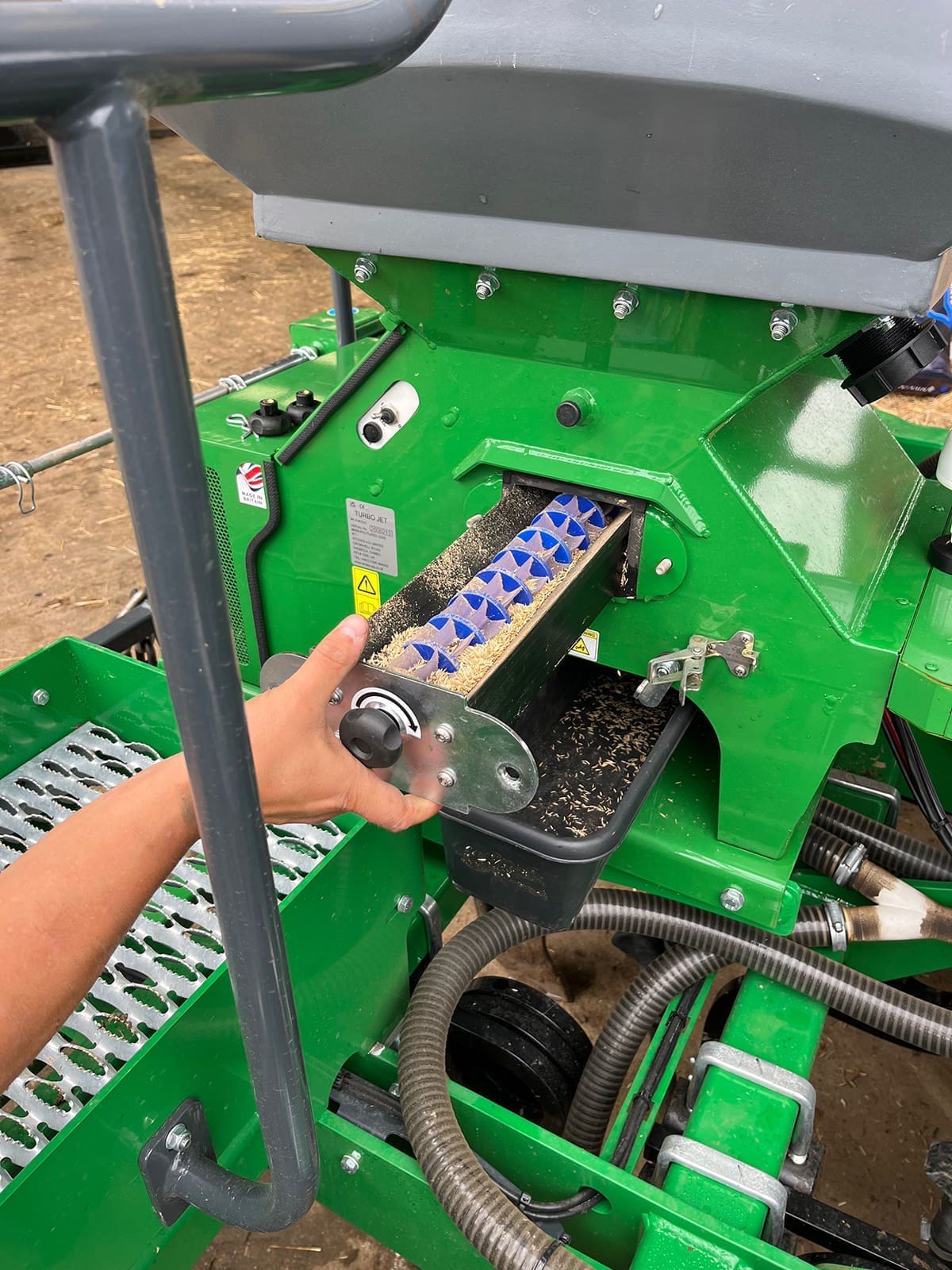
A year on, the first fruit of these innovations has come to bear in the form of the TJG. Rather than the gravity-fed box hopper commonly seen on the brand’s grass-focused seeding rigs or the pneumatic seed tanks of its more arable-oriented drills, this new variant has a TurboJet small seed applicator from Opico’s sister company Stocks. Hence the model designation with a ‘G’ for grassland.
Old and new
Although the ownership and the seeding elements might be new, the under-pinnings of the SimTech have a 50-year-old heritage. The trademark inverted T-slot opener was originally developed in the mid-1970s by Kiwi duo John Baker and Peter Aitchison. Often referred to as the ‘Baker boot’, it was fitted to Aitchison seed drills.
The V-shaped points cut an upside-down T through the dirt to create a trench with a shelf either side where seed can lodge under a protective flap of turf. Mounted on heavy pig-tail tines, the coulters constantly vibrate to generate a tilth in the trench ready for the emerging seedlings to get their roots down into.
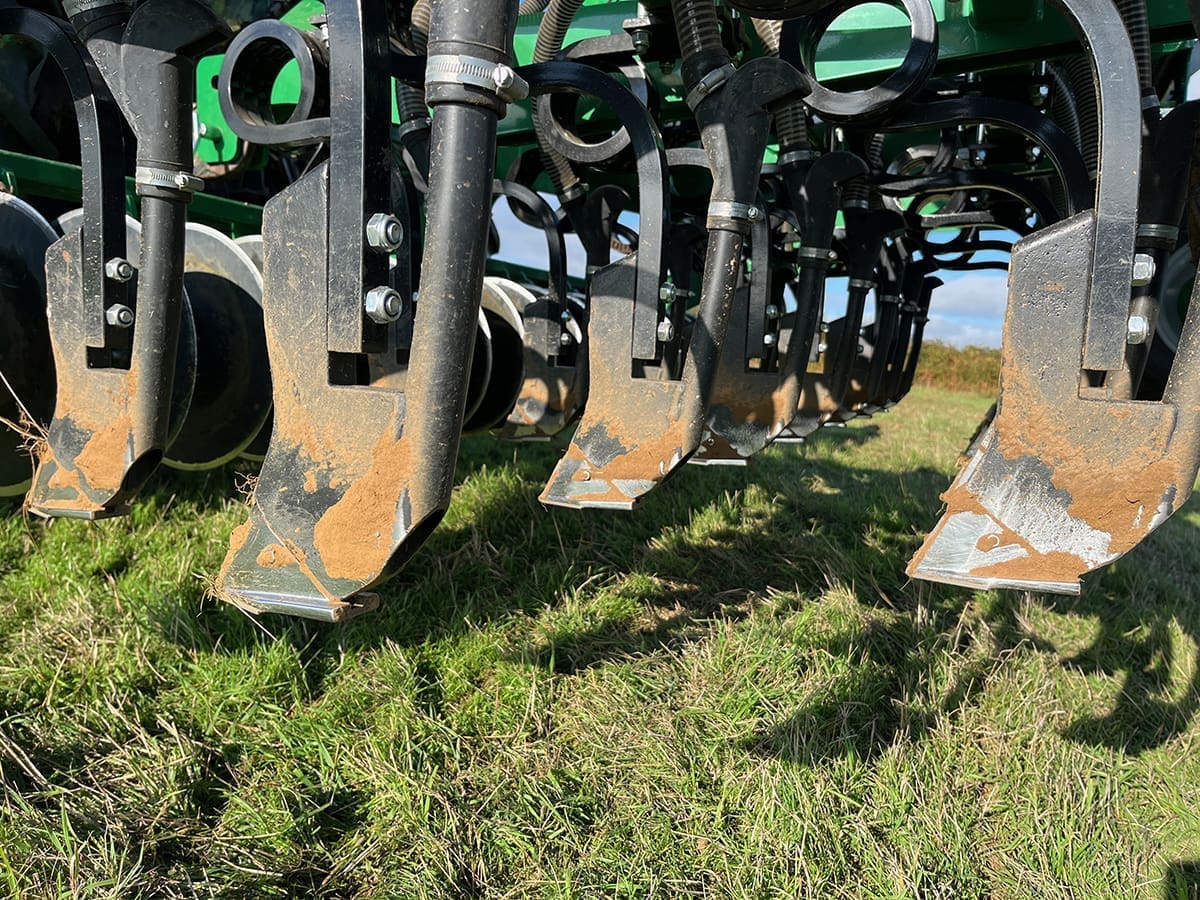
These were the basic principles of the Aitchison/Baker concept, and it became widely regarded as one of the most effective means of over-seeding fresh species into existing grass leys. But the Baker boot wasn’t just limited to Aitchison drills. Other New Zealand drill makers such as Duncan and Cross-Slot could see its benefits and integrated the coulter into their own machines.
By the mid-2000s the Aitchison importer for France and the UK, George Simon could see the merits in a more European-focused seeding rig and started Simtech. This saw the development of wider air-drills with Sulky metering units better suited to establishing a wider range of small- and large-seed crops.
Over the years various different fabrication outfits were used to glue the metalwork together, the job finally falling to Lincs-based Fentech. It continues to deal with the cutting and welding while the new generation of Simtech seeders are assembled at Opico’s Bourne base.
The range is wide, spanning working widths from 1.8m to 6.0m with rigid-frame box-drills and folding pneumatic units with a choice of front- or rear-mounted pressurised hoppers and metering systems from Horizon. Latest addition is the lower-cost, lighter weight TJG.
What we have here
We got hold of one of the first demo I-spec units equipped with twin brushless fans and I-Con touchscreen controller.
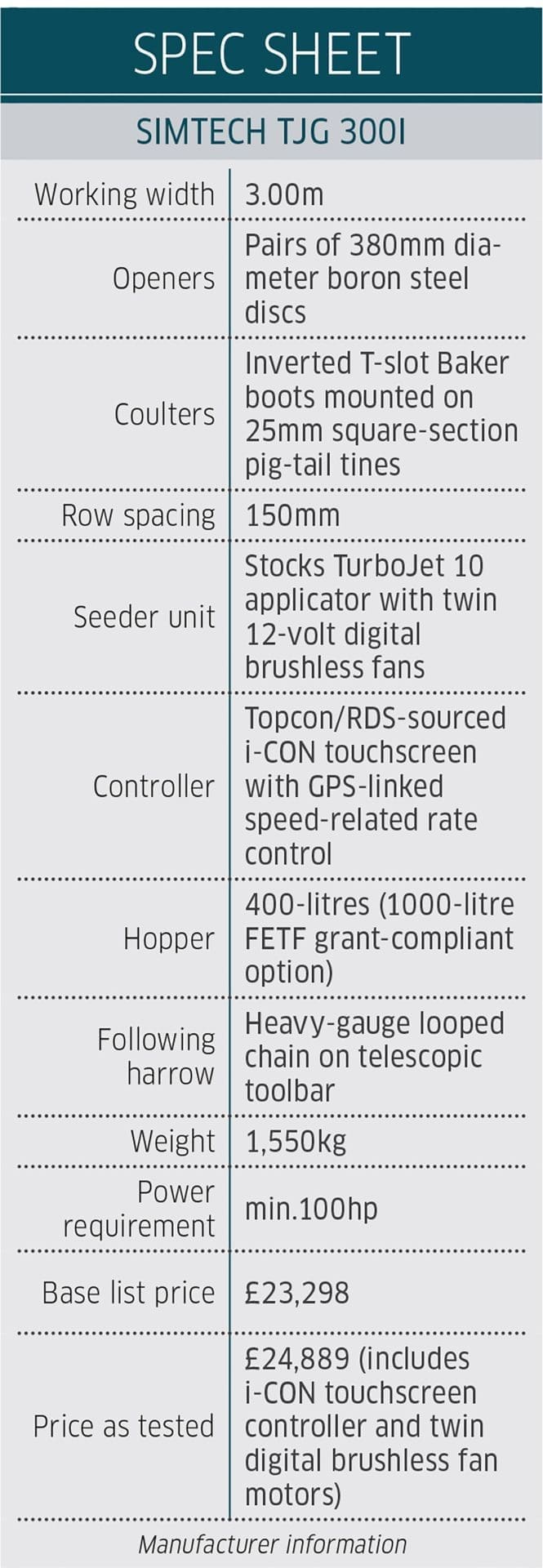
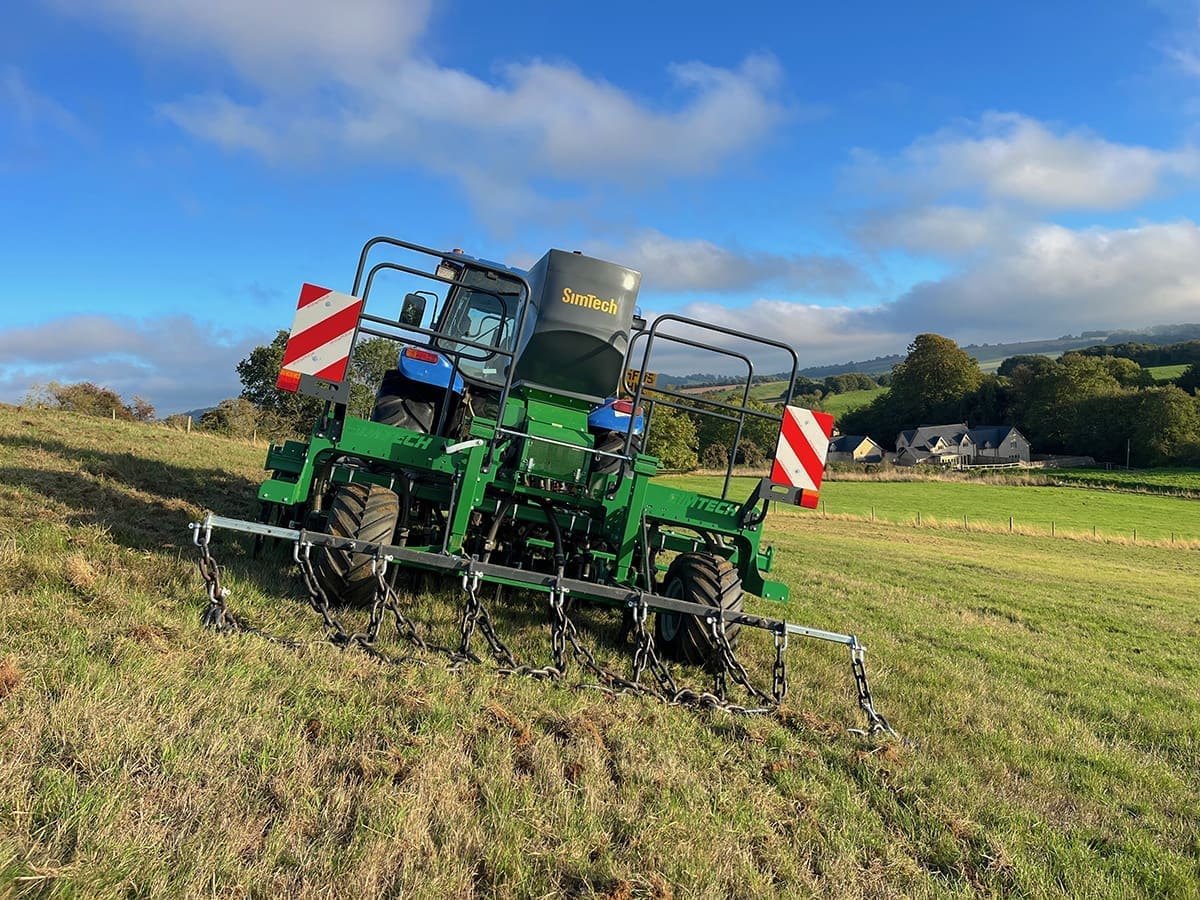
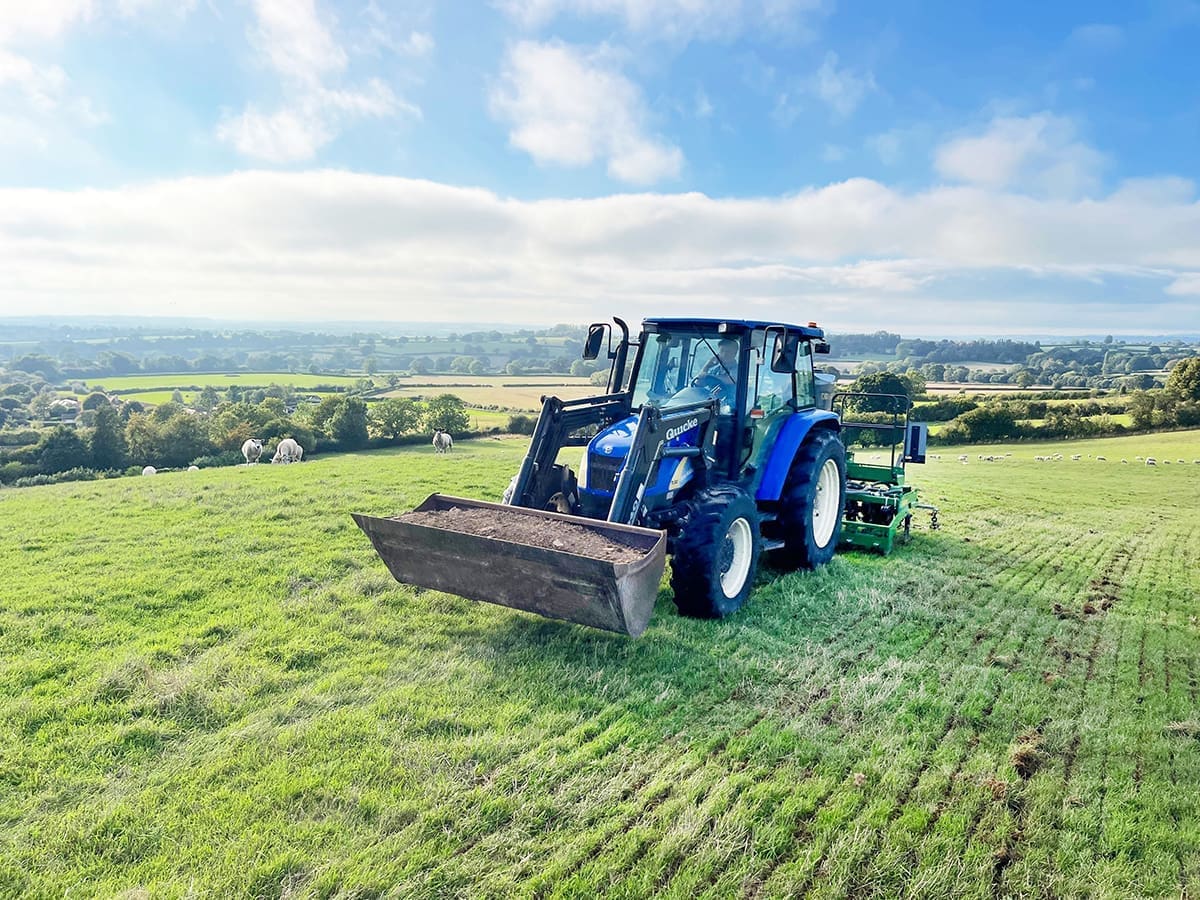
Like many seeding rigs designed for grassland farmers, much weight is put on the lower power requirement of the Simtech TJG. We thought we’d put that to the test, pairing the 3.0m, 20-coulter demo machine with a 20-year-old 100hp New Holland TL100A. While we were confident the combination would work just fine on flat ground, we wanted to see how much it would test the lightweight loader tractor on some of Somerset’s steepest slopes.
With water ballasted tyres on the rear and a bucket full of dirt on the nose, we were taking no chances with traction on the thickly thatched bank of permanent pasture we were faced with under-sowing. The plucky blue brigand surprised the test team, pulling nobly up the hill with only the very steepest gradients prompting diff-lock-in, air-con-off moments.
On the gentler nursery slopes it was comfortably able to pull the TJG along at speeds of up to 15km/hr but, like any direct drill, it works best below 10km/hr.
Getting it right
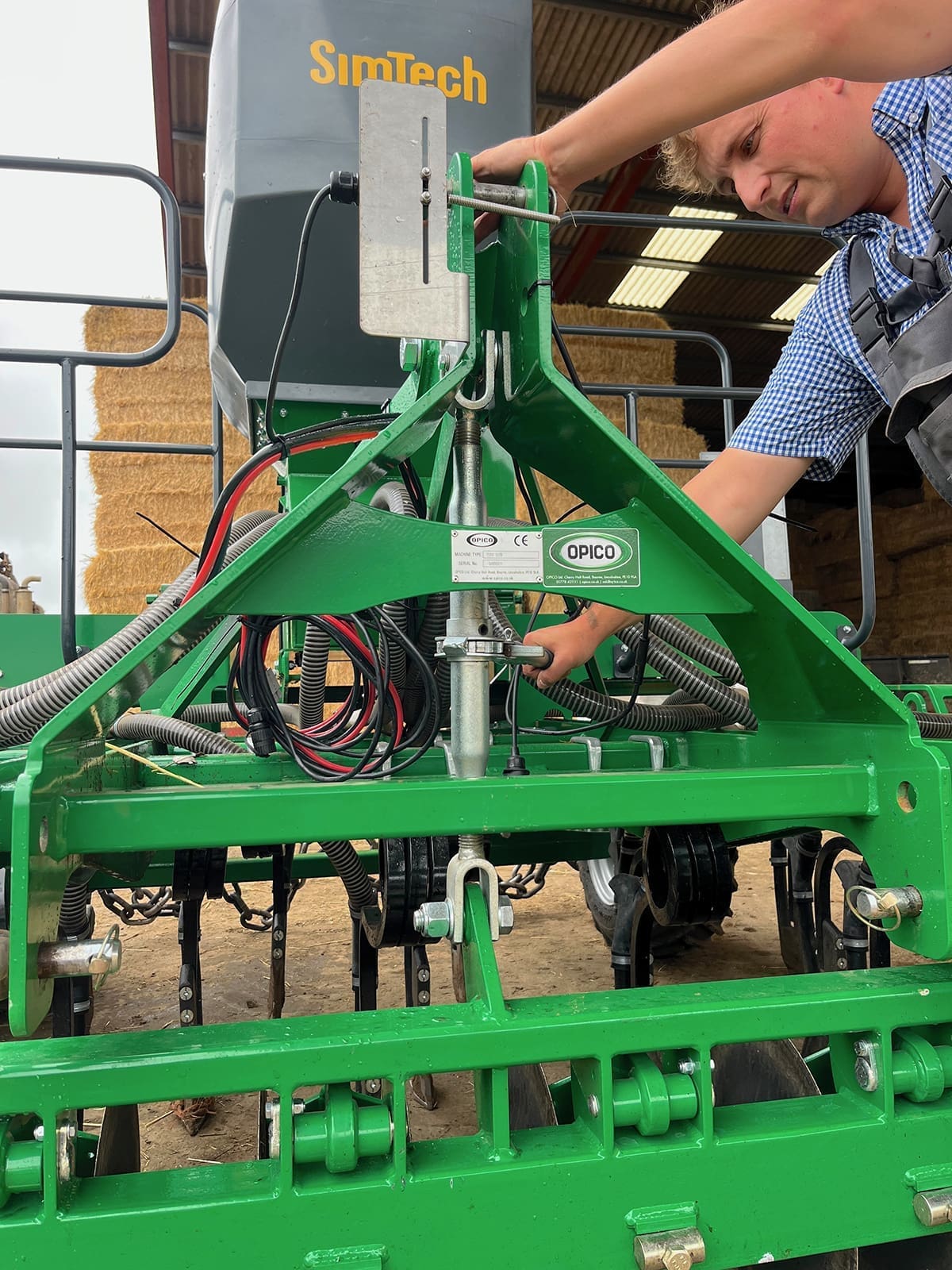
Key to the arrow-tipped coulters doing a decent job of slicing through the turf and placing seed at a consistent depth, the leading opening discs need to be wound in just enough to cut through the thatch but not so deep as to risk losing seed to the underworld. A single centrally-positioned ratchet turnbuckle raises and lowers the whole disc toolbar. Mounted in pairs on spring-protected mini axles, the discs were generally capable of penetrating into the sun-baked, rock-solid surface.
With a neat incision cut through the ground ahead of them, the T-slot coulters tend not to churn up the existing sward except in the areas with the densest thatch. Their depth is controlled by a pair of wheels at the rear of the frame which are adjusted by a simple winder handle. Generally, with grasses, clovers and herbs in the tank the aim is to run no deeper than 30mm. With the not-insignificant humps and hollows of our particular patch of permanent pasture it was challenging to achieve this consistently across the working width of the drill.

The Simtech’s rigid frame is great from a simplicity standpoint but its lack of coulter contour-following means that an element of compromise has to be accepted, some points pulling in deeper than desired through the high spots and others skipping over the surface in the dips.
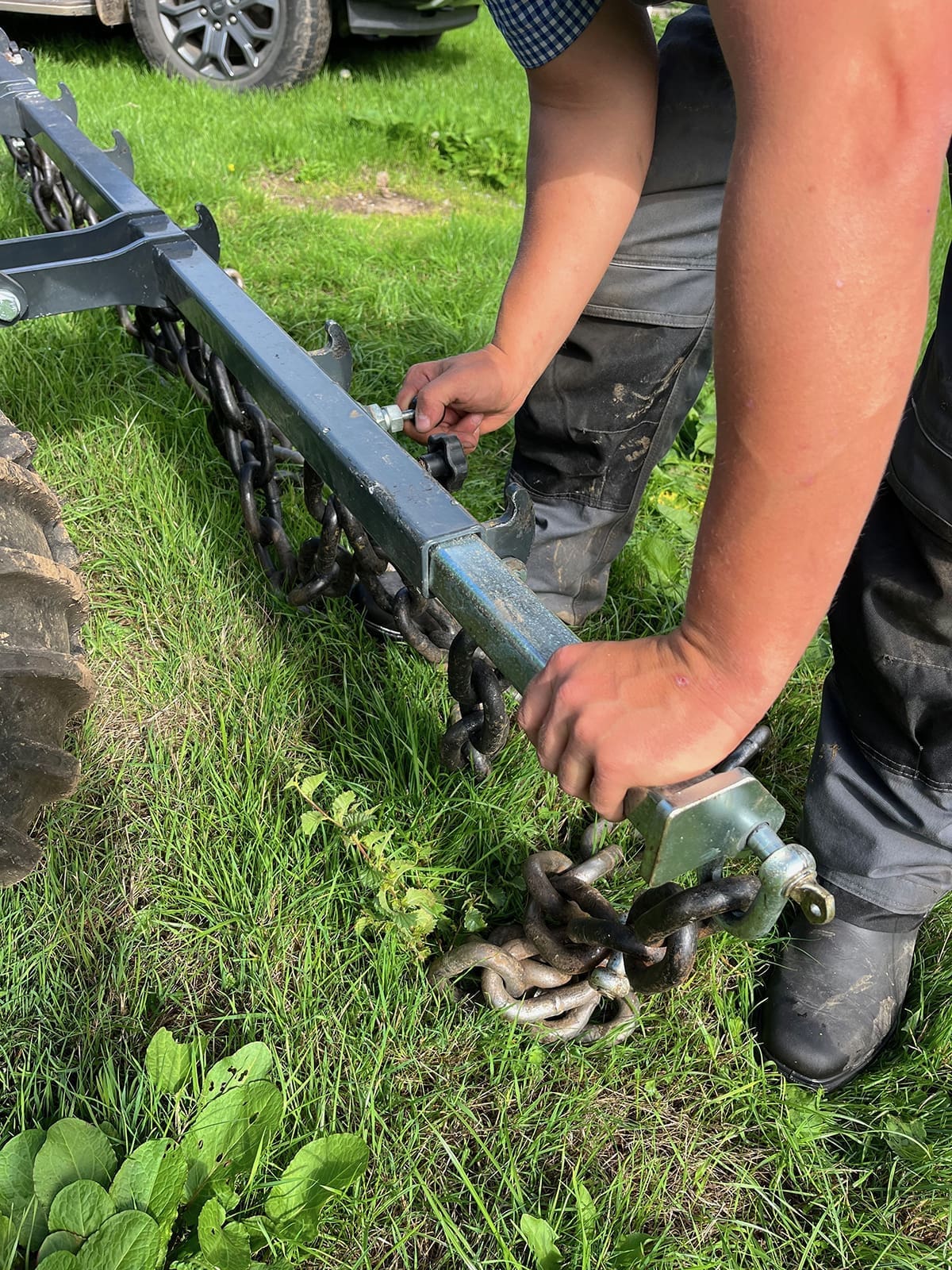
Following up the rear, the heavy-gauge chain covering harrow might look crude but it does a decent job of knocking about any loosened tussocks. In the dry conditions of our test day, it pummelled out the soil, dragging it into the drill rows to give the seed a good covering of tilth. Somewhat surprisingly the advice is not to roll behind the drill, so that the loose under-cut turf in the slots is less inclined to re-root, giving the new seedlings a better chance of getting away from the pre-existing species in the sward.
On the road
Having the tine coulters arranged in three staggered rows is good for turf and trash travel through the drill, but with the leading row of opening discs and the frame for the following harrow, it makes for a long overhang at the backend.
While the telescopic harrow toolbar helps a little, this bulky rigid frame can be cumbersome on the road, especially in parts of the country where narrow lanes are the norm – typically the livestock-rich regions where grass drills such as the TJG are most likely to find their homes.
With this in mind, our tester’s preference would be a skinnier option. Next size down in the range is a 2.4m wide machine which is a fairly big step down and comes in narrower than the TL100A’s modest 420/85 R34 tyres. Unfortunately, at a time when Opico says it is trying to simplify the Simtech line-up, it looks unlikely a 2.7m version will be added to the range.
Our stockman-spec. front weight block (bucket of dirt) was a must both on the road and on the steep Somerset slopes. Without it the steering became sketchy and it was a struggle to keep all four wheels on the deck with the drill lifted.
Controls: simple or smart
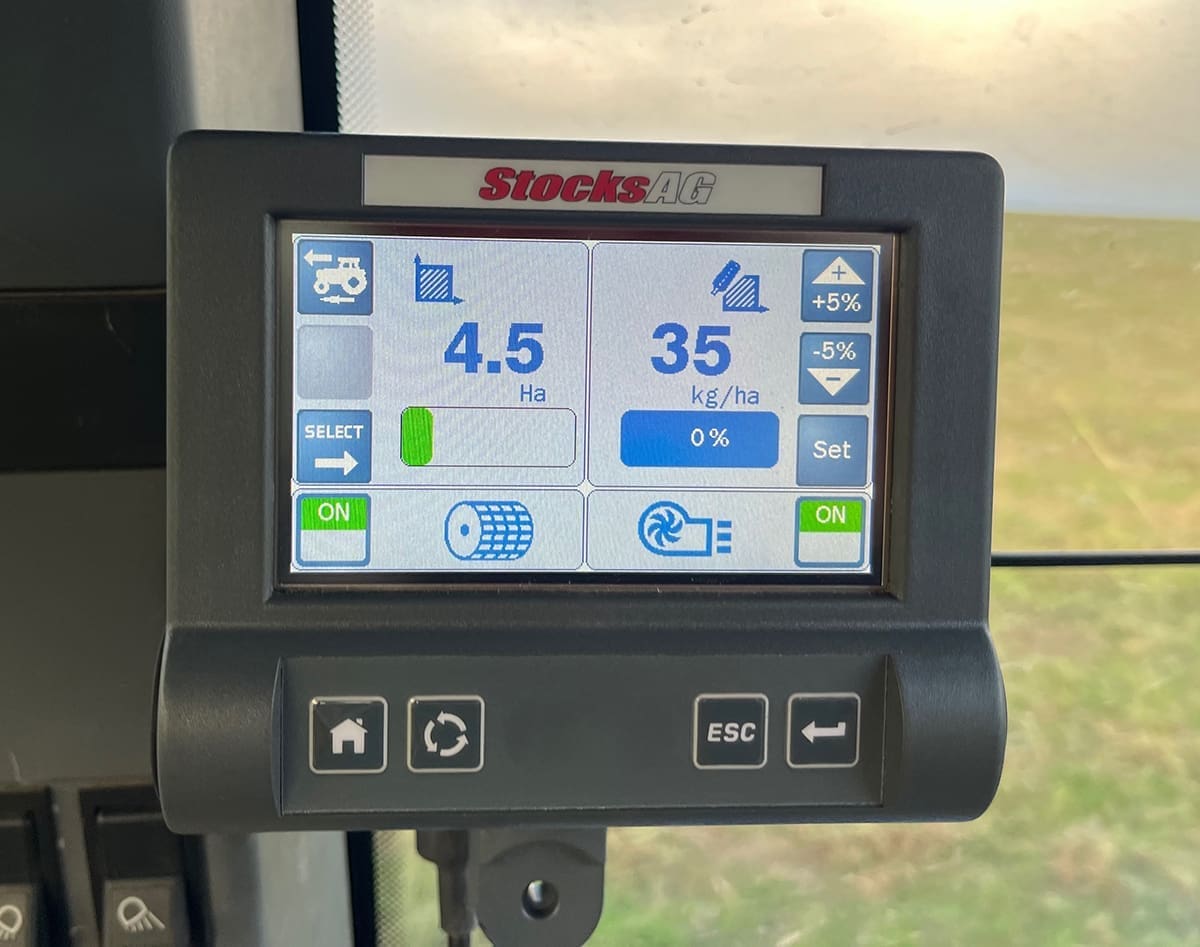
Tagged by Stocks as the I-Con, the colour touchscreen is actually a Topcon/RDS Weighlog controller uploaded with seeder-specific software. Alongside an ISObus option, it’s the firm’s top-spec offering while more budget-conscious operators can opt for a more basic push-button Jackal box.
Going with the poverty-spec box knocks some £1,500-£1,700 off the price but it means you also lose the high airflow twin brushless fans. Their digital controller provides a two-stage soft start to avoid power spikes and blown fuses, working with the I-Con’s pre-start function which primes the system to ensure seed delivery starts as soon as the drill enters work.
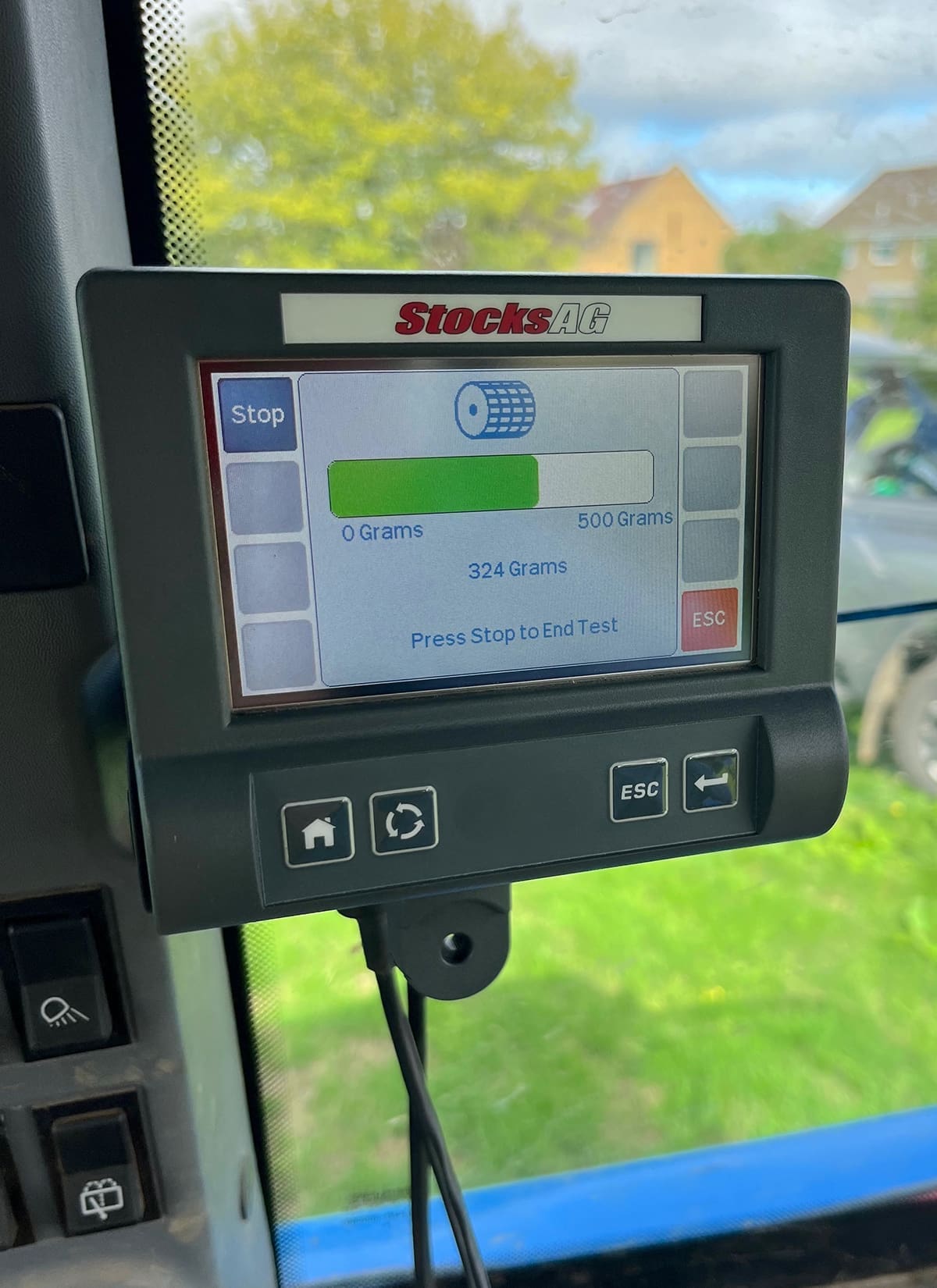
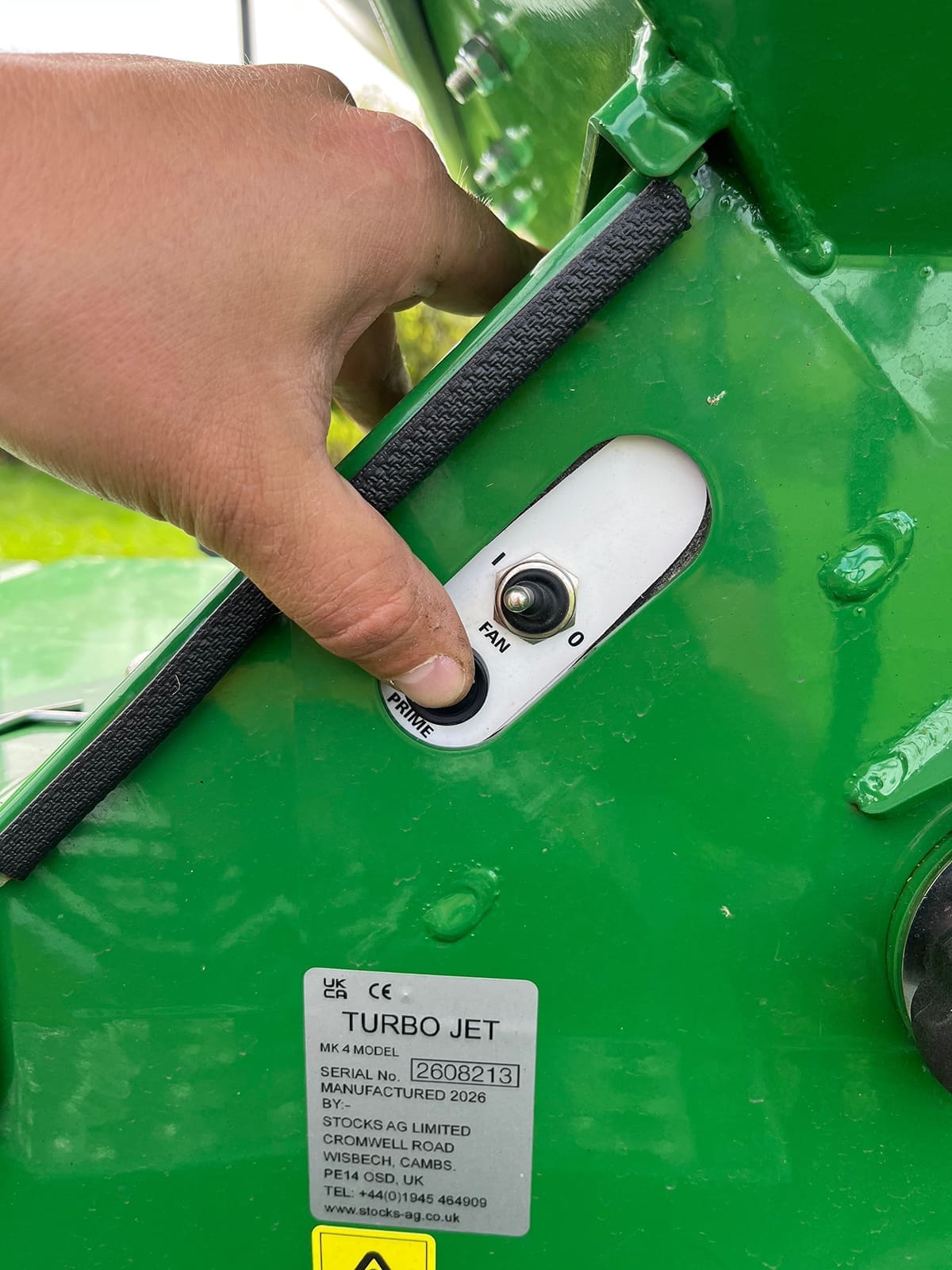
Those features alone mean we’d probably opt for I-Con spec if funds allowed. We particularly liked the simplicity of the touchscreen’s calibration menu. It can either be set to measure out a set quantity from the cab or alternatively a push of a button on the base of the hopper prompts the seed roller to start spooling. Whatever ends up in the tray is then weighed and a correction factor is then entered on the screen. It’s about as straightforward as it gets.
Like any control box it has its own repertoire of beeps, squawks and buzzers which, after a time become easy to ignore. One of the most important is the one that reminds the operator that the metering unit is not running. A finger-switch on the top-link clevis cuts drive to the roller as the drill is lifted and kicks it back in when lowered. The concept is good but unfortunately the positioning of the magic wand on our test machine meant it could jam in the up position.

If you’re not careful you can be halfway down your next run before you twig that the box is trying to tell you something important with its repetitive beeping – a definite issue for dozy, sleep-deprived drill-men (and -women).
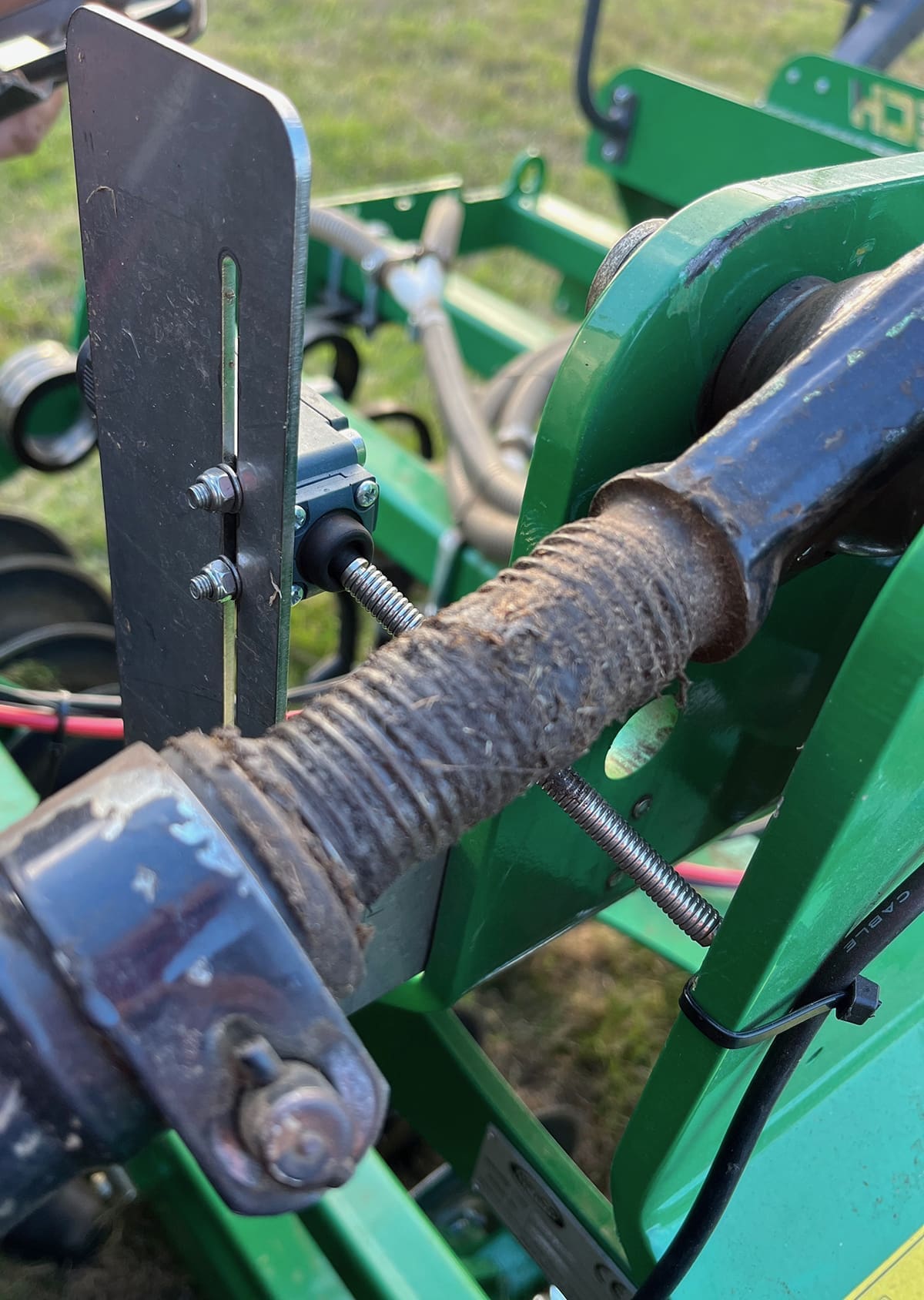
Opico says it has now modified the finger-switch mounting bracket to do away with this issue.
Summary
The TurboJet-equipped Simtech TJG has been developed by Opico as a lower cost – and potentially more adaptable – alternative to the brand’s more conventional air- and box-drills. With a base price of £23,298 it certainly comes in cheaper but add the high-output fans and I-Con touchscreen controller and you’ll be coming in over and above the £23,809 list price of a gravity-fed TSG. It’s still a good stretch away from a 3.0m pneumatic TSGP with its Horizon metering unit at £37,984.
If you’re chasing a FETF grant, then there’s a funding-compliant 1,000-litre hopper version of the TJG. Complete with a hydraulically-driven fan, it comes in at closer to £30,000.
While we’re told the new variant will handle large seeds such as cereals at rates of up to 320kg/ha, if you’re after something that will regularly be required to establish arable crops you may want to look at the old-school metering options. However, if grass is your game and over-seeding is your thing, the top-spec Simtech TJG does the job with a certain level of sophistication and finesse.
Nick Fone
For more up-to-date farming news click here and subscribe now to profi and save.


