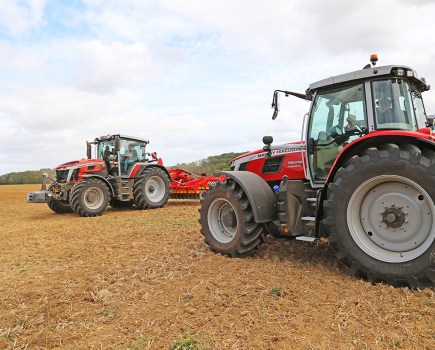


The Evion is now the smallest Claas combine sold here. A mash of proven parts, can the Evion follow in the footsteps of the legendary Claas Dominator? We tested the small straw-walker machine for a season to find out.
KEEPING IT BRIEF
- Around 60% of the components used in the Evion come from the Lexion or Trion.
- Is being built in the factory in Goami, China, which opened in 2014.
- Grain and straw quality during testing were very good.
Introduced in 2023, the Evion is seen as the natural successor to the Avero as well as the Tucano 320. Technically there are three Evion models; the 410, 430 and 450, but we don’t see the biggest model over here in the UK and Ireland, as it starts to tread on the toes of the Trion. We also don’t get the Maxi version of the Evion as it has slight tweaks to the spec so it can handle grain maize. Indeed, all of the Evion 410 and 430s sold here have been the Classic version which is set up for small grains.
Claas is pitching our on-test Evion 430 Classic at British and Irish farms with 200 hectares of cereals to clear each season.
So, what are the likely Evion volumes? Well, there were over 100 Averos sold in the UK and Ireland when they were coming out of Harsewinkel between 2009 and 2021. Then there is the pinprick-sized hole in the market vacated by Deutz-Fahr, while John Deere no longer has a basic straw walker. The Evion’s main market rivals will be from New Holland and AGCO.
No accelerator drum
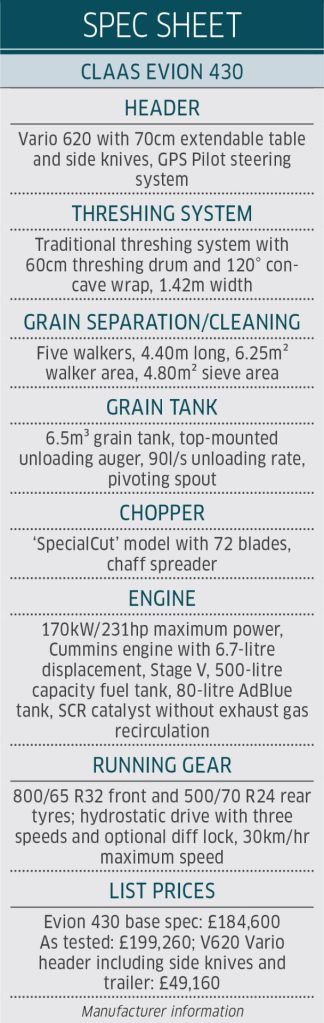
While the four-walker Avero model had an APS accelerator drum, the five-walker Evion does not; instead it uses the Trion’s larger, 60cm diameter, 142cm wide threshing drum fitted with eight rasp bars. The speed of the following impeller drum is synchronised with the threshing drum, which helps treat grain and straw more gently. Even on this entry-level machine, the concave is adjusted electro-hydraulically as standard, while the de-awning plates can be swung in and out without tools by operating a lever low down on the left-hand side. Overall, the layout of the threshing system is straightforward, and adjustments are refreshingly simple.
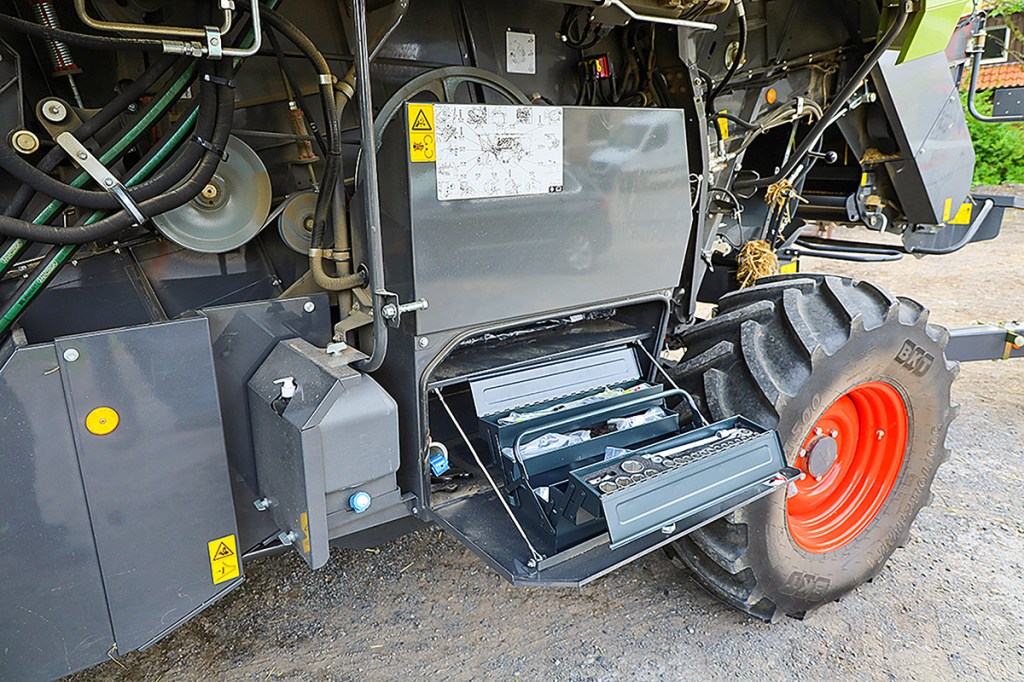
The five walkers, each 4.40m long with four steps, take care of the unseparated grains. Unfortunately, straw trash tended to build up on the frame under the walkers, which then had to be cleaned off every evening. However, these leftovers did not affect the performance in the field.
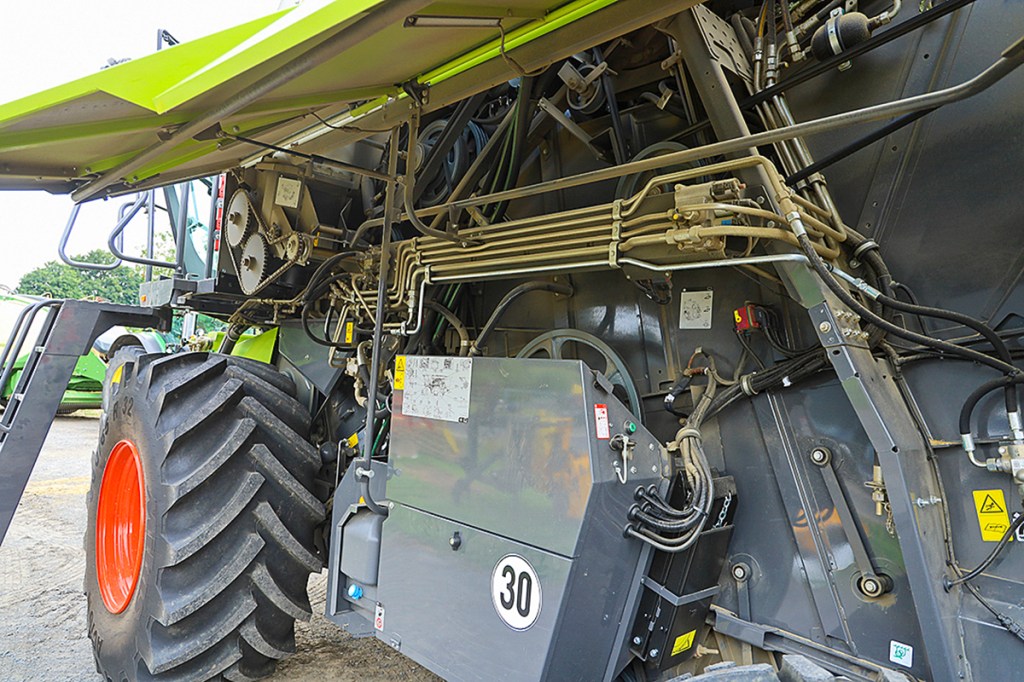
3D cleaning system
Grain leaving the concave drops down onto a preparation pan, made up of individual plastic elements. These plastic elements can be pulled forwards for cleaning.
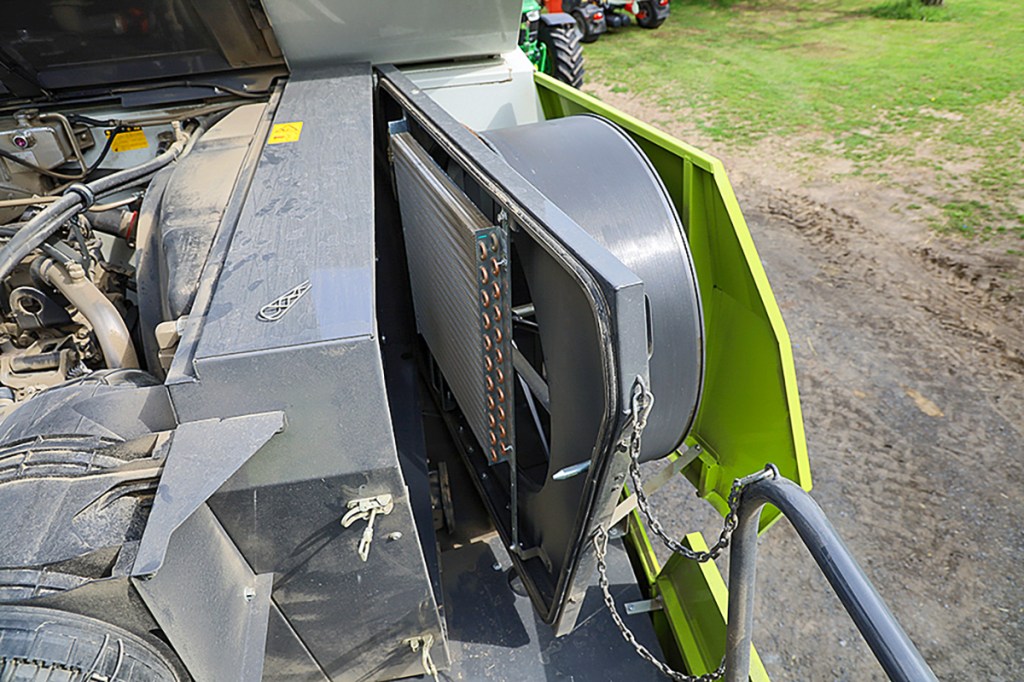
The sieves are adjusted electrically from the cab. The 3D cleaning system ensures the material is spread evenly across the sieves when operating on slopes up to 20%. Returns can be easily checked through a viewing window in the cab.

Straw that puts a smile on your face
Looking a bit farther back in Claas’s history book, the old Dominator range earned a reputation for being gentle on straw, and the Evion continues that tradition, forming a loose, box-shaped row. If you want to go chopping, the 72-knife Special Cut chopper does a good job.
You do need to hop out of the Evion cab to manually swing the chopper into work; this is where the bigger Trion 520 offers that bit more user convenience. The chaff spreader, by comparison, is very handy, because you can swing it out of the way manually to get easy access to the sieves.
Classic difference
As alluded to earlier, one area where the Classic differs from the Maxi is the one-piece universal concave. In contrast, the Maxi has the Multicrop concave with interchangeable concave segments that can be switched for grain maize. It also includes a diff lock (a £2,095 option on the Classic), a compressor and the two-speed drum drive.
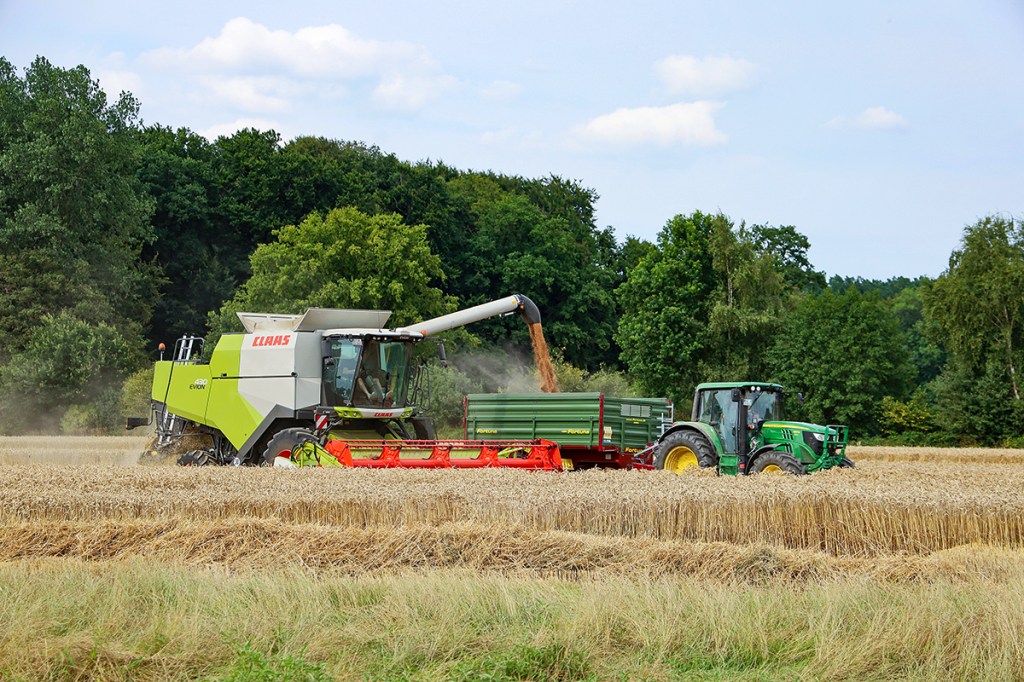
6,500 litres of grain in the tank
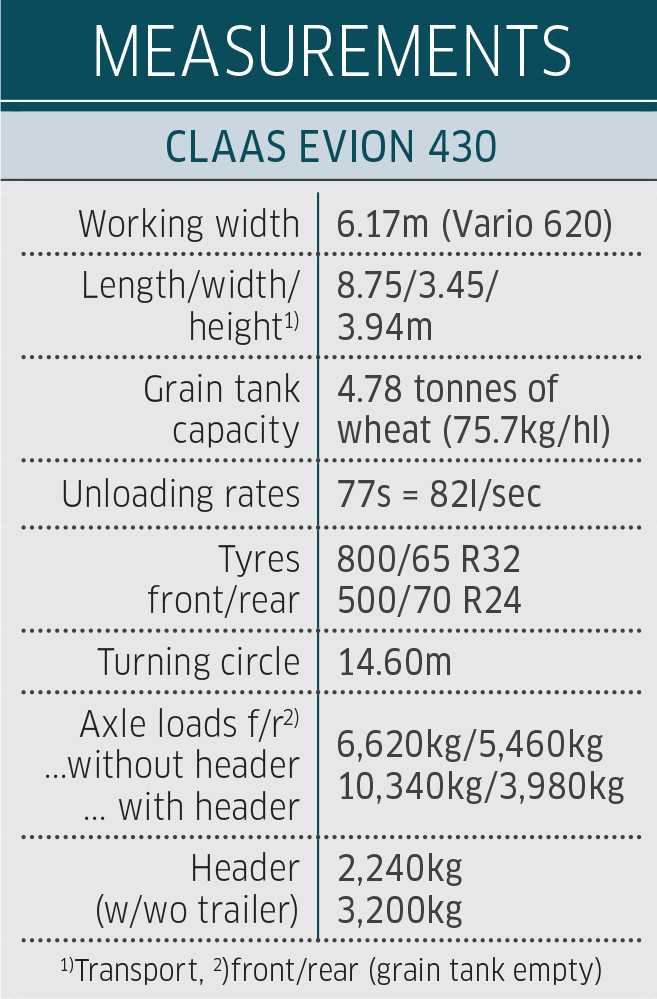
The Evion’s grain tank has a large inspection window, and the tank lids fold in/out at the touch of a button. Tank capacity is said to be 6,500 litres (the 410 is 5,600l), but in reality we managed almost 4.8t of wheat (75.7kg/hl) which equates to around 6,300l. Unloading is a brisk operation: we emptied a full tank in just 77 seconds, which works out at 82l/sec.
The 330mm unloading auger can be swung 105 degrees forwards, giving a very good view of the spout. Incidentally, there is an electrically adjustable spout as an extra-cost option for £1,290, which now automatically swings to either the midway position or to the last saved position at the next unload — a very neat feature.
Smart is better
Auto Crop Flow (£1,545) monitors the crop flow automatically. By monitoring the speed of the engine, threshing drum and straw chopper, plus the signal from the straw jam door, the system is able to detect a potential bung-up, and, if it needs to stop, cuts the drive to the header. This gives you that bit more confidence to work the Evion to its safe limit.
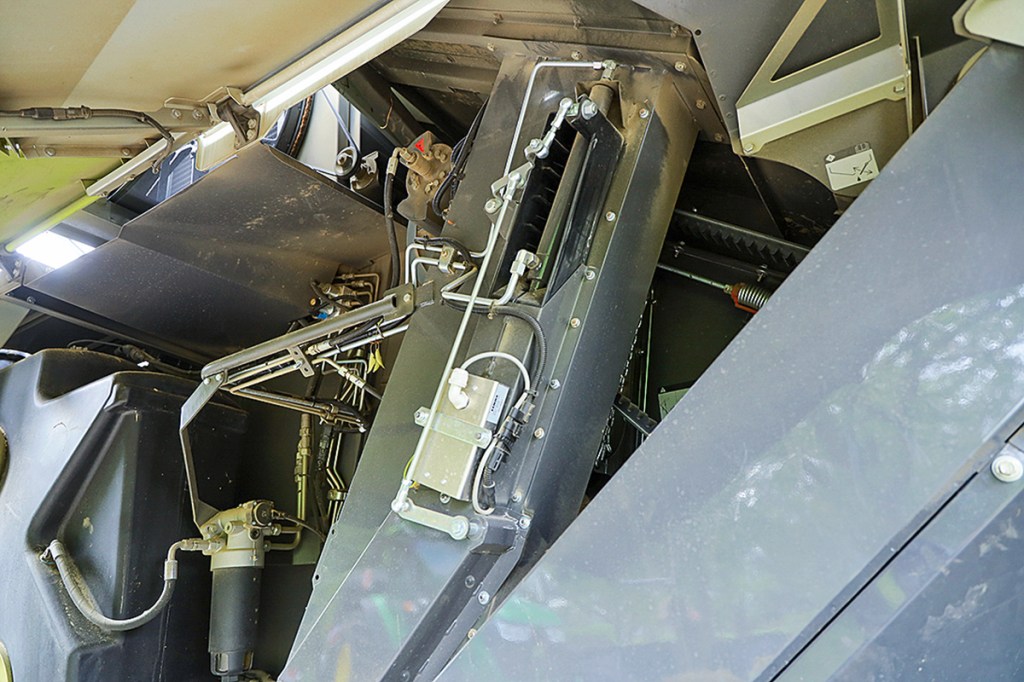
Auto Slope (£1,030) is another auto feature. This reduces fan speed when moving uphill and increases it when travelling downhill, helping to keep crop flow across the sieves more even and reducing losses on slopes. The elevator can be reversed hydraulically at the press of a button.
Upstream of the drum sits a stone trap, which is emptied with a lever at the side.
Vario header…
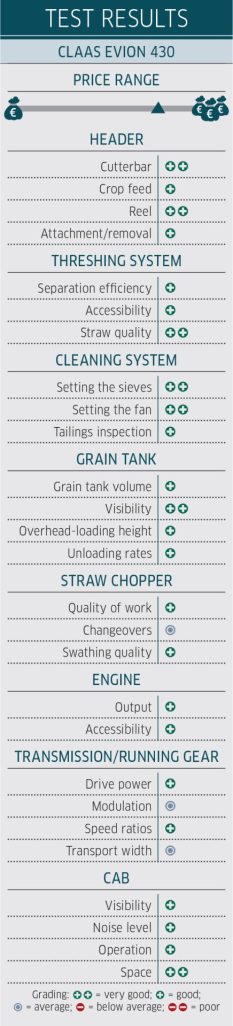
Our test machine had the 6.17m wide Vario 620 header; but you can go up to 6.80m on the 430. For an ‘entry-level’ combine, the Vario header with oilseed rape knives is well equipped.
Alternatively, you can plump for the Cerio header with a mechanically adjustable table, which is £17,000 less than the equivalent Vario 620. This said, we would definitely go with the Vario header if you have oilseed rape in the rotation. With the Vario, the table between the cutterbar and intake auger can be extended hydraulically by up to 70cm.
The well-known Auto Contour system is also standard: two sensors on the header skids constantly measure the distance between the cutterbar and the ground, so the system can continually compensate for any uneven ground both lengthways and crossways. In practice this works very reliably.
…with plenty of automation
We also liked the auto reel speed control, along with all of the memory functions for everything from cutting height and table position through to reel position.
Attaching and removing the header is quick, thanks to the central locking system and the multicoupler — even if the coupler is still bolted on. The way the header sits on its trailer and the transport locks are all very user-friendly. We would definitely tick the option for a camera on the unloading auger and on the clevis for coupling the header trailer. These items are relatively low cost and make the operator’s life easier.
Comfortable workplace
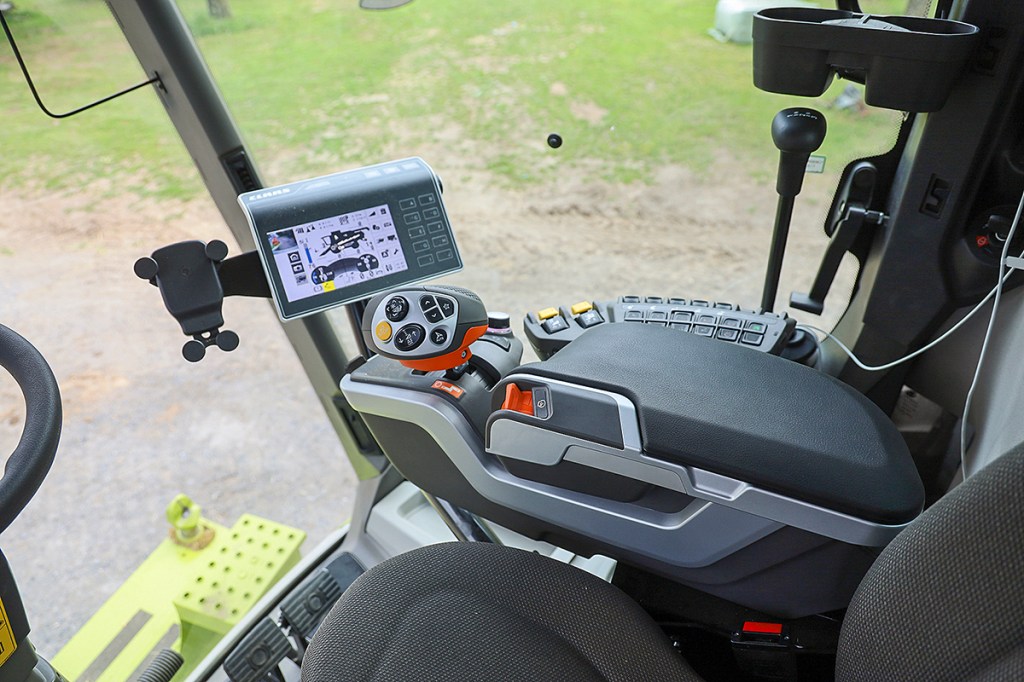
The actual cab is familiar from the Lexion and Trion, although there are some detail differences. The most obvious change is the Cemis 700 screen: at 7in it’s a fair bit smaller than the Cebis display installed in the bigger models. Claas also uses the Cemis 700 as an ISObus terminal with several machines, so it’s relatively familiar.
It can be operated either via touchscreen or the soft keys along the side. All of the more important functions can also be controlled with quick-select buttons on the armrest. The Cemis screen also shows the images from the reversing and unloading cameras.
We would have preferred the larger Cebis screen for a better overview. However, even with the smaller screen, you still need to be careful how you position it, as even this can obscure the view to the right-hand corner of the header.
On the positive side, the Evion features the well-known Cmotion drive lever, which allows you to conveniently control lots of combine functions. The main downside is that the hydrostatic drive is still operated via a Bowden cable, which makes it stiff but very direct to use.
If you do choose the Business package, you also benefit from a decent-sized fridge under the passenger seat and electric mirrors. All that is really missing is a small wide-angle mirror to keep an eye on the header trailer when making turns. And because there is no detent in the mirror arms, they fold back a bit too easily if they brush against branches or other “obstacles”.
In terms of noise, we measured 73.6dB(A) in work. Not a recordbreaker, but still okay. The same goes for the tight 14.60m turning circle and the small, grippy steering wheel.
Cummins engine
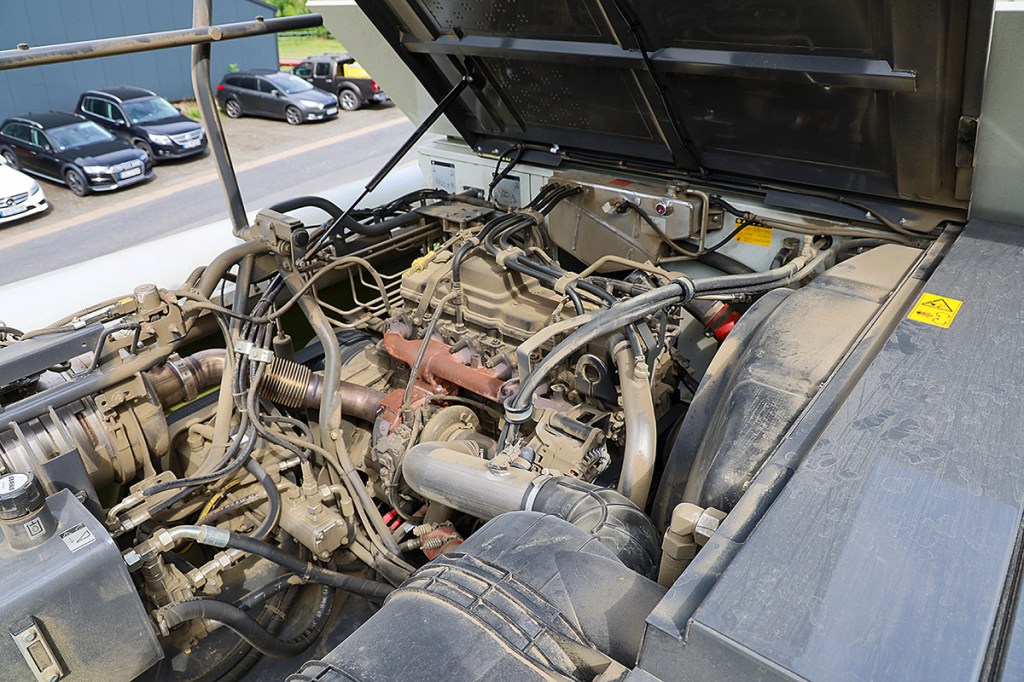
Evion is powered by a six-cylinder Cummins 6.7-litre engine. Claas employs its Dynamic Power feature here, which it says can save up to 10% diesel consumption when working under partial load such as when not chopping straw.
Indeed, when cutting wheat and leaving the straw in a swath, our test combine used 12.4 litre per hectare. This means 500l of diesel and 80l of AdBlue on board should be easily enough for even the longest days.
The hydrostatic transmission has a gear lever for shifting between the three speeds. Gear changes in the gate are not particularly slick, but the gear ratios themselves are well spaced. A positive is the auto engine speed reduction on the road, regardless of whether you order the Evion with a top speed of 20, 25 or 30km/hr.
Pass after pass
Our test machine was fitted with a Claas auto steer system, which includes a Cemis 1200 screen. In the field, this takes a lot of strain off the operator. Unlike the old Laser Pilot, the system allows you to cut the field in big blocks, so you don’t end up with any narrow strips. Instead you are able to make use of the header’s full working width on every pass.
Another plus is that both screen and receiver can be transferred to other machines.
The Evion also has the option of yield data logging: a quantimeter measures throughput and grain moisture content, with the figures displayed live on the screen. At the same time the combine sends the harvest data to the farm management software, and you can later generate yield maps.
18t/hr with just 0.73% losses
Cutting RGT Konzert winter wheat (9.8t/ha, 15.5% grain and 20.3% straw moisture), our Evion achieved an impressive 18.4t/hr with 0.73% losses. This is all the more noteworthy given the very high grain-to-straw ratio of 1.0:1.7, which pushed total crop throughput to nearly 50t/hr.
But we also had a damaged grain percentage of 3.7% in our samples. Claas reckons we should have taken out the easily removable rasp bars on the inlet of the concave. On the plus side again, we found virtually no chaff or straw in the grain tank.
Our summary after one season
The Evion shares a lot of its genes with the previous generation Lexion and now Trion. Those with an encyclopaedic Claas combine knowledge may even be able to trace the breadcrumbs back to the Dominator’s clean threshing and straw-friendly manners.
List price for the Evion 430 in our test spec is £199,260, plus £49,160 for the 620 Vario header. Ahead of harvest 2024, several Evions appeared on UK and Irish shores, so there is clearly a market for such a machine.
Sebastian Rüther, Mervyn Bailey
For more up-to-date farming news click here and subscribe now to profi and save.