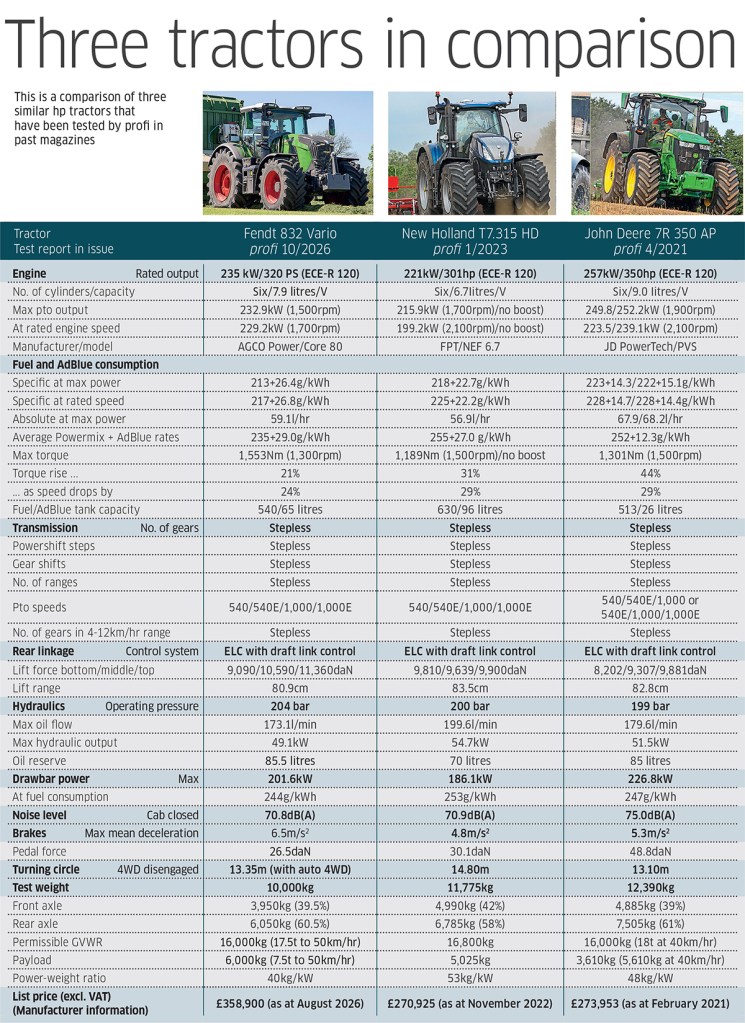

There was huge hype when Fendt unveiled the newest generation Vario 800s a year ago, with a good match of size and power. We put the theory to the test this month, directing our spotlight at the biggest of the three models, the 832, to see what it has to offer.
KEEPING IT BRIEF
- The 832 is powerful, economical and versatile.
- Comfort features such as TMS-Flex, cab suspension and operation are impressive.
- Criticisms: High AdBlue consumption and the old Fendt chestnut of the price, starting at over £355,000.
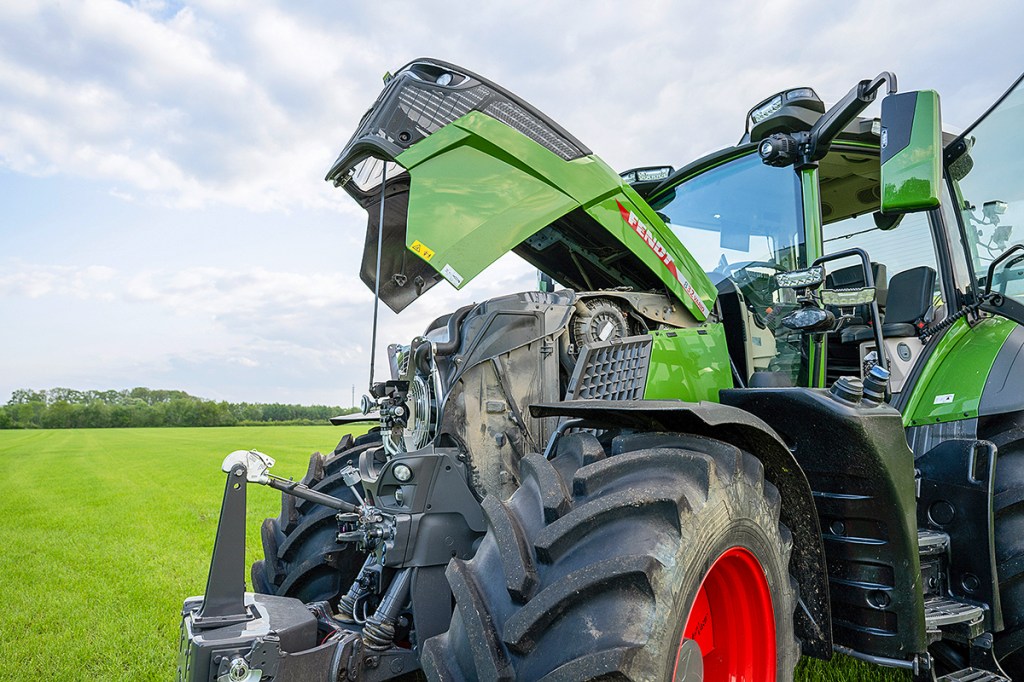
With a wheelbase of 3.02m, the Fendt 832 Vario Gen5 is the “old” 900-series.
Fendt’s target audience is clear: contractors and large farms looking for an all-rounder for both lighter, power-hungry jobs that can also turn its hand to heavy field work. With an unladen weight of just 10t, the 800-series is not only lively on the road, but, courtesy of its 17.5t permissible gross weight (once it is reined in to 50km/hr), it can shift a decent load, ideal for heavy front-rear combinations of all kinds.
More stroke = more capacity
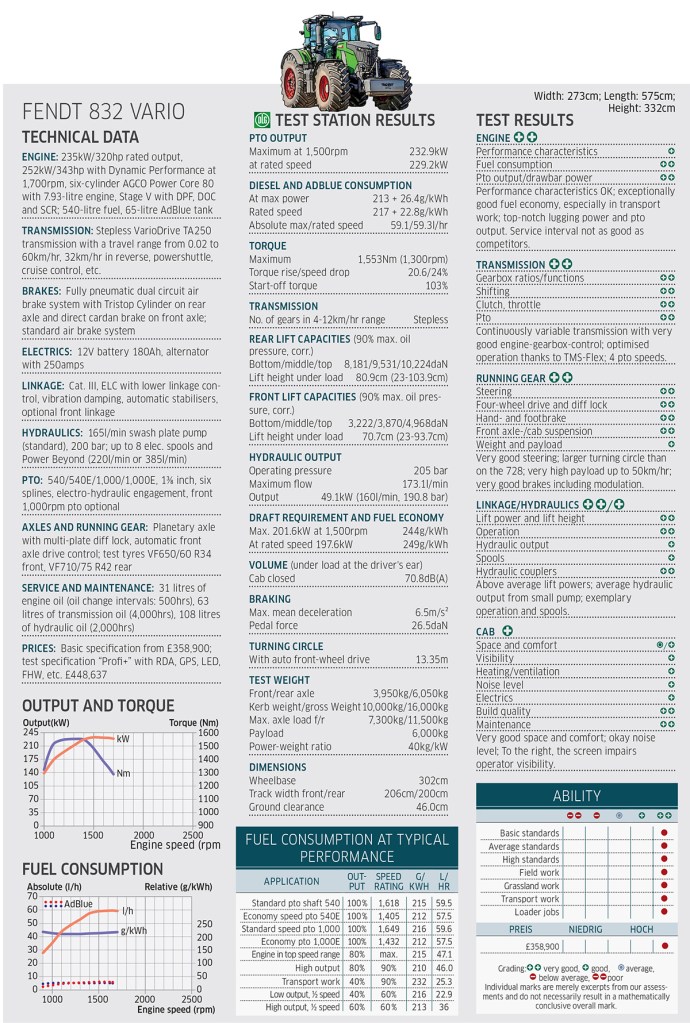
An 800 Vario is not simply a bigger 700; the two are very different. This starts with the 800’s engine: with a longer stroke on its six cylinders, the AGCO Power Core 80 is a 7.93-litre block. It also features high-pressure injection (2,500 bar), a variable-geometry turbocharger (which also has the option of functioning as an engine brake), a low-revving working concept and Dynamic Performance (boost available all the time).The 832 Vario delivers a maximum output of 252kW/343hp.
The DLG tests prove the promised on-paper performance is actually delivered.
At its rated speed of 1,700rpm, the 832 is already putting out a handy 229kW/311hp at the pto. Output maxes at 232kW/316hp as the engine revs pull back to 1,500rpm. At the same time, the engine delivers a whopping 1,553Nm of torque at 1,300rpm — in short, it’s got plenty of grunt.
Not only that, but the engine’s performance has been finely tuned to match the Vario transmission. There is hardly any torque increase, at just 21%, with a 24% drop in engine speed, and only a 103% start-off torque. Apart from stationary pto work, this isn’t a major problem, especially as the engine-transmission relationship is spot on.
Little diesel, more AdBlue
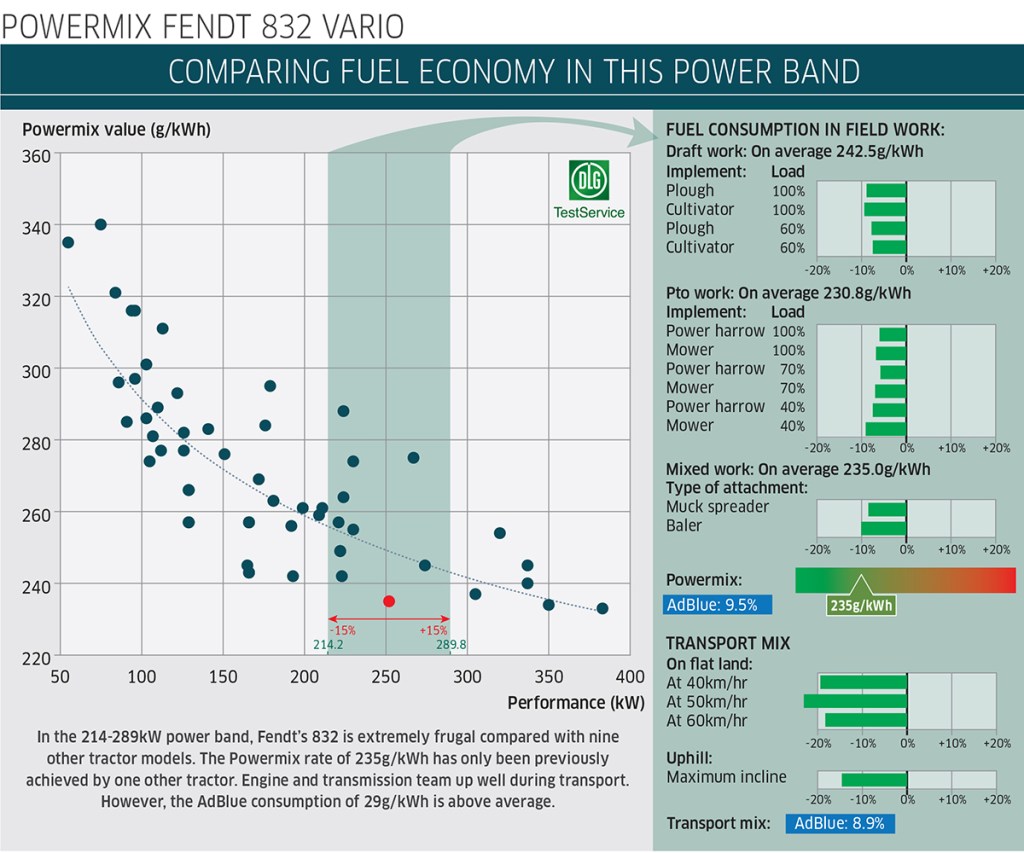
Put on the rolling road test bed we were able to do real-world scrutinising of the tractor’s driveline efficiency. The Gen5 uses the larger TA250 Vario transmission, with just one speed range and automatic four-wheel drive. The fuel efficiency is so good in this power bracket that it set a new Powermix record with 235g/kWh. Up to now, this level of economy has only been offered by its big brother, the 1000 Vario range.
The 832 is especially impressive in heavy drawbar work, although its diesel sipping economy is even more apparent when it comes to road haulage. Aside from almost floating along at 60km/hr when the Core 80 purrs at 1,450rpm, there is the triple- point pneumatic cab suspension playing its part. In fuel saving terms we are talking double-digits compared to the 832’s other competitors in this power bracket that we have tested. At 50km/hr, it is over 23% better than its similarly powerful rivals! The low power-to-weight ratio of just 40kg/kW plays right into the Fendt 832 Vario’s hands.
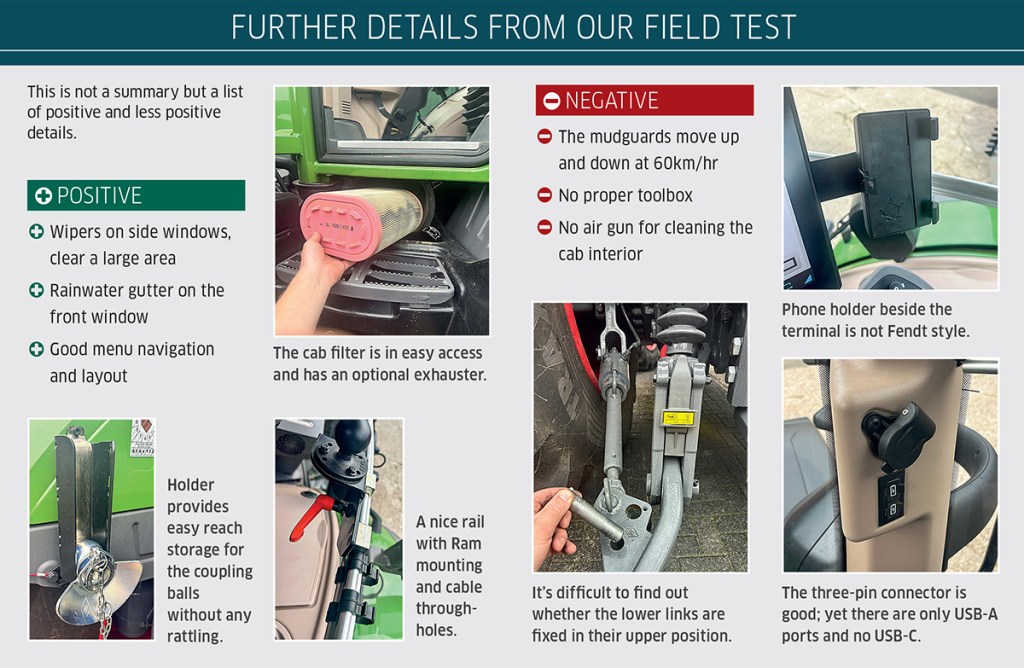
The only downside is the AdBlue use, which is an average of 29g/kWh. That works out at between 5 and 6 litres per hour. Fendt’s reasoning is that the AGCO Power engine doesn’t have EGR, so it needs extra AdBlue to meet Stage V emission standards.
The AdBlue tank holds 65 litres (and there is 540 litres of diesel) which is enough for 12 hours of hard graft. The fuel gauge is deceptive: for the first few hours it hardly moves, leading you into a false sense of diesel sipping efficiency; in fact it will still show as full even after 100 litres have been siphoned out. Not ideal if you glance at the gauge in the morning thinking you have enough for a day’s work.
One other negative engine-related point is servicing. While the 832’s transmission and hydraulics only need fresh oil and filters at 4,000 hours, the engine is every 500 hours. For many businesses, this could mean the dealer van needs to be in the yard two or three times per year.
Four pto speeds
There are no real shortcomings in the pto department. Four pto speeds are as good as it gets (540/540E/1,000/1,000E) though there is no 1,000E front pto. Alternatively, Fendt also offers three 900rpm pto speeds for operating stationary kit such as wood chippers. And speaking of wood chippers, reverse drive is a hefty £9,311 option on the 800-series.
The smallest hydraulic pump has a flow rate of 165l/min and is the standard fit. But the £999 optional 220l/min pump is expected to be the default for UK and Irish customers. If you want even more, then there is also a dual circuit set-up with 165 + 220l/min for hydraulic demanding fans on seed drills or driven axles.
Up to eight spools are available, too (two at the front, six at the rear). In test trim with the 165l/min pump, our tractor delivered 49.1kW — not exactly lavish. So, we would definitely recommend the 220l/min pump. This pump can come with optional 3/4-inch couplers for up to 170l/min through a single spool.
800 Series owners also have the option of electric PowerBeyond. Unfortunately, these couplers are not connected to the large leak-oil reservoir in the cross shaft for the simple reason that they are positioned below it. In this case, the flat-face coupling is the best option for connecting implements without leakage.
With the new software, spools can now be controlled from the terminal for up to 120 seconds, although not independently of time in both flow directions.
Strong lift system
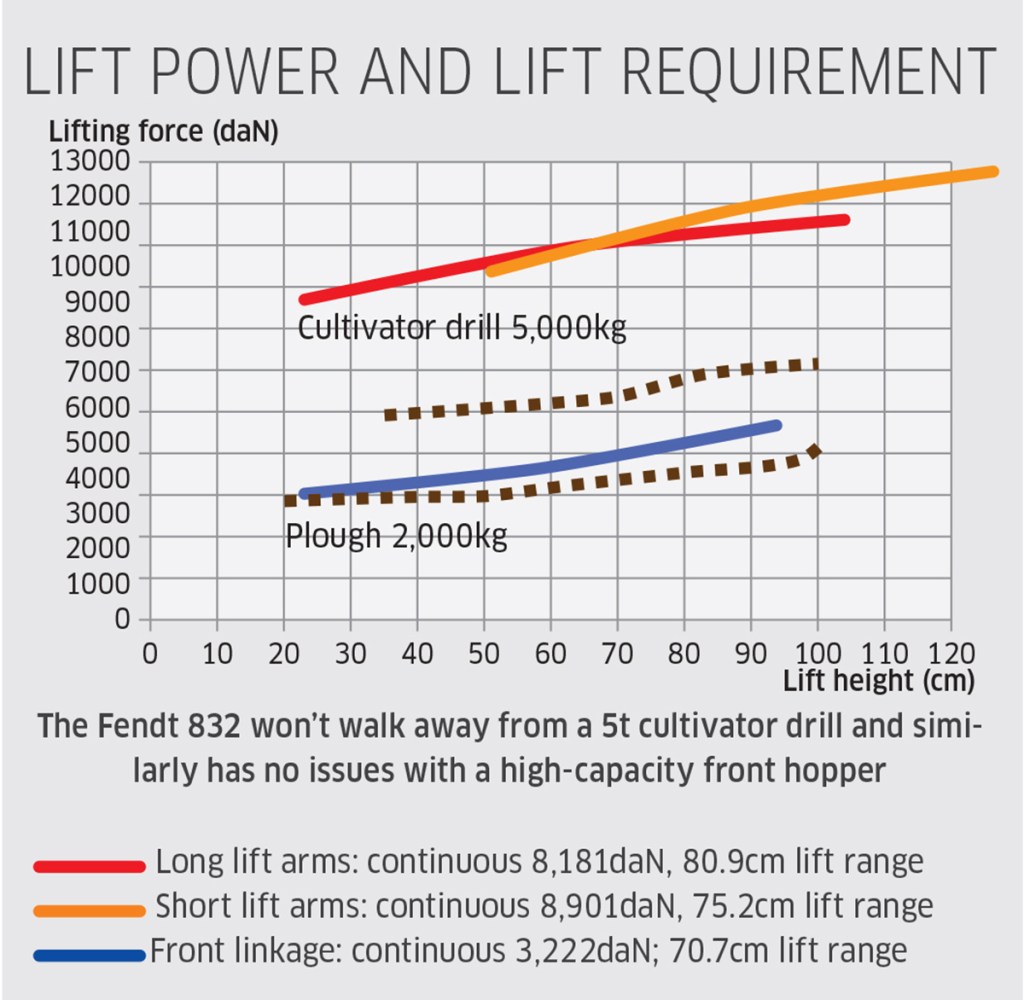
Sticking with the tractor’s rear, the Fendt 832 delivers a continuous lift capacity of 8,181daN; at the front it’s 3,222daN. The rear arms offer some quick adjustment, a two-position pin for swapping between Cat III and IIIN, and then there is a tab that puts the arm in a higher position for some useful extra clearance over a drawbar/pto shaft. Only downside is there’s no obvious symbol to show the arm is in the raised position so, if you do hitch to a mounted implement, you risk damaging the mechanism.
Praise goes to the practical top link holders with integrated weight relief system and the holder for the coupling balls — all of which add to the positives.
TMS-Flex
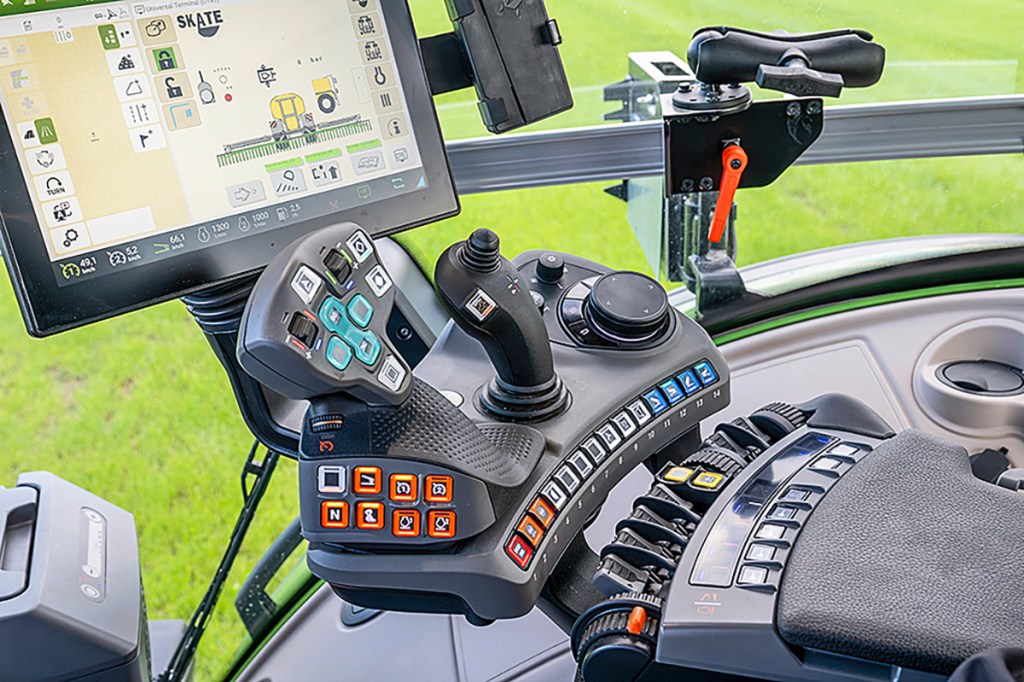
One common point of criticism of the Vario has been TMS mode and the fact that it requires the operator to either drive the tractor from the foot pedal or the joystick. Now comes TMS-Flex. From a button on the side of the joystick, the operator can select flex mode and then juggle back and forth between driving with the pedal and stick. This together with easy adjustment of the speed range and selecting a smaller speed range from the press of a button allows Vario operators to customise their driving experience to exactly how they like it.
It is a pity that Fendt hasn’t copied some other items from its green-and-yellow rival: when the operator accelerates from the joystick and then presses the foot brake, the Fendt doesn’t coast to a stop; instead, once the brake pedal is released it carries on at the current speed. Here, we would much prefer the brake to act as the primary function. After all, when the brakes are pressed the operator generally wants to stop or at least slow down. Fendt argues that this is due to a consistent operating philosophy: this same function is also not available in drive stick mode without TMS-Flex.
Speaking of the 832’s brakes, Fendt uses a dual-circuit brake system for the rear and front axle. Combined with very low pedal pressure, the tractor brakes very smoothly to a complete halt. This ties in nicely with the automatic trailer-brake control linked to the engine brake.
Which brings us to the cab
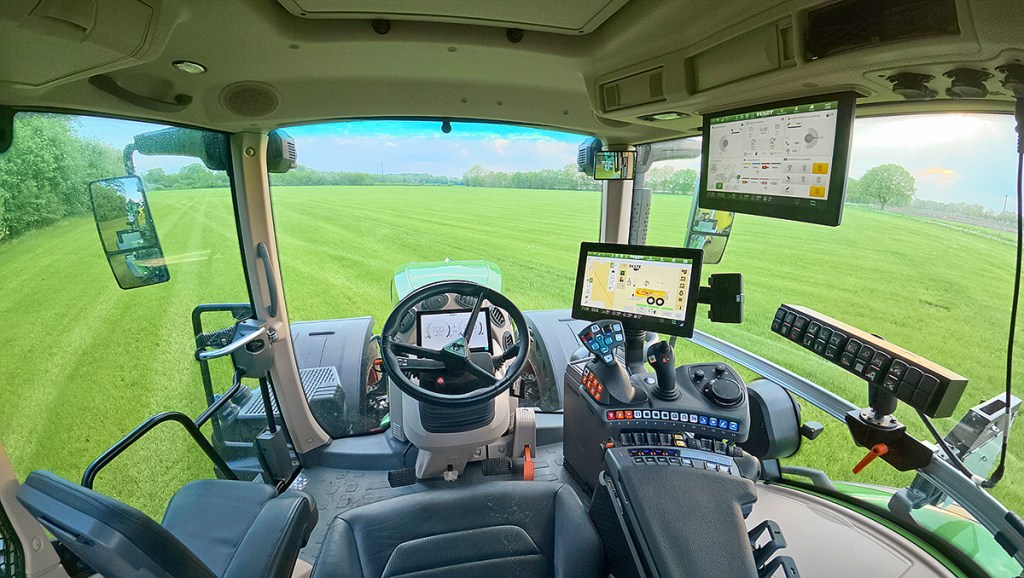
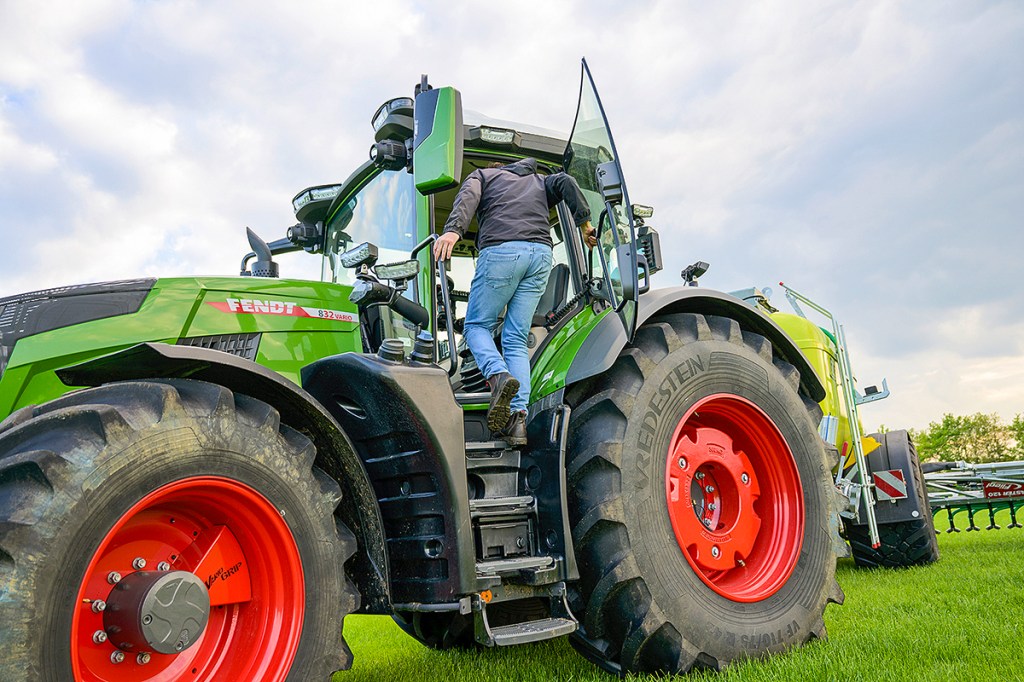
Getting in and out is well thought through: good steps, easy reach handles and wide opening door — not everyone gets this area right! At 70.9dB(A) the noise level is low but not class leading.
The FendtOne operating system is almost identical in its logic to all the other Fendt tractors. The only thing that’s missing is the ventilated joystick, which still feels rather stiff.
By contrast, the buttons come very close to perfection, not only in how they work but also in how freely the functions can be assigned to them. The “white buttons” just need to adopt the relevant symbols that are displayed on the assignment screen.
The cab terminal really ought to save any changes to the job profile automatically. If you forget to save your settings, they’ll be gone the next time you retrieve the job.
Without going into each function in detail (we just don’t have enough pages for that), the welcome F13 update offers a whole raft of electronic functions, such as:
- Slope Compensation with automatic drift adjustment of the way line on a slope.
- Headland management offering many different turns (K-, Y- and U-turn).
- Tramline Control for tramline calculation.
- Additional and selectable field boundaries, marking any obstacles such as poles, for example.
- Way lines with different spacings, for example for special crops.
Fendt is offering a big package here for the digitally minded customer.
Another new 800-series feature is a handy warning to operators should they try to inflate the tyres with VarioGrip at too high a speed. The 832 model can be clad with up to 1.65m high front tyres and 2.17m rear rubber. It takes the twin-piston compressor only seven or so minutes to inflate all the tyres from 0.8 to 1.8 bar. It can drop the tyre pressure again in five minutes.

Bright, brighter, Ultravision
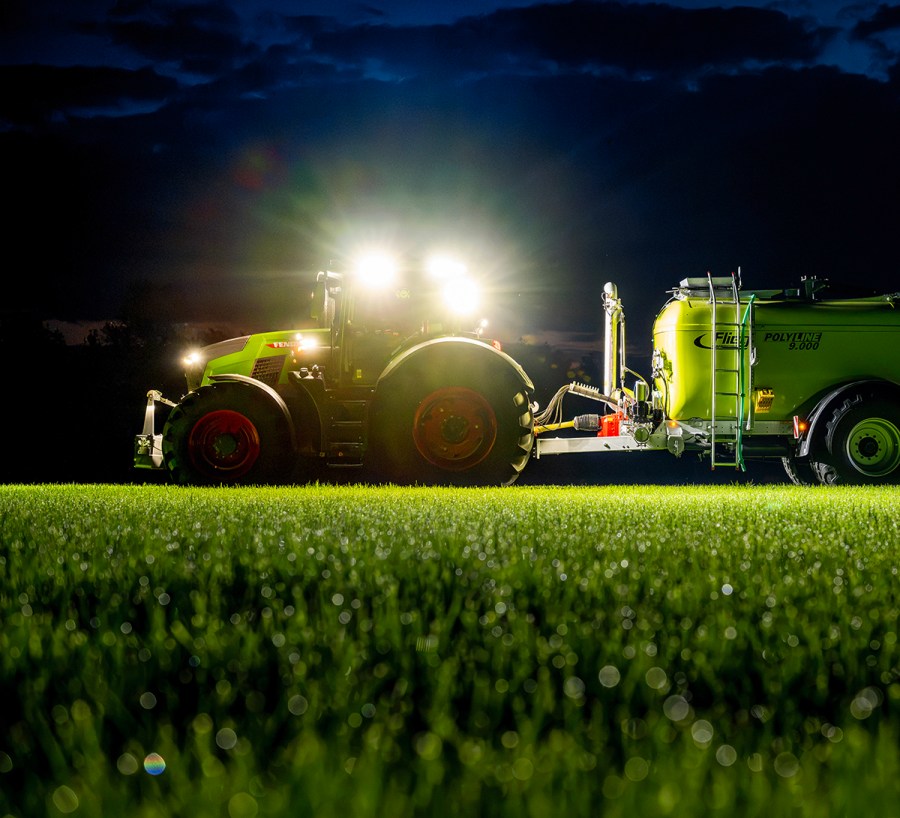
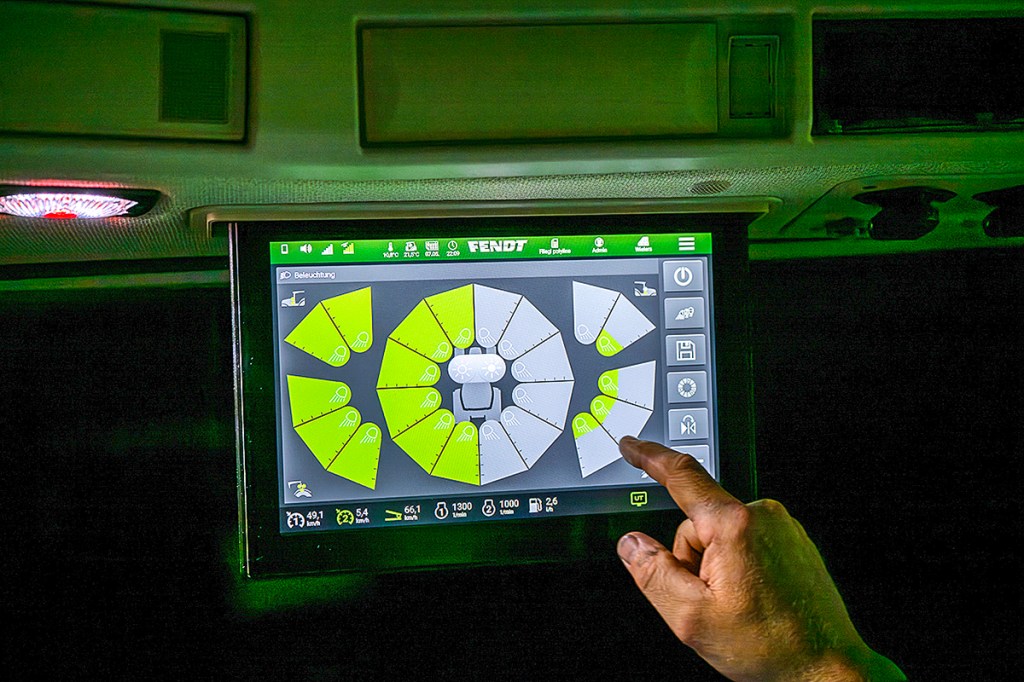
Up to 22 lights turn night into day with the Ultravision light option. Three different lens designs provide either wide or far-reaching illumination. Fendt charges £6,843 for the full light package — a point for negotiation in the overall price.
We’re not completely happy with the menu structure for this option, because only the 832’s dimmable headlights can be switched through the central “flower petal” layout. The dimmable headlights are, however, a blessing!
Summary
Lots of light! The Fendt 832 Vario sets new standards in its class between the 700 and 900-series: its diesel use and performance figures are record-breaking; payload is still excellent even at 60km/hr; four pto speeds and VarioDrive transmission combined with cab suspension are top notch; and Ultravision lighting is similarly impressive.
There are some criticisms on details such as the fuel gauge and the engine’s 500-hour service interval. And, despite all that light, the price still casts a shadow — £358,900 in base spec and more than £440,000 in test spec if you include the maximum eight- year, 8,000-hour warranty package.
Tobias Bensing
For more up-to-date farming news click here and subscribe now to profi and save.