

Coming from an engineering background, AGCO’s Eric Hansotia has a finger on the pulse of product development and how this can help farms progress into the future. We had a chance for a sit-down to get his thoughts on the future of dealers, what tech we could see now and in the future, and why South America could soon be leading the way in autonomous and precision farming.
How much of a say do you have on future development?
I am an engineer by training, so it’s the innovation side of things that really gets me excited. Innovation can be on product, can be on data, but it can also be on distribution. We’ve got FarmerCore as our distribution model, where we provide digital tools for the farmer to engage with the AGCO dealer. Instead of having the farmer come to the bricks-and-mortar store, which is essentially like going to the mall, FarmCore follows the model that pretty much most industries have at this point, where the business comes to the customer.
FarmerCore is all about that, where we want the farmer to consume the key information digitally. We then remotely monitor their machines and, when they require either maintenance or repair, we come out to the farm and do those things on the farm. When we get on the farm, we say: ‘Well, we came here to work on your Fendt, or your Massey machine, is there anything else we can help you with?’ Usually, they will have a John Deere or Case or something like that, and 85% of the maintenance issues the farmer has, we can also help them with. So now we are servicing the farm, not just the product; it’s a 180 degree flip. That is an innovation outside of product. Those are the kinds of things that we are always trying to figure out — where the customer is going, and how do we get in front of that, and do it in a unique way for them.
How do you envisage the dealer map is going to change in the next ten years?
We have two different kinds of dealers —machinery dealers and technology dealers. So, the machinery dealers are what most people think about, and I think those will continue to consolidate. There is so much capability on these machines, the sprayers, tractors, combines, that it is difficult for a small dealer to have the technical depth to be able to sell those properly and support them properly. They need to have scale to invest in the resources to support farmers on these highly capable machines.
Separate from that we have a whole parallel channel, that is our tech channel. They don’t sell tractors or combines or sprayers; they only sell technology. So that is a melting together of our Trimble Ag dealers and Precision Planting dealers. And what we want them to do in the future is carry the full line of PTx. If you wander around the PTx portion of our booth (at Agritechnica) we launched 14 new things in 2025. It’s a technology engine, kicking out a lot of new features. That tech channel will sell all those types of products. These will not consolidate like the machinery dealer does, as they are real specialists, and they are often much smaller than the machinery dealer, often with an agronomy, seed sales or technology background. They are deep specialists.
We have seen some changes to the AGCO dealers taking on multiple brands as part of AGCO’s Route 66 several years ago.
That was the project name, the notion is to have two channels, a Massey channel, and then a Fendt, Valtra channel. That is the general intent, but there are exceptions — sometimes it’s a little different based on where the dealers are coming from, but that’s the intent in Europe.
While PTx is showing a lot of innovations at the show, a lot of the tech is coming on Fendt. Is that the avenue you are taking?
Fendt is our tech leader brand for the most demanding farmers who usually want the latest and greatest technology, so, when we bring it out to the OEM platform, we bring it on the Fendt first typically. When you see the OutRun kit for autonomy is shown on the Fendt product, we think it is the Fendt customer that will adopt autonomy first and will want that. Usually it will be an early adopter on a Fendt.
Was autonomy one of the main reasons for purchasing Trimble’s Ag division?
There are a few things. One is the data platform, so FarmEngage is our new data platform, and that was something holding us back from growing Fendt, especially in North America. We have great products and the customers love them. There were 300 US farmers at a dinner last night, and I spent time talking to them. They love the product. It’s the best of the best product, but several of them had been using Operations Center from John Deere, and they said that you need something like that, and now we have FarmEngage.
FarmEngage is essentially the core area of Operations Center, except it’s for the mixed fleet so it will ingest data and send task files back to the farmer — regardless of brands in their fleet.
What is the uptake of FarmEngage and what is the benefit to you?
With FarmEngage the customer can choose to have their data come into the system and then manage their data there, or they can have their data brought into FarmEngage and pass it to Operations Center if they prefer. We want to make it straightforward for whichever one they prefer to do their analysis. Over time, our job is to make our platform user friendly enough and capable enough in a broad scope to be the platform they choose. But right now they can choose either one.
Overall, we expect to sell FarmEngage via our retrofit channel and we aspire for it to become the mixed fleet platform that many other companies use. We don’t think every other company is going to have the resources to develop a full data platform. You usually don’t get paid for it, and it is a lot of cost. And then there is this network effect, that the more people are on it, the more valuable it becomes because software writers want to write onto that platform.
Networks usually consolidate down to just a couple — our aspiration is that it is just Operations Center and us.
How important is a farmer’s data to you?
It is still the farmer’s data, so they can still choose to share it back with us or not. Or they can capture that data for themselves and share it with their partners. So it is always the farmer’s data. That’s foundational. But secondly, when we look at data, we look at it aggregated, so we will say, for instance, what are the ways tractors are used in Germany or in Europe. We don’t really care what Joe Smith is doing on his farm. We want to look at the aggregated data and look at it over a distribution to say how many farmers are acting in certain ways so this can be a feeder for our engineering teams to say: do we have our designs targeting the right kind of applications? Or are we missing some key cases? That is how we use the data.
Then we look for situations where farmers may be not using the full capabilities of the machine or are using the wrong machine setting, which might indicate we need to do a better job of training or change the design. Or we might need to remotely inform the customer and say: ‘Hey, if you made these changes, you could get better fuel economy or more power to the ground or things like that.’
There are two types of data: machine data and agronomic data. FarmEngage is largely about machine data — what is the machine doing. We then also have Panorama which manages agronomic data. AGCO has even less visibility into that data.
Machine data — farmers really want you to have that so you can design a better, more reliable, higher performing machine. The Panorama data we don’t really need to look at that — it is more for the agronomist.
Which market is the most demanding for autonomous tech?
It’s a toss-up between North America and South America. North America is usually the early adopter — it’s the biggest precision ag market, even though Europe is a bigger machinery market. But we expect that the adoption pace will be highest in South America, and that is because the fields are so large; you have several farms over 50,000ha and some over a million hectares. It is just unbelievable the scale down there and they run more than one crop a year, so they will run one, if not sometimes three crops per year. So, if they buy a $50,000 autonomy kit, they get to the break-even point on that investment three times as quickly as in North America or Europe where they are only using the kit once a year. So, because they are so large, labour is a problem there, too, and they have multiple crops. We think South America will have the fastest rate of adoption to autonomy.
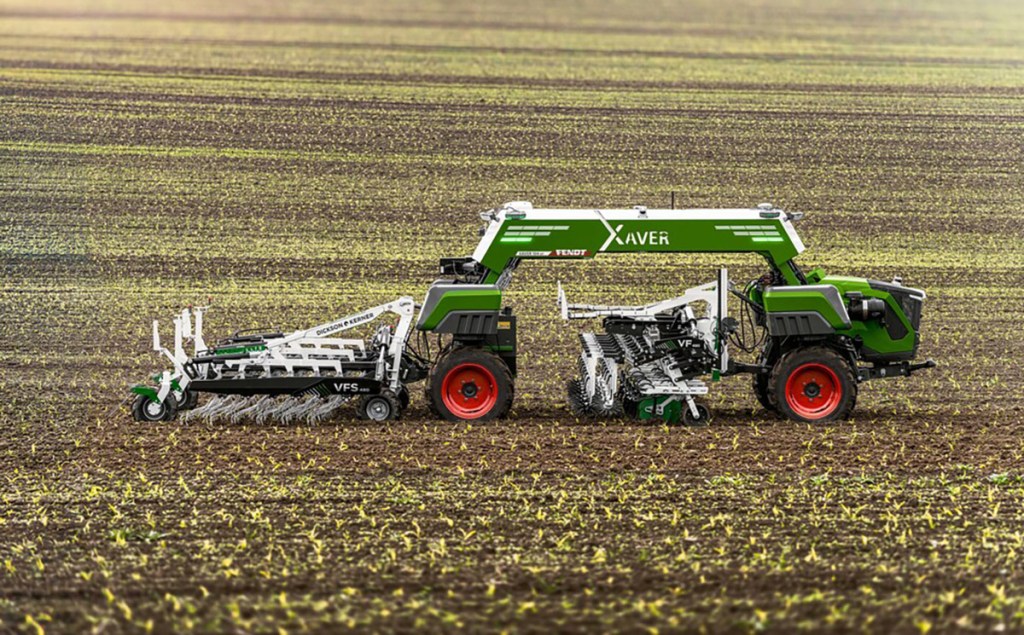
In the European market, due to field size and affordability, is that why we are seeing the Fendt Xaver GT here?
If you move forward 15 or 20 years from now and say where will things ultimately end up, we believe it is very much about smaller machines. The reason for big machines was labour. If you wanted to do more farming but you only had a limited amount of labour, then a bigger machine with bigger implements was the solution. Those are more challenging to handle in small fields and between fields, and if they go down, the whole operation is down. They also create a lot of compaction, and cost per horsepower is higher.
If you can solve labour a different way, then the ideal machine form for land is a lighter weight machine. I am on the board of directors at Toro, and they are having a big autonomy push as well. I was talking to one of the supervisors at a golf course, and I asked why they just bought an autonomous mower. I was expecting him to say labour, but he said compaction; so, even on that size machine, compaction was an issue for him. They wanted a lighter weight, smaller machine, so golf courses recover faster.
Now you take a multi tens of tonnes machine, tractor or combine and you look at how much compaction that thing is creating. That is why when we have designed our robot, maybe it is not going to look exactly like that, but directionally it will be much lighter weight and perfectly balanced between the front and rear axles. One of the problems with tractors is the weight balance between the axles. Once you go to autonomy you can purpose-build the machine for what agriculture needs as opposed to what the operator needs.
Machines are getting more and more expensive. Will we see prices come down or do sales staff need to up their game?
We need to add more value, so our machines need to get smarter so that they can take over more tasks and do a better job than the operators could have done on their own. When you look at targeted spraying, you put cameras on the boom, and through AI it can tell the difference between the weed and the plant, and spray only the weed, saving as much as 55% of the chemical. That’s a huge step forward. The whole PTx booth is all about solutions that enable the machine to do a better job than the operator can. That’s what we have got to do because these machines are expensive to make and tariffs have only made that worse.
No matter where you are in the world there is cost in the system. So, we are taking cost out of our business. Through a project called Reimagine, we have looked at everything that we do — accounting, engineering, marketing — and we asked how could we do that task so there is a better outcome for the farmer at a lower cost. We identified 700 projects where we can either outsource to another company, offshore it or automate it with AI. We are taking $200 million dollars out of our cost structure of a billion-dollar base. It’s almost like 20% savings off our overhead.
For example we have automated warranty administration, so instead of having people read the warranty claims and trying to figure that out, and read all the different languages and so on, AI can do that. We have taken our outstanding warranty claims down from a couple of weeks to a few hours. It is way better for the dealer, because they get their payment faster and in a more accurate way. That is not something the farmer wanted to pay us for; they’d rather we were focused on inventing new machines that do a better job. Any of those kind of back-office tasks we can do at a lower cost allows us to put more resources toward that goal. So that is one category — Project Reimagine. The other is smart machines. We are trying to make machines more and more intelligent and take over more tasks for the farmer so that their job is done better.
But how do you bring value to the second-hand buyer?
Well, PTx is all about retrofitting existing machines. It could be a five-, eight- or ten-year old machine and we’ll retrofit it; planters, sprayers, guidance systems, combines with header height control. That whole business is built on retrofit first. Our engineers design new technology and the very first place that it hits the market is in the retrofit market. Once it stabilises, then we put it in the OEM channel. That way we serve all our customers: the farmer who wants to buy the new machine, farmers who have an existing machine, and all brands. We want to serve all farmers. Being the most farmer-focused firm to us means we listen more, that we act faster and we serve all farmers.
Mervyn Bailey
For more up-to-date farming news click here and subscribe now to profi and save.