
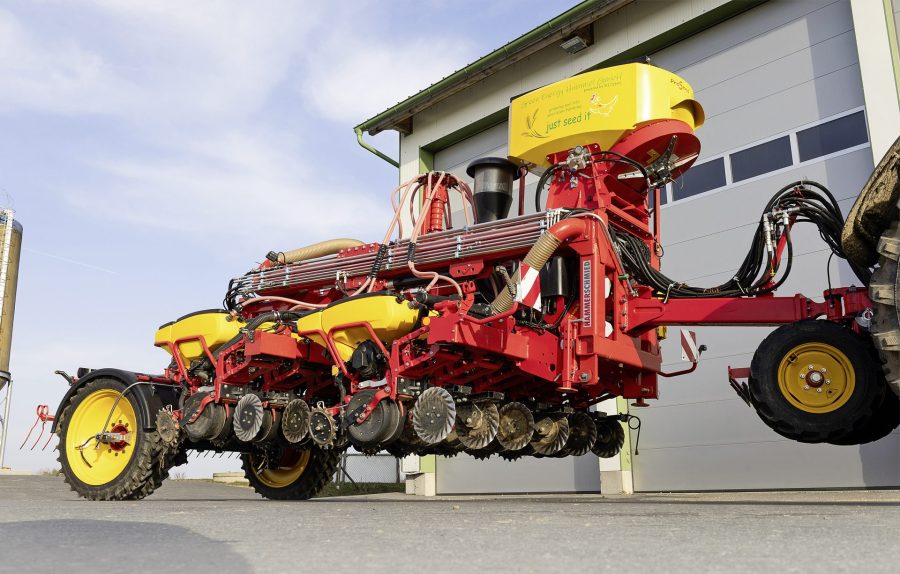
The Hummel family uses a precision drill for sowing all their crops. We paid them a visit to find out why the job can’t be done with an off-the-shelf machine.
“Had we known beforehand how much time it would take to finish the drill project, we probably wouldn’t have started it. But, if we had to do the job again, we’d do it in the same way,” say Alexander Hummel and his father Norbert, summing up their drill project adventure.
It took around 3,000 hours to design and build the precision planter, which can work on a row spacing of 25cm. As Alexander points out: “it’s still basically a Tempo, so is capable of sowing crops in conventional and min-till cultivated seedbeds as well as direct drilling.”
Already familiar
The Hummels already own two Väderstad Tempo precision planters, one with six rows and the other seven. In the spring, these are used to plant sugar beet, maize, sunflowers, soya and several speciality crops such as pumpkins which are in the ground by mid-May. They then go about converting the two planters into the ProSeed before it heads out to sow cover crops in late July. The full changeover takes two people about eight hours. As well as cover crops, the ProSeed is used for establishing oilseed rape (as a contracting service) and winter cereals. Once that workload is taken care of, they convert the two Tempos back to solo operation.
Alexander had the idea while studying for a Masters in agriculture. His final paper was on expanding conservation tillage and then moving into direct drilling. To be fair, Norbert had already started the move, switching to ploughless farming back in 2003 and adding cover crops to the rotation.
The Hummel father and son team, along with Alexander’s mum Elisabeth, farm more than 100ha of arable land, plus a biogas plant and broiler operation.
While still looking at various direct drills, they decided to experiment with the Tempo by setting it to its narrowest row spacing of 50cm, and, by doing two offset passes, they could achieve a tighter 25cm row spacing. “That works in theory, but, in practice, soil conditions, the repeatability of GPS waylines and the workload soon put a limit on it,” explains Alexander.
Swedish inspiration
It just so happened that at the same time Väderstad unveiled its new Proceed (profi 1/2022). “I thought that these are basically Tempo seed units mounted on a frame, so surely we can build that ourselves,” says Alexander. They already had a Tempo V on the farm, which they were very happy with. A second Tempo model was soon located at a reasonable price.
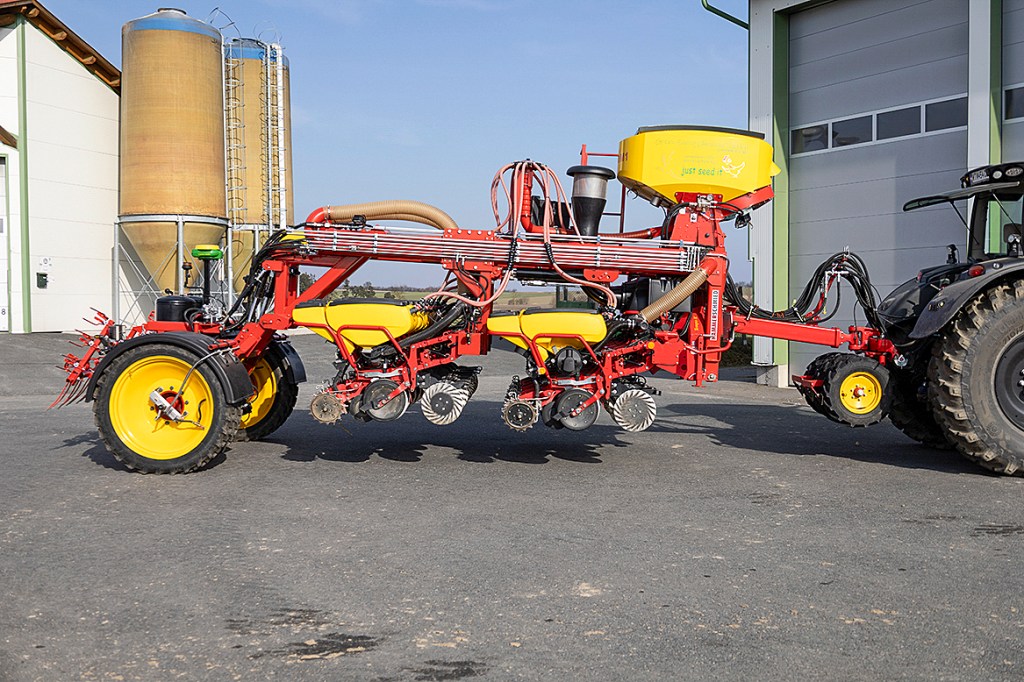
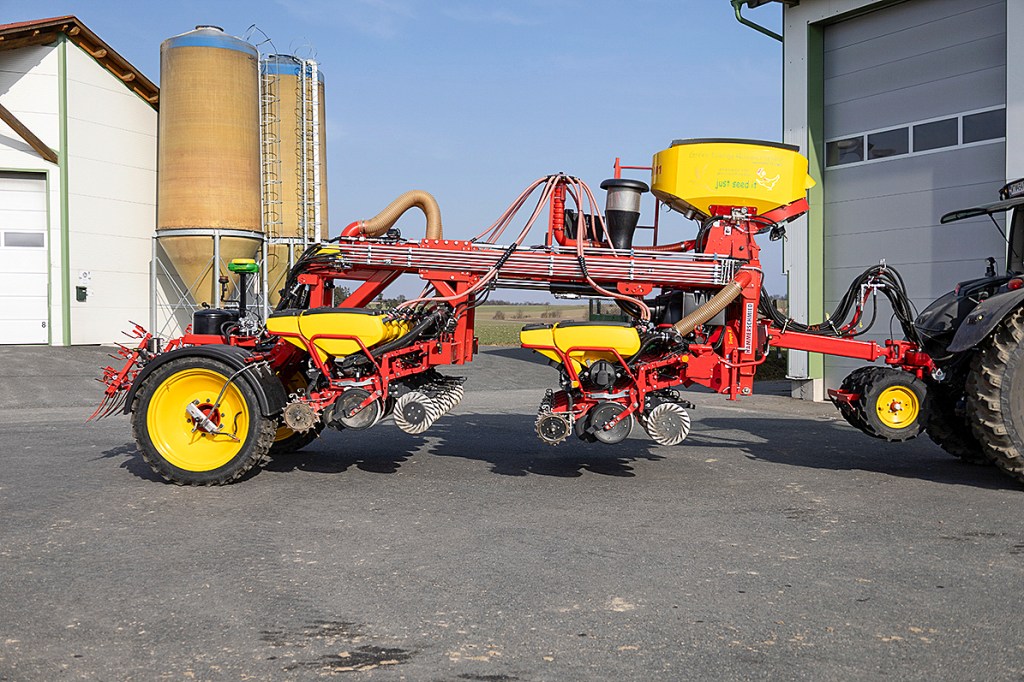
Following the Swedish drill blueprint, the Hummels designed a frame and chassis that they can attach the seeder units from their two Tempos. This gives them 13 rows on a 25cm spacing for a working width of 3.25m.
This frame is designed to carry five times the load, at least when stationary, so about 50 tonnes. “Given the machine weighs about 6 tonnes, some would probably call that over-engineered; we’d call it built to last,” Alexander grins.
With the exception of the frame, they drilled, milled and welded everything themselves in the farm workshop.
First fields planted
In spring 2023, the Hummels planted their first fields with their homemade machine. In the following years, they have continued refining their design. The seed hopper on the main frame, for instance, was added later and turned out to be a real time-saver, especially for any crops with higher seed rates.
Hopper and metering units were supplied by APV. They also adapted their machine for drilling cover crops.
“We use a cover crop mix that’s specially blended for us,” explains Alexander. “But the different seed sizes don’t’ work with the singling discs, so we bypass them and send the seed directly from the APV metering unit to the delivery tubes between the coulter discs. Fitting the 13 bypass tubes takes us around four hours.”
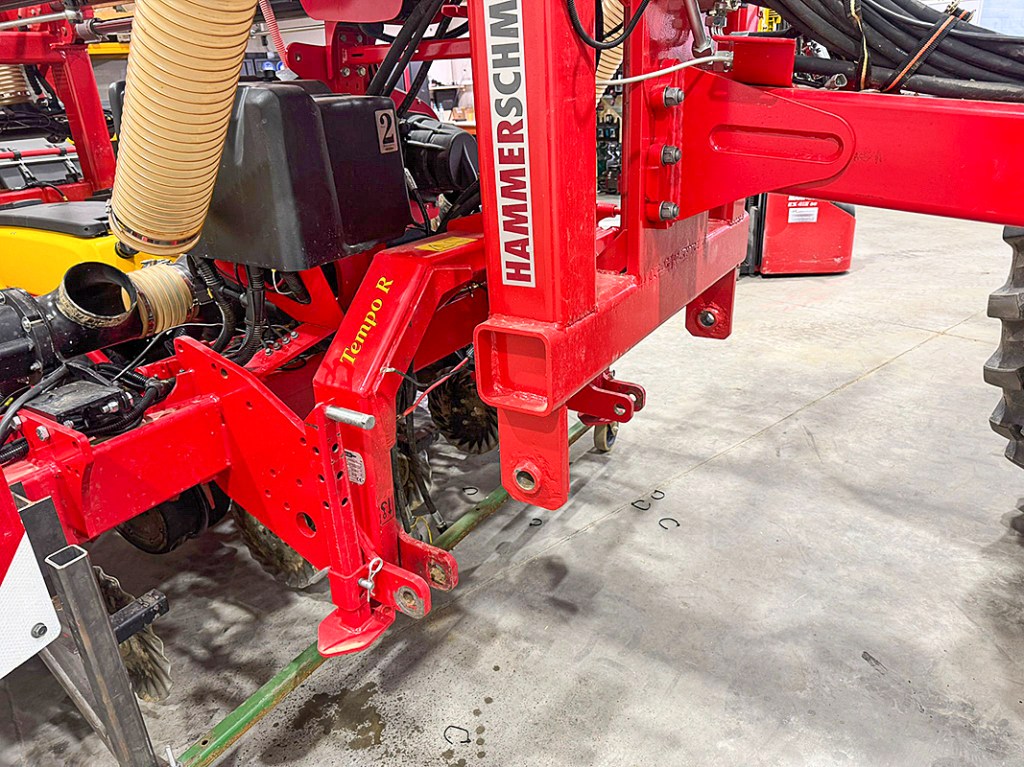
The seeds’ journey always starts in the large hopper, from where it is metered into the air stream and carried to a distributor head and onwards to the 13 Tempo seeder tanks. The seeds then pass through the singling unit, dropping down the delivery tubes into the furrow.
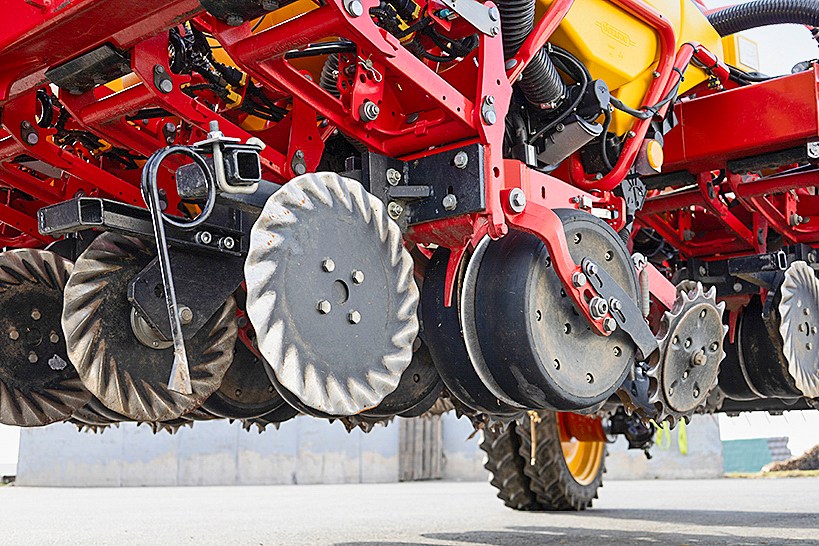
For direct drilling, the Hummels add a spring harrow tine in front of each unit. These tines have a carbide triangle welded to their tip. “The slightly vibrating tines clear nearly all of the crop residue out of the way; it’s only with maize trash that they reach their limit.” For this season, they plan to modify the tine mounting so they can fit longer tines and adjust the pitch.
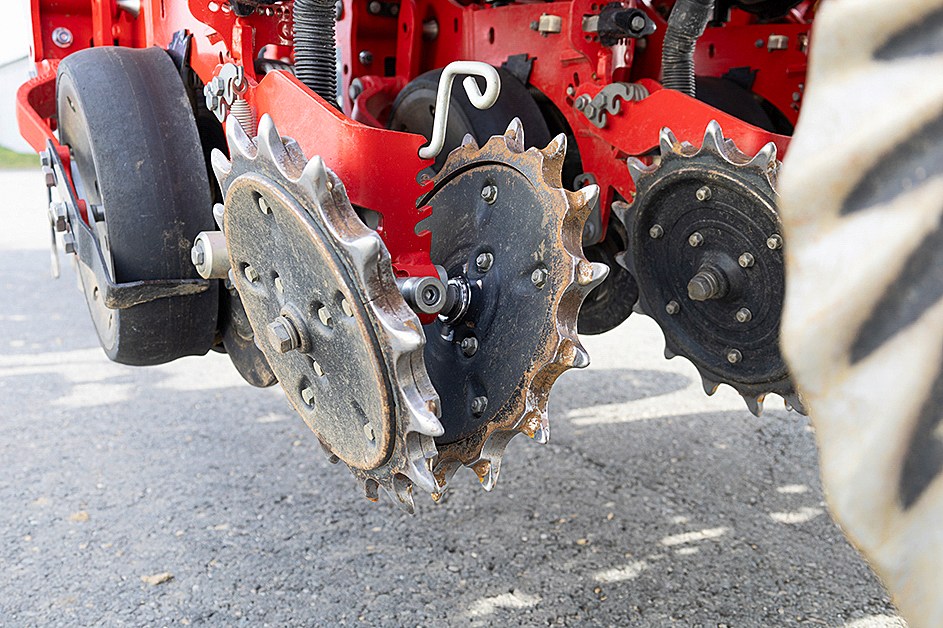
Also mounted on the tine carrier are wavy cutting discs, which prepare the seed furrow for the double-disc coulter. The Hummels swapped standard, V-angled press wheels for so-called Thompson wheels. Widely used in direct drilling, these specially toothed wheels are designed to close the furrow without excessive compaction, while at the same time breaking the furrow wall.
Clever electronics
In work, the machine’s weight is distributed across the 13 seeder units and the running gear — unlike on the Swedish original, where the wheels are raised up out of work in the field. The running gear is depth controlled by a parallelogram linkage and, thanks to nifty Ackermann steering, the wheels steer through a turn angle of up to 18°.
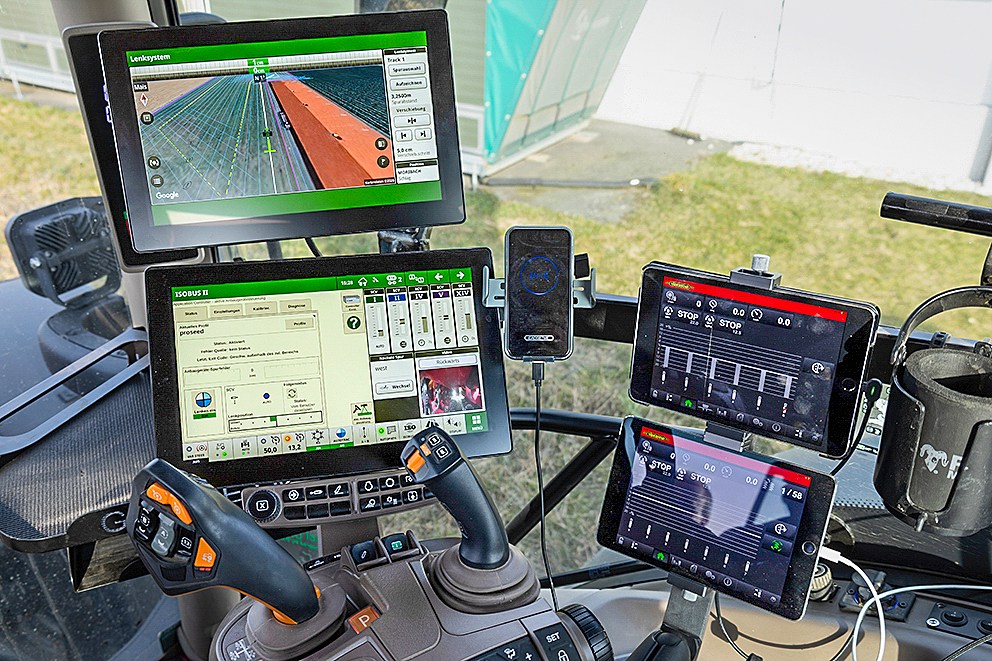
The John Deere tractor in front uses its AutoPath function to control the steering; both the tractor and drill are equipped with StarFire GNSS receiver units. This allows the tractor to know if the drill is drifting off the auto-steer line and to correct it.
The drill’s control system is equally good. A total of seven use interfaces are needed to run the ProSeed: each Tempo via an app on its own iPad; the steering system on a Deere screen, ISObus for implement guidance as well as the APV metering system; and an ISObus control board for the work lights and solenoid valves via the second John Deere display … plus the Digitroll row monitoring system.
Solid work rate
“Apart from one 15ha field, our fields range between 3 and 8ha. With the ProSeed, we can manage 2.5 or 3.0ha/hr and typically drive at 12km/hr,” explains Alexander. “If I completely fill the hopper, I’ve got enough seed for 15ha.“
So far, they have drilled about 300ha, and are very happy with the results. “Regarding profitability, several aspects have to be taken into account,” says Alexander. “First, there are the machine’s costs. Leaving the actual working hours aside, the machine costs about €150,000. That’s considerably less than a drill and a precision drill – let alone an original Proceed.”
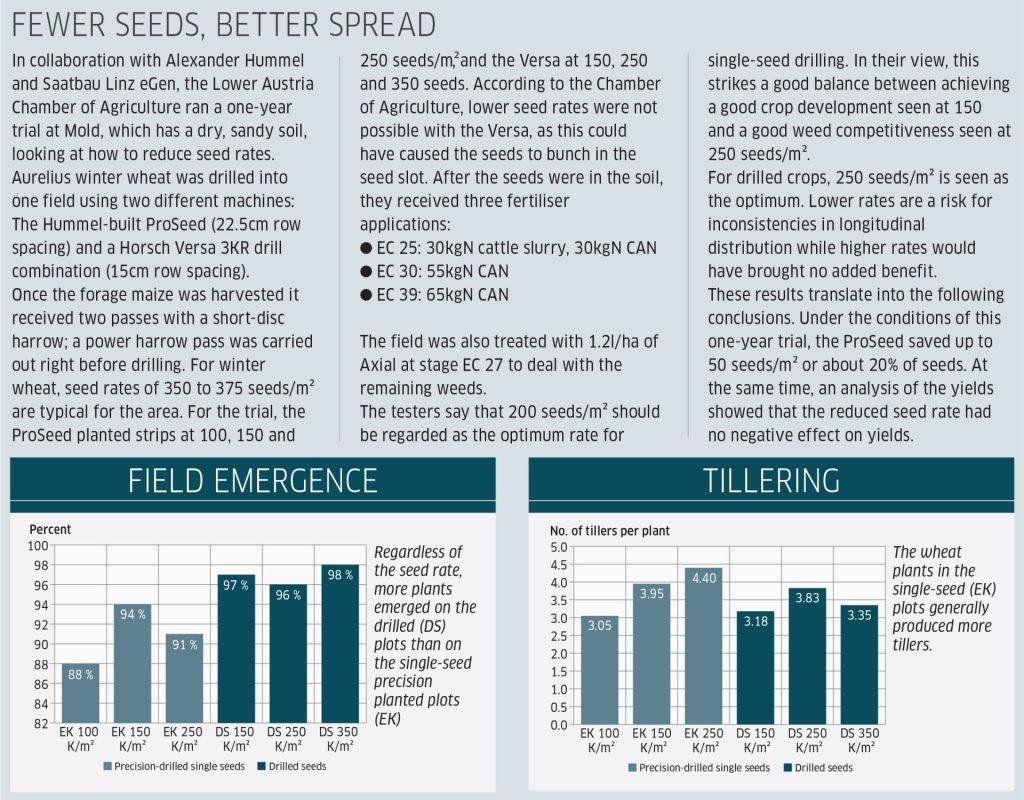
They also see even more potential in the field work: “With our ProSeed, we not only save on cultivation passes but on seeds too, and significantly so. Provided the fields are adequately supplied with nutrients, the seed rate can easily be cut by 30 to 40%. When sowing regular wheat, we manage with a rate of 150 to 200 seeds/m², and for hybrid wheat even just 80 to 100.”
The Hummels see the main benefit being the precise seed depth placement. Plus, with the wider row spacing, the crop is less prone to develop diseases such as yellow rust.
As for the seed, the ProSeed isn’t very picky, says Alexander: “As long as the seeds don’t have any husks, then any cereal will work. Wheat, barley and even a rye-vetch mix haven’t caused any problems so far.” Variety choice hasn’t got any trickier either: “You don’t need extra-tillering varieties, let alone hybrids.”
“But the machine isn’t a jack-of-all-trades,” says Alexander. “As it stands today, it’s a bespoke design for our particular farm and our challenges. Elsewhere, things might be very different.” Whether single-seed drilling of cereals and cover crops suits a given farm, in his view, depends on the type of soil, the field layout and acreage as well as the skills of the farmer or contractor.
Andreas Holzhammer
For more up-to-date farming news click here and subscribe now to profi and save.