
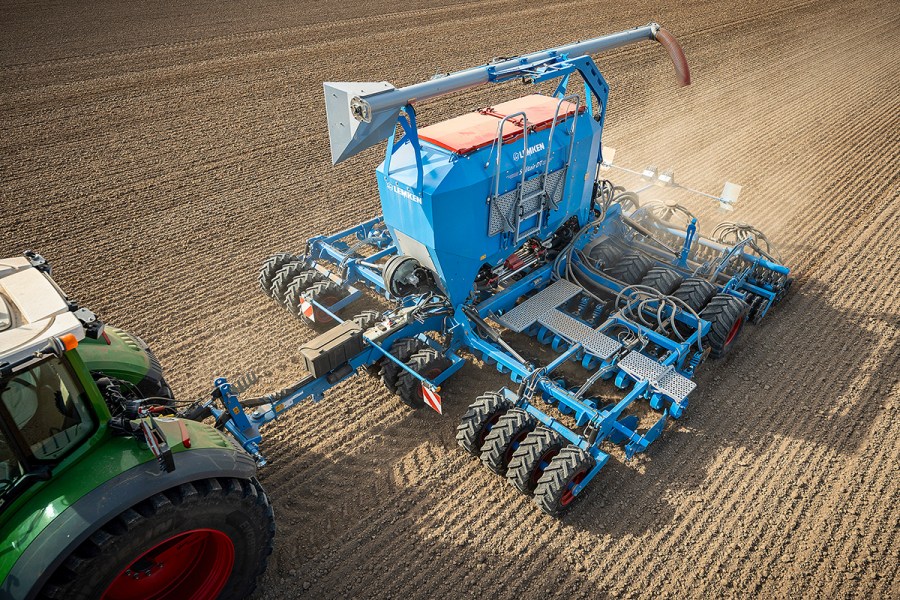
The Solitair DT is Lemken’s latest play at the competitive cultivator drill market. One of the big plus points of the ‘Drill Trailed’ is its flexibility, which we were able to put to the test last season.
KEEPING IT BRIEF
- The DT has resolved many previous Compact Solitair criticisms.
- New modular metering system is precise and easy to use.
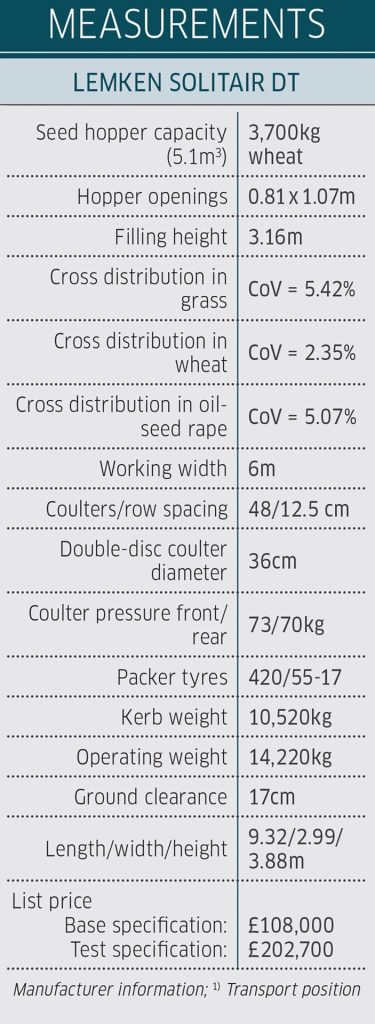
- Depending on spec, a 6.0m wide DT costs between £108,000 and £200,000.
The Compact Solitair replacement, the Solitair DT, is a much more flexible machine with an adaptable layout, new seed hopper design and revised metering system. It still has an integrated disc harrow section for working down ploughed ground or creating some extra tilth in a min-till scenario. But swap the tools in the disc section and it can also turn its hand to drilling directly into stubble — as we said, more flexibility, but more on that later.
Our machine for this practical test was the 6.0m wide, Solitair DT/600 in OptiDisc H 125 guise. Lemken also offers the DT as a 4.0m and 9.0m machine. The other part of the model name refers to the coulter pressure being controlled either mechanically (M) or hydraulically (H) and the disc coulter spacing (125mm or 167mm).
Get hitched
These are not the only choices you have to make when tailoring a DT. The options start at the very front of the machine where you can specify a K80 ball hitch or, as on our tested machine, the Cat. III or IV lower link headstock. Rather than a simple cross shaft, Lemken continues to rely on a three-point headstock which it says has improved power transfer and reduced wear on the pivot point which can be positioned farther back for better manoeuvrability. It has done away with the headstock locking pin which we criticised on the Compact, and now has a nice and easy to use support leg.
There are two lengths of drawbar available from the factory. Ours was the shorter version but still allowed the Fendt 728 Vario to easily turn on an 18m headland back into the next bout — excellent.
The hose holder accommodates the drill’s six hydraulic couplers (three double-acting for controlling the wings, lifting, disc depth and the fan) along with the hydraulic return, lights, ISObus and camera cables.
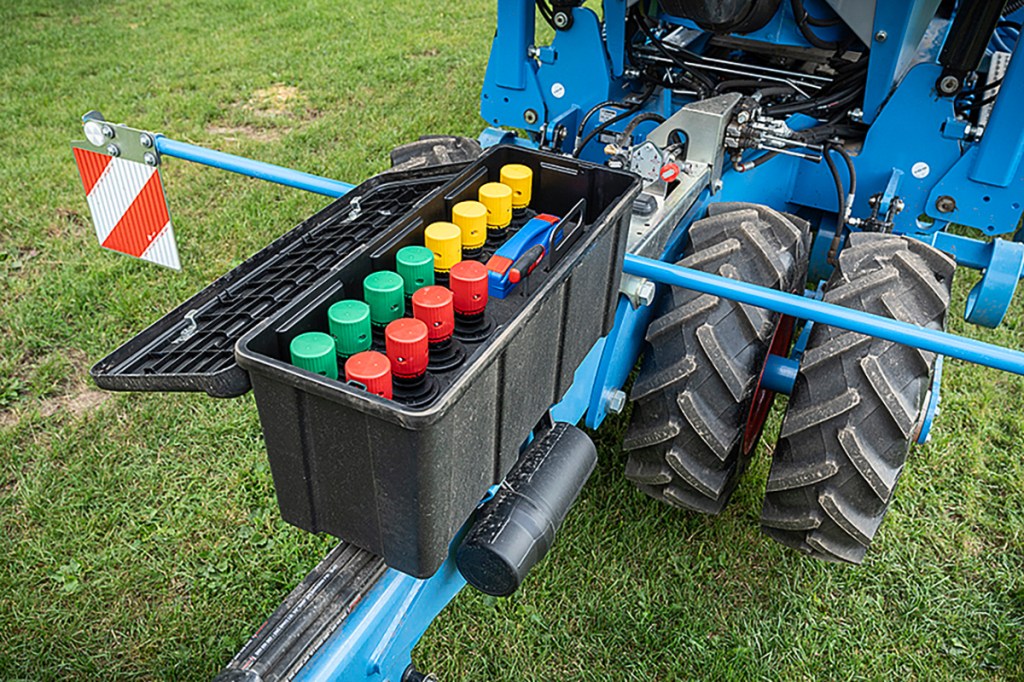
We did notice that the return line would become pressurised when hitching back up, which put a dampener on our experience. The couplers are all clearly marked, so good news there … and the storage box on the drawbar is also really handy.
Must have the tyre press
We tested the DT with the front tyre press, a £12,430 option and is something we would definitely recommend.
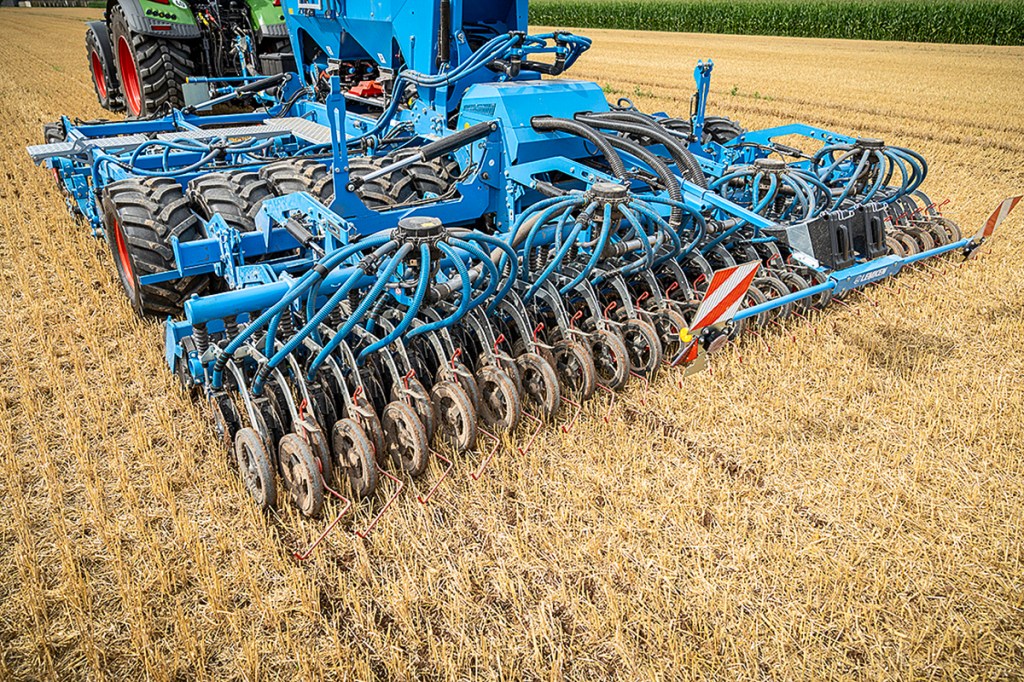
This press has a dozen 10.0/75-15.3 tyres, but none of these tyres sit in the path of the tractor wheels; that area is vacant as it is already consolidated. As an alternative, the front tyre packer can be swapped for a levelling board or depth-control wheels at the sides.
Instead of wheel mark eradicators, Lemken offers the £400 option of increasing the depth of the discs that fall directly in the path of the tractor wheelings.
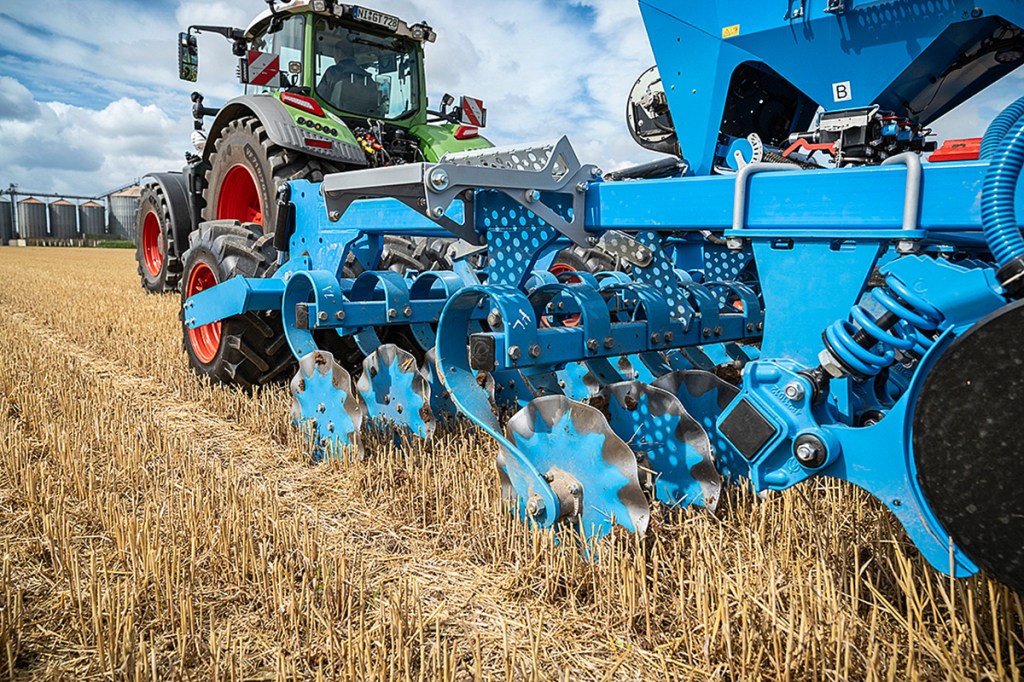
The disc harrow section features individual leaf-sprung mounted scalloped concave or wavy discs. There is a disc hitting the dirt every 12.5cm, and there is 90cm between the front and rear gang.
Lemken supplied our Solitair DT with both disc harrows so that we could assess the difference for ourselves. This machine also had the excellent £1,865 hydraulic depth control option for the discs which is worked off a spool valve.
Started with wavy discs
We kicked off our drill test in the summer using the 465mm wavy discs that cultivate a 22mm wide strip — this is recommended for where you want minimal soil disturbance, such as on blackgrass problem fields, when drilling into a sprayed-off false seedbed. In our case, we were sowing a cover crop direct into cereal stubble. Here, we really liked the quality of work.
After summer, we swapped the wavy discs for the classic Heliodor discs, a job that took two people four hours. Having this second disc harrow option is expected to cost less than £20,000 — no final price just yet.
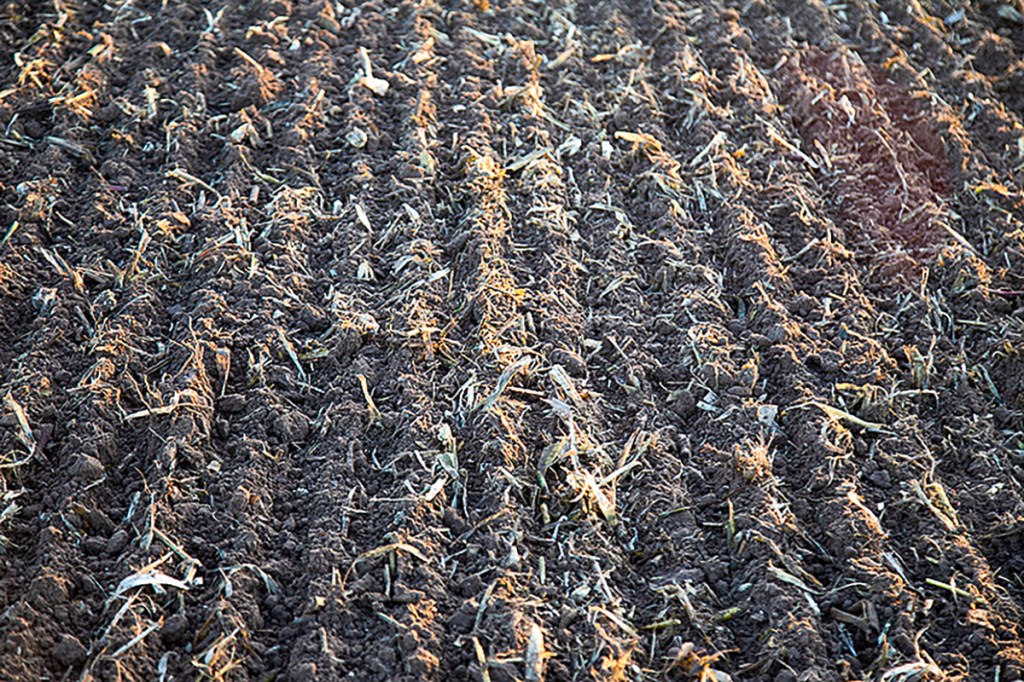
The 5mm thick, 465mm diameter scalloped concave discs move noticeably more soil and created a nice, uniform seedbed at speeds over 8km/hr. Even drilling into grain maize stubble on medium soils worked well. The front row of discs throws the soil to the right, the rear row to the left — we didn’t notice any crabbing.
Ground clearance of just 17cm in transport is a little bit of a concern on the 9.32m long machine.
Extra coulter option
Between the disc harrow and the rear tyre press, there is definitely enough room to fit an additional row of coulters (£20,885) for placing granular fertiliser (or cover crop seeds). These have a 25cm spacing. We used them for drilling field beans and rape seed in one pass.
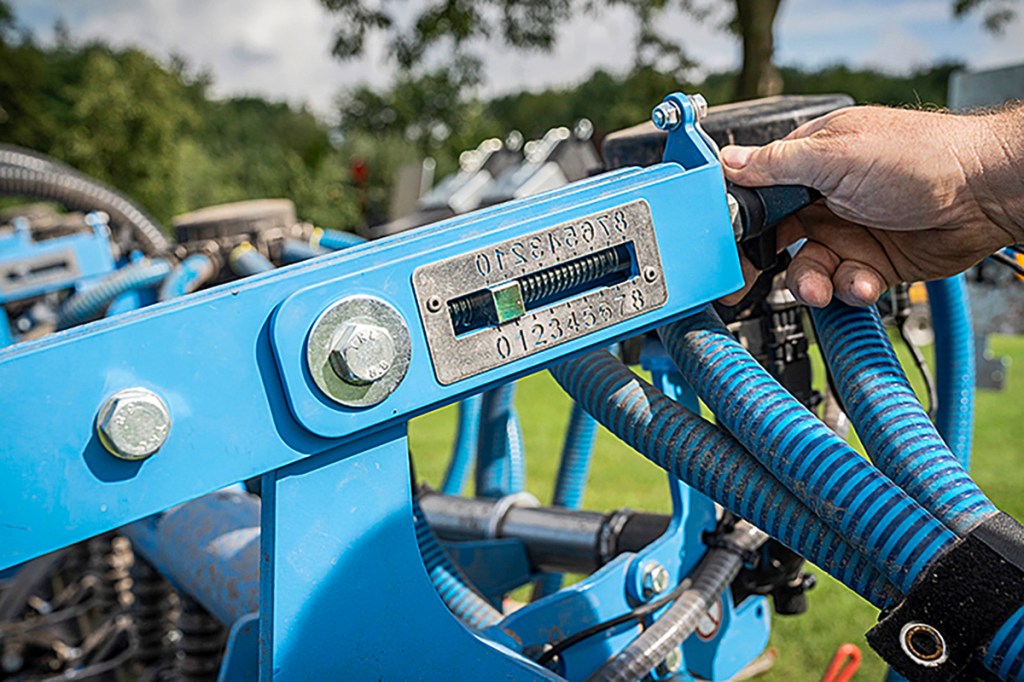
The sowing depth is easily set using several aluminium clip-on shims. Depending on soil conditions, we reckon that depths down to just under 10cm are realistic. One small drawback: although it is possible to switch off the 40cm double-disc coulters in four sections, the individual rows in tramlines are always active.
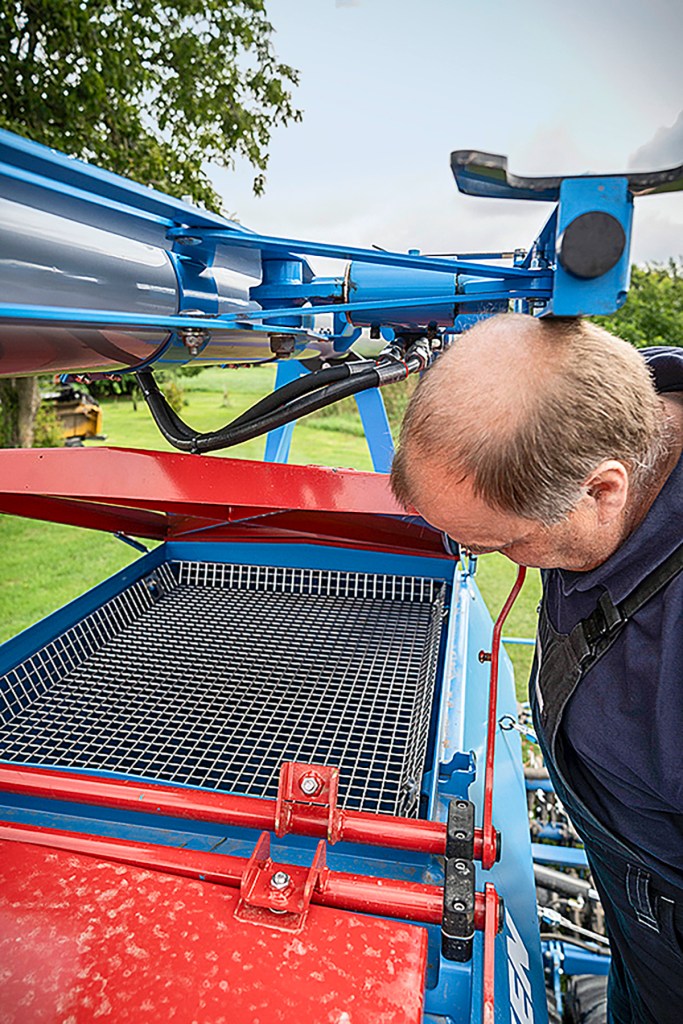
The 5,100-litre double hopper is an extra £9,946 and we reckon it is a 55:45 split. Both compartments are pressurised and fitted with easily removable screens. The 81 x 107cm openings are a good size for filling with big bags or an auger. The hopper lids open to the front and rear and are locked with a central catch. However, closing them can be quite difficult for shorter individuals.
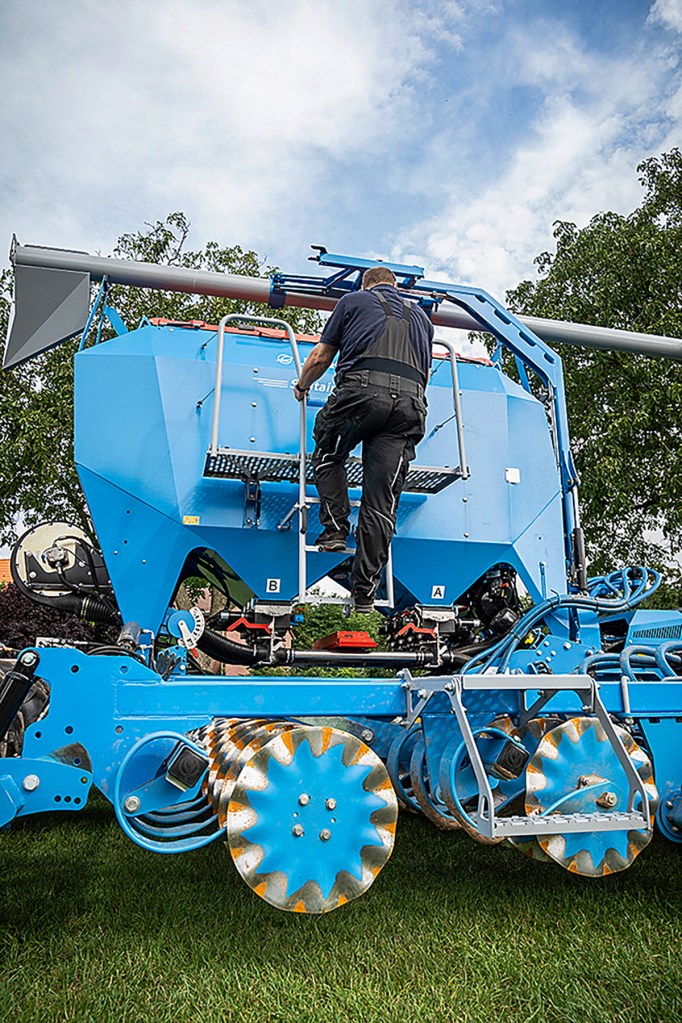
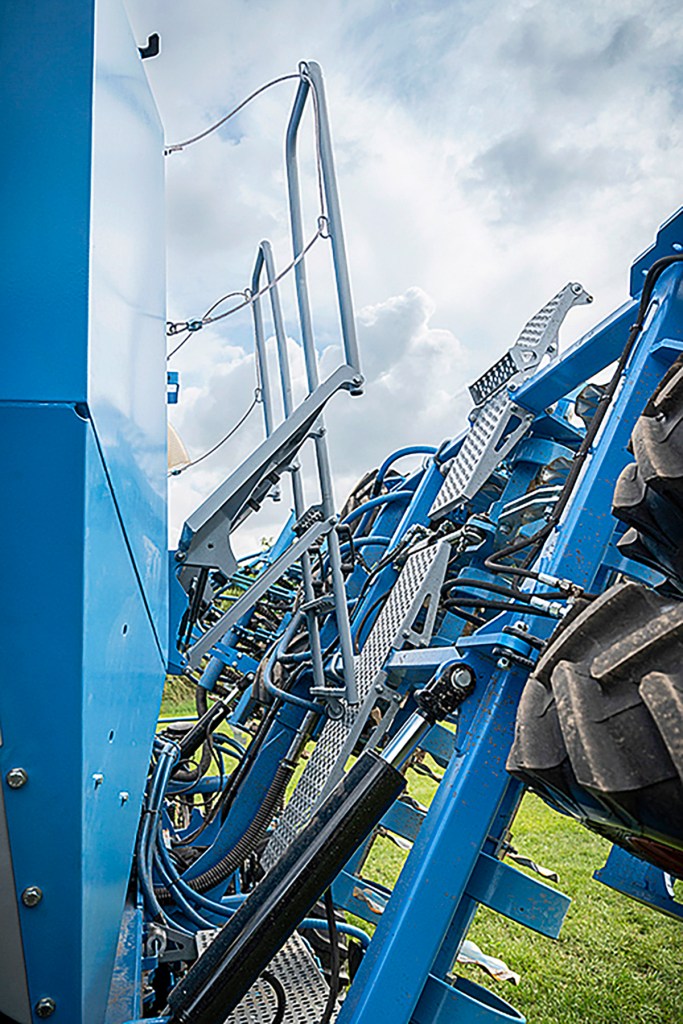
With one wing folded up, we were able to load the 700kg big bags on the front loader of a Fendt 516. The filling height is 3.16m. Folding one wing is more convenient when the machine is in working position than from transport mode. The platform alongside the hopper is spacious and well designed. The first step to walk over the disc harrow lacks a handrail, and the steps for climbing into the hopper are also quite awkwardly placed. Emptying any leftovers would also be better if there were suitable chutes.
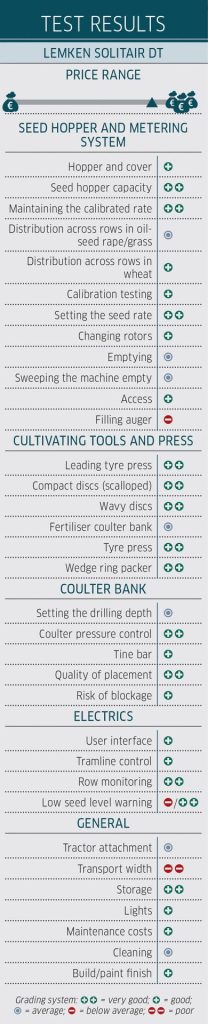
Pluses go to the hopper lights and the three positions of the fill-level sensors as these can be accessed from the outside. There is one sensor per hopper, the calibration of which needed a helping hand in our test. Low level alarm sensors inside the metering units — for example, for oilseed rape — are options.
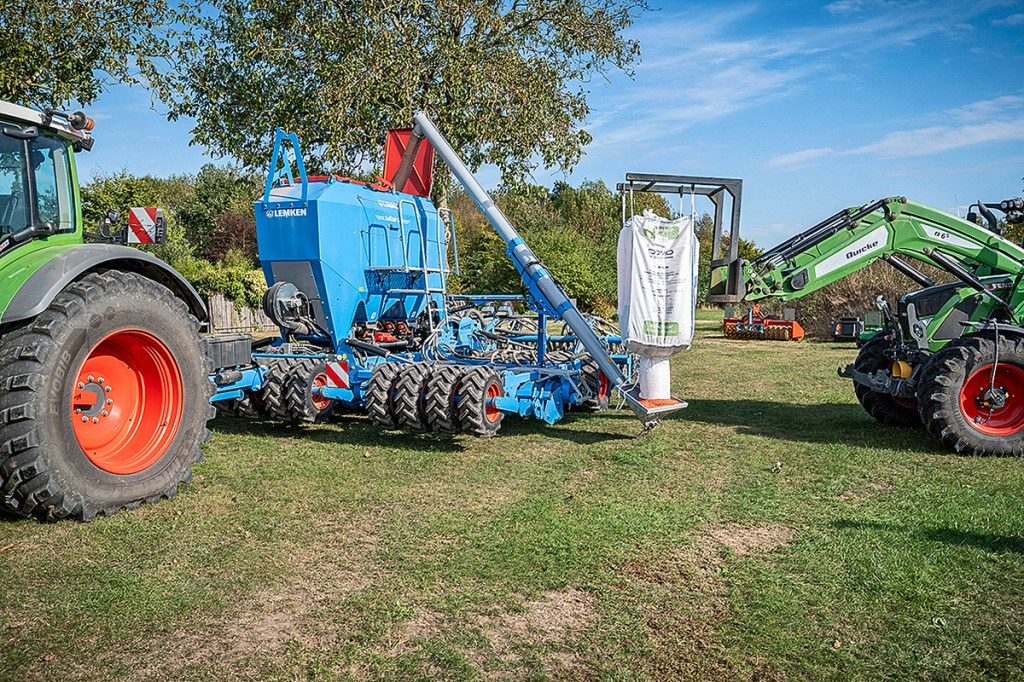
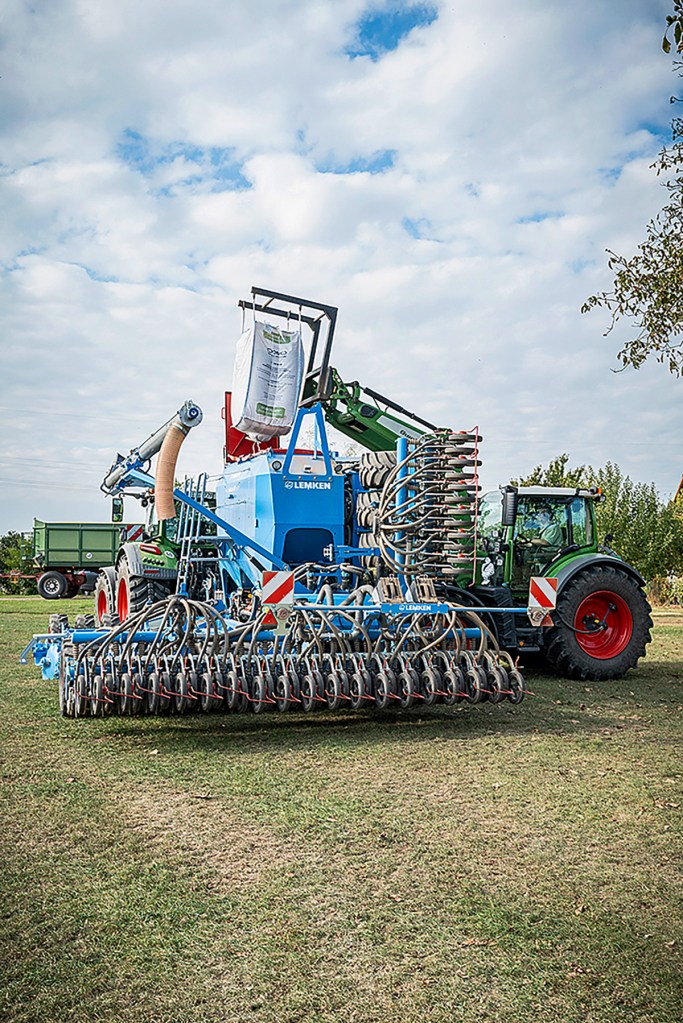
The £9,450 filling auger comes in for well-deserved criticism. At 3.88m high, you do need to be keeping an eye out for any low branches, but more annoyingly is how it restricts access to the tank lids. It has to be hydraulically swung to the side each time you want to open the hopper lid which gets tedious. Good news is that the auger’s intake and its ability to shift material is all fine.
Eight metering units
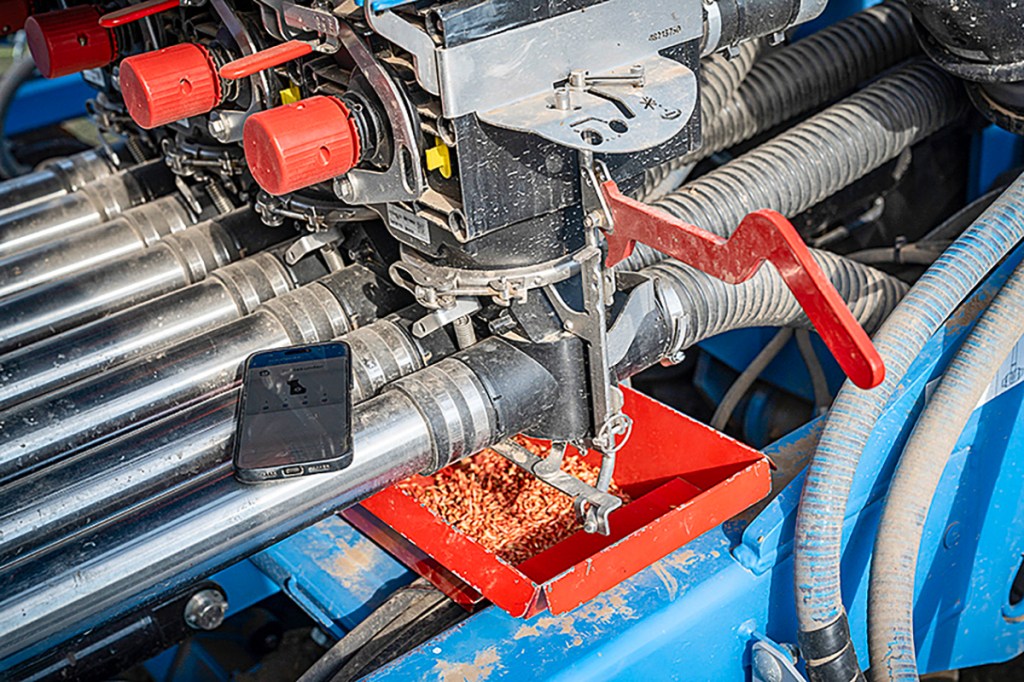
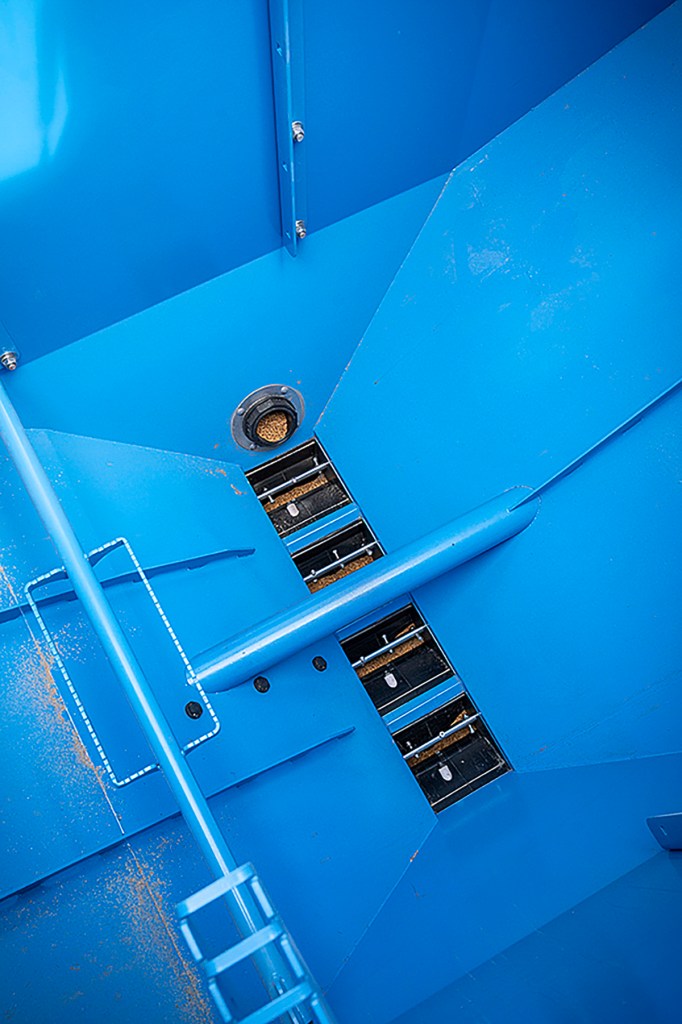
Beneath each hopper compartment you will find four metering units, each feeding a 1.50m working width. Their rotors are interchangeable and clearly colour-coded — very nice. And there’s also a shut-off gate included to isolate the hopper and metering units.
For calibration there is a nifty magnetic collection tray, which is stored between the two hopper outlets. Once this tray is fixed beneath the metering units, the calibration process can be started from the terminal and calibration button, or optionally via an app. Lemken plans to improve the tray’s capacity. It would be a good idea to have a second tray, so you don’t have to walk back to the seed hopper to empty it after each calibration run. Another nice touch is the hook for hanging the scales.
Connecting the company’s IQblue-go app up to a smartphone requires a machine-side activation for £285. The app then connects (using the mobile phone network) to an integrated telematics unit. Calibration is logical, menu navigation is excellent and accuracy is first rate.
Many possibilities
The split-hopper machine with its two lots of coulters is flexibile. Depending on your preference, the fertiliser/seed can be kept separate with the front and rear coulters or all sent down the one spout. As mentioned, we sowed beans as a companion crop when drilling rapeseed using the front coulters.
The front coulters don’t have press wheels, but they are positioned close to the rear tyre packer which consists of twelve 420/55-17 wheels following directly behind. Each pair of tyres is mounted with a 10cm offset in the direction of travel to avoid pushing up soil and bulldozing in sandy soil.
The tyre width also matches the coulter row spacing.
On the road, the DT runs on the four outer wheels which are also braked. Ride stability is very good, even at 40km/hr. Our machine weighed 10,520kg when empty. Filled with 3,700kg of wheat, it then tipped the scales at 11,400kg, with 2,820kg of this sitting on the drawbar.
The kerb weight also includes Lemken’s wedge ring packer (an £9,846 option), which comes after the rear tyre packer. The 42cm diameter plastic rings prepare the seedbed ahead of each coulter. In our test, this led to an excellent emergence. Once the roller is mechanically pre-set, you adjust the ground pressure in ten increments up to 330kg/m from the tractor terminal.
Our DT model had the OptiDisc H coulters: parallelogram-guided, double-disc coulters with a 15cm spacing and hydraulic pressure control (£7,860). The pressure reached up to 70kg on the longer coulter carriers and 73kg on the shorter ones (adjustable in ten increments from the terminal — brilliant).
Alternatively, on the M version, buyers get mechanical pressure control of up to 45kg per coulter.
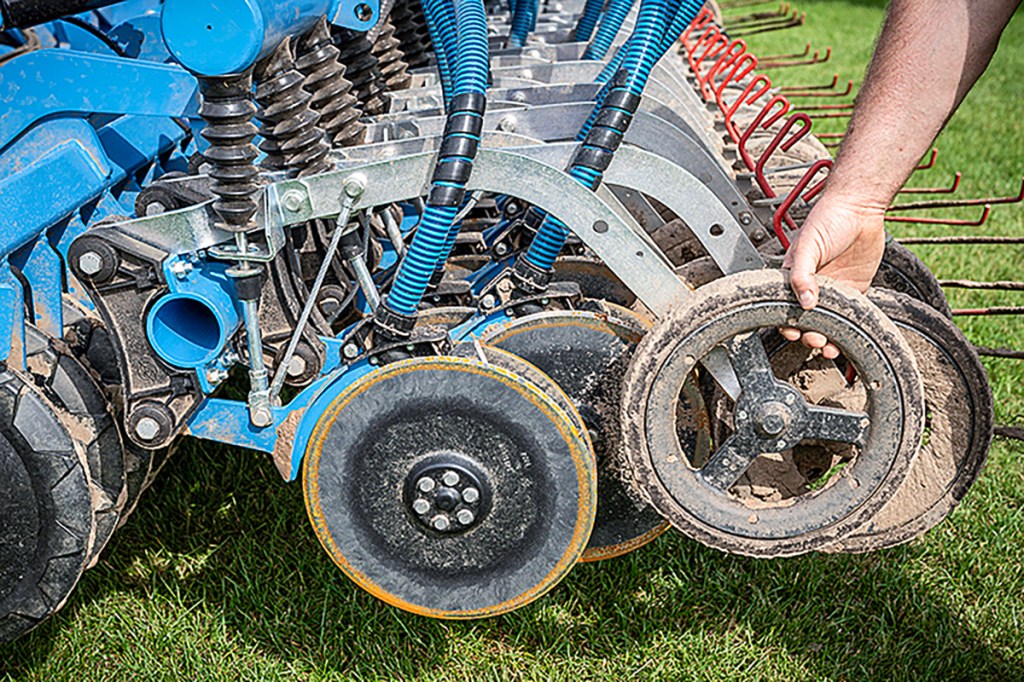
Seed depth is adjusted from four different positions, all being easily accessible at the rear. Clear scales help get the depth right. Depth control of the 360mm disc coulters is controlled by press wheels with three open spokes (340 x 50mm). In sticky conditions, the spokes did clog from the inside, but this didn’t cause any serious issues. Thanks to the internal scrapers (£1,200), the coulters stayed reliably clean. We would always recommend opting for the €931 single-row following harrow with multiple adjustment options, even if you don’t always need it.
As with the metering units, Lemken uses four distributor heads each looking after a 1.50m wide section. These sections can be switched off individually.
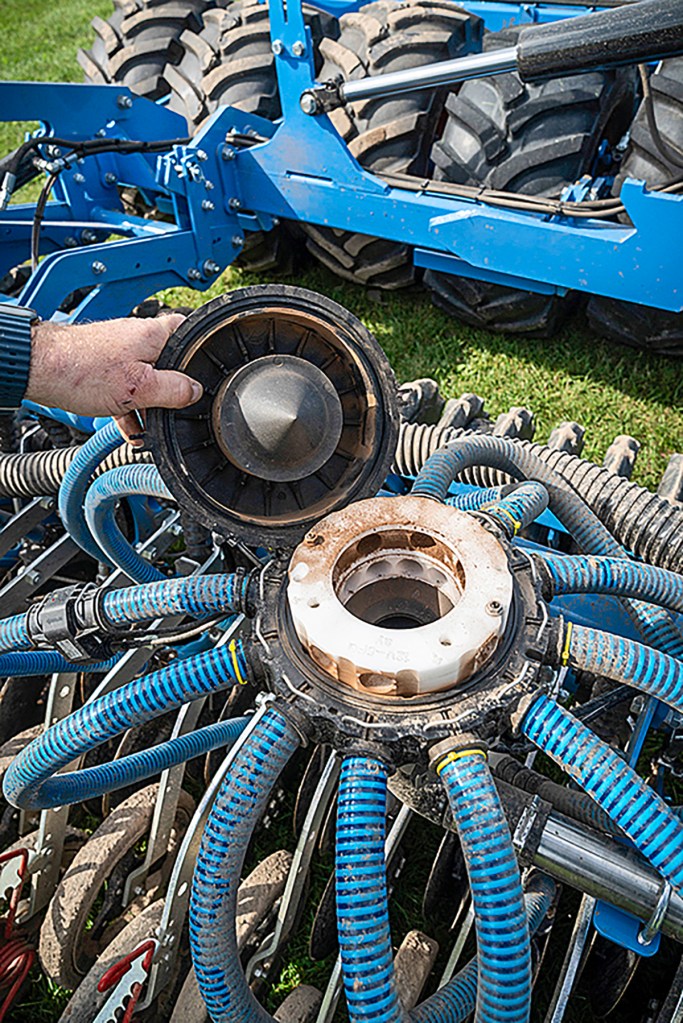
Tramlines are still controlled hydraulically on the DT by blocking individual distributor outlets by lowering a plastic cartridge into position.
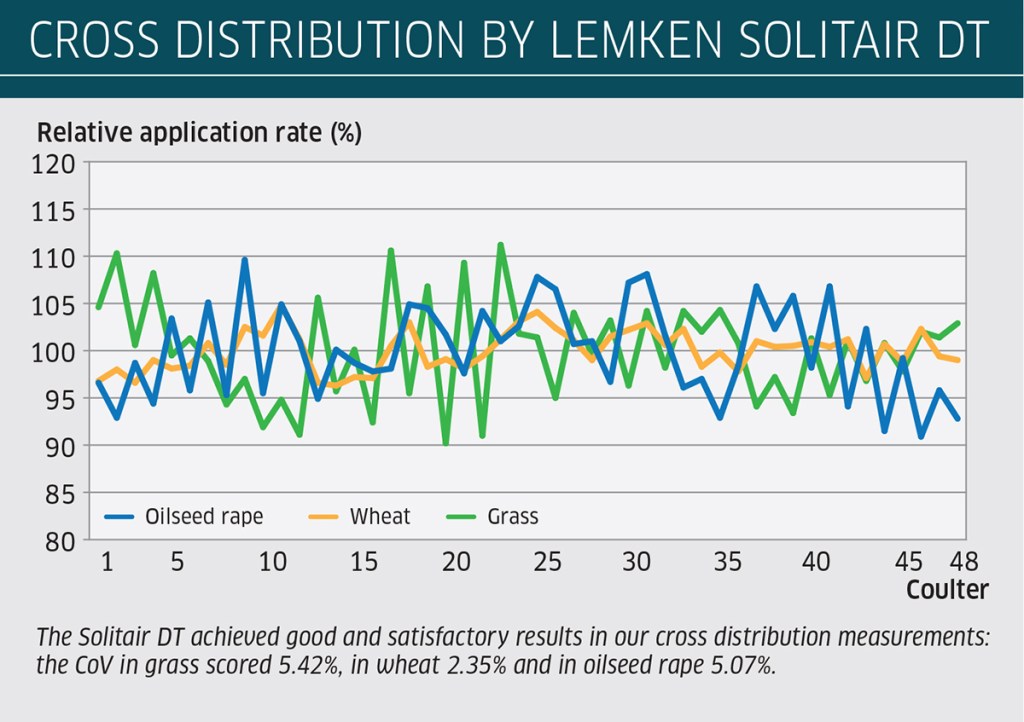
When we checked the distribution across rows using the DLG test framework, the DT drill achieved a satisfactory coefficient of variation in oilseed rape (5.07%), a good distribution in wheat (2.35%) and average in grass (5.42%).
Very versatile
Based on our experience during the season, we can confirm that the machine produces a uniform establishment both on ploughed and min-tilled land. Direct drilling without prior cultivation is not really its thing — the coulter pressure is too low for that.
Diesel use on level ground averaged 4-5l/ha, and we were regularly getting over the land at 6ha/hr.
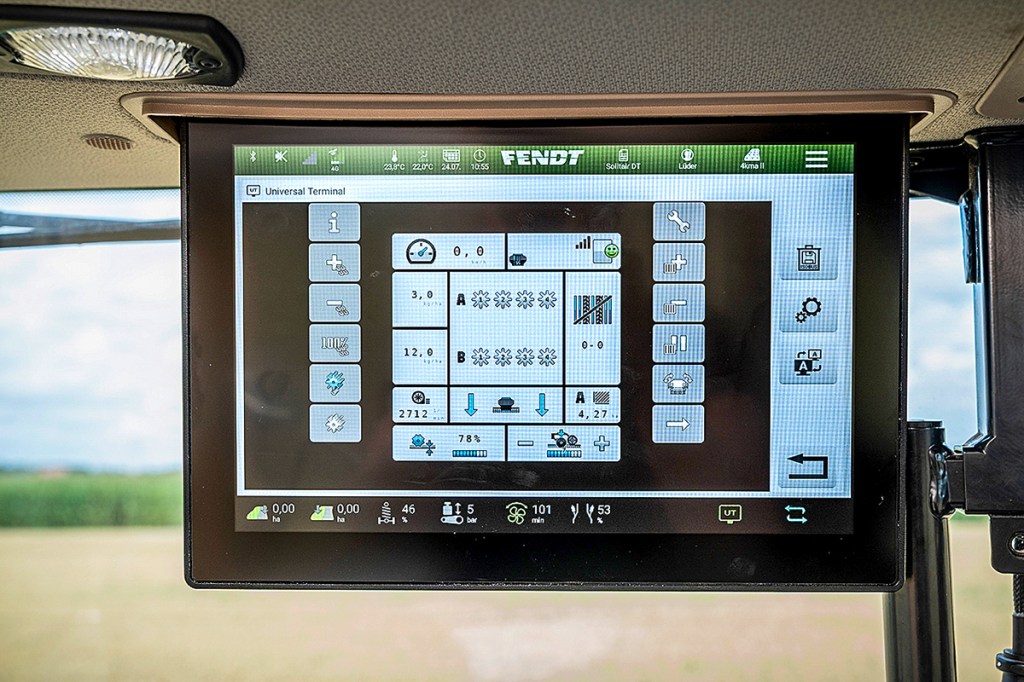
In the cab, the terminal shows most of the machine functions on one screen. Although this gives you a good overview it does mean the size of some symbols is a bit small. On the Fendt One terminal, for example, you have to look very closely to find out whether you are adjusting the pressure of the wedge ring roller or that of the coulters. Also, it would be better if any error messages were shown with a symbol and a combination of letters and numbers.
Further points worth mentioning
- 240hp is recommended on level ground.
- The side plates on the disc harrow worked well.
- A sequence control conveniently raises and lowers the individual gangs one after another.
- To comply with transport width limits, you’ll have to pull in the outboard tines on the following harrow using a strap — outright cumbersome.
- The machine bounced twice during field work. If this effect had happened more often, we may have adjusted the damping system on the leading press, which is done in the service menu and could have solved the issue.
- 25 grease nipples plus four more on the filling auger are not overly onerous.
- The base retail price for the Solitair DT 600 with 48 rows without a twin hopper is £108,000. Add the leading packer roller, harrow, seed delivery line monitoring and hydraulic adjustment of the cultivating element, and the price rises to £138,000. With a split hopper, fertiliser bar, wedge ring packer, OptiDisc H coulter bank and filling auger, the list price comes to a hefty £202,700 — without the extra discs.
Summary
The DT does its drilling job very well. The quality of work and its ease of operation impressed us most of the time. The coulter bar and hydraulic depth control for the disc harrow add to the overall comfort. It also scored on weight: despite the better spec, the drill had the same weight as the Compact Solitair in the last profi comparison test in 2019.
Hitching up has become a whole lot easier. If you can get away without it, we would avoid the filling auger. All in all, the DT won us over on 200ha of test work.
Lüder Görtmüller, Sönke Schulz
For more up-to-date farming news click here and subscribe now to profi and save.