

Manitou’s knowledge of battery-powered access platforms has led the French maker to introduce its first battery-powered telehandler for the agricultural sector, the MLT 625e. Is it a credible alternative to the diesel-powered MLT 625, or a box-ticking poor relation to the popular diesel-engined compact handler?
KEEPING IT BRIEF
- Standard and boost modes
- Lower maintenance requirements
- £32,825 premium over diesel
Manitou first showed a prototype battery-powered MLT 625e in January 2025, at the LAMMA show. It reappeared at this year’s event as a production-ready model, boasting generous run-times and performance that matches the muscle of its diesel-powered MLT 625.
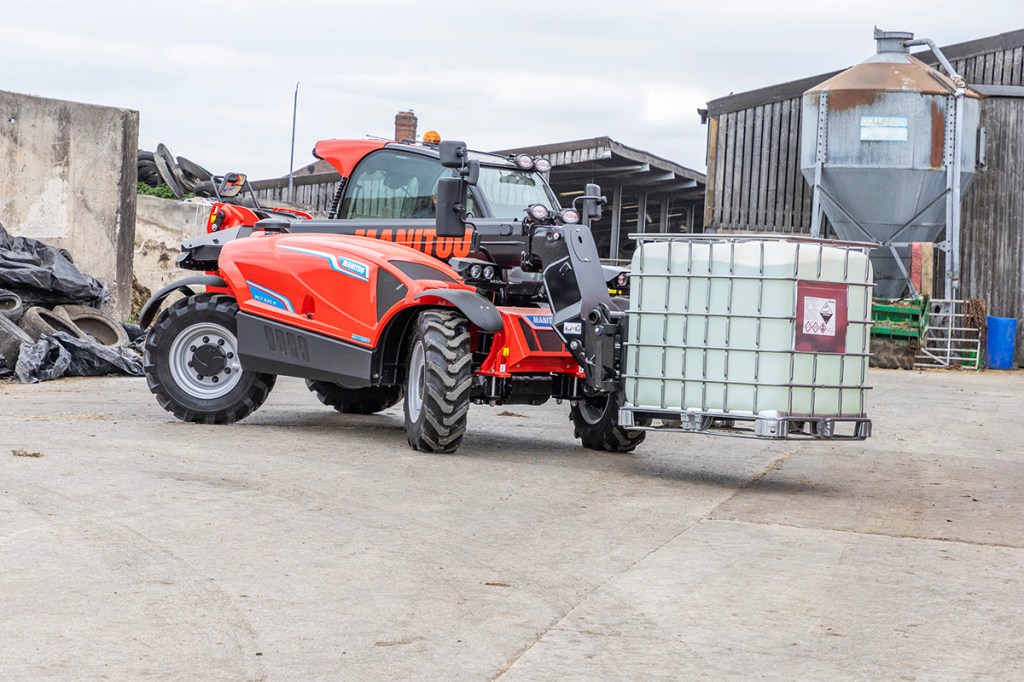
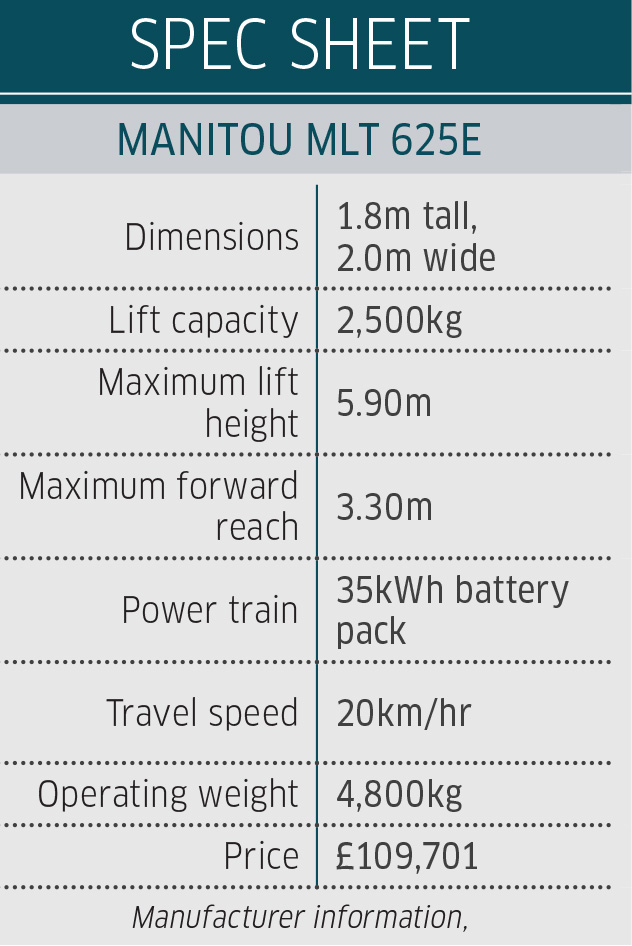
Like most battery-powered innovations, there is a premium to pay for zero emissions. And in the case of Manitou’s MLT 625e, that price hike is around 40% more expensive than the traditional diesel-powered MLT 625 Elite version.
It sees the blue stickered ‘e’ model costing a whopping £109,701. For that, you get zero emissions and quieter operation – not silent though, as the whirring of electric motors comes with a less soothing tone than a traditional oil burner.
What do you get
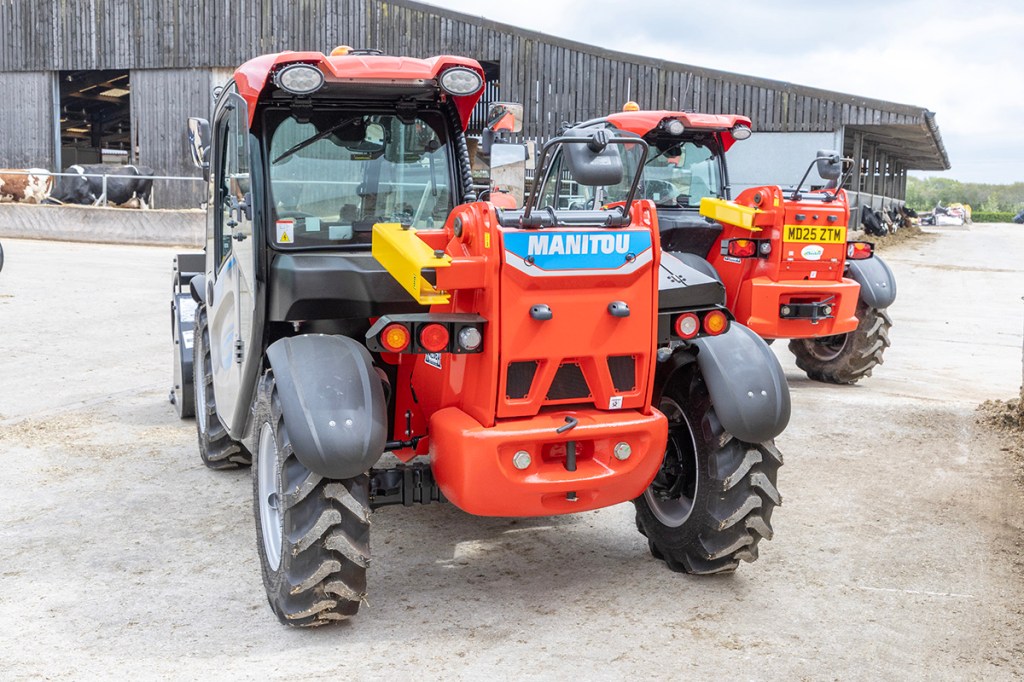
Aside from open wallet surgery, what do you get for going zero? Lift-wise, the 625e can hoist two tonnes to a maximum height of 5.85m – the same as the diesel – and packs a 2.5t maximum lift capacity. Surprisingly, this model weighs less too, at just 4.8 tonnes against the diesel’s 4.9 tonnes.
It also occupies the same physical space and footprint, because it’s essentially an MLT 625 with a different powertrain. The cab, joystick and controls remain unchanged, but the cab gains a new monitor that informs of battery power, performance and regeneration. And the maximum travel speed is 5km/hr slower, topping out at 20km/hr.
Manitou has drawn on its experience of building battery-powered access platforms, and has applied thought to packaging and weight distribution during the design of the MLT 625e. The French maker has assembled its own multi-cell battery pack to suit the handler, which has resulted in a 35kWh Li-Ion battery pack that affords a five-hour run-time that Manitou claims is the largest battery pack on the market for this size of handler.
That confidence also translates into a five-year, 3,000-hour warranty on the battery pack, with a guarantee that 70% charge capacity will still be accessible at the end of the warranty period
Rather than simply tuck the battery pack into the engine compartment, Manitou has slotted this into the middle of the chassis, running almost the length of the handler beneath the boom. This area of the chassis has afforded more space, hence the generous power pack, and also contributes to spreading weight, low in the frame, rather than sitting on one side.
The battery pack is also extremely well protected above, below and on all sides.
Using the central chassis area leaves the right-hand side compartment free for electrickery components. Here, you’ll find the inverter, its water-cooled components and associated cooling pack. There’s also a 30kW electric motor that drives the main hydraulic pump and a 12-volt battery for ECUs and standard vehicle electrics.
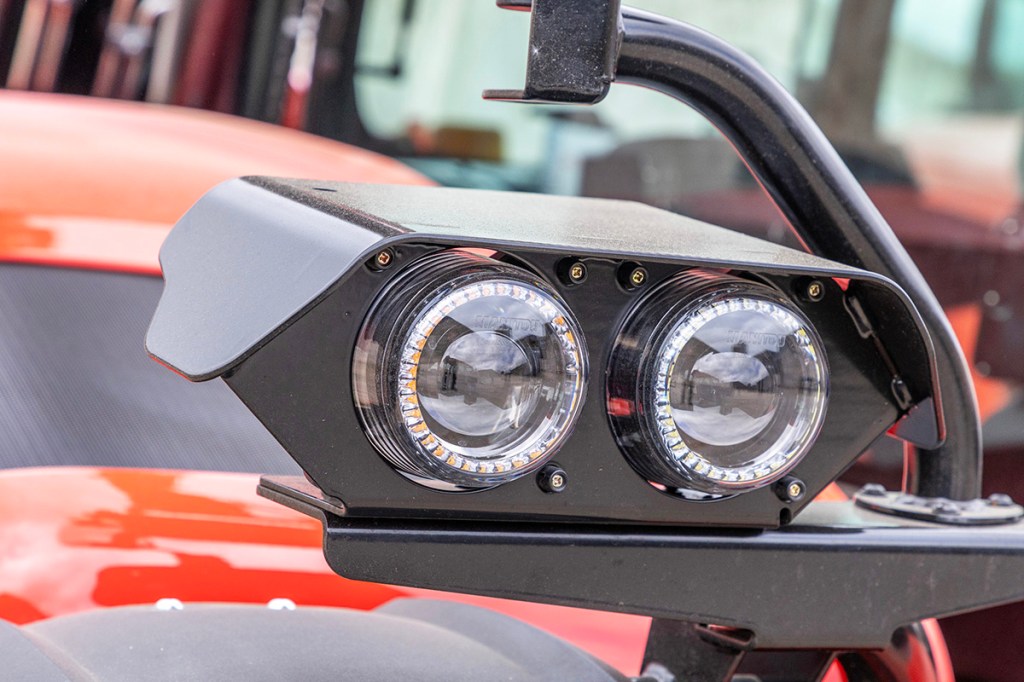
In addition, low power consumers such as LED headlights now replace traditional halogen items to help get the most from the machine’s available battery power.
Less oil
Not having a hydrostatic transmission means a smaller hydraulic oil tank can also be used. Typically, this holds 80 litres compared to 115 on the diesel model – and it’s all neatly packaged and easily accessible in a space once occupied by a 75hp Kubota engine and two-speed hydrostatic transmission.
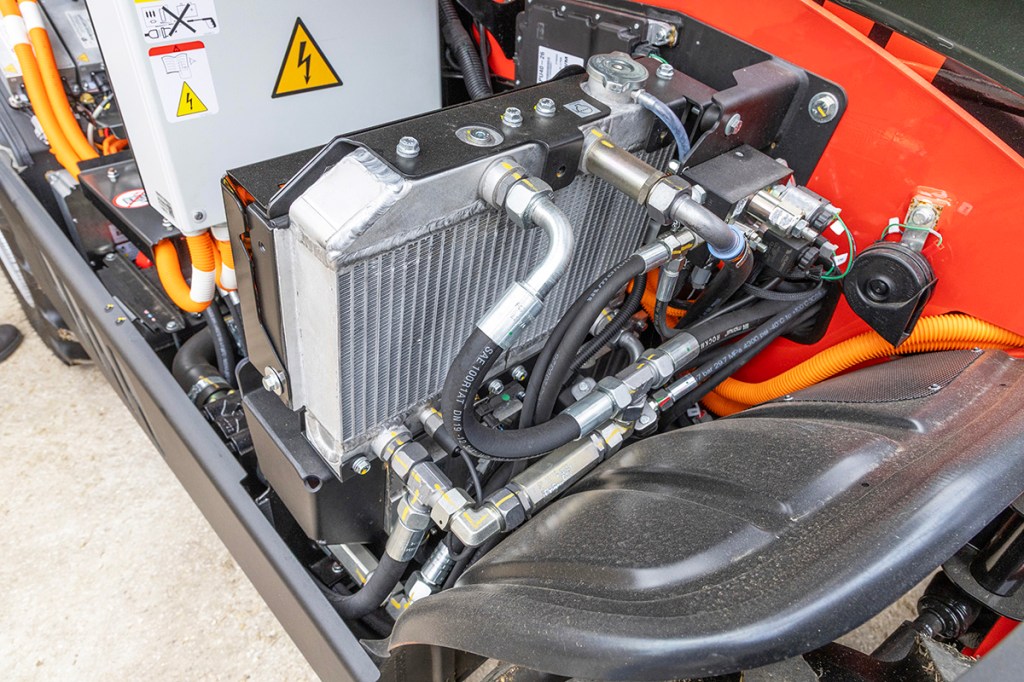
A second electric motor – this one packs 40kW – is fitted to the front axle in the place of the hydrostatic transmission’s motor. This powers the existing driveline, with a propshaft connecting both axles for even power distribution. The running gear of the ‘e’ is identical to that employed on the MLT 625 diesel model.
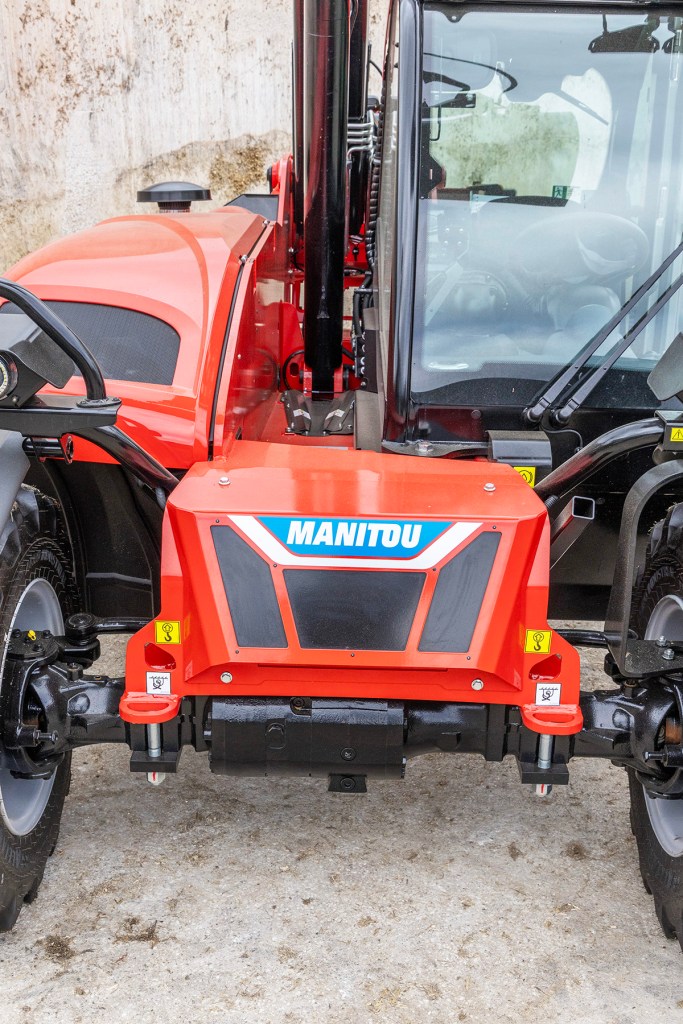
The bonnet is a carry-over too. While an exhaust pipe is the obvious missing piece, the bonnet still carries an engine air intake. Manitou says keeping the existing bonnet has avoided having to remake the part at vast expense, which is a sensible approach considering this machine could turn out to be a low volume seller.
Getting juiced up
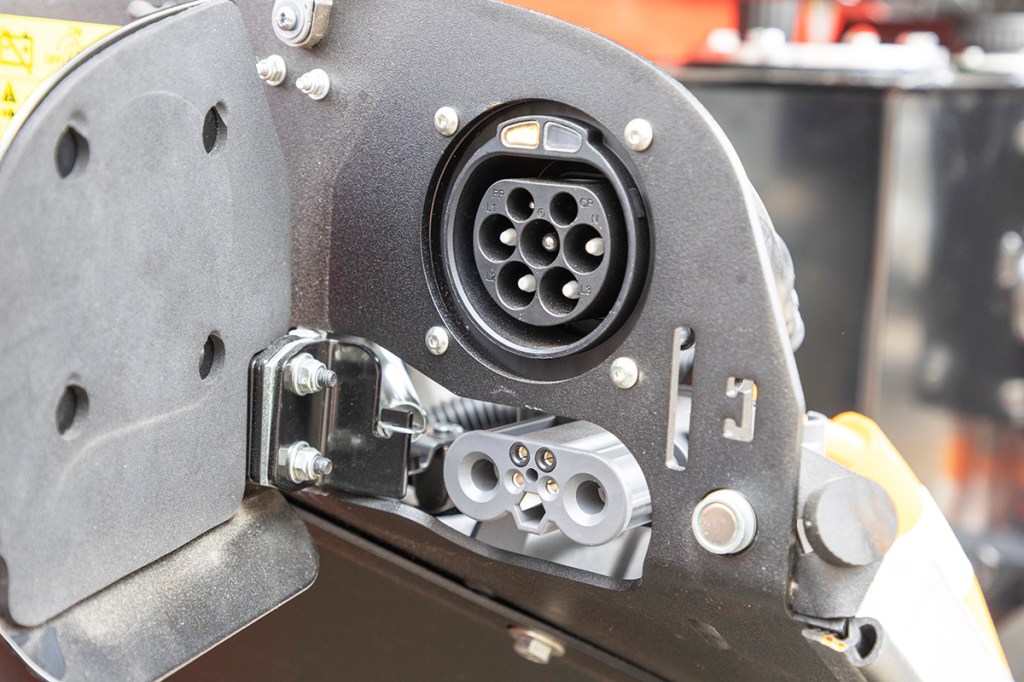
On-board charging has been given considerable thought, with a compartment at the rear of the handler containing a tethered charging lead and a host of different adapters. Flexibility is the key here, enabling the MLT 625e to be connected to a variety of charging mechanisms. The most popular is expected to be a three-phase, 16-amp supply, that can feed a 9kW onboard AC charger.
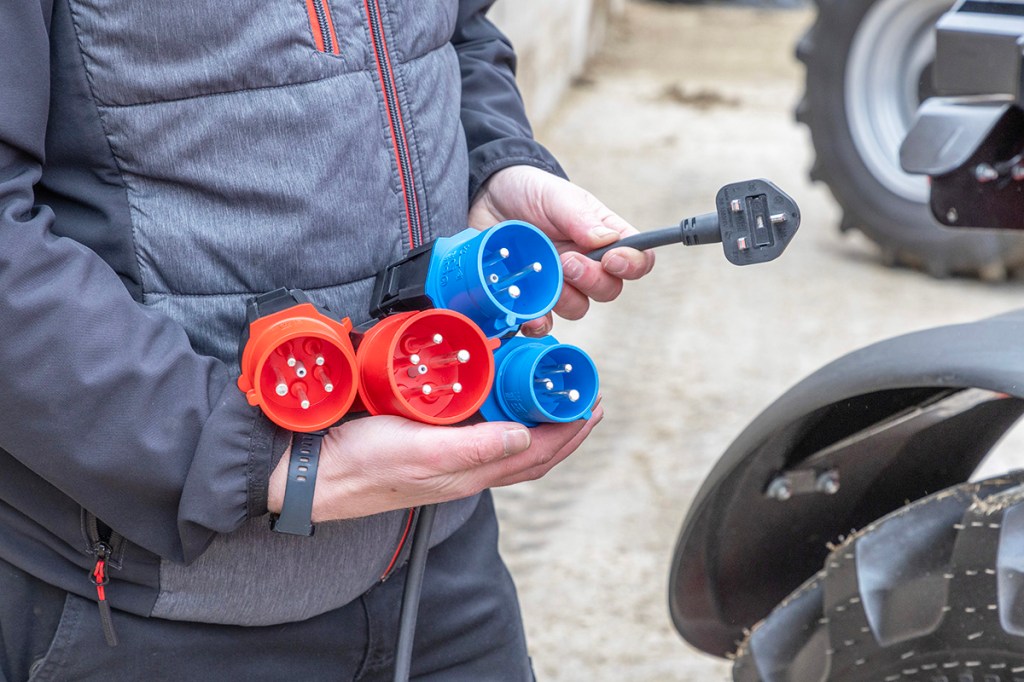
Typical charge times using this method, says the firm, is four hours – the equivalent of 25% charge per hour. Using a 240-volt 16-amp supply sees this extend to 11 hours – the equivalent of just 10% charge per hour.
The MLT625e is also fast charger-ready. Using a secondary charging socket with a Euro DIN connector more often associated with forklift trucks, a DC fast-charge option delivers up to 30kW, which is enough to fully recharge the 625e in just one hour.
Both charging sockets are neatly concealed by a metal flap that is held firmly closed using a magnet, to keep out dust and debris. At less than 15% charge remaining, the telehandler warns the operator that a recharge is required.
Around the yard
The MLT 625e’s cab will be familiar to Manitou operators, and the change in power unit hasn’t impacted on controls or the way it operates. There are brake and throttle pedals, though in reality, the retardation of electric motors means it’s unlikely the foot brake will ever be used.
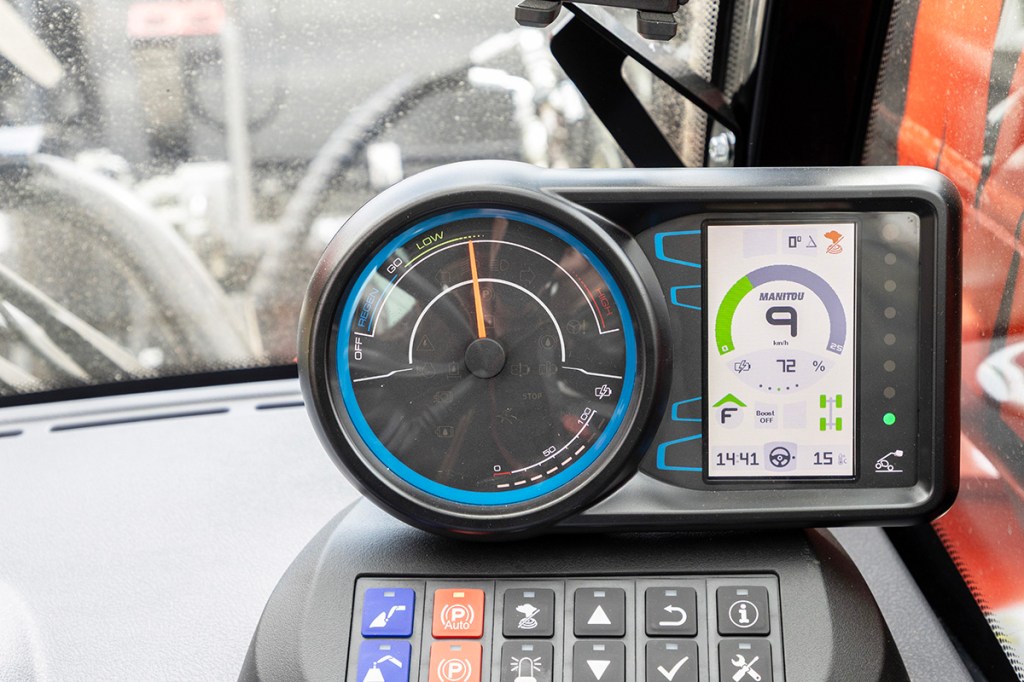
There is still an ignition key, which simply needs a twist to bring the unit to life, and doing so moves the needle on the monitor’s circular dial from ‘off’ to ‘go’. That same dial shows when power is being regenerated – through slowing down – and also indicates battery charge status, from zero to 100%.
Battery charge status is also shown on the LCD panel alongside the dial, along with wheel alignment, forward speed, boom angle, direction of travel and whether boost is on or off.
Activating the boost function is a button press, and it sharpens up the throttle response and puts a bit more oomph into proceedings. In reality, for yard work, it’s not needed, and makes the machine more erratic and less controllable, and not what you need if precision movement is required. Boost off is a far nicer experience.
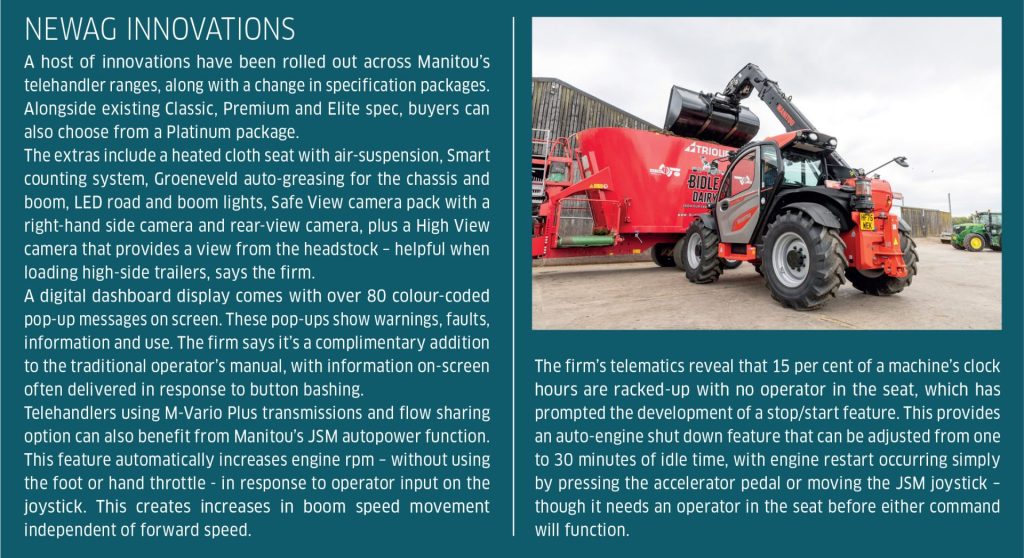
Manitou’s JSM joystick now gains an autopower function (see NewAg innovations for more on this), which enables the electric motor that drives the hydraulic system to operate at a speed in direct response to operator demands. The more you move the joystick, the faster the motor operates, the quicker the boom functions move.
Despite having a gear pump, a flow sharing distribution block cleverly sends oil flow where it’s needed, and doesn’t show up as a limitation when the joystick movements ask for multiple functions at the same time.
The MLT 625e’s throttle pedal is basically a travel pedal, and pressing it simply adjusts forward and reverse speeds, while being accompanied by lots of whirring from the electric drive motor. As there are two motors – one for the hydraulic system and one for the driveline – any machine travel is totally independent to the hydraulic system performance. Though the noise level does intensify, despite Manitou stating this model generates up to 12% less noise than the diesel version.
And despite the constantly changing pitch of the electric motor noises, it’s not hard on your ears – it’s just different. And in an industry that tends to resist change, this could be a challenging obstacle for Manitou to overcome.
The 625e however, is extremely controllable and effortless to use. Lifting off the throttle does need care – the abruptness with which this machine stops moving is far more aggressive than a hydrostatic model, and simply taking your foot off the pedal is likely to catch operators unaware.
Summary
Apart from the 40% uplift in purchase price compared to the diesel version, there’s little to fault on this latest battery-powered telehandler. Five hours of continuous use from one charge suggests the 625e will have plenty of electricity capacity to satisfy all but the most intensive applications.
For the majority of users seeking a zero-emissions, compact telehandler, Manitou’s MLT 625e should be more than up to the task. And without the traditional oil-burner under the hood, there’s less to service, so running costs should be lower too – one possible downside to this is that dealing with high voltage components is exclusively a task for specially trained dealer technicians.
Geoff Ashcroft
For more up-to-date farming news click here and subscribe now to profi and save.