
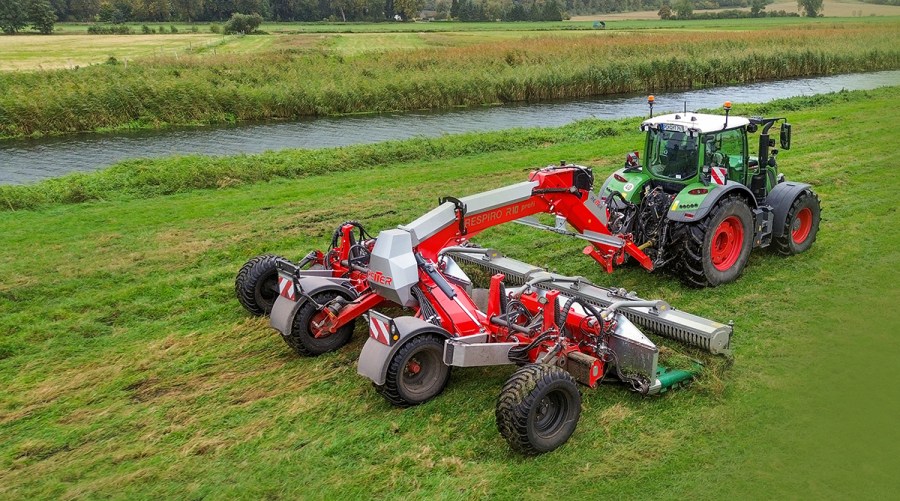
Reiter launched its first belt merger 10 years ago. For this season, the team introduces a new generation, which is based on user experience and wishes. In the last cut in 2025, we found out what’s new.
KEEPING IT BRIEF
- The R10 continues to use the plastic tine holder system it introduced in 2016 (see profi 3/2017).
- Our late season conditions were not ideal for a driving impression.
- Increased working width is a better match to the bigger triple mowers now on the market.
A whole lot has changed since 2016: Modern tractors, wider mowers and new customer demands have pushed Reiter to further develop its belt mergers.
More working width
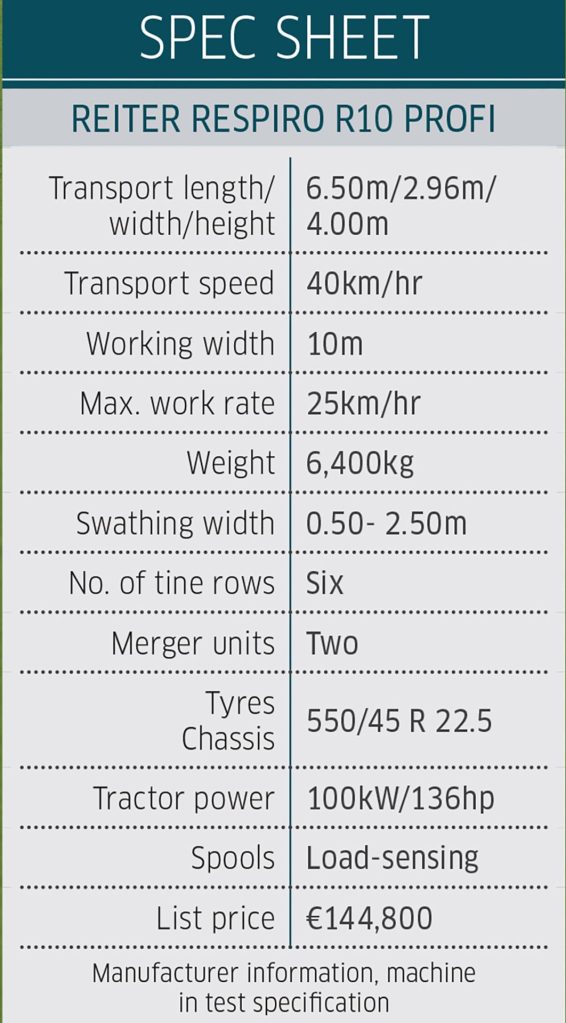
The Respiro R10 Profi has an increased work width of 10m instead of the previous 9.0m when placing the forage in a central row, or 7.50m when depositing the crop to the side. This is made possible by two pick-ups, each 3.75m wide. The swath width has also increased; rows 0.50m to 2.50m are now possible.
At speeds of up to 25km/hr, this noticeably boosts daily outputs. However, the main reason for the wider pick-ups was to better fit in with the larger mowers now on the market and enable the merger to collect 10m of crop.
Small pick-up with rotor
Reiter has always relied on a small, camless 335mm diameter pick-up, with a powered crop rotor above. The pick-up and rotor run in synch for a consistent flow of material into the machine, which is most important in short or wet crop.
The rotor transfers the material smoothly onto the belts. The stripper bands now have an upward slope towards the belt to ensure a more consistent flow of material onto the belt. An advantage of the smaller pick-up is that the tines operate at a lower speed, which should be more crop-friendly and help reduce the risk of crop contamination when hitting the ground. On the other hand, its own weight and production costs are higher.
The rotor is normally run in its float position and is mounted on height-adjustable rubber buffers. For bulky crops the rotor can be raised hydraulically while the passive crop press roller keeps the material on the tines.
Height control dishes
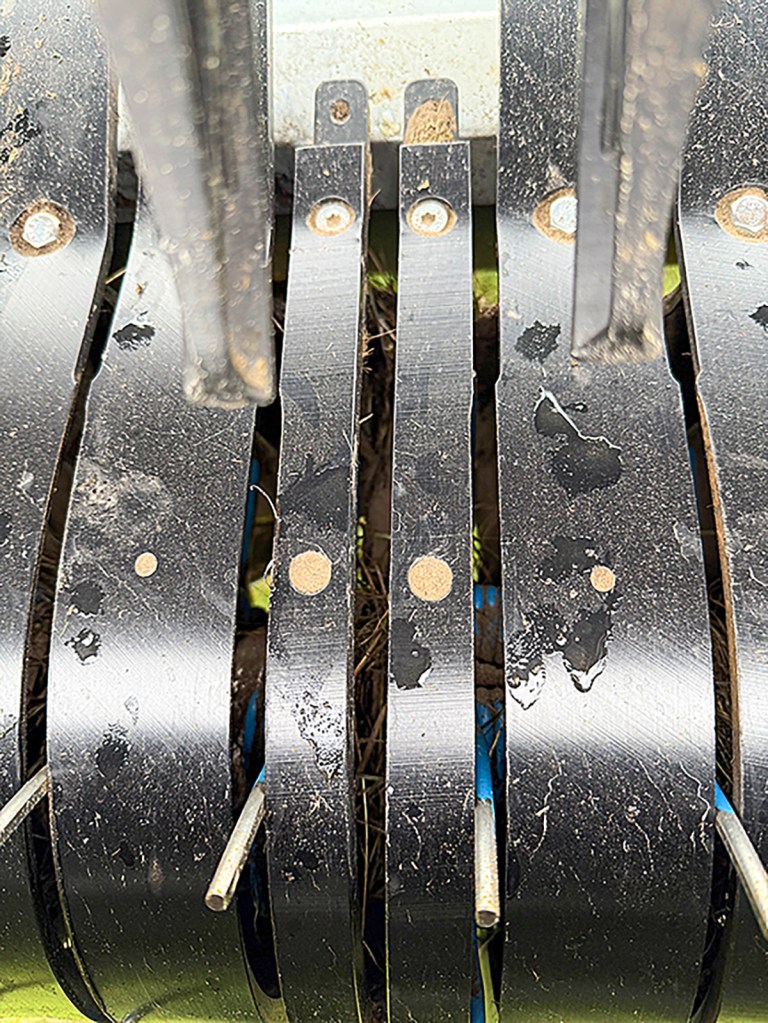
The working height is set by turning four dishes on each pick-up. Positioned directly behind the tines, the two dishes in the middle guide the entire belt unit while the two outer dishes guide the pick-up ends.
Each pick-up is split into three sections that adapt to the ground contours individually. The previous model had five sections but this bumped up the cost.
New strippers with expansion joints in between the mating sections are reckoned to give maximum flexibility. The movement doesn’t take place directly on the tine, but centrally in the stripper. A hex shaft enables this movement. It drives the tines and can withstand a certain amount of bending.
The shaft’s surface is now more fatigue- resistant thanks to introducing nitrogen into the surface. According to the manufacturer, this should offer five to ten times higher durability and cure the issue of broken shafts that occasionally occurred.
The bearings on the tine shafts were also improved to avoid damage in wet and sandy conditions. A special cutting ring protects the seal of the maintenance-free bearings.
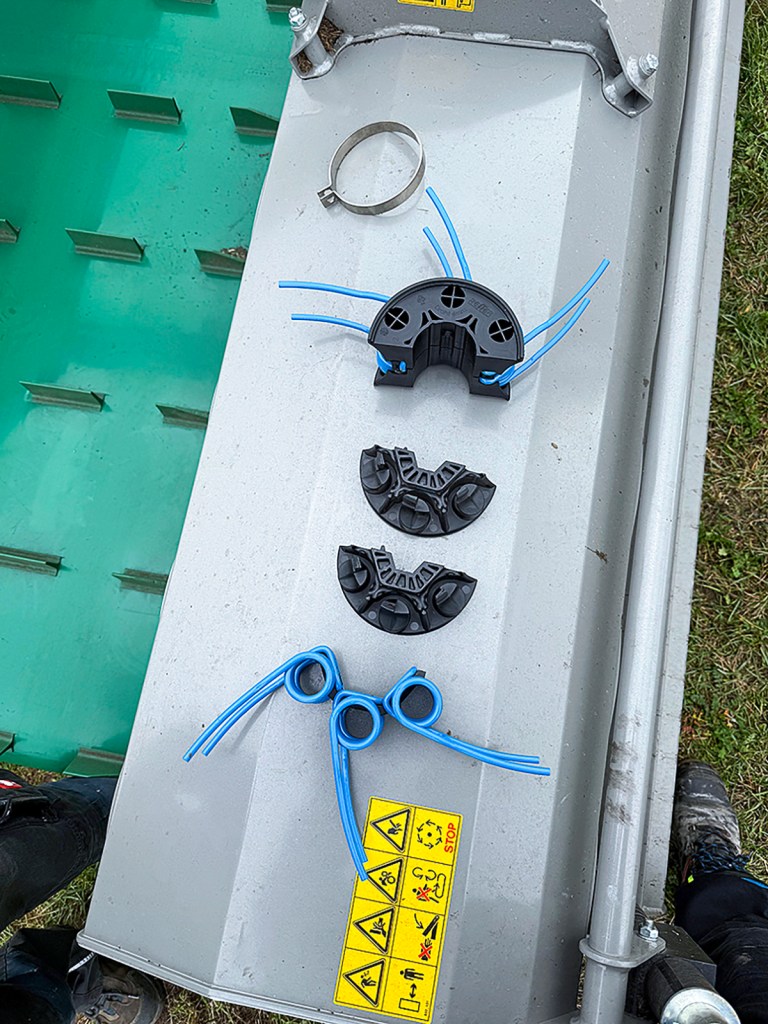
Six tines are fitted to each of the plastic cassettes which clamp to the hex shaft. As with the earlier Reiter crop mergers, the tine carrier can be split in the middle and removed from the shaft by loosening the fastening screw. Then you can split the two halves again along the length. Afterwards, you can simply pull the tines off the holder.
Optimised tensioning
The merging belts are driven by 140mm smooth rollers. The stub axles on the rollers are now 5mm bigger than before. Inside the belt unit there is a scraper that cleans the rollers. The belt body is open at the front to allow any dirt to fall out
Reiter uses a continuous PVC belt which it says can be tensioned more than the rubber alternative. It has also revised the tensioning mechanism: on the previous machine, the tension had to be adjusted on both ends of the belt. The new belt tensioner now allows central adjustment.
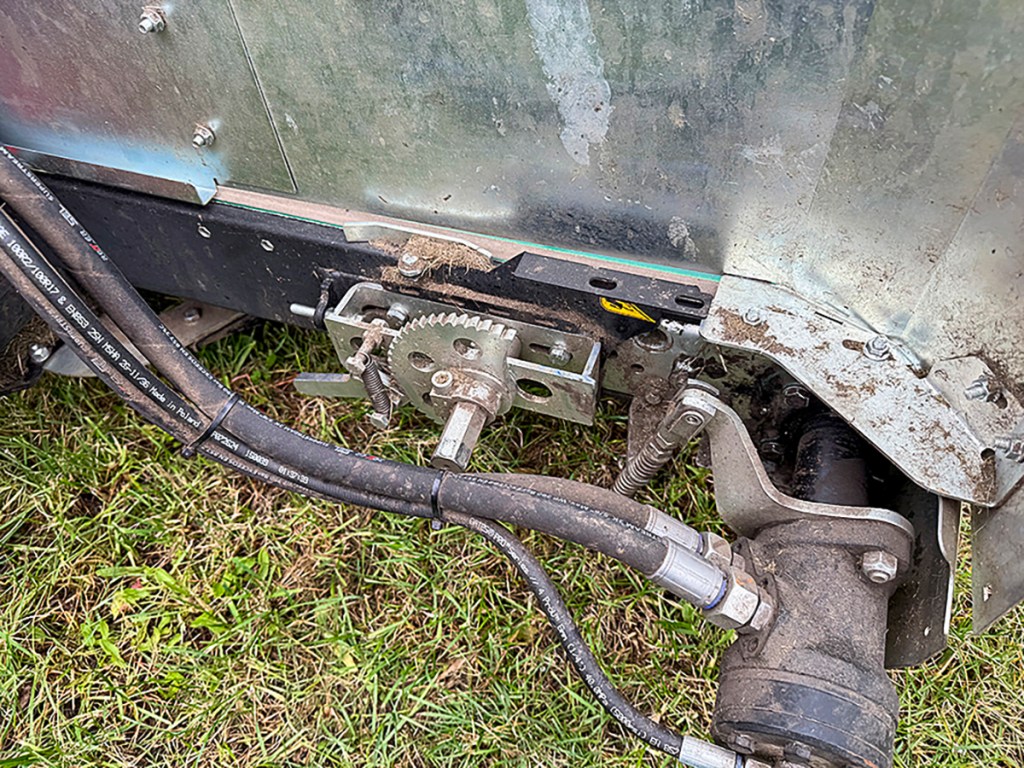
The disadvantage of the continuous belt is the additional work involved in fitting a replacement belt after 4,000 to 6,000ha (depending on conditions). According to the manufacturer, the updated design allows both of the merging belts to be replaced in about an hour by two experienced people. That’s the claim.
Easy to adjust
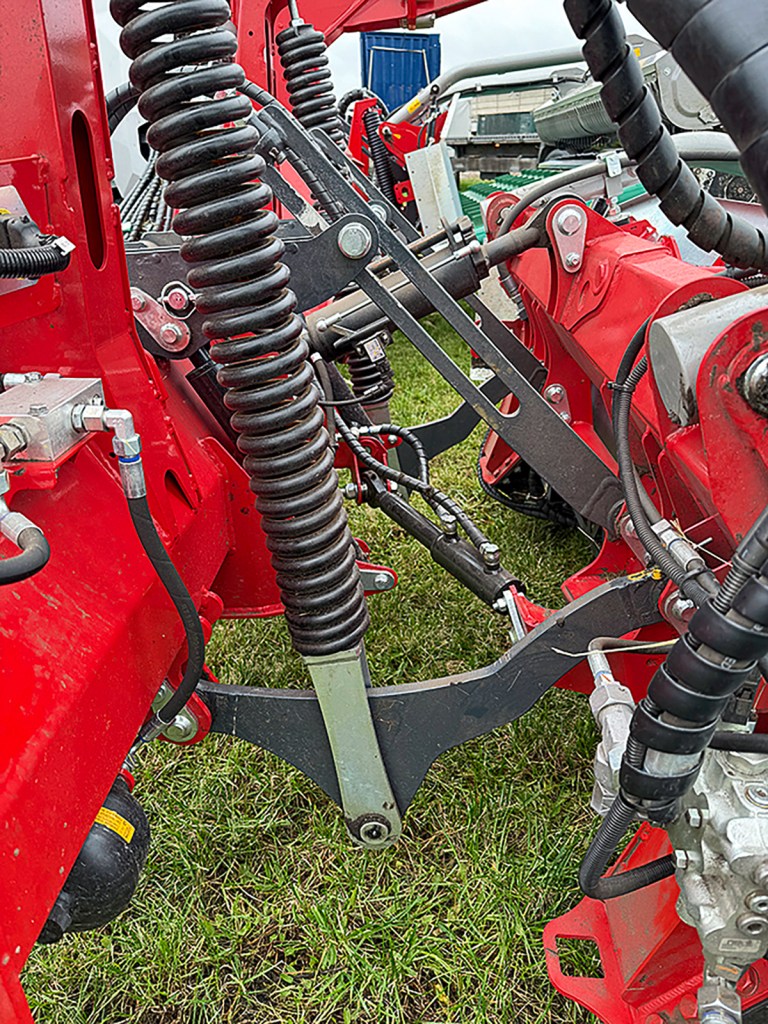
The belt mergers are attached to the three-point linkage and the pick-up height is set by adjusting the length of the hydraulic top-link from the control box. A sensor measures the current setting and indicates the pick-up height in centimetres. The mergers are left in a float position during work.
Suspension comes from a pair of substantial coil springs, which are more responsive than a hydraulic system set-up. Thanks to the three-point design, the suspension effect is said to be consistent even on uneven ground. For merging straw, the work height can be limited by refitting two pins on the linkage, which raises the ground-hugging dishes out of work. The working width can be adjusted hydraulically via the telescopic frame, but this should be done on the move to avoid the wheels damaging the sward.
Running gear and operation
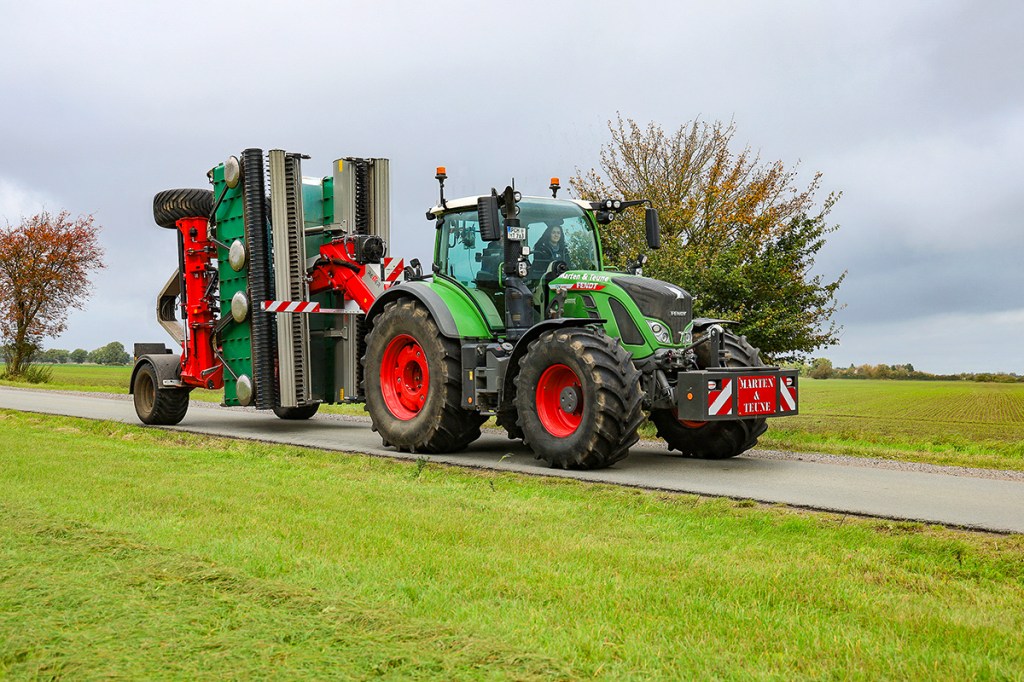
The merger runs on four wheels, a set-up that ensures smooth running, good machine stability when one merger is raised out of work, less sway on the headland and better tracking on slopes, says the manufacturer.
Operation via ISObus is also new. The user interface wasn’t finished yet at the time of our test, but did seem clear and easy to use. Operating the belts is particularly simple: tap the button briefly and the belts stop to collect material — for instance, in a corner. Press and hold the button and the belts continue running at half speed. Another plus is that the most frequently used functions can be comfortably assigned to the tractor’s joystick for easier operation.
Attachment and pivot point
The merger couples to the lower links. Belts and pick-up are supplied with oil by two 84 litre/min swash plate pumps, which are driven by the tractor’s 1,000 pto but at a more fuel-friendly 700rpm. The oil flow and thus the pick-up speed can be seamlessly adjusted from the terminal. The 200-litre oil reservoir is the frame, along with an oil cooler with reverse fan helping to control the temperature of the oil.
Autumn cut
The conditions for the last cut were anything but good: wet grass, drizzling rain, a patchy crop and lots of molehills made the low-yielding permanent grass a real challenge. But this is where a belt merger can show what it’s made of. The farmer had cut the grass with a 12cm stubble. So, we could also set the pick-up to a higher height, which is easily done from the cab. We only had to get out and adjust the rotor’s end stop to adapt the gap between rotor and pick-up.
Despite the challenging conditions, we could work at 1,400 engine revs at 19.5km/hr and produce a good finish. Only in the wheelings was some material occasionally not picked up. Despite the fairly wet silage and plentiful molehills, the Reiter merger did a good job of visibly avoiding bringing any dirt into the swath.
Another advantage of the belt merger was that we were able to group five to seven working widths of the low-yielding grass into the one swath — much to the delight of the following forager operator.
Summary
Reiter has substantially revised the belt merger to increase the effective working width, reduce daily maintenance, increase machine stability and operational reliability. ISObus operation makes regularly worked functions that bit easier on a compatible tractor.
At the same time, the manufacturer has addressed a number of weak points on the previous model. Our featured R10 Profi is priced at €144,800.
Sebastian Rüther
For more up-to-date farming news click here and subscribe now to profi and save.