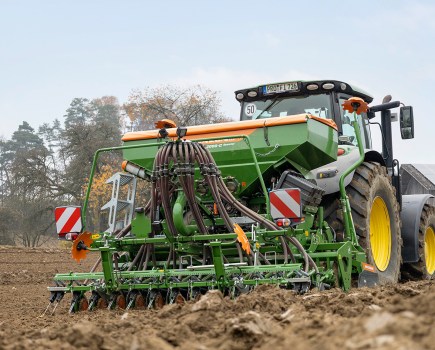


We assess the other key component in our 100hp loader tractor equation — the front loader itself. Keep reading to see how these seven booms performed.
KEEPING IT BRIEF
- As part of our seven 100hp tractor comparison, we also tested the loaders they were supplied with.
- We would recommend specifying boom suspension/damping and a hydraulic quick attach.
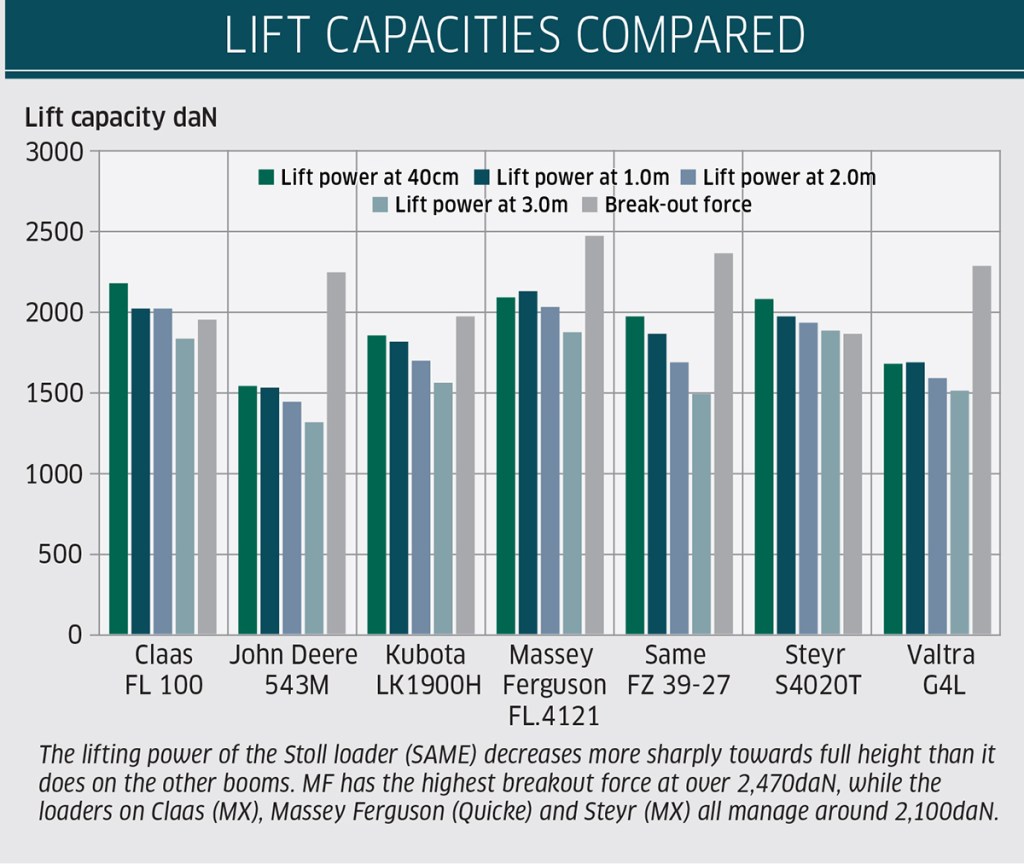
- The loaders on the Claas, Steyr and Massey Ferguson tractors had the highest lift capacities.
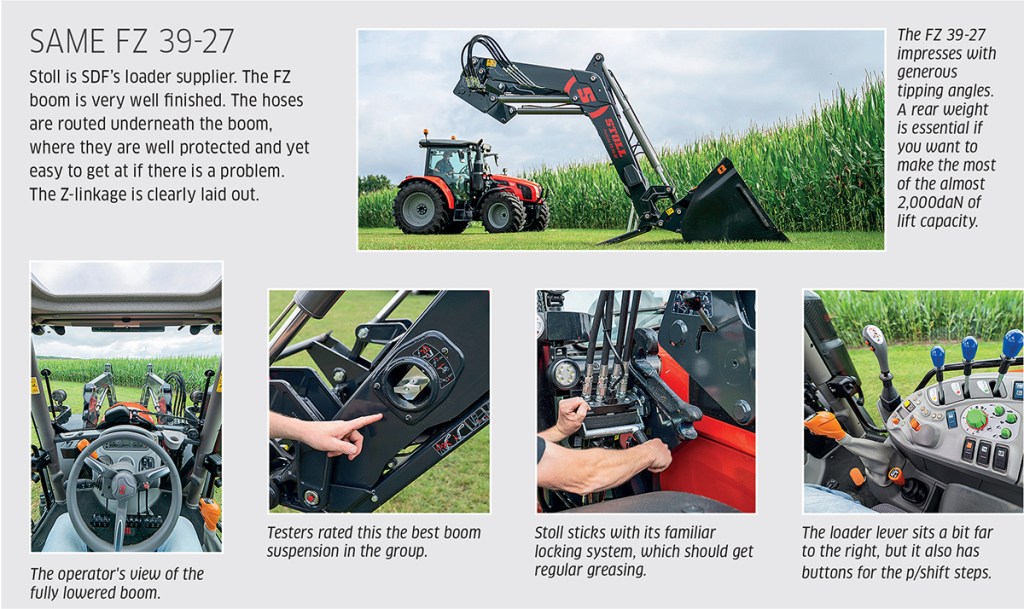
Having scrutinised the seven 100hp tractors within the April and May issues of profi, we wrap up our comparison with a closer look at the front loaders. Three of the makers (Claas, Kubota and Steyr/Case IH) look to the expertise of MX for sourcing their front loader, while Alo Quicke supplies both of the AGCO brands, Massey Ferguson and Valtra. Likewise, SDF partners up with Stoll for the SAME.
John Deere, meanwhile, is the only one in this group that fits its own front loader.
There was a decent bit of variation in our group, not just in how they are operated (electric joystick or Bowden cables) but also the parallel lift — hydraulically on the MX, mechanical on John Deere, Stoll and Quicke. There are also differences in implement attachment locking, boom suspension as well as taking the loader on and off.
Plenty of lifting power
All seven of the loaders have plenty of lift performance, in some cases too much for the tractor. See the graph ‘Lift capacities compared’ to the right for more on the results.
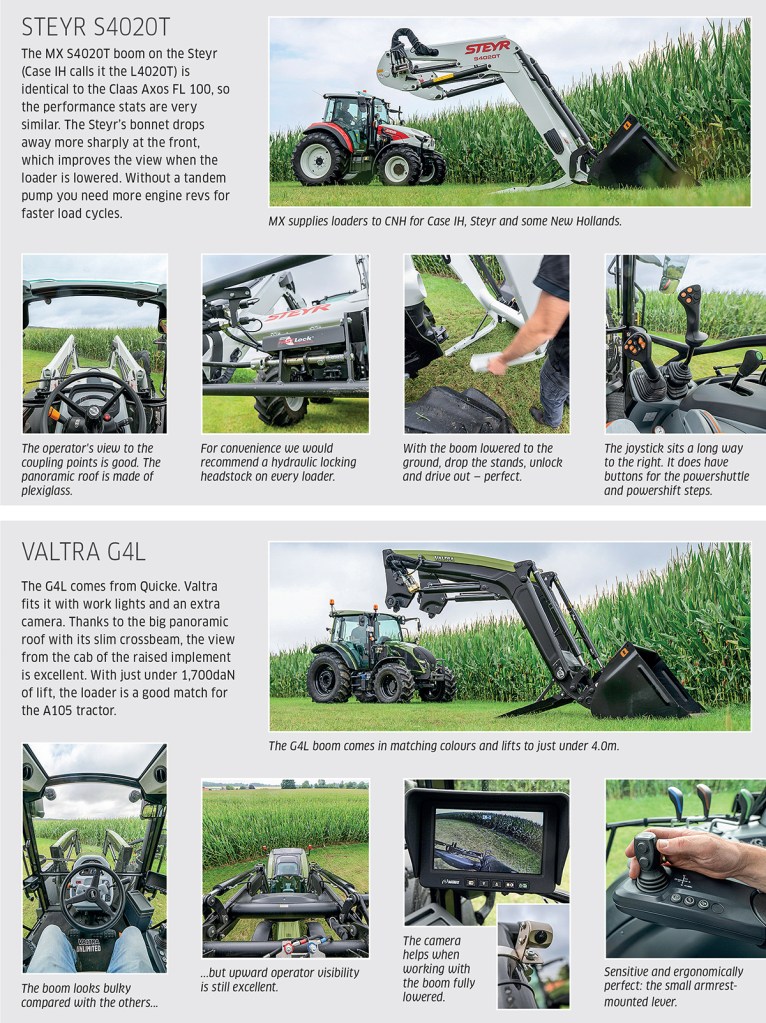
The MX boom on the Claas (FL 100) and Steyr (S4020T) units are identical. With an operating pressure of 200 bar, they top the table at just over 2,000daN, the same as the Quicke FL.4121 on the Massey Ferguson. Without sufficient rear ballast, this longer boom can get the tractor’s tail up in the air. The Valtra loader, also from Quicke, has smaller lift rams and tops out at just under 1,700daN.
John Deere’s M boom is a size down and manages a good 1,500daN in its lower lift range. But even with this lower lift capacity, the load on the front axle still exceeds more than 8t. So, lift capacity alone shouldn’t be the key buying decision — the loader’s size should suit the host tractor.
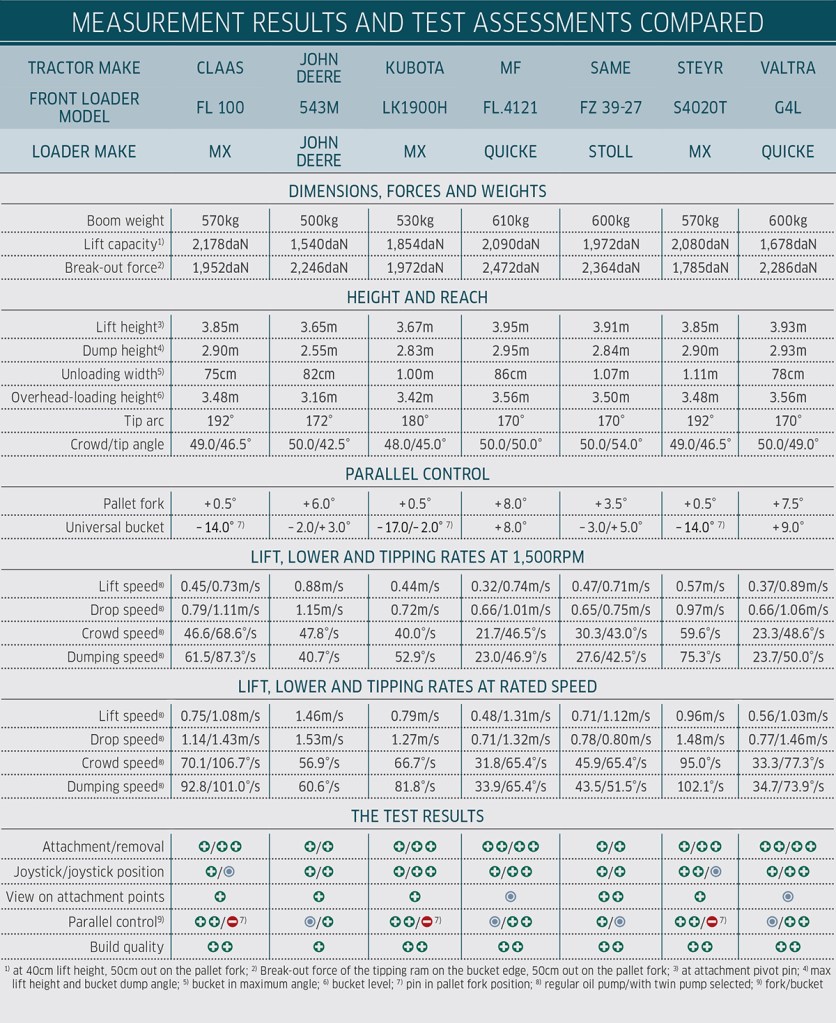
The Quicke loader models reach up to 3.93m (measured at the pivot pin), while the John Deere lifts to 3.65m, but, with heavy loads on board, the operator feels noticeably safer because the shorter loader feels more stable while on the move.
Fast work cycles
Some makes have a twin hydraulic pump set-up (Claas, MF, SAME, Valtra), which, when engaged, provides fast load cycles with low engine revs.
The smaller-diameter lift rams on the Deere loader also allow it to achieve similarly nippy cycle times, even without an extra pump – check out the table ‘Measurements compared’ for more on that.
Smooth modulation
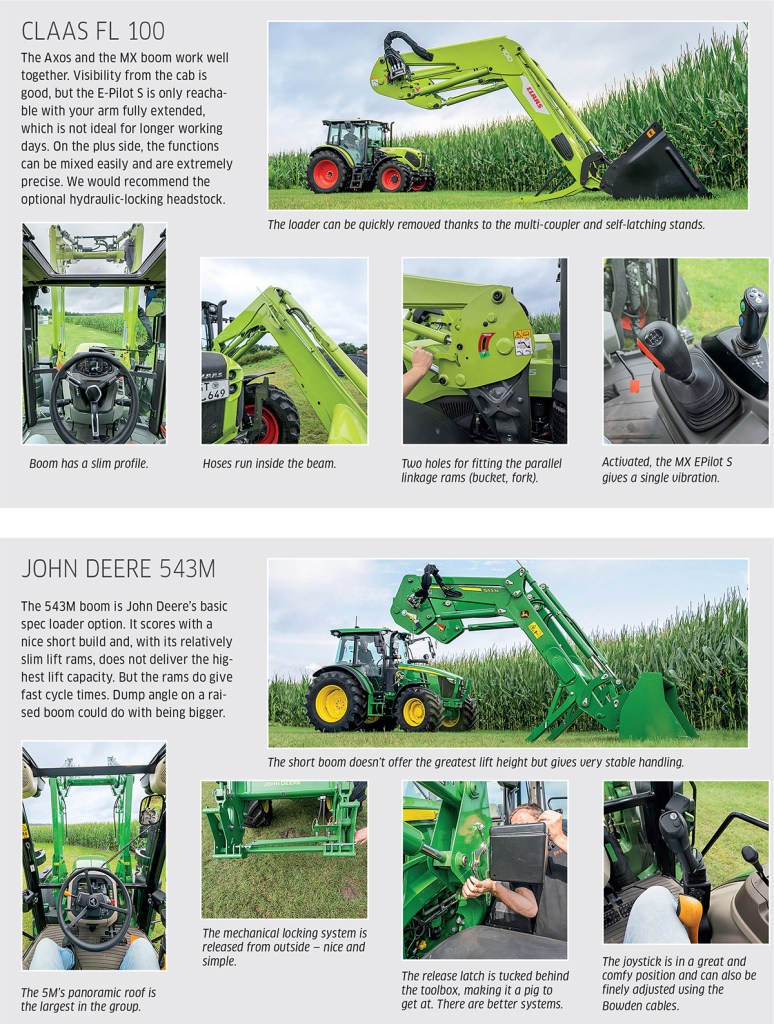
Fast booms are only any good if they can be smoothly controlled. This depends not just on the type of control (electric or mechanical), but on the shape of the joystick and its position in the cab. The comfortable armrest in the Valtra, combined with very sensitive control, is just as impressive as the electric MX E-Pilot S next to the Kubota’s seat, even if the lever sits a bit too high for our liking.
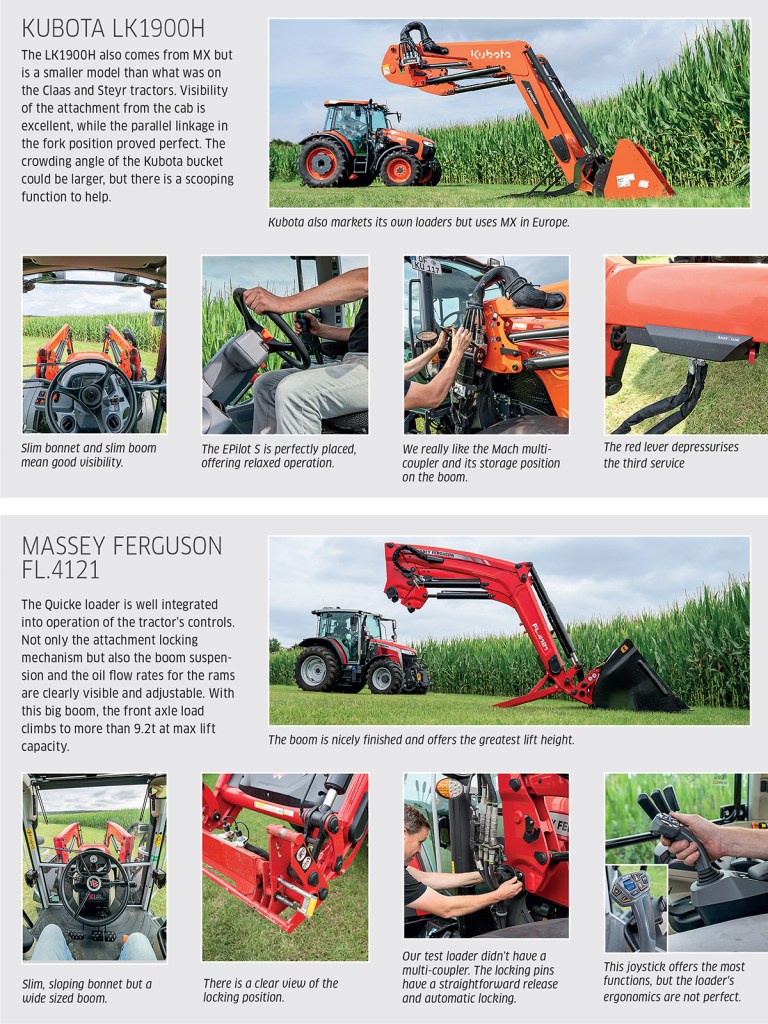
Massey Ferguson’s FL.4121 is also refreshingly easy to control with the armrest joystick, which is also the best integrated when it comes to operating extra tractor functions such as the direction changes and working through the powershift steps. You also get proportional control of the third service (with float position). Another neat feature is that the locking status of the attachment is shown on the screen. But it’s not all praise: we found the joystick too long for the armrest, and you always have to wrap your whole hand around it, which becomes tiring on long days.
That said, we won’t give a general thumbs- down to mechanical Bowden cables. Quite the opposite, as the mechanical feel and control of the Stoll loader model pleasantly surprised us. It’s also nice how Stoll and SAME have integrated buttons for working the Explorer’s powershift steps in the loader lever.
The mechanical Steyr joystick not only changes the direction of travel and selects the powershift step, but it has an integrated engine speed memory — a nice touch.
However, just like on the Claas Axos, the joystick sits over to the right in a gate that you can only reach with a fully extended arm. The mechanical John Deere joystick is in a better spot.
Visibility
Good visibility helps keep things relaxed. Leaving the tractor itself aside, the slim MX booms and the Stoll boom come out best here.
The Quicke loaders with the mechanical parallel control linkage sitting on top of the boom beam are noticeably wider: 104cm wide versus 92cm for the Stoll. This makes it harder to see the catch pins especially when the headstock is tilted.
Attachment and removal
When it comes to taking the loader off we found the MX booms on the Claas, Kubota and Steyr have the edge. Here, the operator can put the loader in its float position with a bucket attached, fold down the parking stands, releasing the locking mechanism, and then disconnect the multi-coupler. As you reverse out of the loader, the boom slides over skids until the stands take the weight. The John Deere 543M comes off in a similar way but is not quite as slick as the stands have to be fixed in a set position with pins.
With both Stoll and Quicke, the loader’s hydraulics are used to lift the boom out of their brackets. The simpler pin release on the Quicke gives it a slight advantage.
How about putting the loader back on? The Stoll and Quicke impressed us most: they are the easiest to couple. First job is re-attaching the multi-coupler before you lift or tip the boom into the self-locking latch. This is safer than trying to slide the boom into the locking mechanism — everything has to line up perfectly if it is going to work first time.
Summary
Lift capacity is not everything, the boom also has to match the tractor. Our ideal loader would use the Valtra joystick with the Massey Ferguson locking mechanism, Stoll’s boom suspension, the MX’s parallel linkage and John Deere’s lift speeds.
Tobias Bensing
For more up-to-date farming news click here and subscribe now to profi and save.