
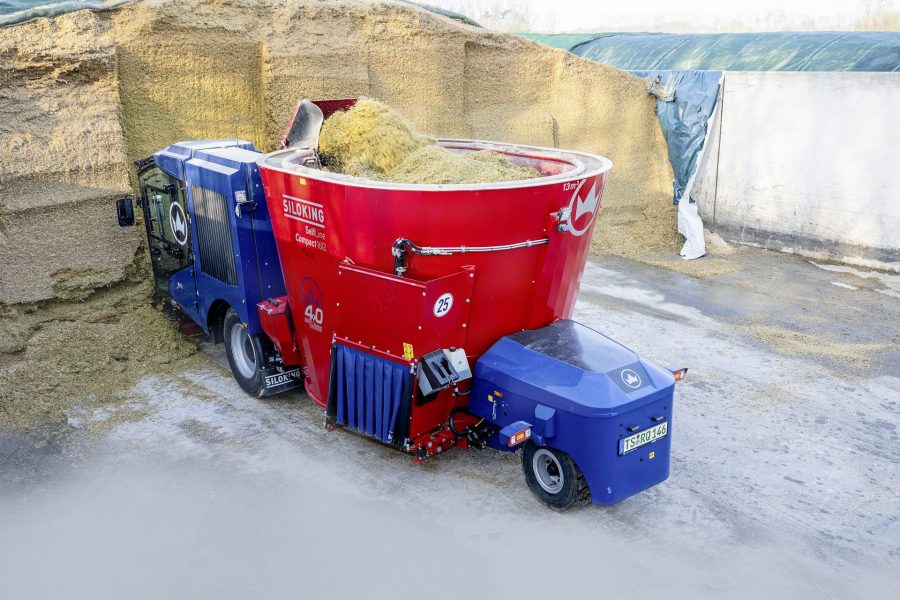
Siloking was using NIRS 10 years ago, so what makes it different this time round? Our test shows why the sensor tech can do more than just measure dry matter.
KEEPING IT BRIEF
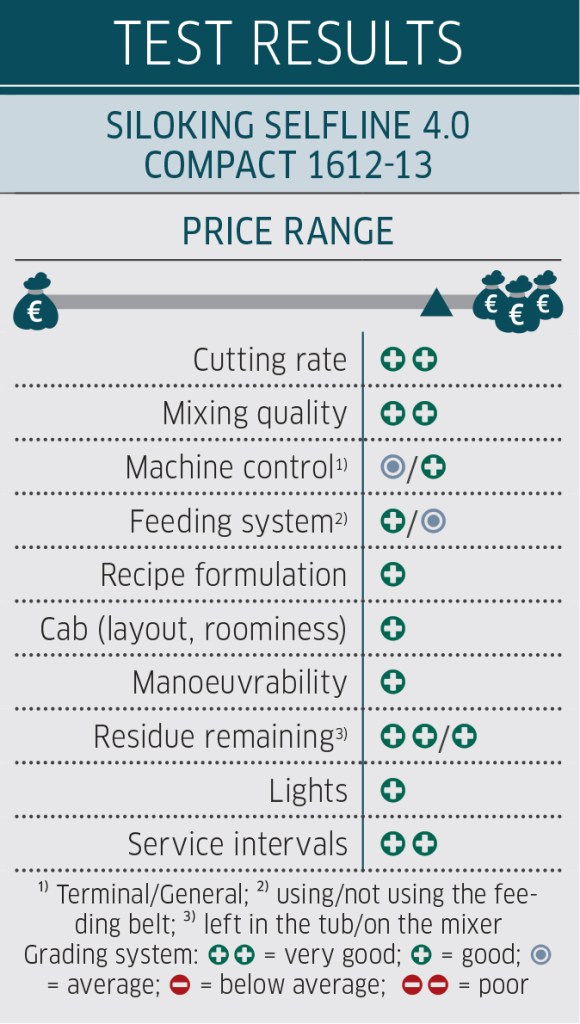
- The Siloking Selfline 4.0 Compact 1612-13 impressed with high unloading performance, clean mixing and good manoeuvrability.
- The DryScan system determines the dry matter content during loading, helping to improve the feeding precision, if calibration is carried
out regularly.
Some important dates to kick things off. Siloking presented its first self-propelled diet feeder at Eurotier in 2004 and now makes over 600 per year. In fact, the model featured here, the Selfline Compact, has been on the market since 2015, so the actual forage handling hardware is well proven. And 10 years ago, Siloking was already dabbling with NIR when it introduced FeedScan.
More recently Siloking has been developing its own NIR software, rather than leaving it to Dynamica Generale. The sensor has been pared back to measure just one parameter: dry matter content. Siloking says that the sensor can accurately measure dry matter in silage. It can also keep an eye on other parameters such as protein and energy, but the company reckons the biggest leverage for achieving optimum diets lies in the job of dry matter measurement.
Tried and tested
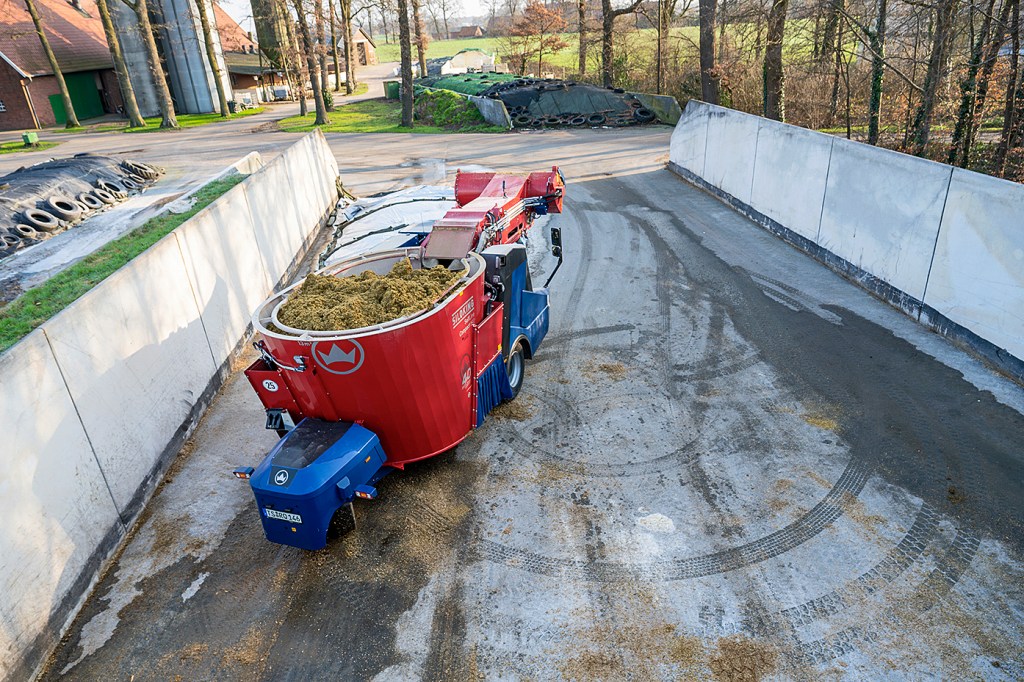
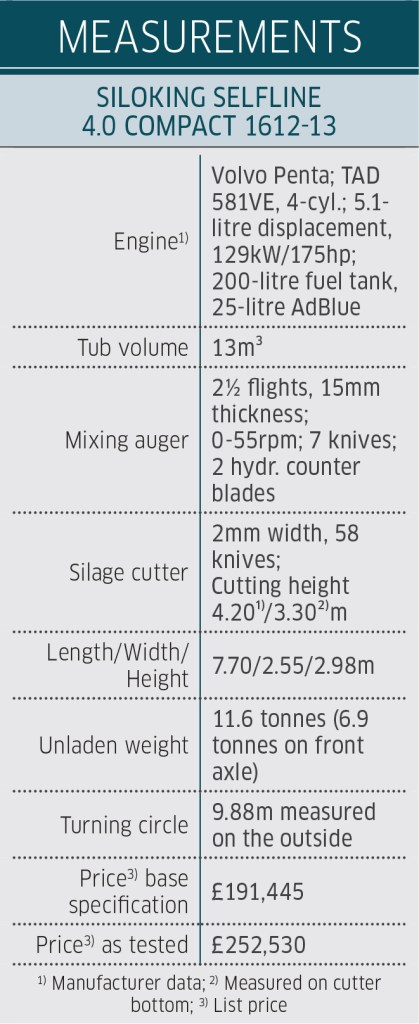
The Siloking Selfline 4.0 Compact 1612-13 stands just 2.65m tall thanks to its low-slung chassis, on top of which sits the mixing tub. With a 2.95m overhang ahead of the driven front axle, the Selfline handles like a bus. The unit’s steered rear axle can turn through almost 90°, giving the 7.71m-long machine an outer turning circle of 9.90m. That’s good news, although the operator does need to keep the milling head’s overhang in mind when driving into buildings and the like.
Powerful engine
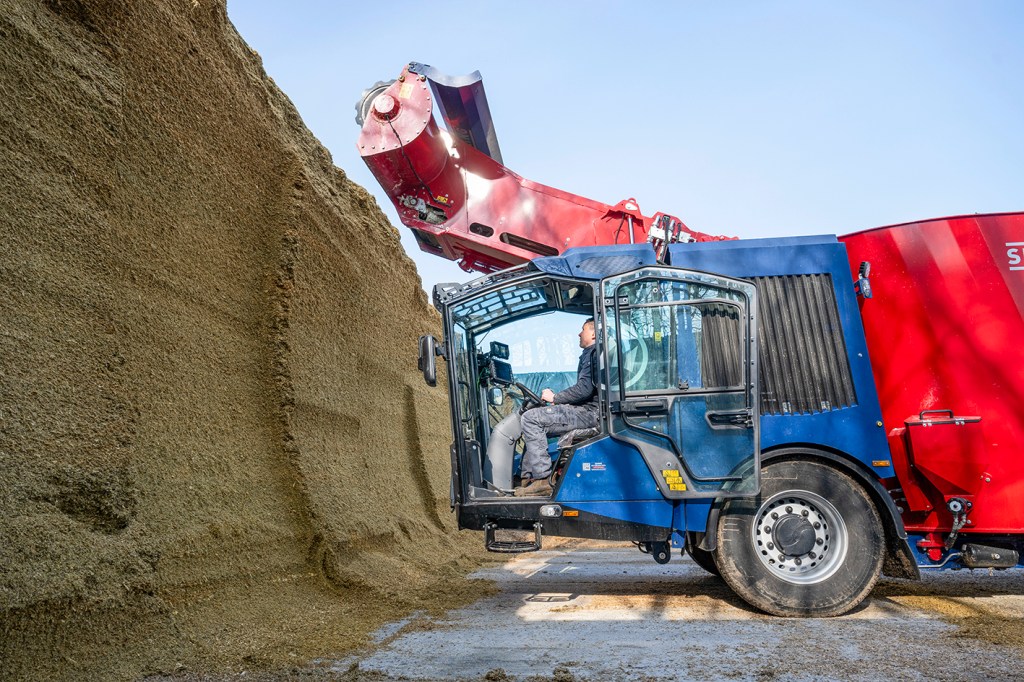
The 5.1-litre, four-cyl Volvo Penta engine in our test machine delivers 129kW/175hp — plenty of grunt to keep the mill spinning when loading from the clamp face.
Our host farm for the test was home to a herd of dairy cows, followers and bulls for beef that all needed feeding. The Selfline averaged 9.0 litres of diesel per hour, plus AdBlue. The 200-litre fuel tank is a good size, but the fine mesh filter on the 27-litre AdBlue tank is less convenient, frequently causing the automatic filler nozzle to shut off.
The engine is mounted transversely under the milling arm, in behind the cab. It’s well enclosed, but before opening the bonnet it’s worth clearing away any remaining feed residue, especially meal-type feeds, to make sure that nothing finds its way into the hot engine compartment.
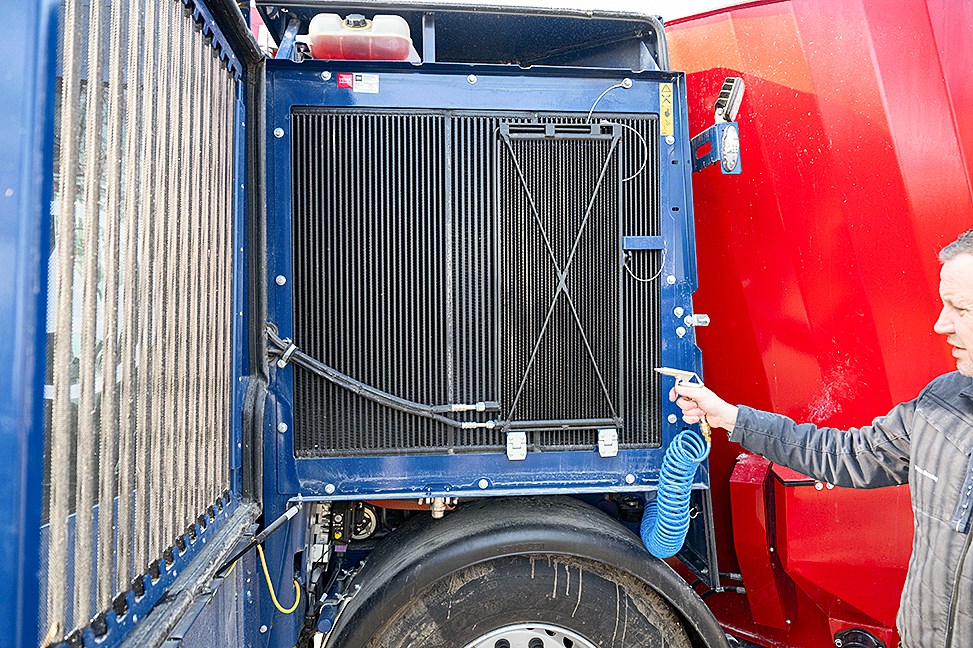
The rad pack for the engine, intercooler and air-conditioning is located on the left-hand side, directly behind the machine’s cabin, while the hydraulically driven fan reverses automatically at preset intervals. A nice detail is an air gun on a suzi hose for blowing down the rads and around the hopper for adding minerals — excellent.
13m³ mixing tub
The Compact 1612-13 is the smallest model to come out of Tittmoning with a single auger. The Compact is also available with two augers and a 16m³ tub. Externally, the machine measures 2.55m wide.
We maxed out the tub with 6.3t of compact ration for the dairy cows, filling it to the brim. With this amount of feed on board, the milling arm has to be in its lowered position; otherwise material backs up at the elevator outlet. Our test feeder had two doors on the hopper: a simple door on the right side and a short conveyor belt on the left for feeding into troughs.
When using the right-hand door, the feeder operator needs to drive very close to the barrier, so the feed is within reach. This can also mean the feed gets driven over when reversing.
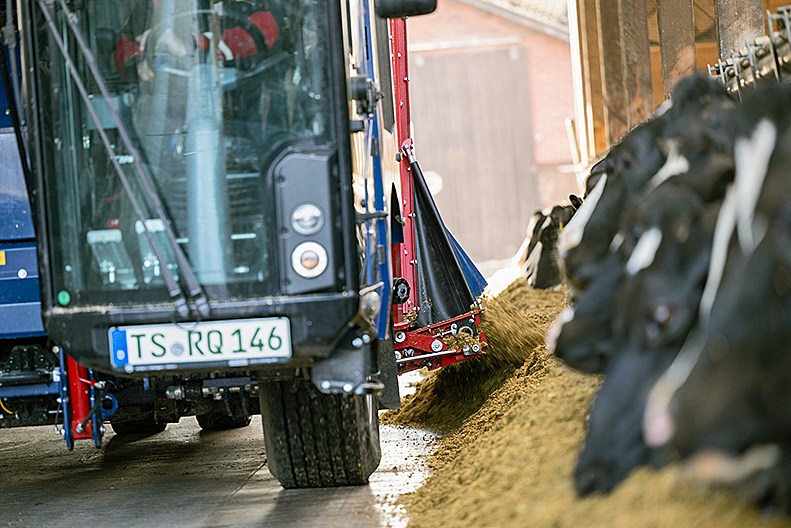
There’s an auto-mode for emptying the tub: at the press of a button, the conveyor belt swings out, starts running, and the door opens up to a pre-set position. All nice and simple, but it would be even better if the door open position could be adjusted on the terminal to match the different feed rations. Currently, the operator must quickly react to the mix being dispensed to avoid feeding out too much or too little at the start.
The auger has seven knives and hydraulic-activated counter blades. In our case, the forage didn’t need any additional chopping as it was already cut short for the compact TMR mix. The auger is made from 15mm-thick steel and can be fitted with optional Silonox, a wear-resistant alloy material, on the auger’s outer edge.
Auger speed is variable from 0 to 55rpm. Two speeds can be pre-selected along with a “Boost” function to fling remaining feed off the auger flights. We carried out several shaker-box tests to verify the quality of the mixing. Fraction variations were very small in terms of chop-length and distribution along the entire length of the trough. In our situation, the post-mixing time was around four minutes.
Hungry mill
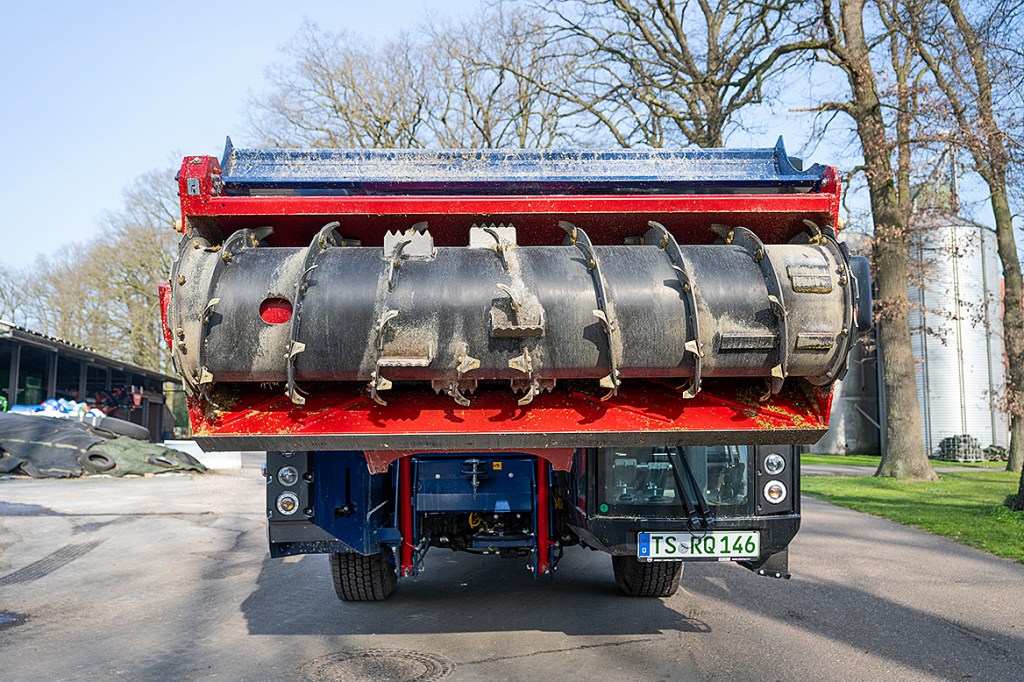
The hopper is filled by the familiar 2.0m wide, 60cm diameter mill with 58 banana-shaped knives. Delivering impressive overall performance we managed to load in more than 1,100kg of grass silage and more than 2,000kg of maize per minute. The output is matched by the very swift arm movement needed to return the mill to the top of the clamp and start cutting again.
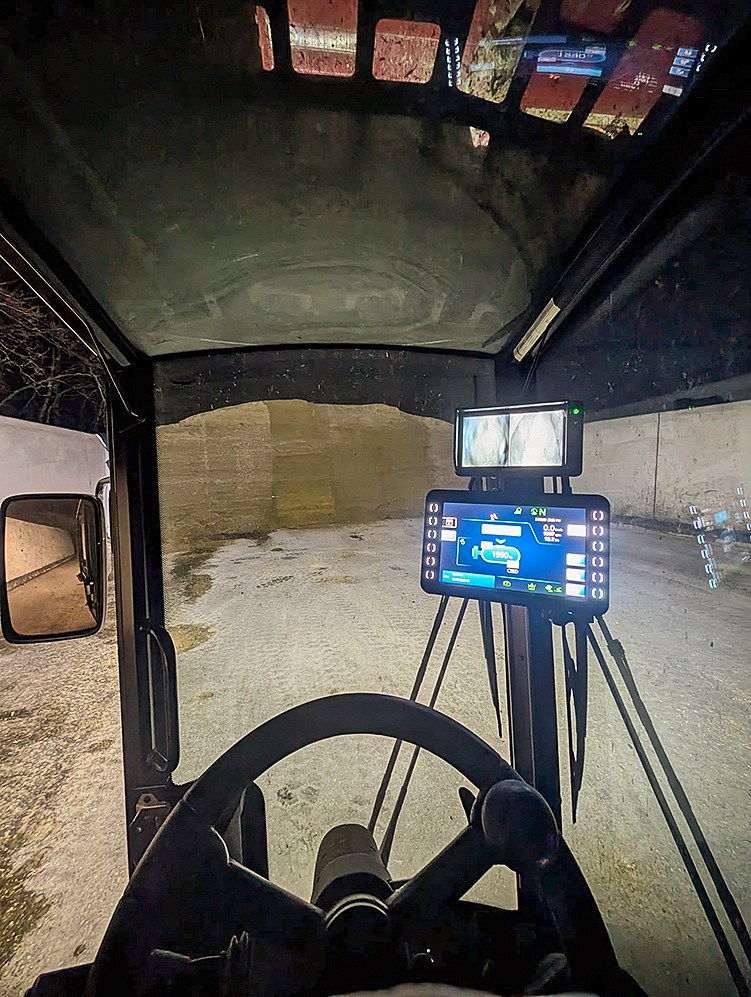
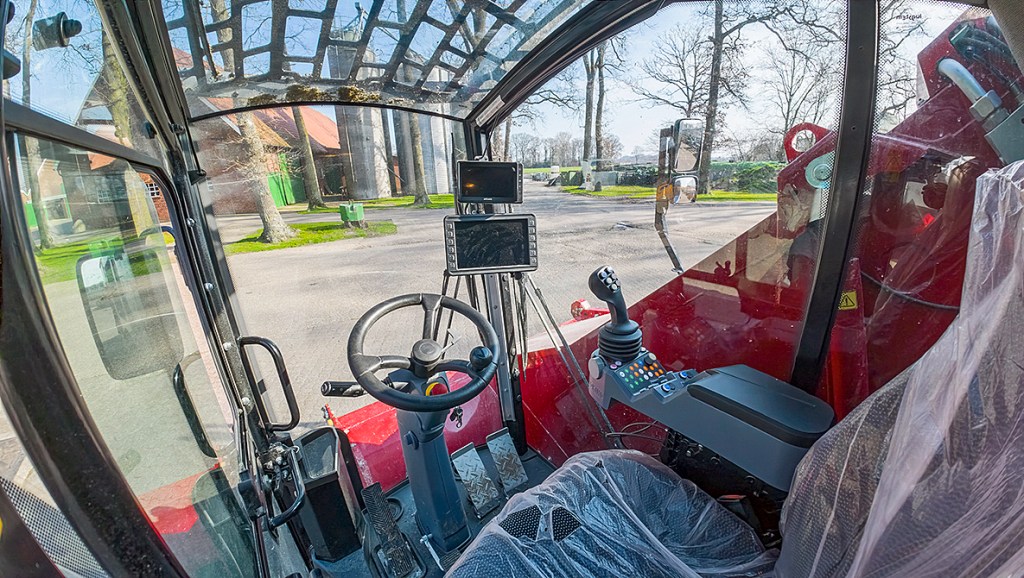
The terminal has an easy-to-understand bar chart to show the current load on the milling rotor. The sequence and quantity of all the various ingredients is also shown on the display. This then uses a progress bar to count down the amount during loading.
Once the final target is reached, the elevator automatically stops. Any remaining feed can then be cleared away from the channel by reversing the belt. Ideally for very small quantities, it would be great if the system could learn, or simply know, how much feed is still left in the elevator, so it could tell the mill to stop even sooner.
In our case, the feed weighing system was a bit sluggish in determining the final figure. Adjusting the response time in the menu only brought limited improvement. We also double-checked the weighing accuracy, and it was fine; it just needs to be a bit faster.
DryScan sensor
Typical ration calculations are largely based on the dry matter content of what’s actually being fed. But a few lab results will not give you a reliable picture of what’s in the clamp from start to finish. Testing samples using an air fryer provides a faster, more accurate picture for daily feeding, but this is then another chore to do.
So, can an NIR sensor really revolutionise feed management?
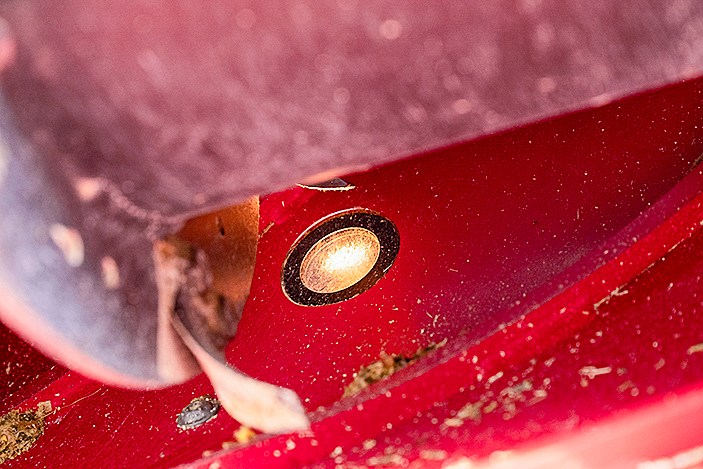
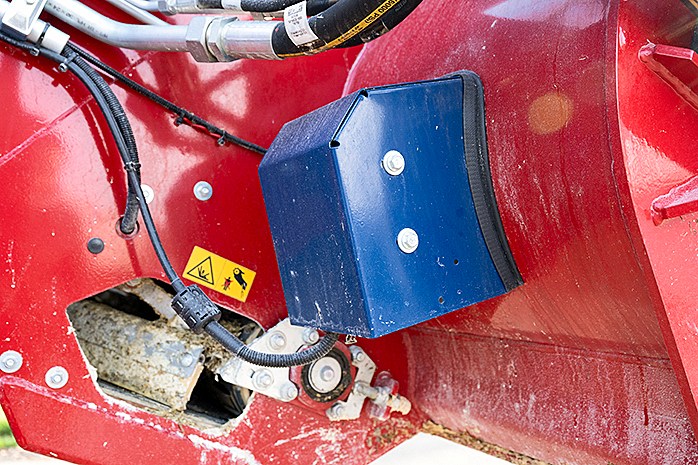
The NIR sensor measures the dry matter in silage (maize, lucerne, hay and of course grass) as material is being cut from the pit face. The sensor is positioned on the back of the cutter housing on the right-hand side. As the feed is being cut, it brushes past the lens giving a snapshot.
The Dynamica Generale-supplied sensor takes 50 moisture readings per second. From the menu, operators can select further parameters: for example, the lens is initially cleaned by the material to be mixed before a measurement begins. Measuring starts only when the hydraulic pressure in the milling head exceeds 150 bar, ensuring the rotor is properly filled; and measuring ends when 30% of the targeted quantity remains to be cut, so there’s still enough left to tweak the desired fresh matter adjustment.
The more data, the better
The larger the database of the number of spectral analyses for different silages, the more accurate the system will become. In practice, the silage clamp is initially sampled at various depths to establish the actual DM content and calibrate the sensor.
Simultaneously, DM content values from the calibration measurements are cross-checked against control measurements. These results are then uploaded on to the system as a calibration curve. Once all this is done, the system is ready to go.
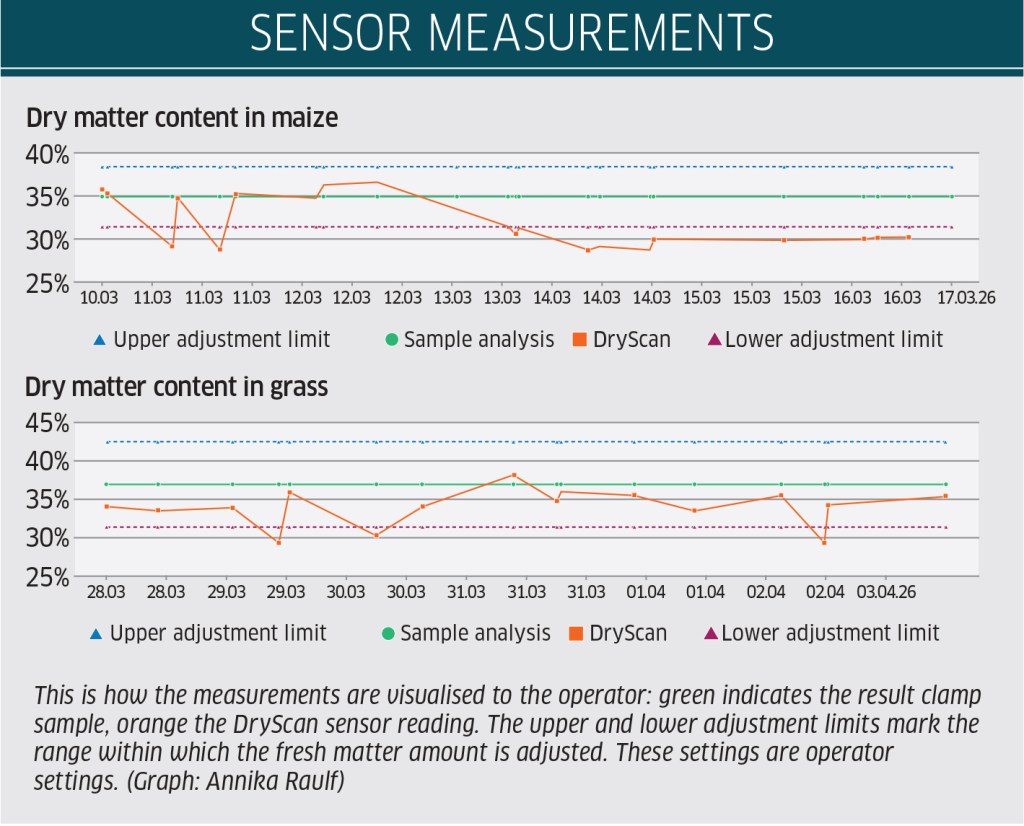
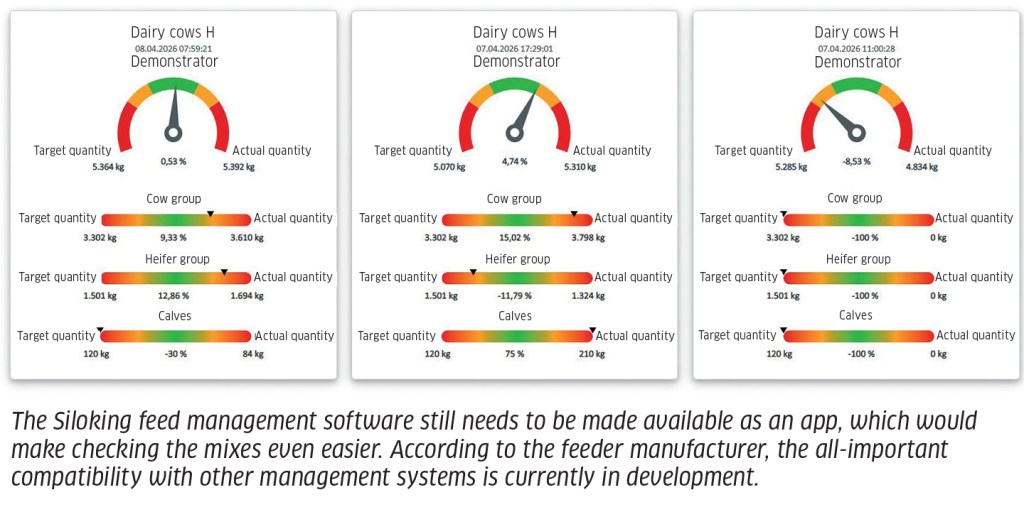
The feeding management software (at the moment there isn’t an app version) is used to adjust the parameters and set up recipes including the sequence for how the various ingredients are loaded. For forage, you pre-select silage type (maize, grass or lucerne) and then you set the maximum possible fresh-matter adjustment above or below the pre-calculated DM value. From there, the farm manager can carry out fine-tuning. In our case, the system adjusted the fresh-matter quantity by 10% up to a maximum of 15%, above/below the assumed DM value in the silage.
What this actually means is that instead of the assumed 1,700kg of maize, the system automatically upped this to 1,890kg, to account for the change in dry matter content which was 3.2% lower than the analysed sample.
Does that mean more milk?
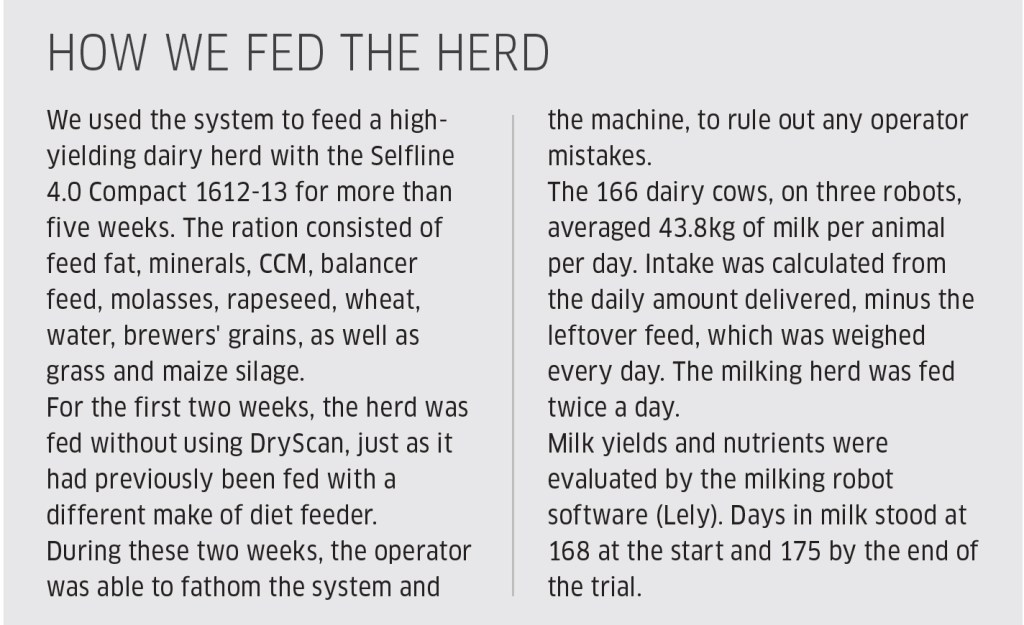
To find out, we kept a close eye on the test farm’s cows (see the panel “How we fed the herd”). At the start of the trial period in early March 2026, the herd was averaging 43.8kg ECM milk per animal per day over the 168 lactation days. After starting to feed with the NIRS automatically adjusting the ration, the fresh matter intake rose by just under 1kg per animal per day to 68kg. During our test we also noted that the DryScan sensor resulted in more consistent amounts left in the feed trough — which was also noticed by other farmers we interviewed that are using the system. The herd’s average yield rose by 0.5kg to 44.3kg ECM, at 175 days in milk.
The feed components and the ration didn’t change during this period. What we’re seeing is a trend that needs to be further studied by carrying out precise feeding trials, since plenty of other factors besides feeding are constantly acting on a herd.
It’s also a fact that the farm manager pays a lot more attention to dry matter, simply because the sensor presents the manager with fresh data every day.
In our test, the DryScan system showed the maize silage was noticeably wetter than the original Lufa lab analysis. We cut samples from the silage clamp, prepared a composite sample and had the silage analysed again in the lab. The DryScan system estimated the DM content of this sample at 32.2%, Lufa at 34%. We repeated the same procedure with the first cut grass silage: here the analyses were almost identical — DryScan measured 36% DM, Lufa 35.8%, and our own follow-up measurement came out at 36.5%.
Feed rates at a glance
The system helps to make feeding far more precise. Unlike the forage harvester, it is the last link in the forage chain before the feed reaches the stock. The feeding management system developed by Siloking provides a very good basis for checking the mixes. The farm manager can precisely monitor if a recipe mix is being followed, as well as the quantities discharged per barn or group.
Access rights are likewise assigned by the farm manager via a browser on a PC. This means preset recipe sequences, component quantities and recipes themselves can’t be altered by unauthorised users.
Other detail
- In automatic feeding mode, the mixing auger switches off automatically when the target quantity is reached.
- Before leaving the cab with the auger still turning, the handbrake must be applied and an additional safety button pressed.
- The cab is quiet; the door opens wide for good access.
- The mineral feed auger did its job.
- A rear-view camera and a camera inside the tub improve visibility.
- The sensor software takes a long time to boot up. Integrating the DryScan system into the mixer software wasn’t entirely seamless.
- Foreign objects that hit the lens didn’t damage it.
- A neodymium magnet on the lower auger flight catches magnetic foreign objects.
Price of precision
In base specification, the mixer feeder costs just under £191,445. The lavish trim of our test machine bumped this price to £252,530. DryScan accounts for a significant £14,928 of this — including support service, licence and training during the first year. After that, Siloking charges its customers £2,247 a year for data management.
Our machine’s spec also included the more powerful 175hp engine, 25km/hr top speed transmission, rear steering with 27×10-12 tyres, an additional discharge door on the front right, heavy duty tub magnet, extra auger speed ratio for faster emptying and a shock-absorber on the milling head plus an auto-greaser.
Summary
The Siloking Selfline 4.0 Compact 1612-13 delivers a good mix of results. The tried-and-tested hardware, quick loading rates, precise mixing and tidy feed discharge, are excellent features.
With NIR technology, dry matter is analysed just before the forage is served to the stock. The system is no guarantee of achieving higher milk yields, but it does help capture and feed the feed ration’s dry matter more accurately, helping to reduce wasted forage. Tobias Bensing
For more up-to-date farming news click here and subscribe now to profi and save.