


There’ve been plenty of new handlers, loaders and related kit introduced since the start of 2026. Here is our round-up of material handling news.
SCHÄFFER 16E T
Schäffer unveiled the electric 16e T at EuroTier. It combines the reach of the 1622 T telescopic wheel loader with the emission-free electric drive of the 16e compact wheel loader.
With a width starting at 0.89m and a height of 1.99m, the 16e T fits through narrow and low barn doors. The tipping load is approximately 800kg with a bucket and the telescopic arm retracted. The operating weight is 1,500kg.
A 9.6kW electric motor powers the hydrostatic drive and hydraulics. Energy is supplied by a 12.5kWh, 48V lithium-ion battery. The 16e T can be charged using standard wallboxes with a Type 2 connector or via regular household current. In both cases, charging to 80% takes about two and a half hours under optimal conditions.
The drive system utilizes original Schäffer axles, which it says are designed to offer higher thrust, better traction and a longer service life with reduced maintenance compared with wheel motors. The hydraulic flow rate is 28l/min. LED work lights ensure good visibility in the barn and around the yard.

WEIDEMANN 90-SERIES
Weidemann’s redesigned four-model range of 90 series wheel loaders comprises the 2090, 2090T, 3090 and 3090T.
Fixed boom lift heights are from 3.24m to 3.39m while telescopic versions span 4.30 to 4.98m.
One main highlight is the Dynamic Loading Assistance package which comprises five functions: automatic bucket return, auto retraction of the bucket when the boom is raised, bucket shake, lift height limiter, and tele-retract. The latter automatically retracts the tele-boom on the 2090T and 3090T at the push of a button.
Outputs of the transversely mounted Rehlko Stage V engines are 68hp (2090/2090T) and 75hp (3090/3090T). Diesel tank capacity on all models is 80 litres, and the top speed is up to 40km/hr.
The integrated 7-inch display and joystick are on the armrest so they move with the seat. Object detection uses ultrasonic sensors to scan the rear area of the machine, and, when reversing, warns the operator of obstacles both on the display and acoustically. A rear-view camera is optional.
Standard spec includes LED work lights, lockable toolbox and a manual parking brake (electric parking brake optional). There are new storage options and a mobile phone holder. The heated and ventilated seat has automatic weight detection and low-frequency suspension.
BKT MULTIMAX
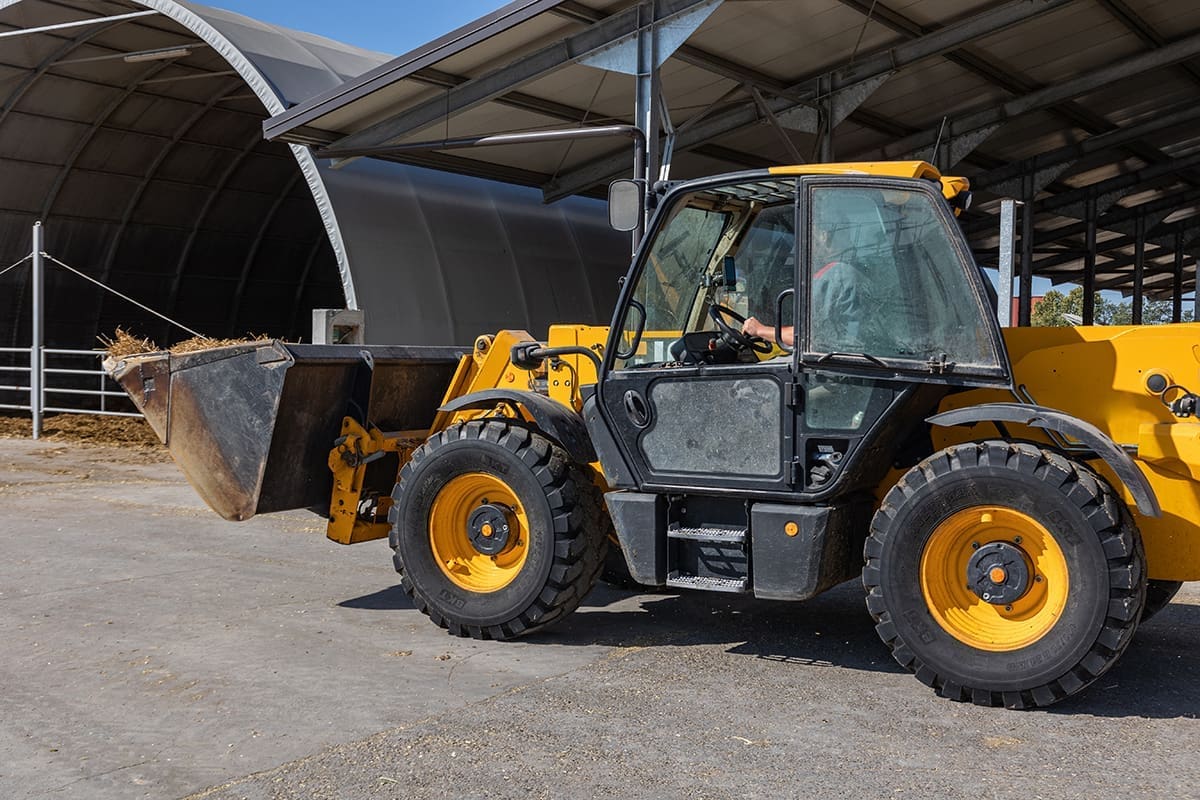
The Multimax MP 527 is a new tyre from BKT. The tread pattern, featuring a special abrasion-resistant rubber compound, is said to be designed to provide effective traction on hard and firm surfaces during pushing and loading operations. The overlapping blocks are intended to enhance operator comfort. Because compact loaders and telescopic handlers often involve frequent changes of direction, BKT relies on a wear-resistant rubber compound and a tread pattern specifically tailored to it.
LINDE TELEHANDLERS
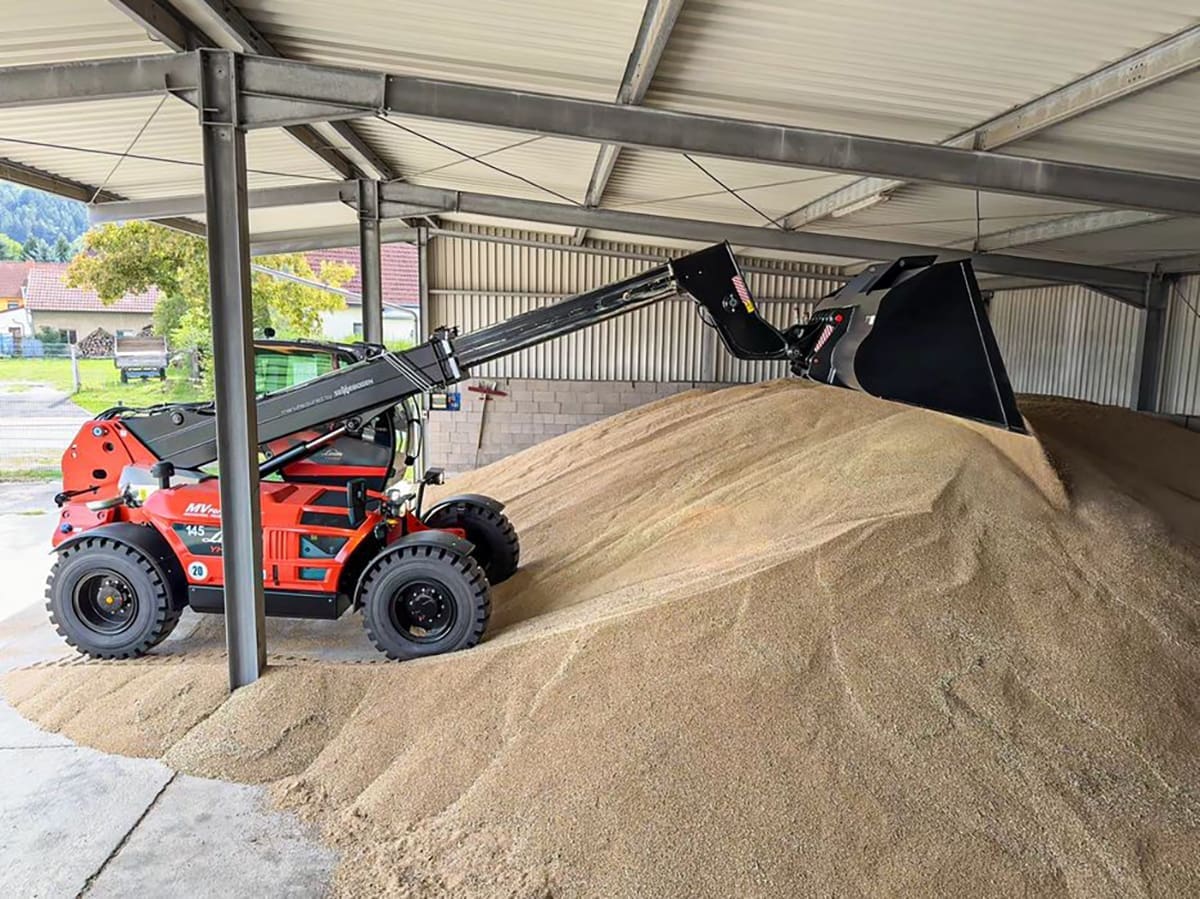
Linde, the well-known forklift maker, is to market two Sennebogen-made telehandlers. The red-liveried YH40 (4.0t/7.7m) and YH60 (6.0t/8.5m) are the Sennebogen equivalents of the 340G and 360G, both of which have a high-lift cab. A Stage V Cummins engine is in both machines, developing 136hp and 167hp respectively.
Other countries may follow, but for now the Linde versions, which like their Sennebogen counterparts are made at a new plant at Wackersdorf in Bavaria, are currently only available in Germany and Austria.
Sennebogen will continue to sell the 340G and 360G via its own dealer network. The Linde handlers are similar to the Cargo T telehandlers that Sennebogen previously built for Fendt.

FLIEGL 2527
The 2527 is Fliegl’s first in-house telescopic wheel loader as the firm expands the former Kaweco range which it bought in 2025.
The new telescopic reaches a lift height of 3.95m at the carriage pivot point. Fliegl highlights the large dump angle of 51°; with a bucket the dump height is 2.95m. Other key stats are an operating weight of 2,500kg and tipping load of 1.5t when fully extended. The hydraulics deliver a flow rate of 51l/min, and a free return line is standard.
The 2575 model is powered by a Yanmar three-cylinder engine with 27kW/37hp.
With standard tyres, the compact Fliegl 2527 has an overall width of 1.36m and a height of 2.45m. Like its fixed boom counterparts, the newcomer is made in Germany.

WEYCOR 3 SERIES
Atlas Weyhausen launched the Weycor 3 series, namely the 360 and 380, in the 2.7 to 3.5-tonne class. These diesel models will be joined by the all-electric 360e and 380e variants as the manufacturer aims to bolster its offering.
There are three boom options: two parallel controlled booms, short (2.60m) and long (3.20m); and a Z-linkage with a lift height of around 2.90m. Spec sheet stats say the Weycor 360 lifts over 1.6t with pallet forks, while the 380 model is rated at 2.0t. Operating weights are 2.7t and 3.5t.
One of the main updates is the new cab. This benefits from a larger doorway, better all-around visibility and an ergonomic design.

BOBCAT L85 and L100
Bobcat has unveiled the updated L85 and an additional model to its compact loader line-up, the L100 These have a new cab, increased hydraulic power and other technical features.
The bucket capacity is indicated in the model name: the L100 has a capacity of 1.0m³ while the L85 is 0.8m³. Both machines come with a heated cab, adjustable steering wheel, automatic parking brake, joystick integrated into the seat, and a high-resolution display. But the main talking point is the new joystick: up to four implement functions can be operated directly via the joystick without having to take your hand off it. The optional 5-inch colour display comes with expanded settings:
Three selectable driving modes adapt acceleration, braking and forward/reverse switching to the respective application.
Max work speed is adjustable between 8 and 16km/hr.
With new ACD attachment recognition, the machine automatically recognizes connected Bobcat attachments and adjusts the operation on the joystick.
Both models are available with top speeds of 20, 30, or 40km/hr. An additional counterweight, reversible cooling fan, protective plates, and a floor protection kit are available as options.
Bobcat’s Machine IQ telematics system comes as standard. It transmits operating data in real time, enables remote diagnostics and allows remote activation or deactivation of the engine.
The manufacturer’s standard warranty package is two years or 2,000 hours, although this level of cover can be extended to five years or 6,000 hours.

CLAAS TORION 537E SINUS
Previewed at Agritechnica 2025, the battery-electric drive system in the Torion 537e Sinus telescopic wheel loader replaces the diesel engine and hydrostat found in the otherwise identical Torion 537. Expected to be popular as a quiet running machine around livestock buildings and on farms looking to use homegrown electricity, the standard lithium-ion battery has a capacity of 32.2kWh with an optional second battery increasing this to 64.4kWh.
During operation, it provides up to 30kW for the drive system and 15kW for the hydraulic pump. Run times on a full charge range from eight to 16 hours, and Claas reckons it is an ideal machine for two to three hours of feeding each end of the day.
Depending on the on-board charger and the available connection, the battery can be fully charged in 1.5 to three hours. It is said to take just 50 minutes to increase battery capacity from 20% to 80% (90 minutes with two batteries).
An ‘e’ unit should be arriving at Saxham soon.
MANITOU SMART WEIGHING SYSTEM
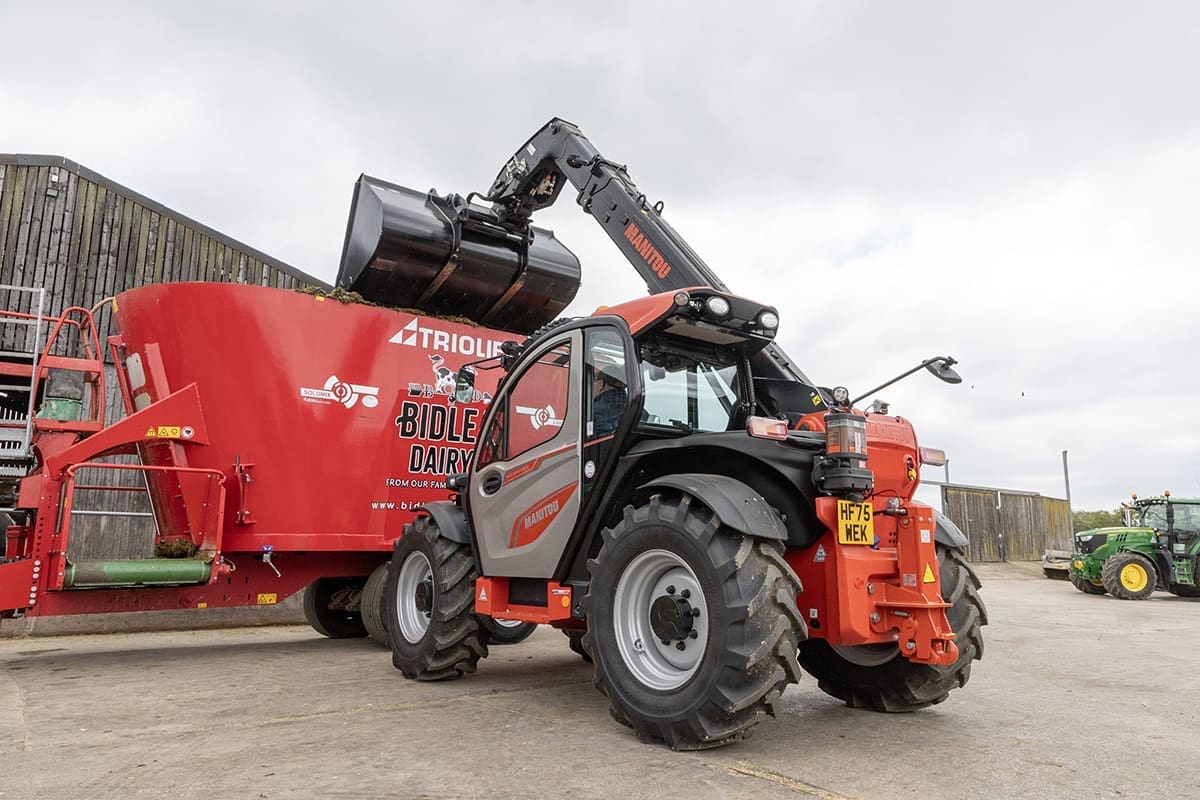
Manitou’s MLT 841 and 1041 models can now be equipped with an optional Smart Weigh System (SWS), that has been developed in-house by the French maker. Using a combination of six pressure sensors — there are two each in the main lift ram, compensation ram and headstock ram — it affords static and dynamic weighing that is claimed to deliver an accuracy of +/-2%.
By monitoring boom angle, length of reach and angle of carriage, this weighing process constantly updates payload weight, without needing to stop and let the system settle. The payload is shown on the in-cab screen, and a tare function enables operators to zero SWS after changing attachments.
Added capability comes from basic weighing, cumulative weighing and target weighing functions, and, for those who feed livestock rations, SWS software affords a ration capability that can be used to store up to 44 ingredients in 13 rations.
In addition to being a factory option, SWS can be retro-fitted at a cost of £3,500. Manitou says SWS is likely to be rolled out across the rest of its telehandler range later in the year.

MERLO TURBOFARMER
One of the most noticeable visible changes on the Gen III TF38.10 (3.8t/10m) and TF42.7 (4.2t/7m) is the redesigned cab access format. Wider, staggered steps and a new 50mm cab floor cut-out make entering and exiting the machine easier, and new silent block cab mountings help to reduce noise and vibration transmission to the operator.
The updated Adaptive Stability Control System (ASCS) system offers additional recovery movements during overload situations while maintaining safe operating parameters. Furthermore, attachment management functionality has been expanded, allowing attachments to be pre-programmed so that operators can benefit from full ASCS functionality, even when using attachments outside of the Merlo portfolio.
Alongside standard and CVTronic variants (both powered by a 136hp Perkins engine), customers can also specify TT models, which combine frame levelling and boom side-shift.
Other changes include new metal mudguards to replace the previous plastic fenders. A new hydraulic distributor has been incorporated into the hydraulic system, and the 30mm longer chassis increases clearance between it and the tyres.
“The 4.2-tonne, 7-metre sector represents one of the most significant markets within UK agriculture,” comments Owen Buttle, national sales manager, Merlo UK. “Every change we’ve made has been focused on improving the overall operator experience, from reducing vibration and improving visibility to making access easier and safer.”
The Gen III TurboFarmers will be introduced to the UK in two phases. The two-speed hydrostatic machines are available now. They will be joined by CVTronic models from January 2027.

JCB UPDATES TELESKID
The latest version of the Teleskid 3TS-8T telescopic boom tracked loader is said to offer the ultimate small loader versatility.
The spec is largely the same as the wheeled 3TS-8W, and both US-built machines use the same 74hp DieselMax Stage V engine. Drive comes from a two-speed hydrostatic transmission that also provides steering control by slowing the wheels or tracks on the inside of a turn.
The two machines are identical in height at 2.1m, have all but identical maximum lift heights at 4.05m with the boom fully extended, and the same 1.7m forward reach at a full-height lift. The difference is that the added weight and configuration of the undercarriage give the tracked machine more lift capacity (1,705kg versus 1,483kg), and its 450mm tracks provide additional traction in tough conditions and a gentle footprint. Top speed of the 3TS-8T is 13km/hr (3TS-8W 20km/hr), but the tracked model has the benefit of a 2.1m wheelbase (versus 1.25m).
Both tracked and wheeled Teleskids use the same patented single boom design. The layout has enabled JCB to fit a more than 30% larger cab, which provides better visibility all around the loader, especially to the left.
The side door is said to be a great time-saver, especially when winter feeding livestock or distributing bedding material, which may involve frequently opening, passing through and closing gateways, whether out in grazing paddocks or in and around buildings.

MONA NOVA
Battery-powered handler maker Mona was back at Agritechnica with an expanded line-up. Sitting alongside its refreshed yard loaders was a new prototype rigid chassis telehandler. The Nova has a 53kWh lithium-ion battery pack in the 2,700kg, 6.36m handler. The battery should provide enough power for up to four hours of continuous use under load from the 54kW electric motor.
Based in the south of Germany, the company says it has strived to use high-end components such as the Elobau joystick. The machines also contain telematics with remote monitoring via the firm’s app.

QUICKE Q-COMPANION 2.0
The Q-Companion system is aimed at users of Q-series front loaders. According to Quicke, Q-Companion 2.0 is designed to increase overall efficiency, ease of use, and make handling more precise. It achieves this by automatically recognising the connected attachment so it can load the stored settings to reduce set-up time. The system displays the load weight in real time in 10kg increments, without requiring the loader to be moved.
Q-Companion 2.0 transmits load data to the Quicke Mobile App via Bluetooth. This allows operators to monitor the data both in the cab and outside the tractor. An activity log records material handling operations and the storage locations for documentation purposes. According to the manufacturer, the data can be exported as a PDF, sent via email or printed out.
It can also be used to show a loading list for filling a diet feeder. Users can prepare the lists in the app and then transfer them to the control system. The system then provides real-time support during loading.
For more up-to-date farming news click here and subscribe now to profi and save.


