

Researchers and industry have teamed up to put a fuel cell tractor on its wheels and send it into a real field trial.
The FCTrac was developed under the leadership of the Institute of Vehicle Drives & Automotive Engineering (IFA) at Vienna University of Technology. Other partners included AVL List, CNH Industrial Austria, Engineering Centre Steyr, Glock Technology, HyCentA Research, SoHaTex and TU Vienna’s Institute of Process Engineering, Environmental Engineering and Technical Biosciences.
Converting the tractor into the FCTrac
The FCTrac is based on a Steyr 4130 Expert CVT (model year 2020, 96kW/128hp and equivalent to a Case IH Maxxum CVX), for which the tractor had to undergo a number of changes. First up, the fuel tank was replaced by a high-pressure hydrogen storage system that was mounted on the roof. The tank holds 12.4kg of hydrogen at a pressure of 700 bar. This is the equivalent of about 413kWh, which in turn roughly equates to 43 litres of diesel.
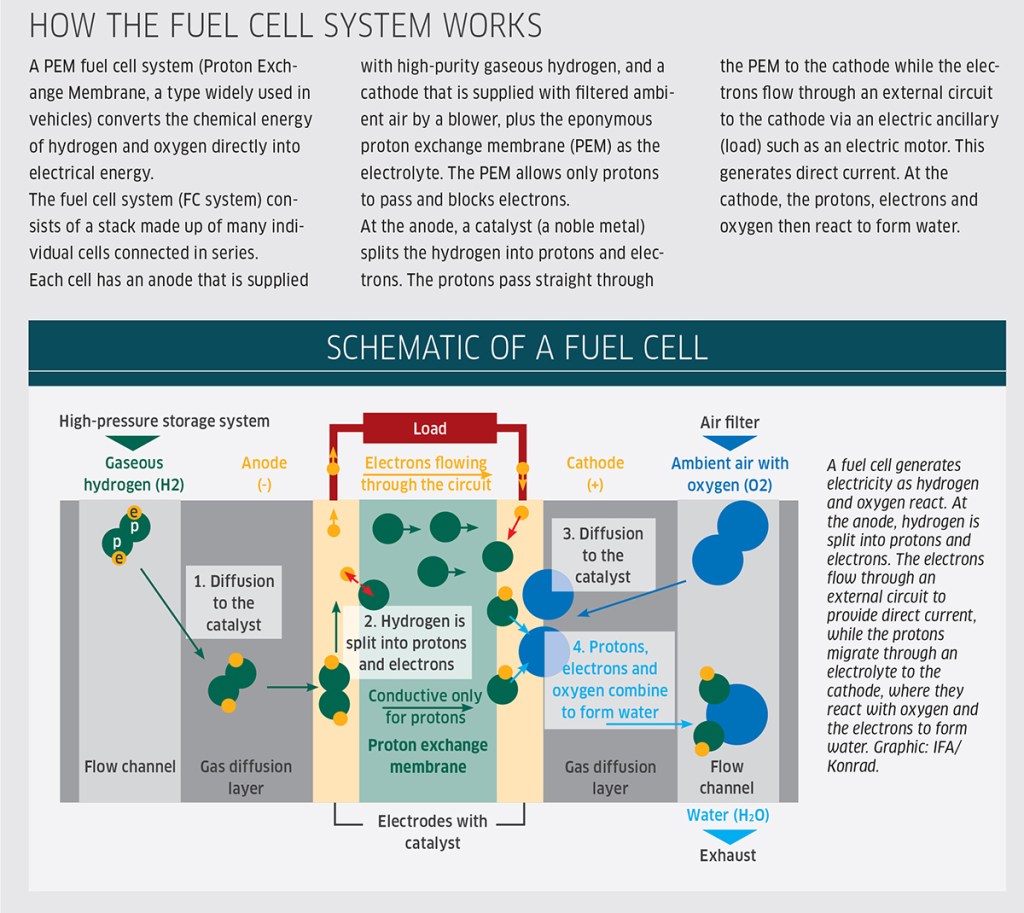
The diesel engine was replaced by a 95kW fuel cell system and an electric drive motor. With an inlet pressure of 8 bar, hydrogen is fed into the fuel cell system (FC system). The FC system delivers a net electrical output of 110kW at between 360 and 560V to drive the electric motor. High power peaks are covered by a high-voltage battery with 11kWh of usable capacity, not least because the FC system itself responds relatively slowly. The high-voltage battery makes the tractor exclusively battery powered. All ancillaries such as the air conditioning compressor and the air compressor are electrically driven as well.
The CVT transmission is retained
The front pto, the hydraulic pumps, the rear pto and the unchanged CVT transmission are all driven directly by the electric motor.
In reality, the tractor wouldn’t need the Steyr’s hydro-mechanical transmission — the driveline and pto shafts could be driven electrically with greater efficiency. This is something that the researchers are well aware of.
FCTrac vs diesel
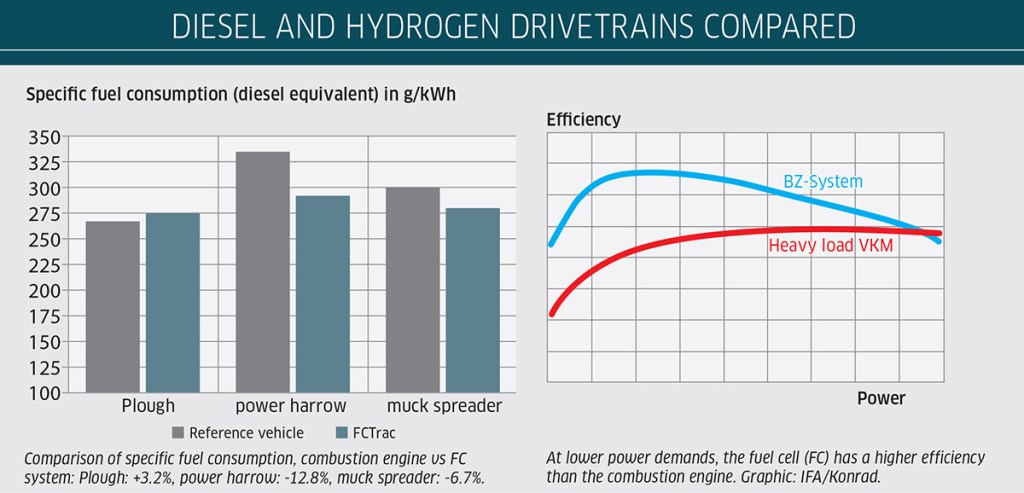
There are clear differences in efficiency between fuel cell systems and combustion engines (see the table “Diesel and hydrogen drivetrains compared”). The diesel engine’s efficiency tends to improve as its output increases. The FC system, by comparison, develops its maximum efficiency in the low to medium power range, clearly above the diesel engine’s optimum. Then, it drops off again as the output increases. This type of performance curve is attributed to the interdependence of the power demand by the fuel cell ancillaries and the physics-driven efficiency drop in the fuel cell.
A standard spec diesel-powered Steyr 4130 Expert CVT was used as a comparison to the FCTrac. To ensure the comparison was fair, the power and torque were measured using a dyno. Fuel cells — including the one in the FCTrac — need a large radiator so the fuel cell stacks are kept nice and cool. On the FCTrac, this radiator sits on top of the cab.
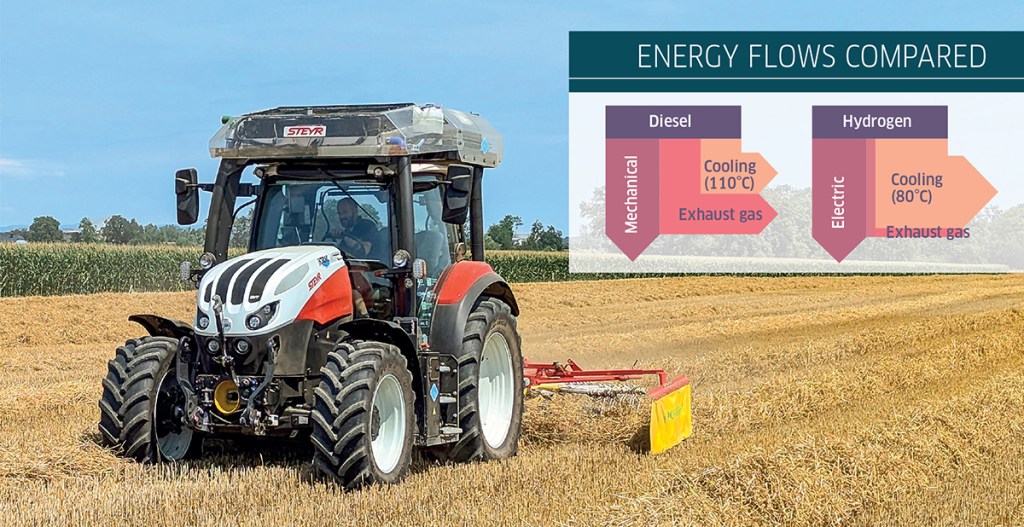
At high loads a diesel engine in operation dissipates about half of its waste heat through the exhaust gas and the other half through the cooling system (see “Energy flows compared”). The temperature of the coolant may reach up to 120°C. In contrast, the fuel cell system, with similar efficiency level at higher power, produces virtually no exhaust heat. Instead almost all its waste heat is directed into the cooling cycle.
With such a substantial demand for heat dissipation and a lower coolant temperature of about 80°C — meaning a smaller temp difference to ambient — the fuel cell system requires large cooling surfaces and powerful fans.
This is why FC systems currently are more suitable for medium-range outputs whereas combustion engines still suit high power applications better — at least with today’s state of research.
The results in the field
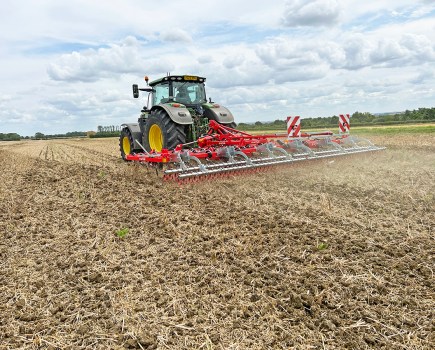
The figures back this up: At light work, the specific fuel consumption of the FCTrac, shown in its diesel equivalent, is noticeably lower than the diesel tractor’s consumption. In addition to simulated duty cycles on the test bed, TU Vienna also ran the FCTrac through real field work. Pulling a cultivator, disc harrow, power harrow, rake and trailer, the FCTrac had to prove how long it could work on a single tank of hydrogen. While the it could rake for six hours on one fill, it only lasted two to three hours in draft work.
Summary
The FCTrac proves that alternative drives can work on farm — albeit currently with some limitations. Range and tank size are the big sticking points. The comparison with the diesel engine shows that the fuel cell system is particularly efficient at half load whereas heavy draft work isn’t yet the fuel cell’s strong suit — there is still plenty of scope for further research and development here.
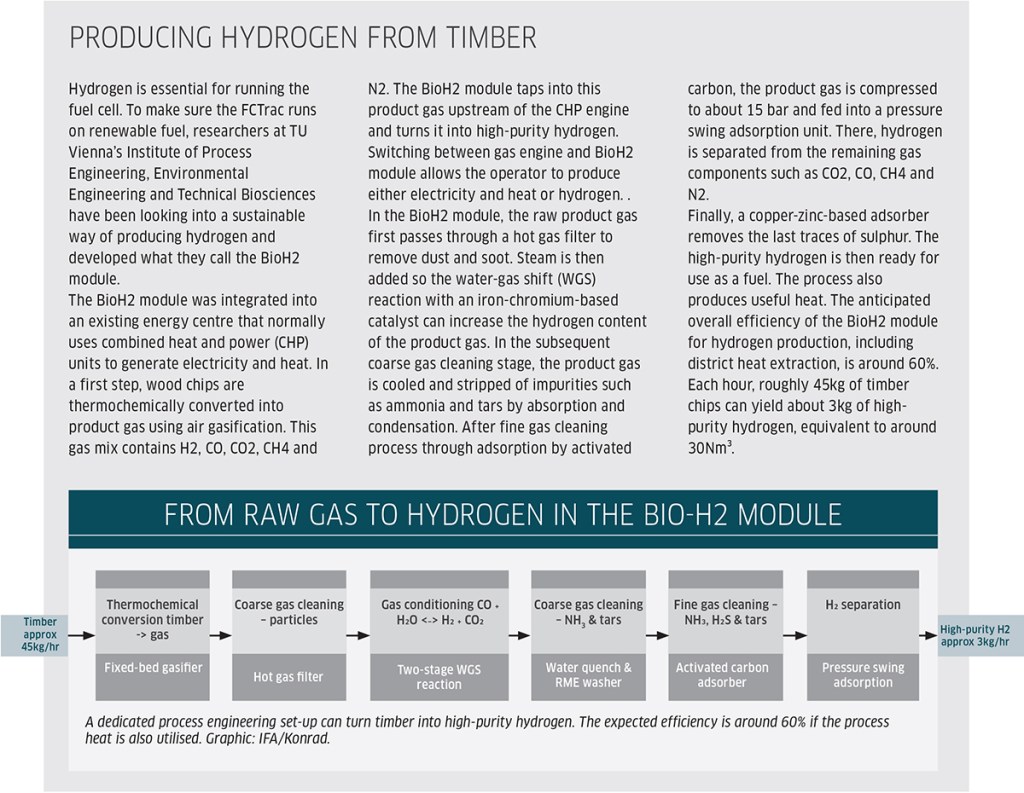
An exciting field of research is certainly the timber-hydrogen cycle, which is particularly interesting in countries such as Austria where sustainable biomass is available in large quantities. This is where research can uncover further potential.
Hanna Deipenbrock, Veronica Gubin, Johannes Konrad
For more up-to-date farming news click here and subscribe now to profi and save.