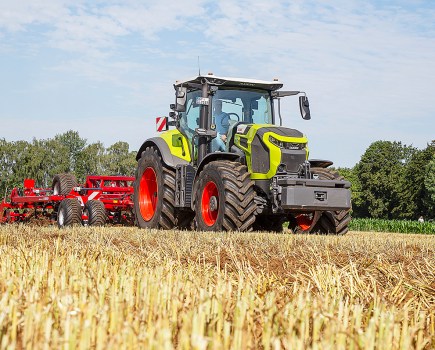


The engineering team at John Deere deserves a round of applause. The new, fully automatic E19 transmission is largely based on the PowrQuad, which has proven itself thousands of times over. So, time to give it a go …
KEEPING IT BRIEF
- John Deere is updating both the 6M and 6R tractors.
- The 6M gets a CommandX-Plus multi-control drive lever along with the new E19 transmission.
- Price wise, E19 will sit between the AutoQuad semi-powershift and stepless AutoPowr.
By the time you read this driving impression, news of the latest 6R models will have sneaked out from Mannheim, (see page 37 for some of the details). So, to ensure that buyers don’t overlook the lower cost 6M when making their purchasing decision, especially those thinking of changing makes, John Deere has also given the M models a comprehensive update. After all, two-thirds of the tractors now produced in Mannheim are 6M models. Globally, this lower-pecking series plays an important role for John Deere.
Nothing has changed in the actual model range: there are still seven four-cylinder models (6M 95 to 6M 150) and ten six-cylinder tractors ranging from the 6M 145 to the 6M 185 with a 2.77m wheelbase. The 6M 180 to 6M 240 have a wheelbase of 2.80m, whilst the larger 6M 230 and 6M 250 models, with the 2.90m frame, round off the range at the top end.
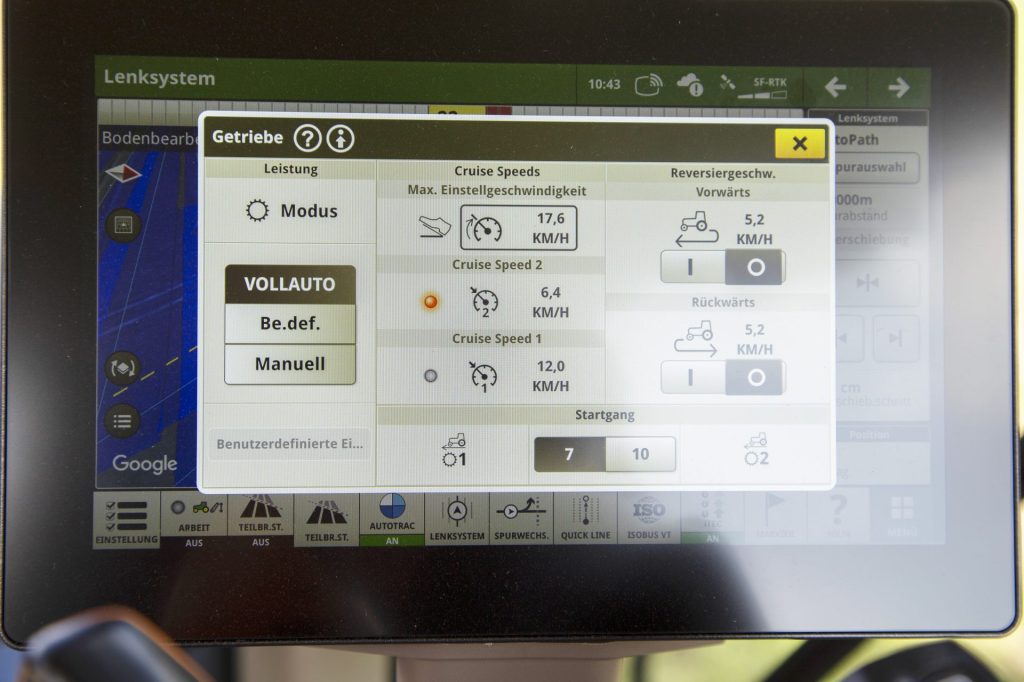
E19 transmission
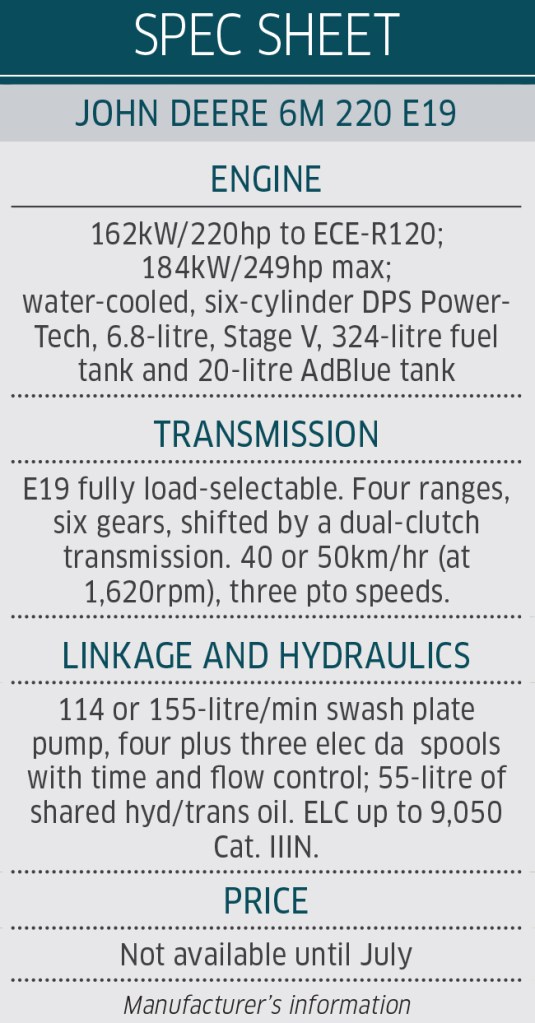
For the six-cylinder models – with the exception of the 6M 185 and 6M 240 — there is the all-new E19 transmission.
Another transmission option? Yes, if you are going for one of the six-cylinder models, as the four-pot 6M does not get the new ‘box just yet. John Deere will continue to offer the AutoQuad and CommandQuad transmissions with six ranges and four powershift stages as well as the continuously variable AutoPowr.
Building on a proven design
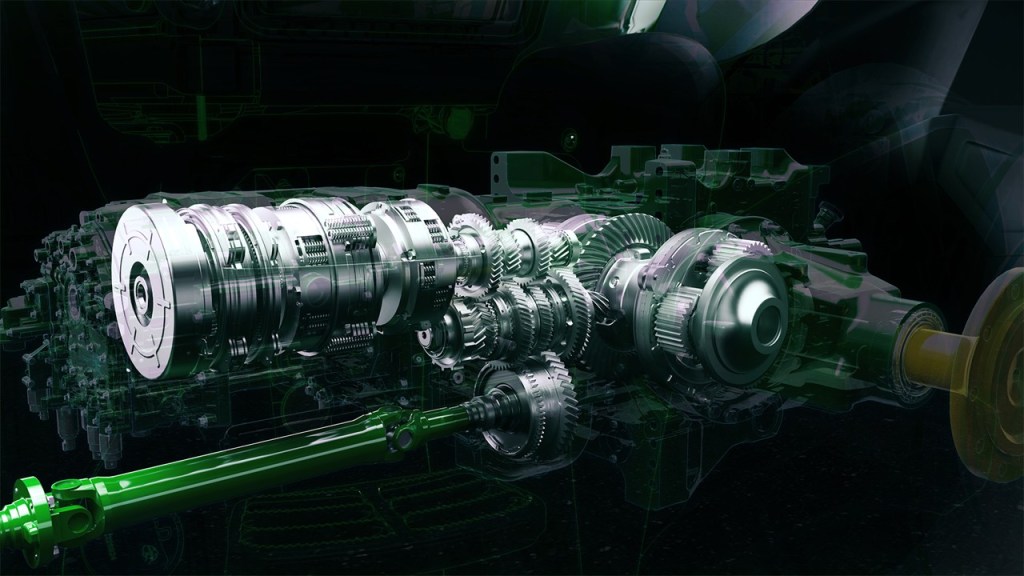
The E19 box is based on the PowrQuad transmission. However, unlike the previous John Deere ‘Direct-Drive’ dual-clutch box, (which is getting binned) the ranges are changed under load without any interruption in power. This is made possible by a dual clutch arrangement that, in essence, shifts the gears twice.
The gear ratios are coordinated so that the final gear in one range corresponds to the first gear in the next range. One clutch is responsible for groups A, C and E, the other for B, D and F. This reduces the number of gears from 24 to 19. The design of the new drivetrain is actually quite simple: behind the engine, within the main frame, is the unit containing the four powershift stages, followed by the Powr-Reverser and range selector including the dual clutch.
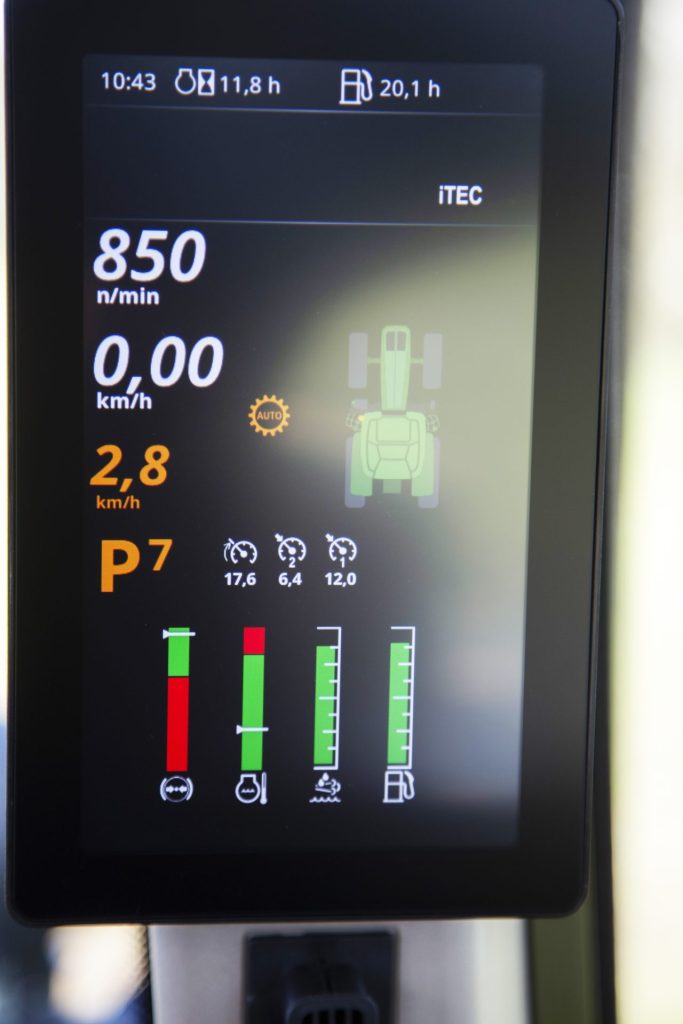
24-5=19
As a result, the transmission shifts through all the gears very smoothly and, just as importantly, quickly. On the A-pillar, the driver only sees the gears running up from one to 19 — and barely feels the change. The software is so finely tuned that the gear changes are not only fast, but also take place almost imperceptibly. And of course John Deere has given this a snazzy name, ‘scroll shifting’: two gears are positioned so close together that it creates the impression that gear ratios are literally being skipped. In first gear, the tractor travels at around 2km/hr. Each subsequent gear increases the speed by around 21 per cent, so that the maximum speed of 50km/hr is already reached at a low 1,620rpm.
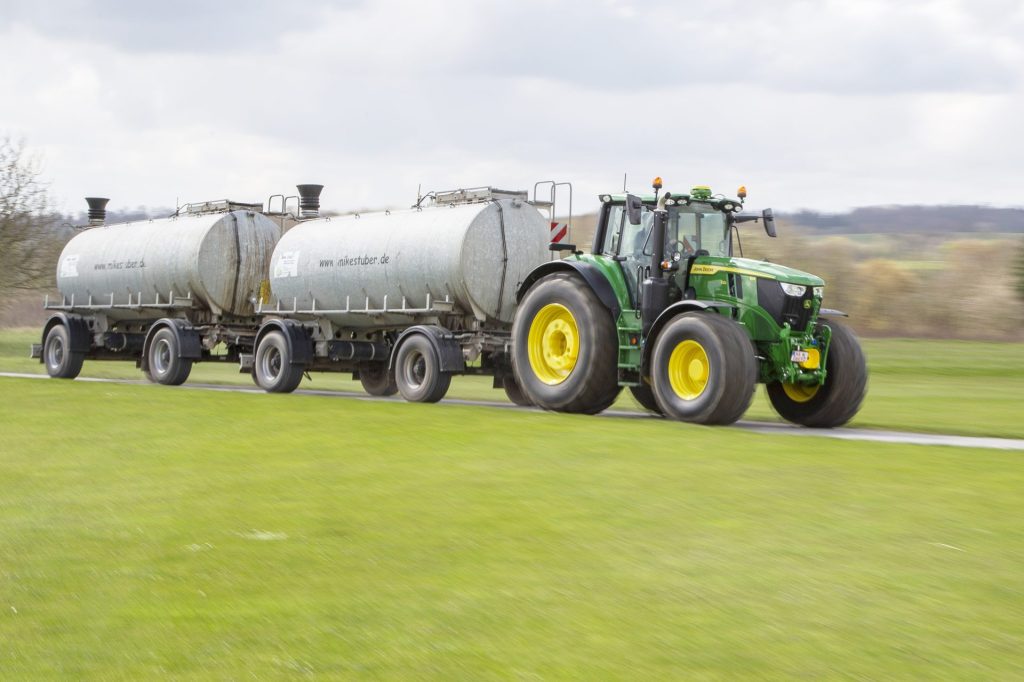
Integrated position sensor
As part of this new transmission design, the engineers have also integrated a tilt sensor that detects the position and orientation of the tractor and adjusts the clutches to suit. If the machine is on a slope, for example, the clutches engage differently than on flat ground. Of course, it is still possible to stall the tractor. As with Direct-Drive, a start-off gear must be preselected in the terminal, which can also be quickly changed via a button in future.
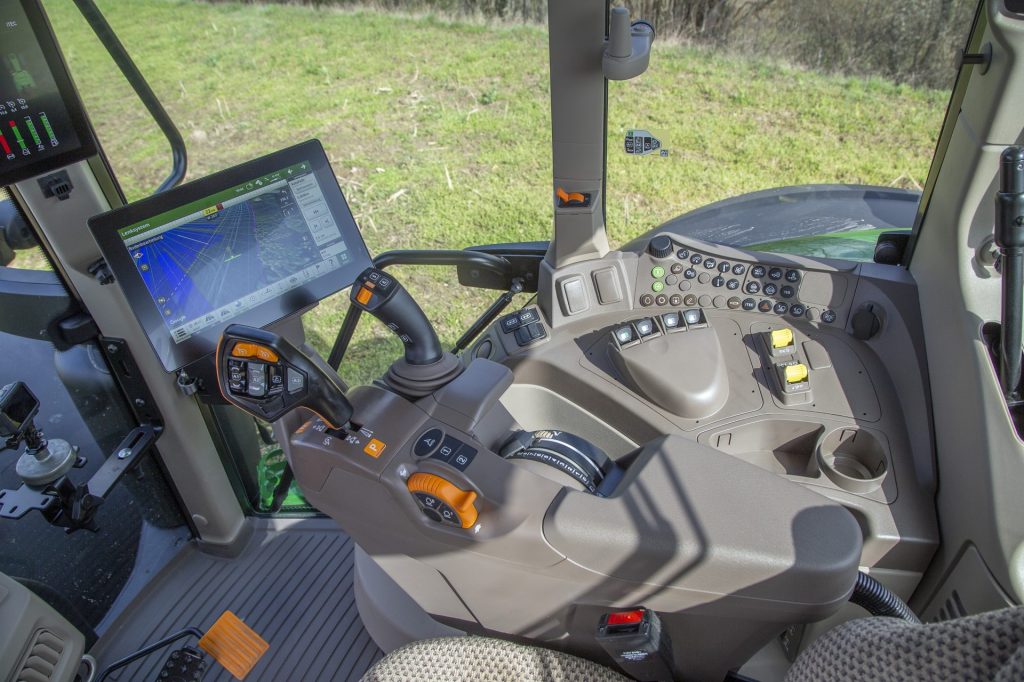
CommandX Plus
Also new and available as an option for all M models with AutoPowr or the new E19 is the CommandX Plus multi-function drive lever. This stick feels similar to the familiar CommandPro.
Six programmable buttons are available, although the CommandX Plus lacks the buttons on the back of the drive lever. The right-hand kick is no longer used; instead, the two cruise control speeds are activated via orange buttons at the top of the lever. In its place, the activation button provides the left-hand kick for changing direction, the familiar forward click for accelerating up to top speed, and the scroll wheel for spreading or speed preselection.
Another positive feature is the ease of switching between the accelerator pedal and CommandX Plus operation. If you nudge over to the left without pressing the safety button, the tractor decelerates and activates active standstill. However, active standstill on the E19 is simulated by the service brake (including trailer braking). On the 6M, the driver must consciously activate standstill. Automation remains exclusive to the 6R for the time being.
It is precisely these differences that are intended to further distinguish the model ranges from one another.
Other details
- The G5 display is now available for the 6M range.
- The ITEC headland automation has been expanded so that the spool valves can now also be integrated into the headland control system.
- Section control, variable rate control and headland automation are now available for the M — the latter, however, without Speed Automation. Drivers can integrate the cruise control systems via ITEC.
- At last, a clock has been added to the list of key information shown on the A-pillar display.
- The mirrors are smaller but offer a wider viewing angle, making it easier to climb into the cab without clonking your head.
- The E19 will be positioned between the semi-powershift AutoQuad and more expensive, stepless AutoPowr.
- In addition to the CommandX Plus control arrangement, the Compact CommandARM armrest with a small gear knob is also available as an option.
Summary
The 6M is clearly catching up. With several details, particularly in terms of operation and software, the lower peg models adopt a number of updates from the higher-end R-series. This means that in many respects, the 6M can hold its own against the more expensive 6R.
The reasoning is clear: the new 6R-series is setting new standards in other areas, so there is still a distinct difference between the two lines. Plus, if you think globally, the bigger 6M models could well appeal to the South American and Far East markets not wanting the extra frills of an R.
The CommandX Plus drive lever is a nice addition to the M, even if active standstill can only be activated manually.
New and impressive is the E19 transmission, which will also be available for some of the new generation 6R tractors. The dual-clutch system, featuring familiar hardware from PowrQuad, shifts cleanly and quickly. At the same time, in automatic mode, many of the functions of the CVT have been used.
How the transmission establishes itself on the market depends heavily on its price positioning relative to the continuously variable AutoPowr.
Tobias Bensing
For more up-to-date farming news click here and subscribe now to profi and save.