
A lifetime’s work of agricultural contracting and engineering for Nottingham-based D Clifford & Sons has recently evolved to include 60 hectares of stubble-to-stubble contracting. Alongside its general contracting business, the shift into direct farming has given the family-run business a different focus when it comes to getting the job done.
KEEPING IT BRIEF
- Knight sprayer to gain retro-fitted boom tech
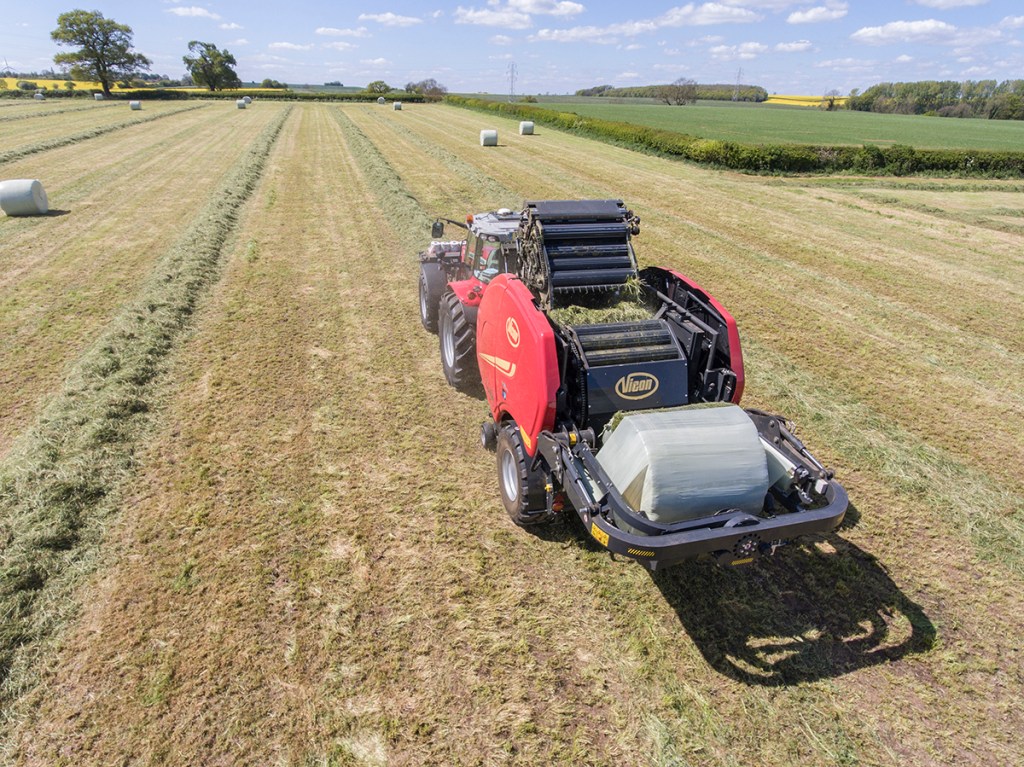
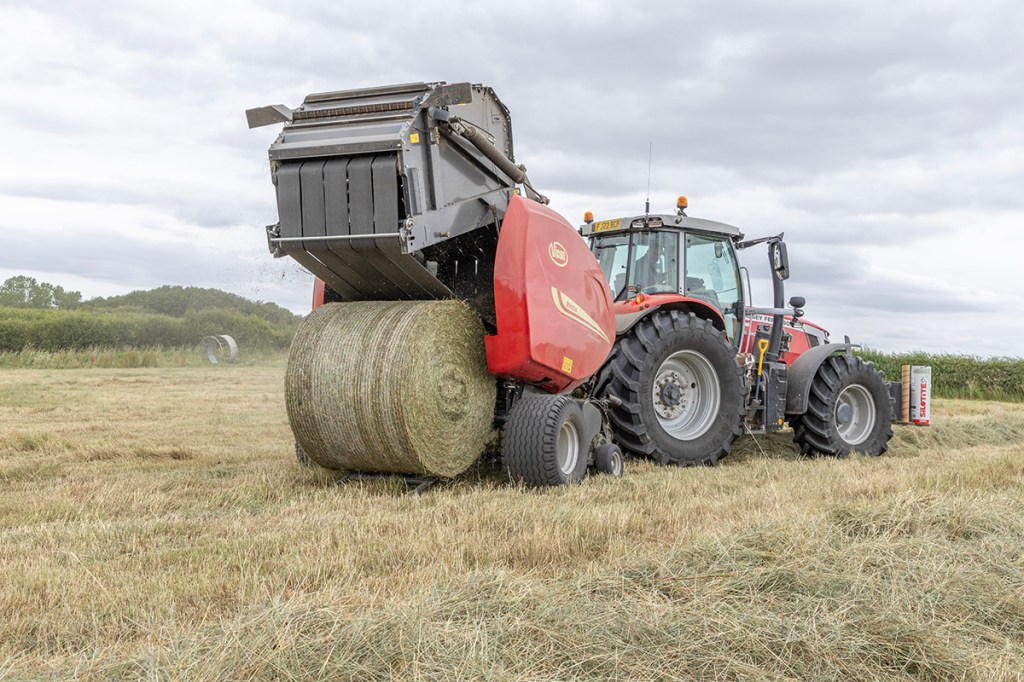
- Vicon FastBale provides non-stop baling and wrapping
- Drone improves field imaging for drainage
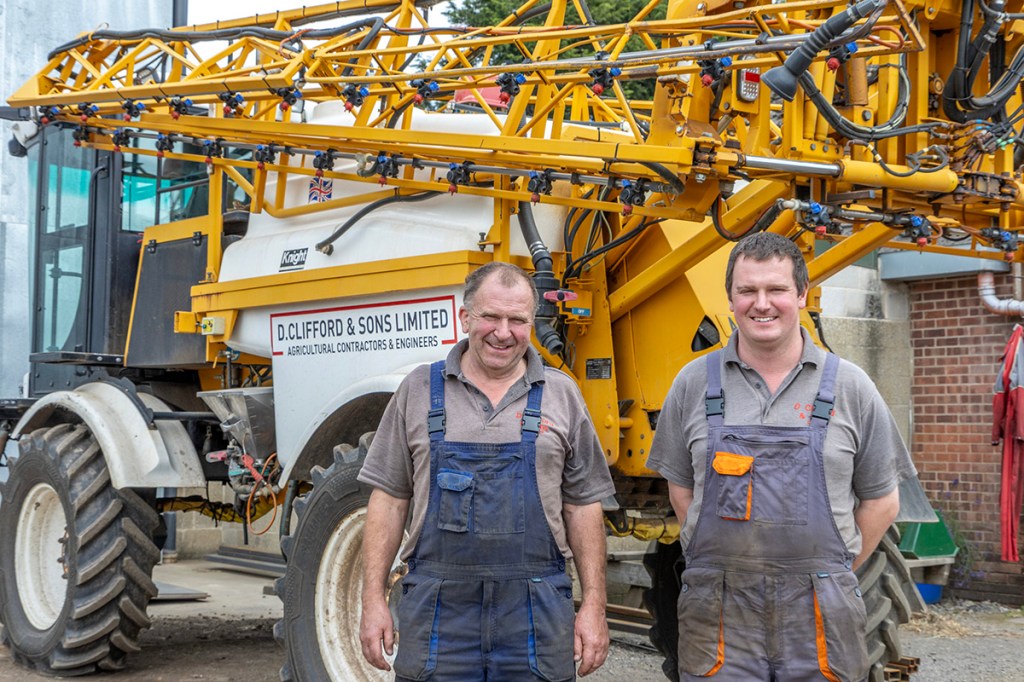
For contractors John Clifford and son Sam, of D Clifford & Sons based at Ash Close Farm, East Bridgford, the arrival of a 60 hectare stubble-to-stubble contract has brought different thought processes to a business that has thrived on providing a prompt and efficient range of general contracting services for its customers.
“Growing somebody else’s crops is very different to reacting to phone calls from existing customers asking can you come and drill two fields of wheat, or can you bale our silage,” explains John. “It’s a preset workload that has introduced some much-needed routine alongside what has traditionally been a transient and extremely varied business model.”
As a contractor, John appreciates that you’re only as good as your last job, and over the last 40 years he has been focused on meeting and exceeding customer expectations – it’s a mindset that continues and is one that has certainly helped the business adapt to changing circumstances.
Alongside that philosophy is an engineering mind that has helped the business provide engineering services and repairs for customers too, with their well-equipped workshop simplifying the Cliffords’ own repairs and upgrades – the latter being the firm’s own custom-made, 4.0m folding power-harrow drill combination.
In recent years however, both John and Sam have noticed a gradual decline in round baling, and the pair have stepped back from lime spreading too, with the business choosing to focus on niche services that can help the Clifford family to remain profitable.
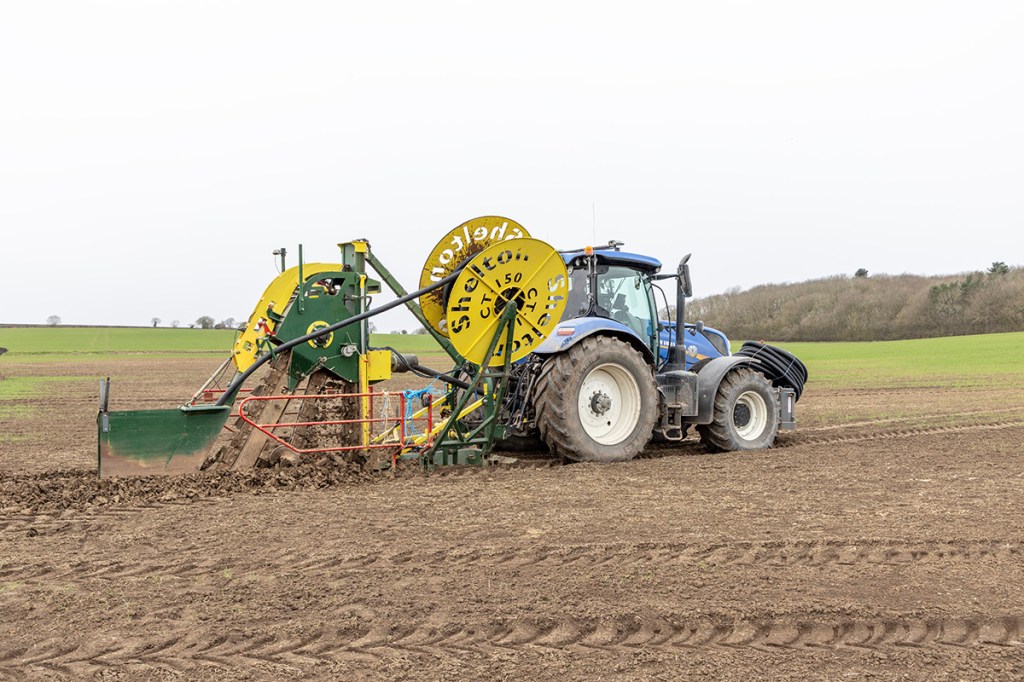
Alongside its extensive workshop fabrication and repair skills is a shift into land drainage using a tractor-mounted Shelton trencher. And now the business finds itself venturing deeper into arable farming operations with a five-year agreement on a stubble-to-stubble contract, that is about to start its second harvest.
“It’s great to have a different focus, to challenge your thought processes and work alongside customers to harvest a product you have grown, rather than just supply a single service,” explains John. “It’s all about the detail.”
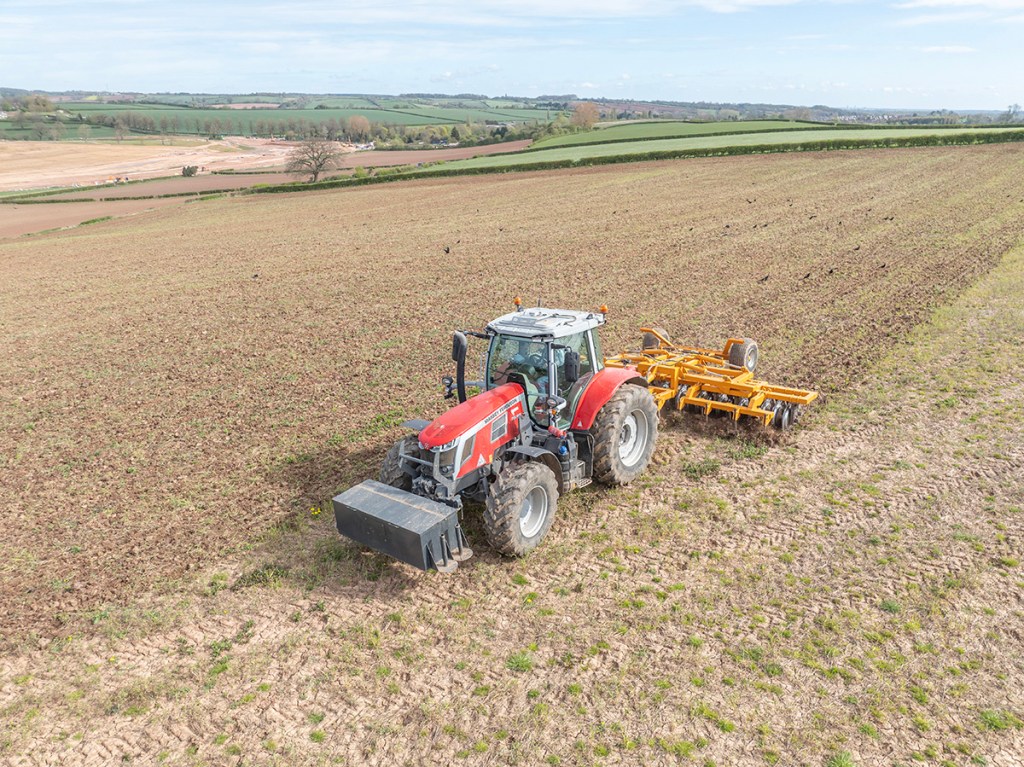
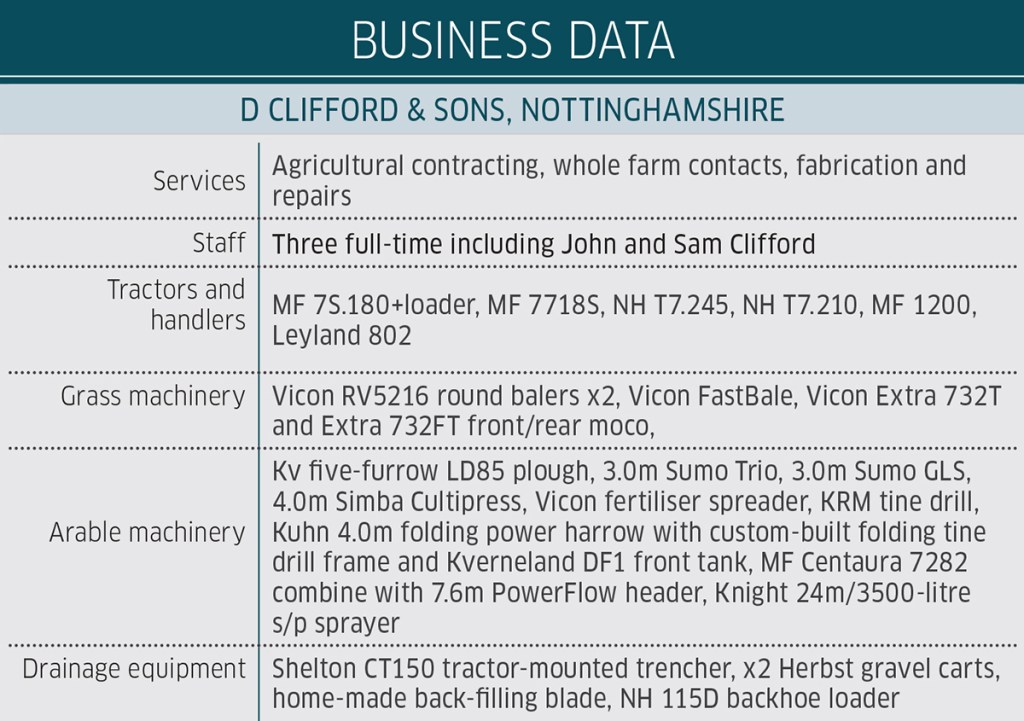
Tractor choices include a pair of Massey Ferguson’s for most of the firm’s general contracting tasks as John’s 22-plate 7S.180 Dyna 6 and Sam’s 21-reg 7718S Dyna 6 clock-up the bulk of the hours. For heavier work, there’s a pair of CVT-equipped NH T7 AutoCommand models including a 9,000-hour T7.210 and an 18-month-old T7.245 for trenching and heavy draft work.
While the firm has amassed a wide range of grassland and arable equipment from a lifetime of general contracting, there have been a couple of notable exceptions in the machinery line-up – that of a combine and a self-propelled sprayer.
Owning a combine
“I never thought I would ever own a combine,” he says. “But needs must, and based on a five-year plan, we set out with a £25,000 budget to find something suitable for our 150-acre arable workload.”
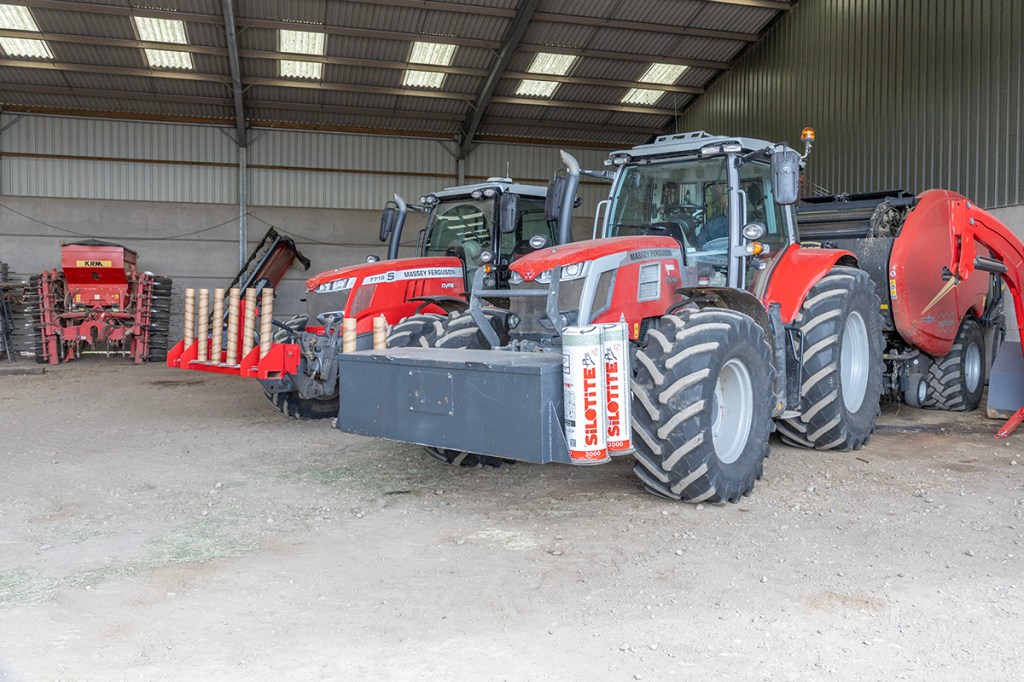
With a pair of Massey tractors as the mainstay of the fleet, both John and Sam favoured an MF combine.
“With our budget, we were looking for either an early Cerea or a late 40RS model,” explains Sam Clifford.
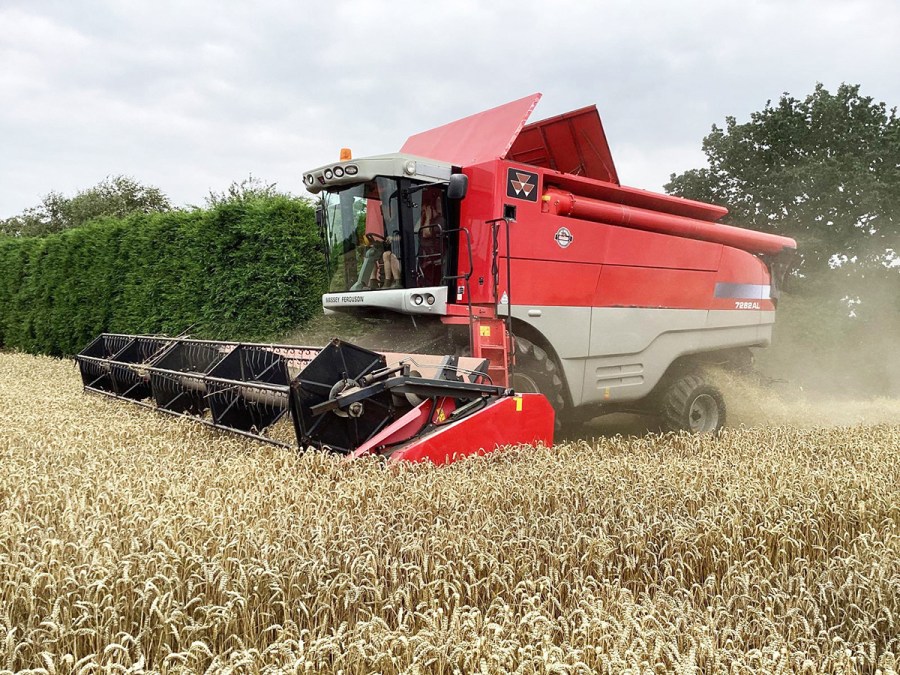
It was a search that eventually took the pair to a farm sale, and along with a slightly increased budget, secured an ‘09-model MF Centaura 7282AL complete with 7.60m (25ft) wide PowerFlow table. The eight-walker machine offered far more capacity and an extra 1.50m of header than initially planned, but with the ability to harvest around 3ha per hour, the Cliffords reasoned that harvest could be wrapped up in just five days, working four-hour evenings.
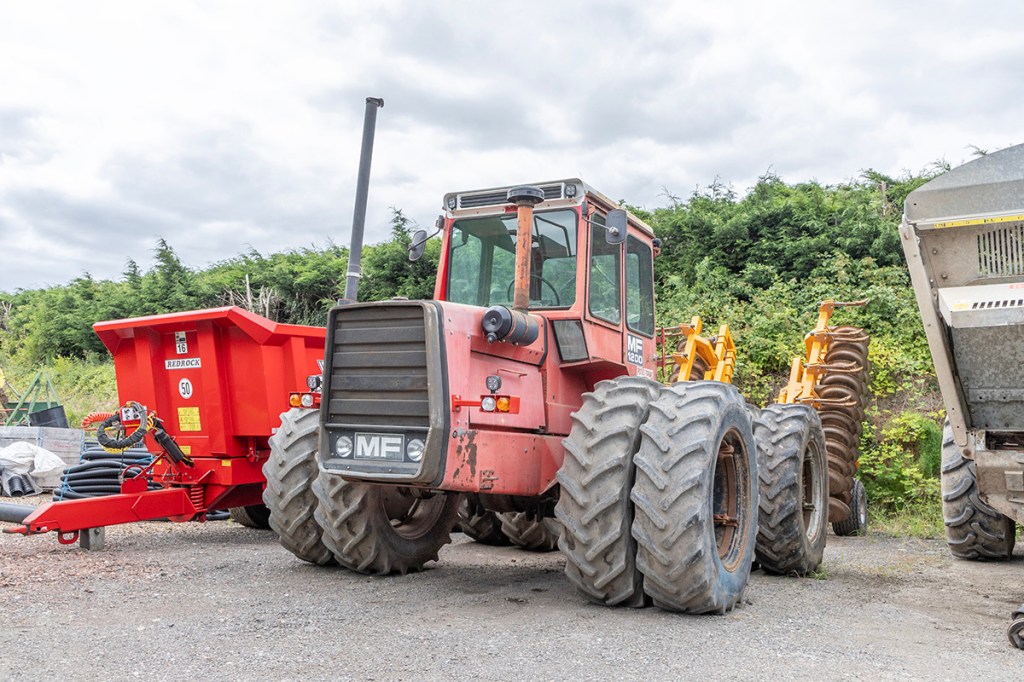
A harvest gold Leyland 802 has been acquired and is currently undergoing restoration through the workshop, so it can be used with the header trailer instead of tying up one of the firm’s two 180hp Masseys or one of the New Hollands.
It’s not the only classic that sits alongside more modern mules – Sam is the proud owner of an articulated and dualled-up Massey Ferguson 1200, that will be putting in a shift as required when it comes to rolling.
“The extra capacity from the Centaura has been useful and meant we won’t need to involve a drier,” explains John. “Harvest is also a task that we can comfortably fit in around existing contracting jobs. There’s only the two of us, with help from my brother – we’re not aiming to farm the world. In its first season with us, the combine blew a hydraulic hose, and a ram inside the header came loose. Given that we carry out our own hydraulic hose repairs, the downtime was minimal.”
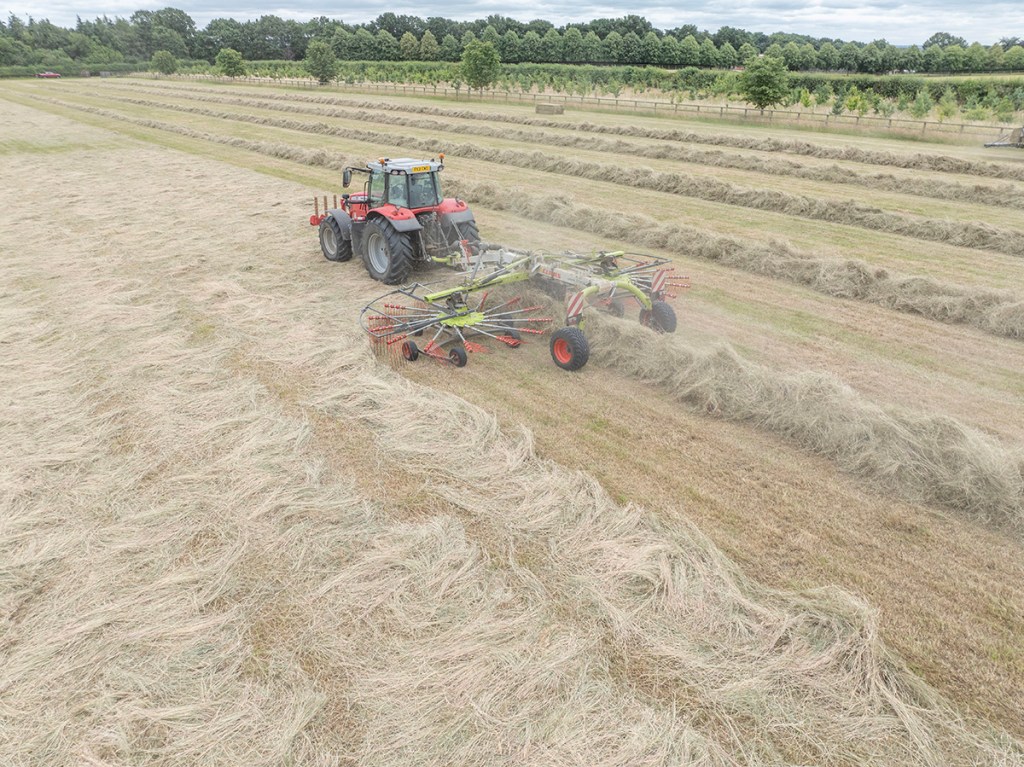
Straw is sold in the swath, with the eight-walker machine creating a decent grain sample, and leaving a generous swath for the following baler.
The other key item of kit added to the fleet to help manage the stubble-to-stubble contact was a self-propelled sprayer.
“We did previously have a mounted sprayer, but it lacked capacity,” he explains. “Our intention was to add a front tank to boost capacity. But the practicalities of swapping between standard wheels and tyres for contracting and row crops for spraying, was an area where too much time could be lost.”
He says son Sam threw in the idea of buying a low-cost self-propelled model that could be dedicated to the arable workload, for taking care of sprays and liquid fertiliser applications. It was a search that saw the pair invest in a 21-year old Knight self-propelled model, complete with 24m boom and 3,500-litre tank.
“It’s a 9,000-hour machine that is in very good condition,” he says. “Other than needing a wheel motor replacement, it’s been a reliable investment. And we now carry a reconditioned, spare wheel motor on the shelf.”
John says the sprayer has just four boom sections, and the long-term plan is to add some form of auto start/stop and increase boom sections to seven.
“The overlaps are noticeable, and we’d like to manage these better, to reduce waste and improve the crop canopy,” he adds. “We’ve already added a motorised steering wheel so the GPS capability is already there.”
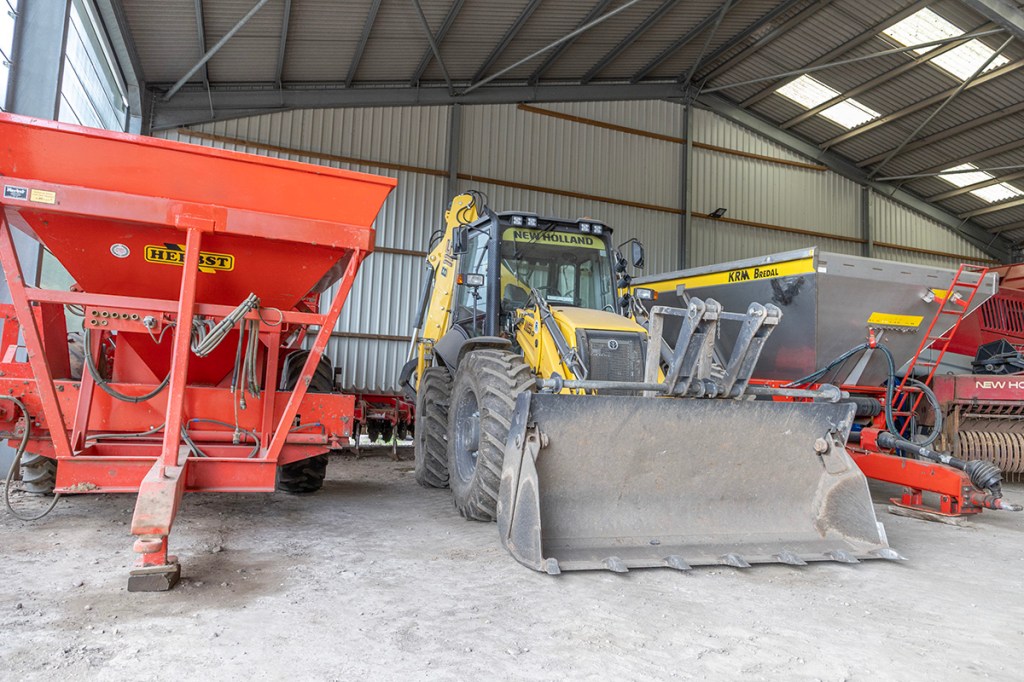
GPS is widely adopted across the rest of the fleet, with the firm’s tractors using RTK auto-steering guidance – none more so than the latest New Holland T7.245 AutoCommand bought for primary cultivations and to power the businesses’ Shelton CT150 trencher.
Lasers out, RTK in
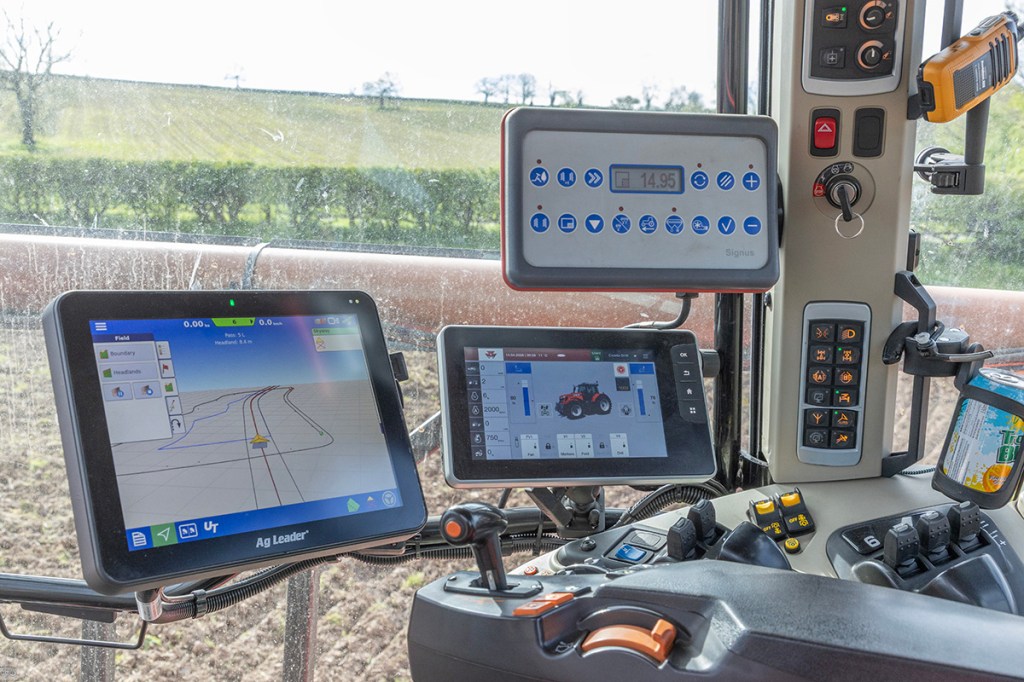
While drainage is a task that has traditionally relied on lasers, the Cliffords have opted for GPS technology and RTK guidance, with an Ag Leader control system used to apply greater accuracy to their processes.
“We’ve modernised how we survey and install schemes, while operating with much greater efficiency,” adds John. “Typically, we’d go out with electric fencing poles, a laser level and pieces of paper to survey and quote for a job – what used to take two to three hours walking a field is now done in 30 minutes using the Ag Leader kit.”
Supplied and installed by now-defunct New Holland dealer RVT at Sudbury near Derby, the kit uses DualTrac 7500 receivers on the roof of an auto-steer ready T7.245, linking to a 12.1in terminal, with a third 7500 receiver installed on the digging chain’s hydraulically raised and lowered frame so it could monitor the position and depth of the trench.
In addition, the trencher’s fixed mast was equipped with a gimbal to monitor pitch and roll, and the outfit acquires signal from a portable base station, which provides a fixed reference point with a corrected RTK signal for high accuracy.
“DualTrac provides reliable performance at ultra-low forward speeds that are as slow as 0.08km/h,” explains Sam Clifford. “With a CVT, I have full control of productivity and accuracy, without risk of losing a line of sight to a laser as we follow field contours.”
Sam adds that the portability of the Ag Leader kit allows it to be transferred from the tractor onto a Gator that is used for surveying.
“With two seats in the Gator, I can take the customer with me to determine the areas that need remediation,” explains Sam. “I’ll also set the base station up and mark its exact position, so if we get the job, I can put the base station in exactly the same location when we come back to install the field drains.”
Another advantage of using satellite guidance with a corrected RTK signal is that when a new scheme is completed, it’ll never again be difficult to find.
“If we ever need to locate the end of a lateral or a main on a scheme we’ve put in, the GPS records will simplify finding its exact location,” he adds. “And that means no more guesswork while hunting blindly for buried pipes.”
With surveying complete, Sam creates a topography map and drainage plan that can be uploaded onto cloud servers when completed, ready to be picked up by the tractor and trencher.
“I input the pipe sizes for main, sub-main and laterals, along with a minimum grade, a minimum and maximum depth and a target depth, and the software does the rest,” he says.
“We have the technology to install schemes so that the effect of compaction from tramlines is minimised,” he adds. “And when the scheme is uploaded into the tractor’s terminal, the tractor follows the prescribed drainage path using auto steer, while the trencher automatically follows the drainage plan to cut the trench to the target depth and required gradient.”
Custom-built combi
The firm has relied on a modified KRM 4.0m tine drill used with a front-mounted disc cultivator, to carry out contract drilling. But the arrival of a contract farming agreement has prompted the need for more choice in the sowing department.
“We’re already handling an existing 500-acre drilling workload of spring and autumn-sown crops, but as this workload grows, we know it’s only a matter of time before we get a bad autumn,” says John. “And in those circumstances, our modified KRM drill won’t be good enough.”
“So we reasoned that a combi-drill would give us more flexibility, either following our Sumo Trio, Sumo GLS, Cultipress or as a weather-proof option behind our five-furrow Kv plough. And we already had the expensive bit – a 4.0m folding, Kuhn HR4003 power harrow.”
The prospect of buying expensive kit that wasn’t quite right saw the pair do a deep dive into the workshop and fabricate their own custom-built outfit, as Sam explains.
“I thought I could make something better and more bespoke for us, for a fraction of the cost,” says Sam.
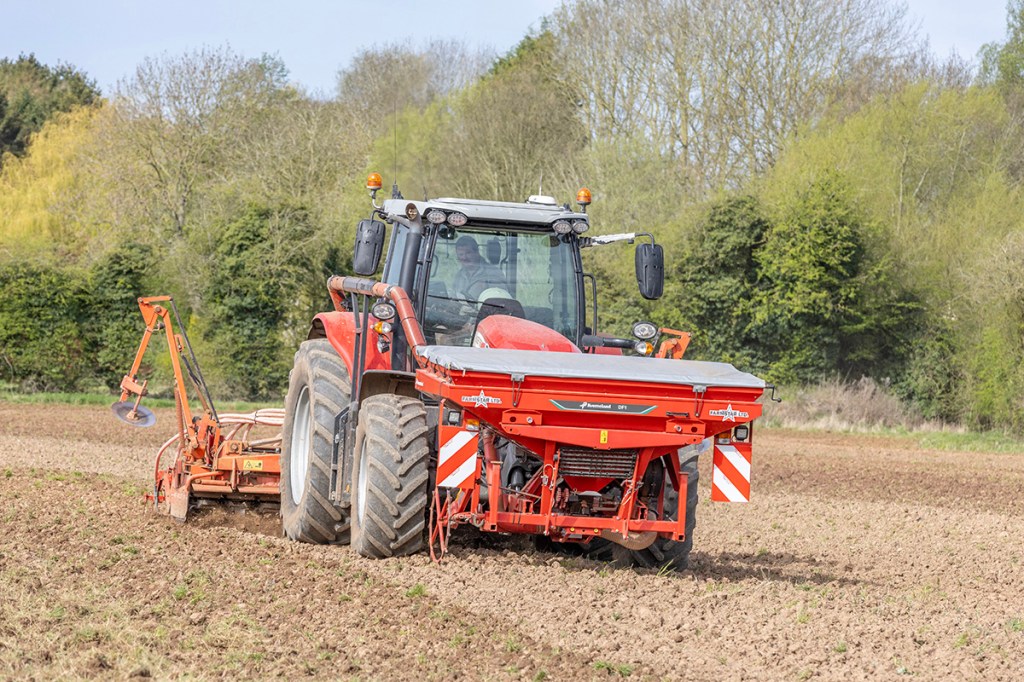
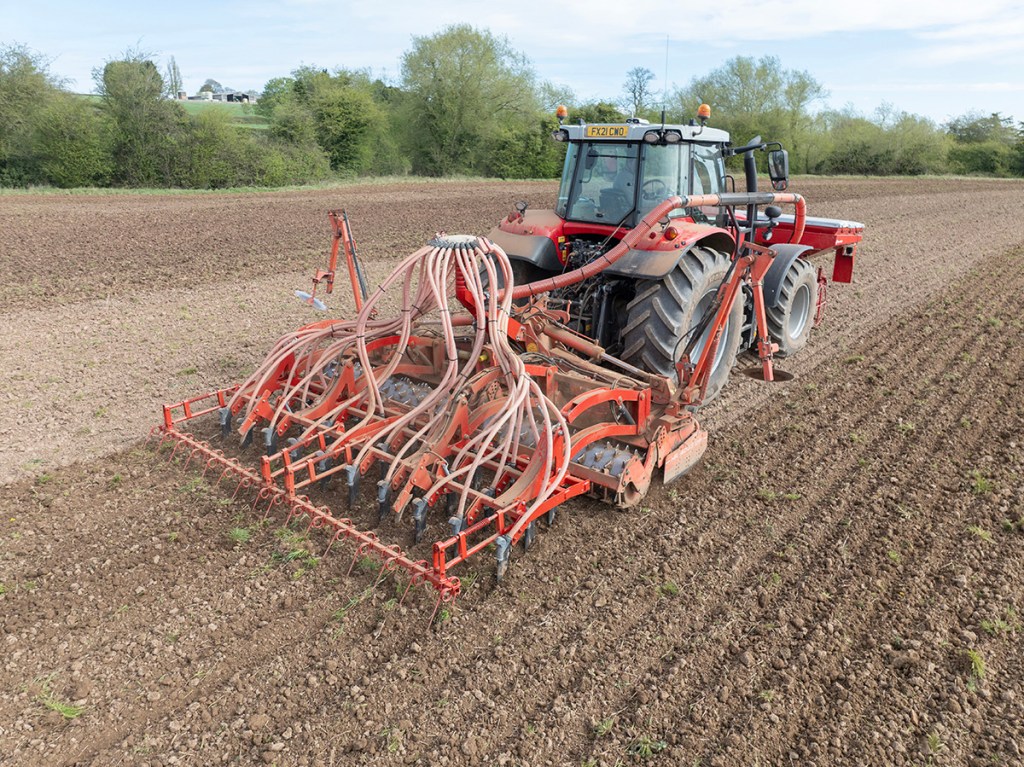
The Cliffords bought a Kverneland DF1 front tank with grain-only metering and mushroom tower, then built the coulter frame to fit onto the back of the power harrow, complete with a spring-loaded following harrow.
“We bought the Agri Carb equivalent of the TineTec coulter as used on Amazone’s Cayena – we have these on our KRM drill – and arranged them in three rows of five, on each 2.0m folding section,” says Sam.
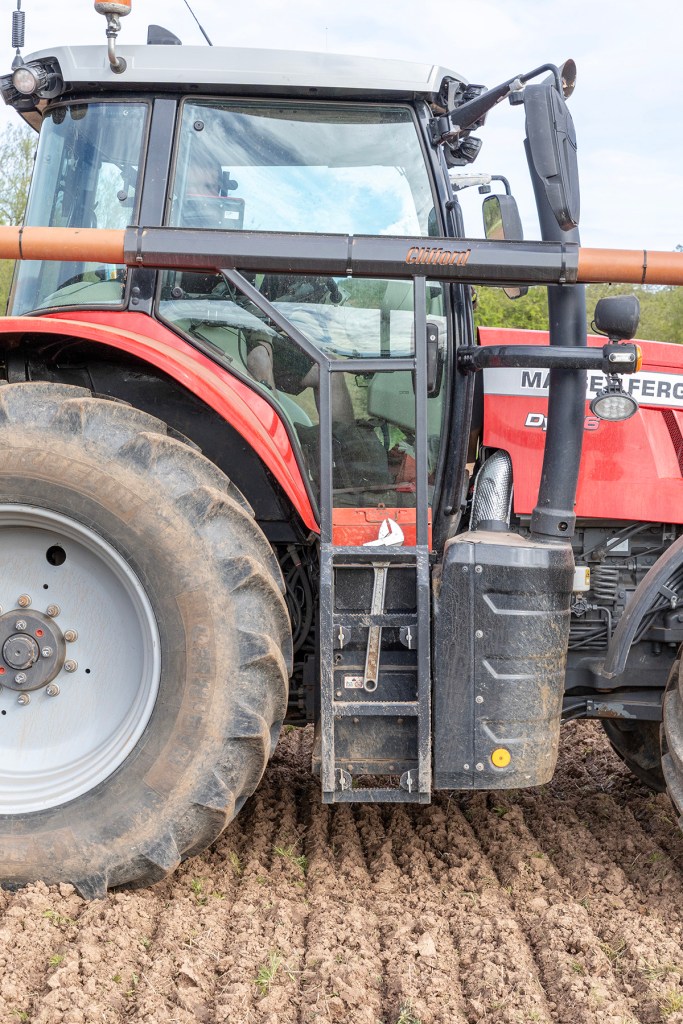
With a plasma cutter, bending machine, milling and turning equipment plus MIG, TIG and stick welding equipment, the pair devised and built everything needed to assemble the drill frame. Pipe brackets were manufactured too, to simplify installation on Sam’s 7718S.
Drill testing was carried out on a two hectare field at Ash Close Farm before unleashing the custom-rig on paying customers.
“We’ve spaced the tines at 133mm and with tines secured with two different sizes of bolt, one acts as a shear-bolt,” he adds. “We can get a positive coulter depth, working in ground that’s been through the power harrow. And a respectable output of around 40 acres/day is easily achievable.”
For the Cliffords, the mantra it’ll be alright is nowhere to be seen, and a 2ha field at the back of Ash Close Farm provides all the space they need to ensure kit is tested and correctly set-up before descending on customers.
“Everything we do for our customers has to be accurate, efficient and professional – or that last job could, one day, be our last job.”
Summary
The Cliffords’ ability to turn their hands to fabrication in the workshop has helped the business to move forward on more than one occasion. Their can-do attitude and attention to detail when creating cost-effective solutions for them and their customers, has steered the business in its drive for efficiency, without breaking the bank through excessive machinery investment.
Geoff Ashcroft
For more up-to-date farming news click here and subscribe now to profi and save.