
Whether you refer to it as fert, till or bag-muck, fertiliser offers crops a much needed boost of nutrients. But how do you know these costly products are being applied correctly? We caught up with spreader testing specialist SCS to find out
Proper prior planning prevents poor performance certainly rings true when it comes to fertiliser application. Somewhat often forgotten about for months of the year, gathering dust at the back of a shed or (hopefully not) growing deeper into the nettles, the twin-disc fertiliser spreader dates back more than 60 years, and levels of sophistication vary enormously.
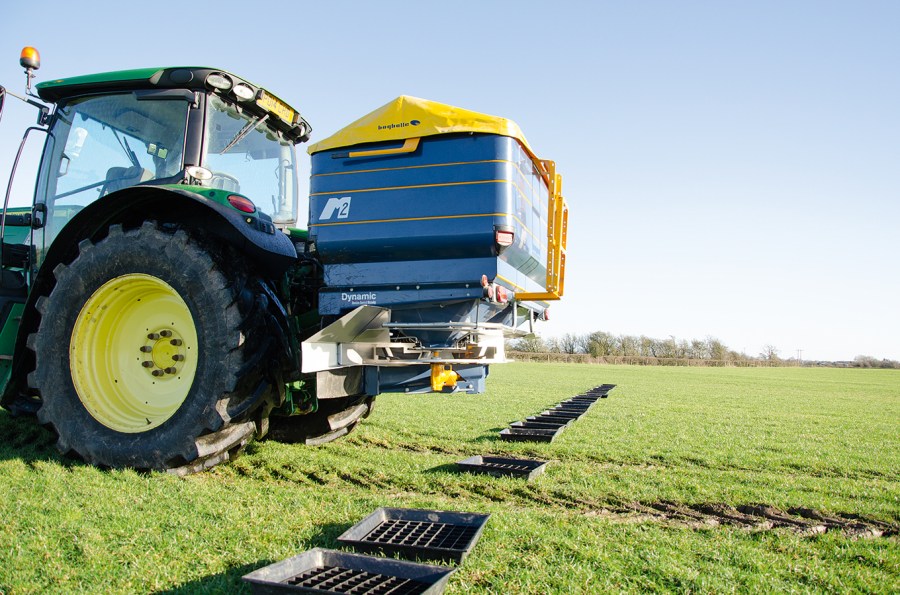
At one end of the spectrum, the manually set spreader with hydraulic spool valve control of shutters (as seen here) offers simple, nofrills approach to the job. At the other end, GPS section shutoff and variable rate control offer the ability to reduce fertiliser use and fatigue on the operator. And, while most spreader manufacturers offer a vast database containing all manner of fertiliser and seed setups for their machine, it is still down to the operator to ensure the spreader is set correctly.
In England, to meet farm assurance standards you must calibrate a spreader for the amount of each product applied; this does not, however, give any indication if the fertiliser is being applied evenly. This can only really be done by a full-width tray test, either by you or a specialist firm such as SCS Spreader and Sprayer Testing.
For more up-to-date farming news click here and subscribe now to profi and save