
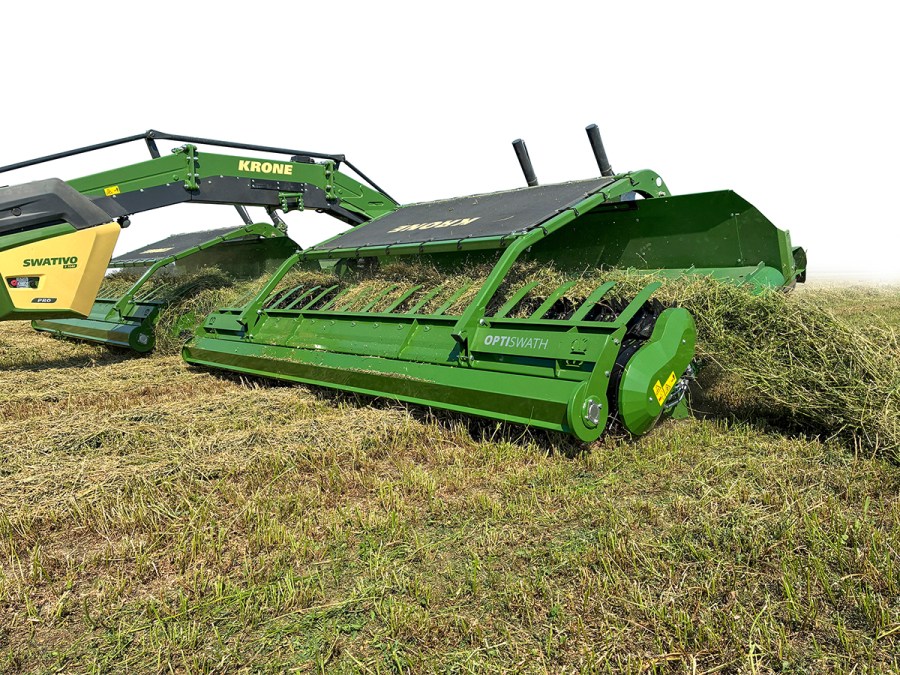
Krone is now in the growing merger market with its fresh-out-of-the-box Swativo T1040 Pro. A combination of existing pick-up tech and a new transfer rotor is designed to lift delicate leafy crops and other forage for delivery to the centre or sides. Here is our exclusive first look.
KEEPING IT BRIEF
- Krone’s first belt merger made a very good impression in the field.
- Initial target markets are likely to be the main lucerne/alfalfa growing regions.
- Just one model, the T1040 with a max working width of 10.40m.
Despite all of their many positives — versatile working width, reduced ash content, less leaf loss — the bulk of belt crop mergers are still sold in areas growing delicate leaf crops such as lucerne/alfalfa. This may explain why Krone has been a bit late to the merger party, but it can now offer the full accompaniment of grass gathering kit with the introduction of the Swativo T1040 Pro.
The green harvest specialist reckons now is the right time, as it sees lucerne becoming a more popular crop due to the hotter, drier summers.
Designed for delicate forage
During the machine development phase, the engineers deliberately focused on working quality in delicate forage crops. The firm says that the Swativo was never intended to become just another model among the many competing machines on the market, nor was it designed to replace the rotary rake for grassland work.
That is hardly surprising, as comparative tests — including those carried out by profi — have shown that mergers don’t necessarily produce better results in grass crops than a properly set-up rotary rake. They are, however, more expensive to purchase and maintain.
One particular standout on the Swativo is how it uses a rotor to transfer the crop from directly behind the pick-up to the belt. In addition, the cross conveyor belt is wide and fitted with chunky cleated crossbars. The benefits of both features are discussed towards the end of this write-up.
Clever hinge
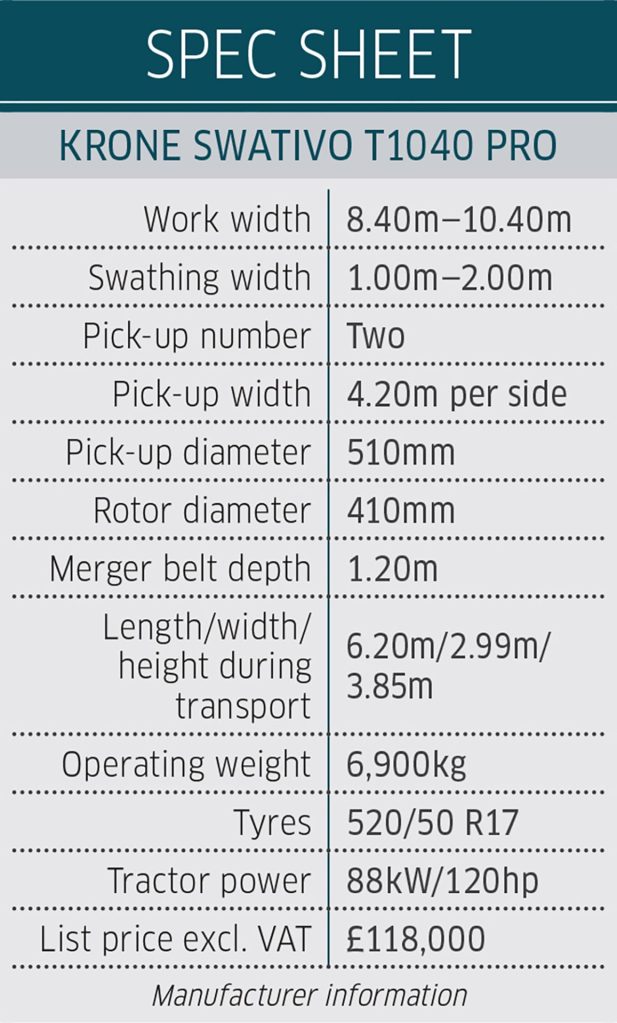
The order book for the Swativo is now open and initially there will just be one model available. The trailed T1040 uses a pair of 4.0m wide pick-ups, each having a working width of 4.20m.
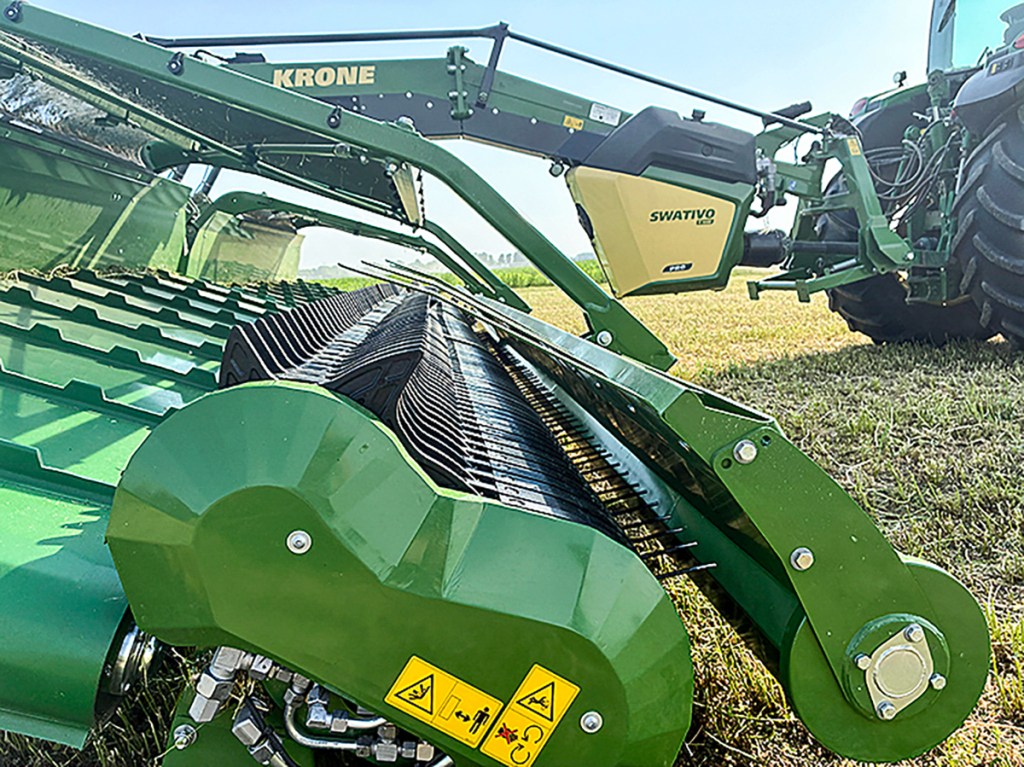
To ensure good ground following, each pick-up is split in the middle and connected by a positive-drive ‘OctoLink’ finger clutch coupling. This articulated joint system is a clever solution, especially since this coupling design has proven its reliability over many decades of use.
A 100cm wide rubber gauge wheel is sited centrally beneath each 2.0m section and can be adjusted into one of three positions to determine pick-up height. Fine adjustment is carried out via the cab control terminal, where a hydraulic cylinder tilts the complete pick-up assembly. The operator can also adjust the ground pressure hydraulically from the tractor cab.
As well as the hydraulic suspension of the pick-up units, additional spring suspension enables the pick-up to respond quickly to minor ground undulations.
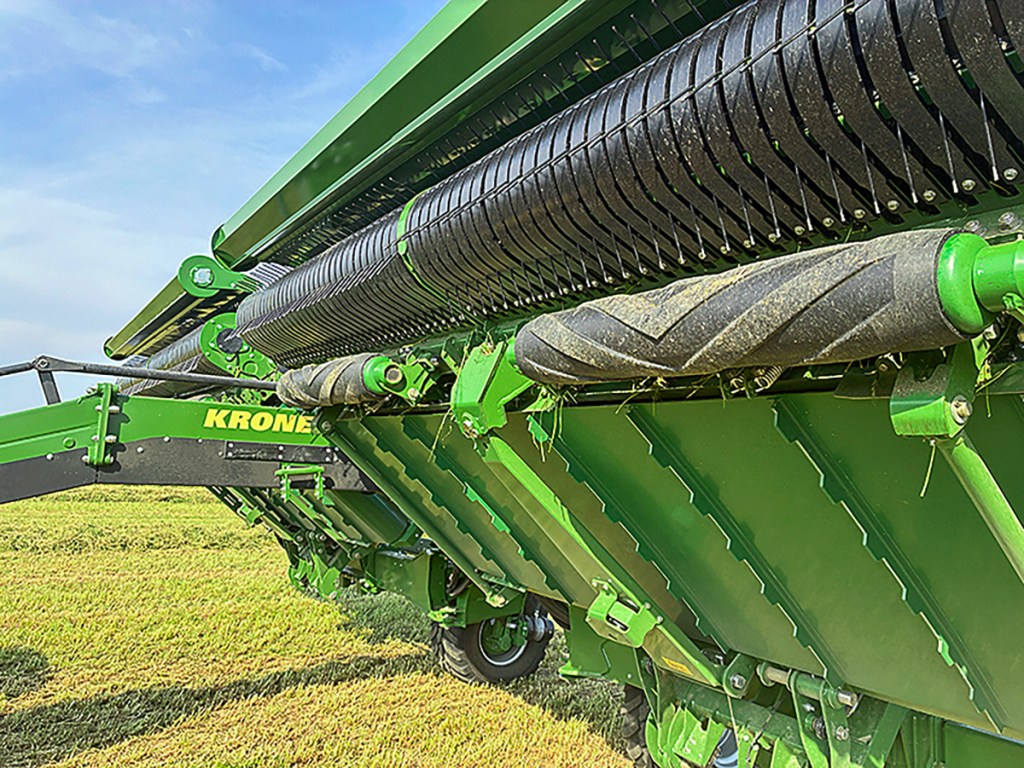
The pressure exerted by the crop rollers and guide plates can likewise be adjusted hydraulically, allowing crop flow and swath formation to be optimised.
Keeping the crop moving
The Swativo’s most distinctive feature is the combination of the camless EasyFlow pick-up and the FlexFlow transfer rotor. Together they provide the basis for smooth, even crop transport.
The 510mm pick-up is not simply an existing component from another Krone machine that was adapted for the Swativo. While it still relies on the EasyFlow design, every element has been redesigned for this specific application. For instance, the tine spacing has been increased from 55mm to 60mm, whereas the tine diameter was reduced compared with Krone’s forage wagons, and the bent tine tips were also modified. These changes were necessary so the pick-up and transfer rotor could intermesh correctly.
The 410mm diameter rotor consists of two polypropylene elements, each carrying three fingers, giving six fingers in total. These engage the crop mat from below and transfer it centrally onto the 1.20m wide cross conveyor, which is a bit wider than its competitors, according to Krone.
To prevent creating lumps, blockages and twisting the crop, the speed relationship between pick-up and rotor can be fine-tuned. The rotor can run up to 15% faster or slower than the pick-up, with the desired value adjusted in 1% increments from the terminal. Pick-up speed, on the other hand, is controlled directly by selecting a different pto speed.
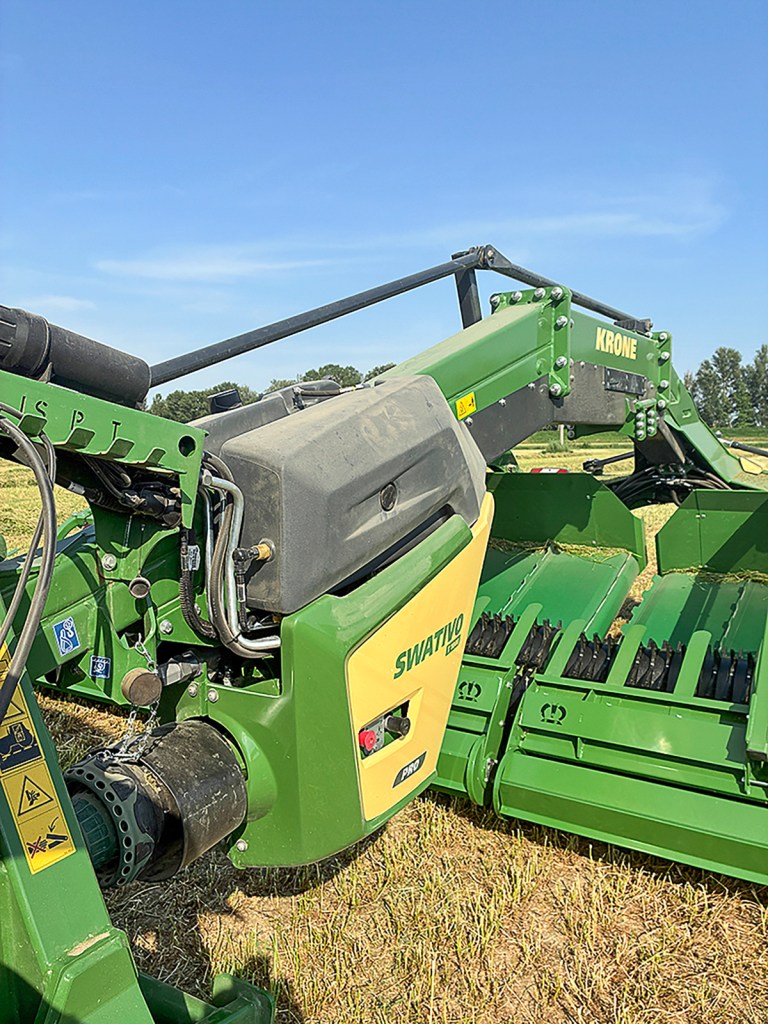
Both the Swativo’s pick-up and the rotor are driven hydraulically, each by its own constant-displacement pump. Together with the variable-displacement pump for the conveyor belt drive, they form part of the machine’s onboard hydraulic system, which includes a 70-litre oil reservoir mounted on the frame.
Directly onto the centre of the belt
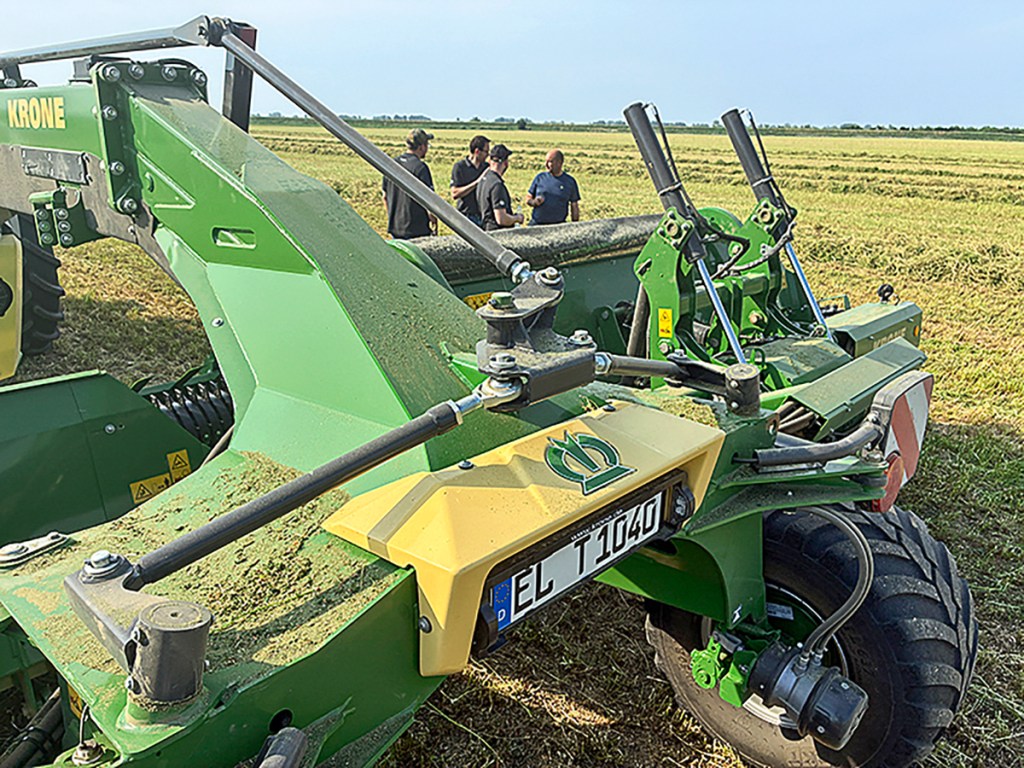
The last element in the crop flow is the cross conveyor belt. Because it is mounted at an angle, the crop lands directly in the middle of the belt without needing to be redirected by guide plates. Cleated crossbars running across the belt prevent the crop from rolling or stalling due to slip.
During our albeit limited time in the field, this system worked very effectively. The result was a consistently even mat of forage on the belt. To ensure the swath is placed cleanly on the ground, operators can either adjust the belt speed manually or activate an automatic mode that matches conveyor speed to the tractor’s forward speed — a very practical solution.
Provided forward speed, pick-up speed and the rotor speed are matched correctly, the machine produces a very loose, box-shaped swath that allows the crop to dry before being baled or put through a forager.
Torsten Wobser
For more up-to-date farming news click here and subscribe now to profi and save.